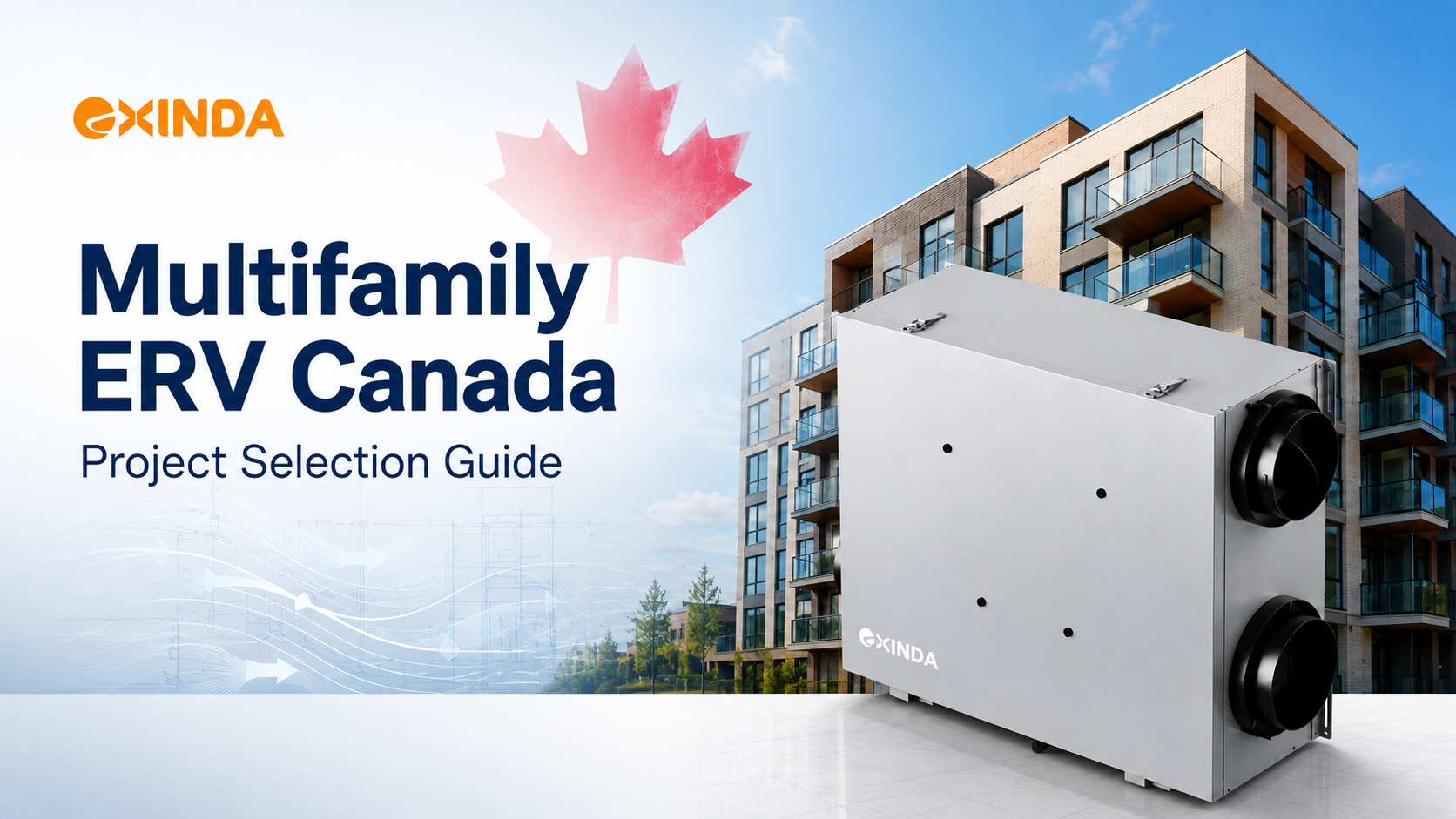
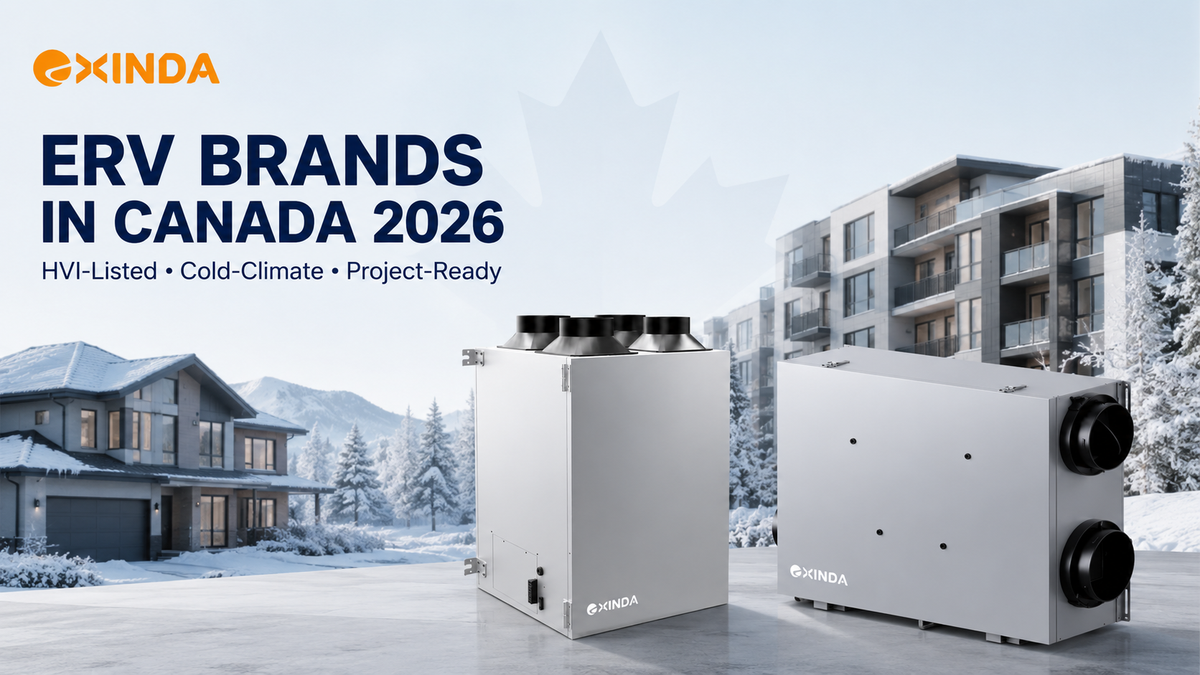
Contractors, builders, mechanical consultants and distributors comparing ERV brands in Canada need the same four things from any supplier: airflow that holds up once the ducts are connected, recovery data measured at a stated airflow, frost control that keeps ventilation running through a prairie winter, and certification a reviewer can look up without asking anyone.
This is what EXINDA publishes for its five residential models, so you can judge the range against the brands you already stock.
The Breeze range, with its certified numbers
Five models, each with its own HVI listing. Net supply is the HVI certified value at 0.4 in. w.g.; sensible recovery efficiency (SRE) is the HVI rated value at 0 °C, and each one is measured at its own airflow. All five are certified to UL 1812 for safety and CSA C439 for performance under CSA certificate 80227354.
| Model | Installation | Net supply at 0.4 in. w.g. | SRE (at airflow) | Frost control | HVI ID |
|---|---|---|---|---|---|
| ICMBCNF1AYE | Ceiling, 4 in. | 95 CFM | 77% at 66 CFM | Exhaust defrost | 2005353 |
| ICMBCOFF1AYE | Ceiling, 6 in. side ports | 136 CFM | 74% at 64 CFM | Recirculation | 2005359 |
| ICMBCOFF1AYS | Ceiling, 6 in. side ports | 170 CFM | 86% at 42 CFM | Recirculation | 2005500 |
| IWMBCOOF1AYE | Wall, 4 in. top ports | 102 CFM | 72% at 66 CFM | Recirculation | 2005360 |
| IWMBCOFF1AYE | Wall, 6 in. top ports | 153 CFM | 77% at 57 CFM | Recirculation | 2005356 |
Read the SRE column with its airflow attached. The 86% belongs to ICMBCOFF1AYS at 42 CFM; run the same unit at 135 CFM and it recovers 65%. A percentage quoted without its airflow tells you nothing about the duty your project actually needs, whichever brand it comes from.
Cold-climate ERV performance for Canadian winters
All five models carry a rated outdoor operating range of −18 to 109 °F (−28 to 43 °C). What matters more for a Calgary or Edmonton project is whether the manufacturer publishes recovery data at the bottom of that range, because frost forming in the core is what takes ventilation out of service.
Three of the five have a published −13 °F (−25 °C) test point:
- ICMBCNF1AYE — 44% SRE at 43 CFM, 30 W
- ICMBCOFF1AYE — 67% SRE at 40 CFM, 64 W
- ICMBCOFF1AYS — 67% SRE at 40 CFM, 41 W
The two wall-mounted models are tested at 32 °F and 95 °F only. If the specification asks for recovery efficiency at −25 °C, specify one of the three ceiling models and quote the figure above.
Four models use recirculation defrost; ICMBCNF1AYE uses exhaust defrost. That difference changes how supply air behaves during a defrost cycle, so it is worth settling before the mechanical schedule is issued rather than at commissioning.
Airflow at external static pressure, not maximum CFM
The commonest selection error is comparing catalogue maxima. Once ducts, elbows, exterior hoods, grilles and filters are connected, the fan is working against real resistance, and the useful question is what the unit delivers there.
IWMBCOFF1AYE is the clearest example in the range: 152 CFM at 0.4 in. w.g., 149 at 0.8, 144 at 1.0 and 135 at 1.2 — about 11% across the whole band. On a long multifamily duct run that flatness is worth more than a higher headline number that collapses at 0.8.
Each model page carries the full airflow-versus-static-pressure table from its submittal, in 0.1 in. w.g. steps.
Balancing and controls
Four of the five balance themselves: ECM motors with constant-airflow control hold the set rate as resistance changes, within the unit's rated external static range. ICMBCOFF1AYS is the exception — it has pressure taps and integrated balancing dampers instead, and is set by hand with a manometer. For a building where every suite has a slightly different duct run, that is sometimes what you want; for a repeated identical suite, the automatic models save commissioning time. Neither removes the need to measure installed supply and exhaust airflow.
All five take the same three control paths: a three-speed wall controller with electronic dehumidistat, an optional 20/40/60-minute bathroom timer, and a 24 V thermostat input on terminals 8 and 9. A dry contact (NC/C/NO) is available to request the furnace or fan-coil blower — see how the ERV interlock starts the HVAC blower.
Choosing a model for a Canadian project
- Set the required continuous and boost airflow from the ventilation design.
- Calculate the external static pressure of the complete duct system, including hoods and filters.
- Pick from the airflow at that pressure, using the model's fan table.
- Check the installation format against the space: three ceiling models with side or 4 in. ports, two wall-mounted models with top ports.
- For cold regions, confirm the −13 °F data and the defrost method.
- Measure and balance the installed system at commissioning.
Frequently asked questions about ERV brands in Canada
Are EXINDA ERVs HVI certified?
Yes. Each of the five residential models holds its own listing in the HVI Certified Products Directory — 2005353, 2005359, 2005500, 2005360 and 2005356. Search the HVI ID or the model number to read the certified net supply, SRE, power and efficacy.
What Canadian certification do they carry?
UL 1812 for safety and CSA C439 for performance, under CSA certificate 80227354. Quote the certificate number with the model number in the submittal.
Can an EXINDA ERV run at −25 °C?
The rated outdoor operating range is −18 to 109 °F on all five models. Three of them — ICMBCNF1AYE, ICMBCOFF1AYE and ICMBCOFF1AYS — also have a published −13 °F recovery test point, listed above.
What airflow range does the residential range cover?
95 to 170 CFM certified net supply at 0.4 in. w.g. Standard three-speed settings run lower, from 42 CFM.
Is maximum CFM enough to select an ERV?
No. Compare at the external static pressure the installed duct system creates. A unit that looks larger on the product name can deliver less at 0.8 in. w.g. than a smaller one with a flatter curve.
Does automatic balancing replace commissioning?
No. It holds the set airflow as resistance changes within the rated range; the installer still verifies installed supply and exhaust airflow against the design.
Getting a model recommendation
Contractors, builders and consultants: send the project location and building type, the required airflow in CFM, the design external static pressure in in. w.g. and where the unit will be mounted. EXINDA returns a model recommendation with the airflow at that operating point, the submittal, the dimensional drawing, a copy of CSA certificate 80227354 and lead time. Floor plans and duct details can follow once a model is shortlisted.
Distributors and manufacturer's reps: ask for the Breeze product information pack, sample-unit terms and the support arrangements.
Request ERV selection support · Compare the residential ERV range · info@exindagroup.com