
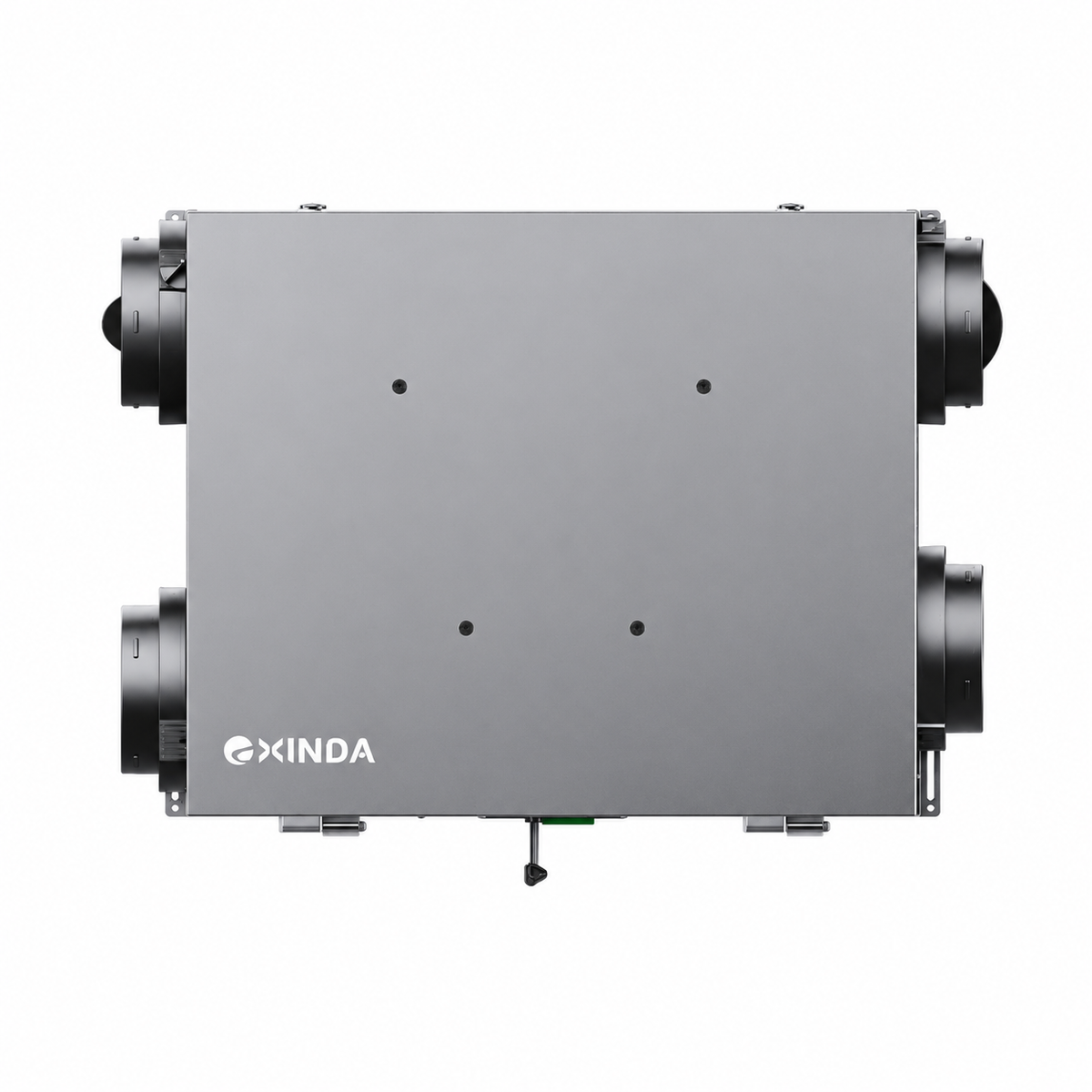
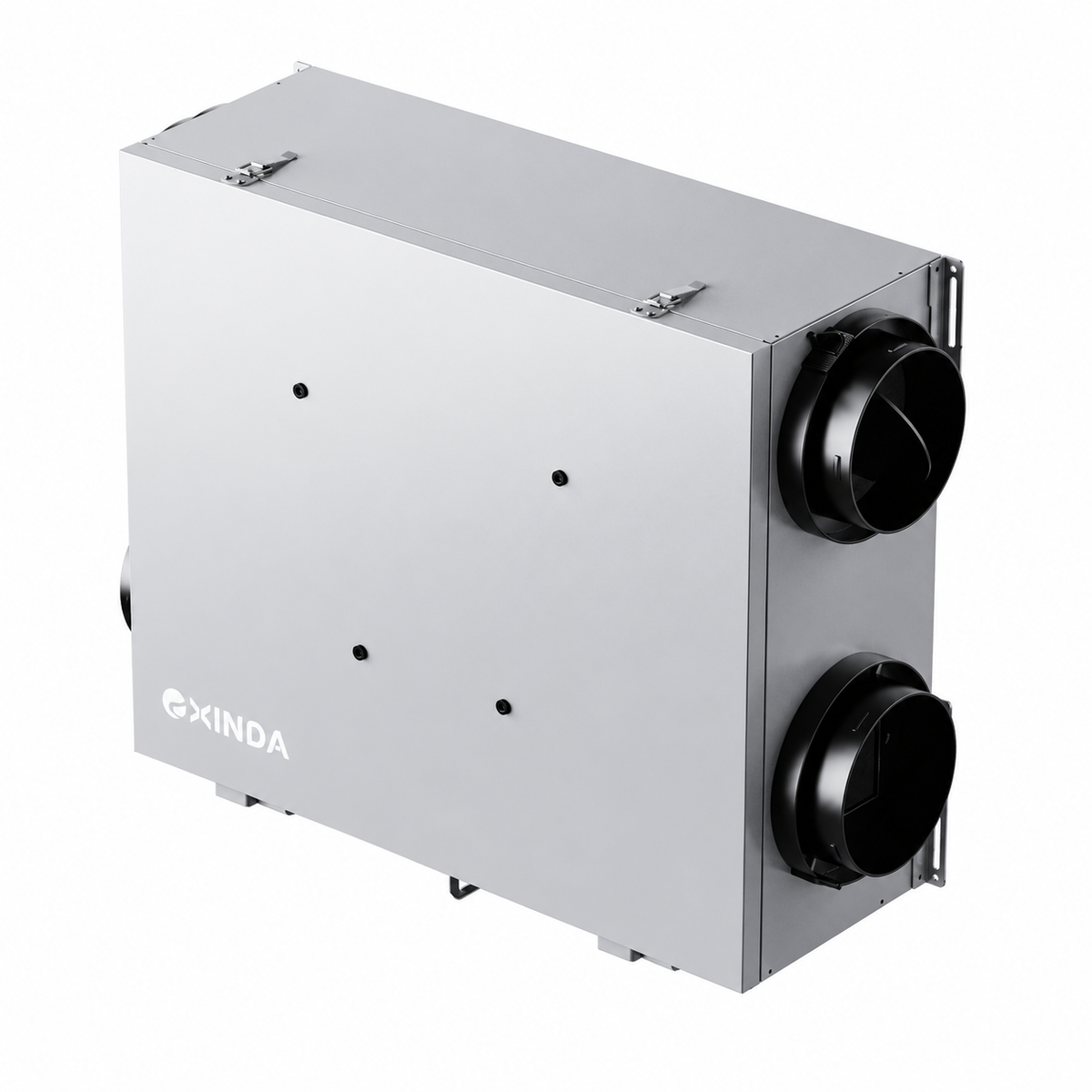
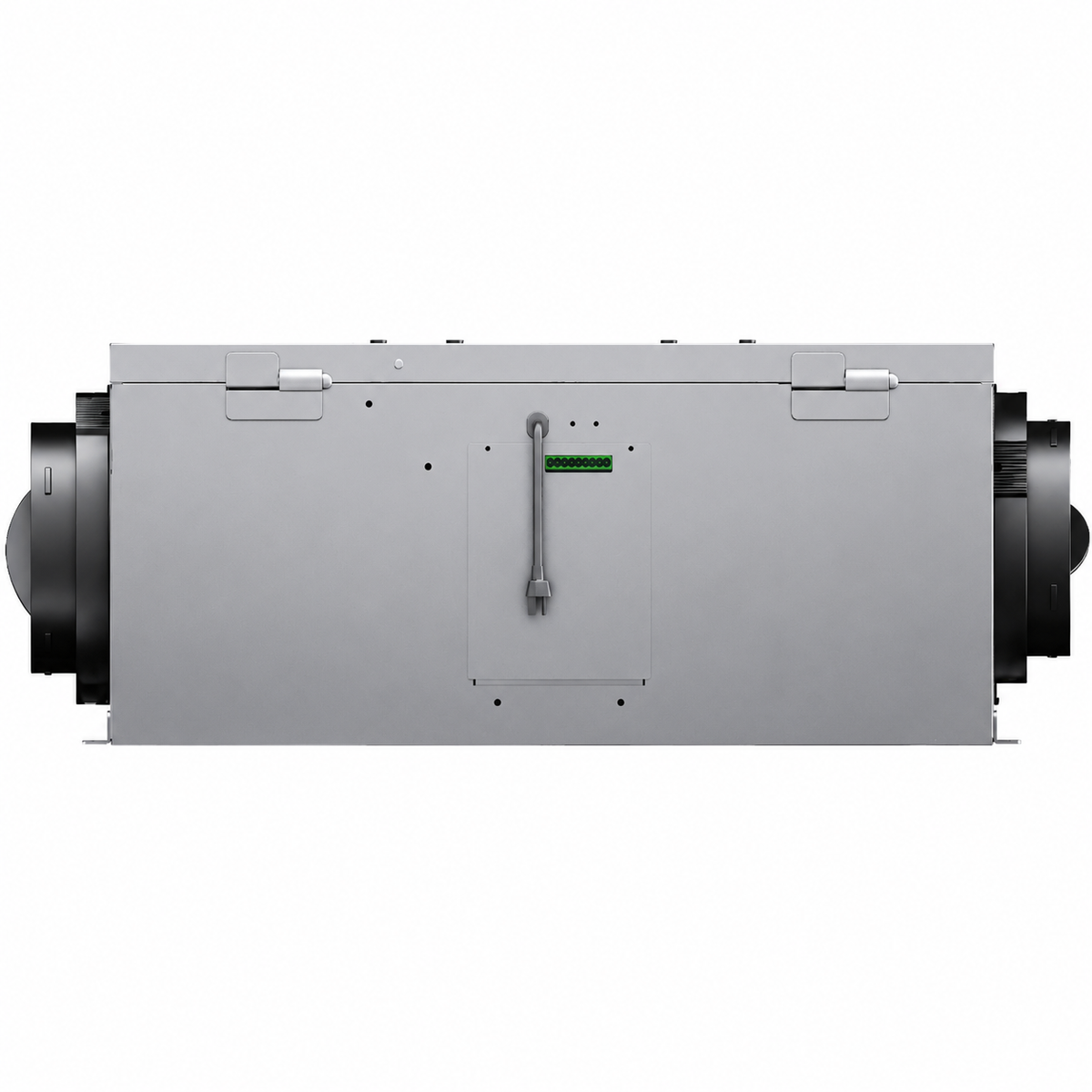
EXINDA Breeze 42-170 CFM Energy Recovery Ventilator
HIGH HEAT RECOVERY. SLIM DESIGN. BUILT FOR NORTH AMERICAN HOMES.
EXINDA Breeze brings fresh air into houses, townhomes and apartments while helping retain indoor heat, even through cold winters. Its high heat-recovery efficiency supports energy-efficient housing across North America, while the slim cabinet and side duct connections suit compact ceiling layouts.
Breeze ERV Specifications
| Model | ICMBCOFF1AYS |
| Product type | Side-port residential energy recovery ventilator, field adjustable |
| Sensible recovery efficiency (HVI), 0 °C | 86% at 42 CFM net airflow, 27 W |
| Sensible recovery efficiency, −25 °C | 67% at 40 CFM net airflow, 41 W |
| Standard airflow settings | 42 / 90 / 130 CFM at 0.1 / 0.2 / 0.4 in. w.g. |
| Certified net supply at 0.4 in. w.g. (HVI) | 170 CFM |
| Reference settings at 0.25 in. w.g. | 45 / 70 / 100 CFM — submittal reference operating points, not fan performance ratings |
| Power supply | 120 V / 60 Hz / 1 Ph |
| Cabinet height | 9-3/4 in. |
| Duct connection | 4 × 6 in., side of cabinet |
| Control interface | Wall controller; 24 V thermostat terminals (C / G / R / W / Y) for furnace or air-handler interlock; optional timer and dehumidistat inputs |
| MCA / MOP | 1.6 A / 15 A |
| Maximum input power | 180 W |
| Sound pressure, HH / H / L | 36 / 33 / 24 dB(A) — per submittal; measurement distance not stated. |
| Outdoor operating range | −18 to 109 °F DB |
| Filters | 2 × washable MERV 8 |
| Energy-recovery core | Cross-flow, non-washable |
| Balancing | Automatic balancing with field-adjustable airflow. Pressure taps and integrated dampers let the installer set and verify airflow on site. |
| Defrost | Recirculation defrost |
| Dimensions (H × W × D) | 9-3/4 × 26 × 21-9/16 in. |
| Net weight | 43 lb |
| Certification references | HVI ID 2005500; CSA certificate 80227354 (UL 1812 safety, CSA C439 performance) |
Airflow and Energy Recovery Performance
Fan curve values show how net supply responds to external static pressure; airflow is set on site with the balancing dampers and read at the pressure taps. Energy recovery performance is reported at separate test conditions, each with its own inlet temperature, airflow and power — recovery is highest at the low setting and falls as airflow rises.
| Performance | Net airflow | Power | Recovery metric |
|---|---|---|---|
| 0.1 in. w.g. fan curve | 186 CFM | 145.1 W | — |
| 0.4 in. w.g. fan curve (HVI certified) | 170 CFM | 142.8 W | — |
| 0.8 in. w.g. fan curve | 144 CFM | 141 W | — |
| 1.0 in. w.g. fan curve | 133 CFM | 139.8 W | — |
| 32 °F inlet supply | 42 CFM | 27 W | 86% SRE / 90% adjusted SRE |
| 32 °F inlet supply | 91 CFM | 82 W | 73% SRE / 80% adjusted SRE |
| 32 °F inlet supply | 135 CFM | 145 W | 65% SRE / 72% adjusted SRE |
| −13 °F inlet supply | 40 CFM | 41 W | 67% SRE / 70% adjusted SRE |
| 95 °F inlet supply | 42 CFM | — | 67% total / 69% adjusted total recovery |
Breeze ERV Technical Documents
Model-specific five-page specifications, fan and recovery tables, wiring diagrams and dimension drawing.Revit Family — Breeze side-port cabinet (RFA)
Shared BIM family for the side-port cabinet. Published under ICMBCOFF1AYE, which uses the same 26 × 21-9/16 in. footprint, the same four 6 in. side connections and a cabinet height within 1/16 in. Confirm clearances against the ICMBCOFF1AYS submittal.
Compare all Breeze residential ERV models
Breeze ERV Selection Questions
Why is high heat recovery valuable for my housing project?
It brings fresh air into the home while keeping more of the outgoing heat inside. This reduces the heating needed for ventilation and supports the energy-performance goals of efficient new homes.
Does it need a preheater for a Canadian winter?
No. Breeze uses recirculation defrost and runs without an electric preheater. Tested at −25 °C outdoor air, it still recovers 67% of the sensible heat at 40 CFM, and as an ERV it needs no condensate drain.
How does it support housing projects across Canadian provinces?
For builders working in British Columbia, Ontario, Quebec or the Prairies, the ratings cover both mild and very cold conditions. This gives project teams a strong starting point for meeting provincial ventilation energy requirements, with one model to evaluate across developments. EXINDA supplies the performance data and submittal for each project's building-code review.
Will it fit where ceiling space is limited?
Its slim cabinet and side duct connections make it a practical option for compact ceiling and bulkhead layouts. Allow space beside the unit for ductwork and leave an access panel for filter cleaning and service.
Can I specify it across an apartment or townhouse development?
Yes. It can serve individual homes in a development, with one unit selected for each dwelling's ventilation needs. Using the same model across matching layouts can simplify installation planning, maintenance and spare-parts stocking.
What should my contractor include before handover?
The installer should balance the fresh-air and exhaust airflow, check the controls and show the homeowner how to clean the filters. The unit balances supply and exhaust automatically; set the airflow for the home and confirm it at the pressure taps.
Mit EXINDA zusammenarbeiten
Globaler HLK-Hersteller und Anbieter kundenspezifischer HLK-Lösungen
EXINDA ist ein globaler HLK-Hersteller, der auf Wärmepumpen, Lüftungssysteme und kundenspezifische Klimalösungen für Wohn- und Gewerbeanwendungen spezialisiert ist.
Wir arbeiten weltweit mit Vertriebspartnern, Ingenieuren, Installationsunternehmen und OEM-Partnern zusammen.
1. HLK-Vertriebspartner und Fachhändler
Wir unterstützen Partner weltweit mit zuverlässigen Wärmepumpen- und Lüftungslösungen.
2. Ingenieur- und Installationsunternehmen
Wir bieten technische Dokumentation, Unterstützung bei der Produktauswahl und Projektbetreuung.
3. Bauunternehmen und Bauherren
Wir liefern energieeffiziente HLK-Lösungen für Wohnanlagen, Hotels, Gesundheitseinrichtungen, Schulen, Büros und Gewerbeprojekte.