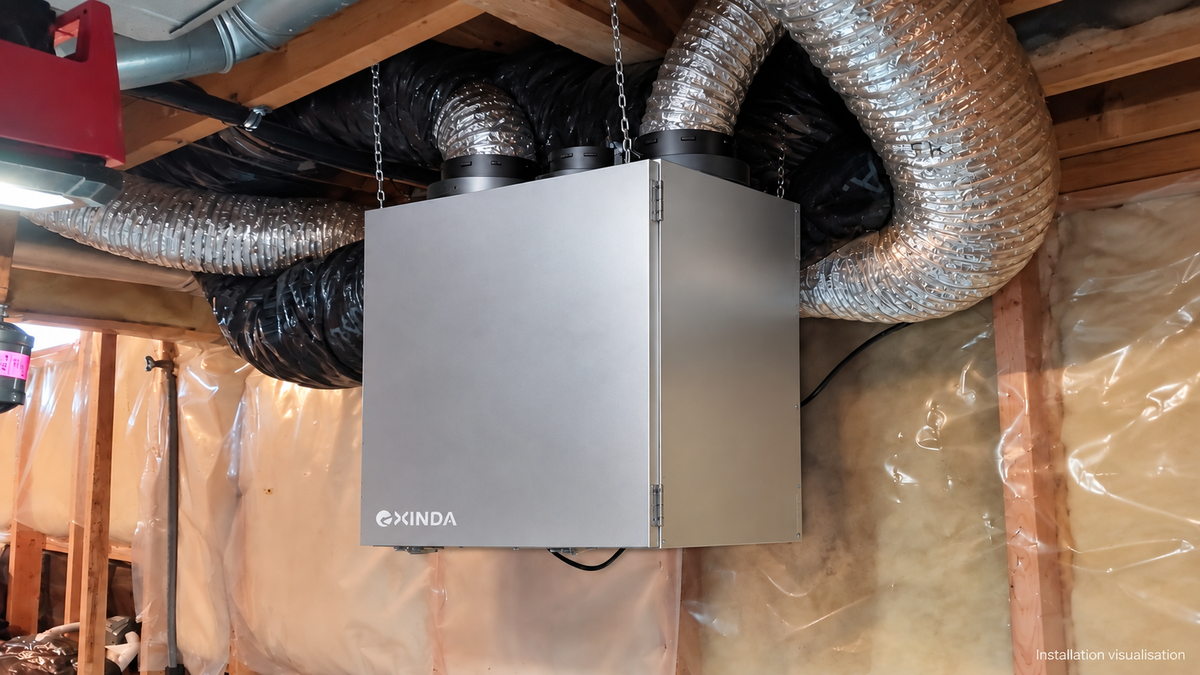

ERV interlock coordinates the ventilator with the indoor blower so ventilation can run even when the thermostat is not calling for heating or cooling. In the EXINDA control arrangement described here, starting the ERV closes its NO–C dry contact to request fan-coil or furnace blower operation. The thermostat continues to control heating and cooling.
For contractors and distributors working on residential projects in the United States and Canada, the important question is straightforward: when the ERV runs, will the equipment distributing its fresh air run too? This guide covers EXINDA configurations equipped with this interlock function. Confirm the current wiring diagram for the selected unit and the connected HVAC equipment before installation.
How the ERV Interlock Works
The ERV initiates the ventilation request. Its normally open contact, NO, closes to the relay common, C, requesting operation of the connected indoor blower. Here, C means the common of the dry-contact relay; it must not be assumed to be the HVAC system's 24V common.
The dry contact switches a compatible control circuit. It does not supply blower motor power. The receiving terminals and any required interface must follow the approved equipment wiring diagrams.
This is a blower request. Starting the ERV does not itself request a burner, compressor or heating element to operate.
Heating, Cooling and Independent Ventilation
Heating and cooling remain under normal thermostat control. When ventilation is required without a heating or cooling call, the ERV requests blower operation through the interlock.
| Operating condition | ERV and blower response | Heating and cooling control |
|---|---|---|
| Thermostat calls for heating | The heating equipment follows its normal sequence. If the ERV is enabled, its ventilation interlock requests blower operation. | Thermostat and equipment controls |
| Thermostat calls for cooling | The cooling equipment follows its normal sequence. If the ERV is enabled, its ventilation interlock requests blower operation. | Thermostat and equipment controls |
| ERV operates with no heating or cooling call | The ERV runs and its NO–C contact requests the indoor blower. | No heating or cooling request from the ERV interlock |
Do not make independent ventilation depend solely on a thermostat fan signal. The purpose of this arrangement is to let the ERV request the air distribution it needs. This does not mean that every thermostat heating call must start the ERV; ventilation operation follows the selected ERV controls and settings.
Why Return/Return Ducting Needs Blower Interlock
In a simplified return/return arrangement, the ERV extracts indoor air from the HVAC return duct and introduces fresh air back into that duct downstream of the extraction connection, toward the indoor blower. Both connections use the return duct; a partially dedicated arrangement uses separate indoor extraction ductwork.
The indoor blower carries the introduced fresh air through the supply system to the rooms. If the ERV runs while that blower is stopped, fresh air can take a short path back to the ERV extraction connection instead of reaching the occupied space. For this arrangement, coordinate blower operation with ventilation demand using the equipment manufacturer's approved control method.
Review the duct layout together with the interlock. Connection order, separation, duct sizing and blower settings must follow the applicable installation instructions. There is no universal connection spacing or low-speed setting specified by this article. A working relay alone does not establish correct air distribution.
What to Verify in a Dual-Fuel HVAC System
A dual-fuel system using a heat pump and a fuel-fired furnace needs checks in both heating modes, during changeover and during independent ventilation. Confirming that the ERV can request the blower is only one part of that review. The thermostat and equipment controls must retain control of heat-source selection, operating delays and protection functions.
Use the following as a commissioning checklist, not as a statement that every EXINDA ERV is compatible with every dual-fuel system.
| Operating mode | What to verify |
|---|---|
| Heat-pump heating | Enable ventilation and confirm air distribution without overriding the equipment's required heating airflow or control sequence. |
| Furnace heating | Confirm ventilation and blower coordination while preserving the furnace's startup delay, heating airflow and shutdown sequence. |
| Cooling | Confirm ventilation operation without overriding the cooling airflow or compressor controls. |
| Independent ventilation | With no heating or cooling demand, test the wall controller, timer and supported humidity call. Confirm the blower responds without starting a heat source or compressor. |
| Heat-source changeover | Check both transition directions. Confirm the ventilation request does not interfere with thermostat staging, equipment interlocks or protective delays. |
| ERV stop or protective mode | Verify relay behavior and any fan overrun against the documented sequence. Other valid HVAC demands must retain the blower operation they require. |
Record the ERV and indoor-equipment models, control versions, thermostat settings, wiring arrangement, blower response and measured ventilation airflow. Compatibility should be confirmed for that combination before it is specified for a project.
Wall Controller, Timer and Humidity Demand
The blower interlock follows ERV startup from all three supported control paths: the wall controller, the timer and the humidity-control function. Each path should be tested during commissioning.
- Wall controller: start ventilation at the supported speed settings and confirm the blower response.
- Timer: initiate a ventilation call and confirm both units run.
- Humidity demand: initiate the supported humidity-control call and verify the same blower response.
A humidity-triggered ventilation call is not a claim that the ERV provides active refrigerated dehumidification. Check the controller instructions for its settings and intended operation.
Check Air Distribution, Not Just Startup
When an ERV supplies outdoor air into shared HVAC ductwork, commissioning must verify both the control sequence and the air path to occupied rooms. Two running fans alone do not demonstrate correct ventilation distribution.
- With no thermostat heating or cooling call, start the ERV and confirm the indoor blower responds.
- Repeat the check using the wall controller, timer and humidity-control function.
- Check stable airflow at the intended room supply outlets. Verify ERV outdoor-air supply and exhaust airflow against the project targets.
- Inspect the duct connections and airflow direction to confirm that the supplied fresh air reaches the distribution system rather than taking a short path back to extraction.
- Repeat the functional checks during thermostat heating and cooling calls. Confirm that normal equipment operation is preserved.
- Record the settings, measured airflow, blower response and any corrective work.
Air moving at a room grille can include recirculated indoor air. Use the approved duct arrangement and ventilation measurements together to assess fresh-air delivery. If distribution is inadequate, review duct connections, blower settings and balancing before signing off the installation.
Shutdown, fan overrun, frost protection and fault conditions should also be checked against the selected model's documented sequence. They are separate from the normal startup behavior described above.
Frequently Asked Questions
Does ERV interlock turn on furnace heating?
No. In this EXINDA arrangement, the interlock requests the furnace or fan-coil blower. Heating and cooling remain controlled by the thermostat and the HVAC equipment.
Can the ERV run when there is no heating or cooling demand?
Yes. When enabled through its supported controls, the ERV requests blower operation for independent ventilation.
Does the indoor blower have to run continuously at low speed?
Not as a universal rule. An approved demand-based interlock can coordinate blower operation with ERV ventilation calls. Some system designs require continuous blower operation. Follow the selected equipment's instructions and confirm the necessary airflow, relay release behavior and fan overrun. A low-speed label alone does not prove adequate fresh-air distribution.
Do I connect every furnace to the same terminals?
No. Use the current diagrams for both the ERV and the receiving equipment. Relay common and HVAC power common are different functions; matching terminal letters alone is not a wiring specification.
Request an ERV Controls Review
EXINDA manufactures residential ERVs and supports contractors with product selection and control coordination. Send the proposed ERV model, indoor-unit and thermostat details, wiring diagrams and ventilation duct layout to info@exindagroup.com. Tell us which controller, timer and humidity functions are required so the applicable interlock arrangement can be reviewed.
Request an ERV Controls Review
Related resources: EXINDA ERV products and manufacturer support · ERV selection for Alberta new homes · Multifamily ERV procurement and submittal checklist.