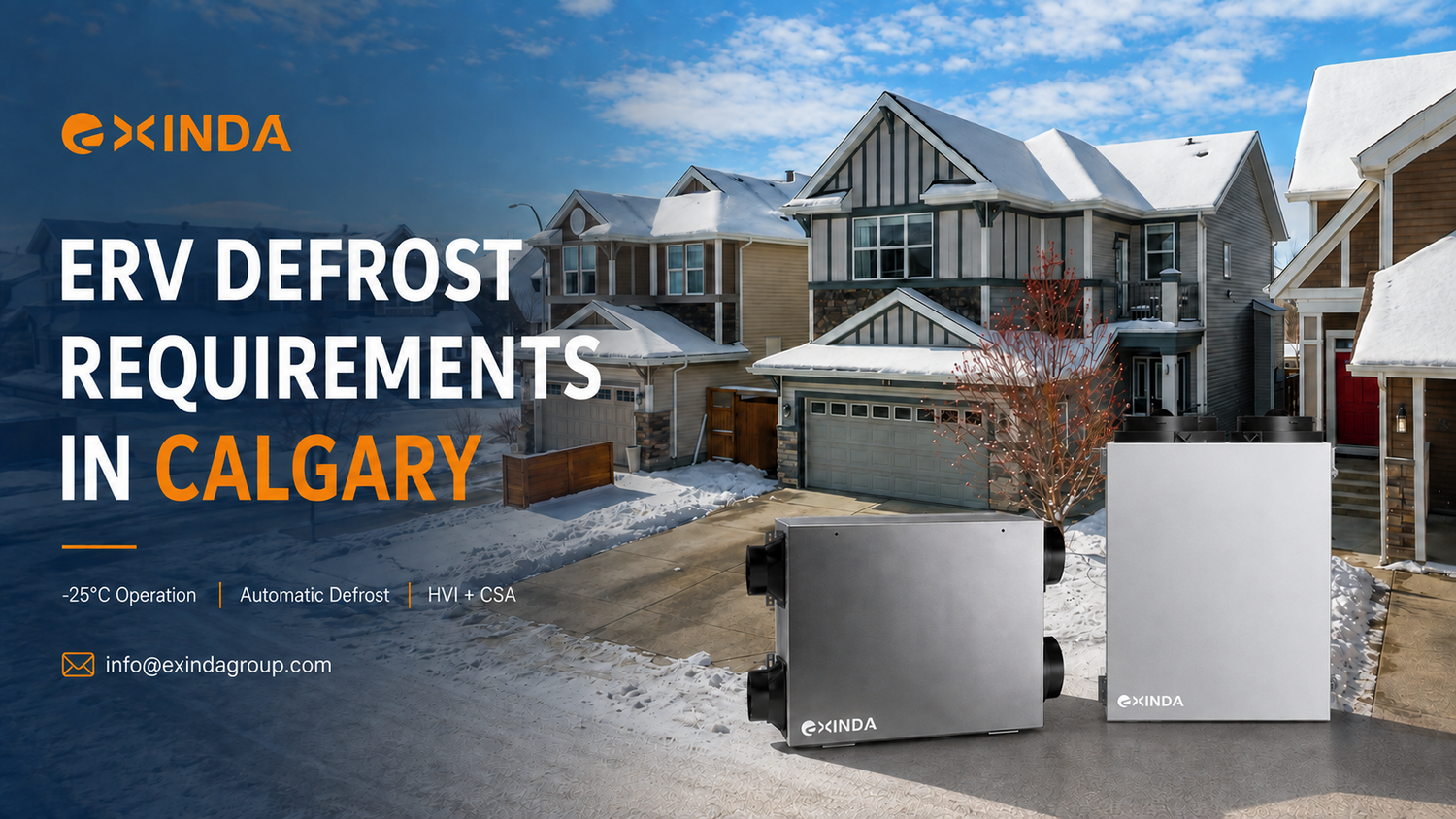
ERV Defrost Requirements in Calgary—— A Cold Climate ERV Solution for Builders, Contractors and Distributors
A residential ERV in Calgary should have documented low-temperature performance, automatic frost control and verified airflow at the installed duct resistance. Calgary is classified as Climate Zone 7A, where prolonged freezing conditions can cause moisture in indoor exhaust air to freeze inside the energy-recovery core. Alberta’s ventilation regulations cover airflow, system balance and installation, but they do not prescribe one universal defrost temperature for every ERV. Contractors should therefore review the operating range and complete frost-control sequence of the exact model selected for each project.
Why ERV Defrost Matters in Calgary
The City of Calgary identifies the city as Climate Zone 7A, with approximately 5,000 heating degree days. Residential ERVs may operate for extended periods with a significant difference between indoor and outdoor temperatures.
Although Calgary’s outdoor air is generally dry during winter, cooking, bathing, laundry and occupancy continue to produce indoor moisture. When warm exhaust air passes through a cold energy-recovery core, moisture can condense and freeze.
Frost accumulation may restrict airflow, reduce energy-recovery performance and affect the balance between supply and exhaust air. Automatic frost control protects the core and supports reliable ventilation through Calgary’s changing winter conditions.
What Alberta’s Ventilation Requirements Mean
The National Building Code – 2023 Alberta Edition addresses residential ventilation under Section 9.32 and energy efficiency under Section 9.36.
The Code does not require every Calgary home to install an ERV by product name. It also does not establish one frost-control activation temperature for every ERV.
Instead, the completed ventilation system must provide the airflow required by the approved mechanical design. Alberta municipal guidance states that outdoor-air supply should be balanced to within approximately 10% of the principal ventilation fan at normal operating capacity.
For Calgary projects, this means the ERV must:
1. Deliver the required residential ventilation airflow;
2. Operate within its documented outdoor temperature range;
3. Maintain the intended supply-and-exhaust relationship;
4. Be installed with suitable insulated ductwork and controls; and
5. Be measured and balanced after installation.
What Calgary Contractors Should Verify
Defrost operation is specific to each ERV model. A general “cold-climate ERV” description is not enough to confirm project suitability.
| Review item | What to confirm | Why it matters |
|---|---|---|
| Operating range | Minimum documented outdoor temperature | Confirms whether the model is suitable for the project conditions |
| Frost activation | Temperature, time or sensor condition | Explains when frost control begins |
| Defrost operation | Fan, damper and controller sequence | Shows how the unit responds to frost conditions |
| Outdoor-air delivery | Airflow available during defrost | Identifies temporary ventilation changes |
| Cold-weather data | Performance at relevant outdoor temperatures | Avoids relying only on normal-temperature ratings |
| Static pressure | Airflow at the installed system resistance | Confirms actual project airflow |
| Controls | Controller and furnace-interlock functions | Ensures correct system coordination |
| Normal operation recovery | How the unit exits defrost | Confirms that regular ventilation resumes correctly |
These items should be confirmed from the exact-model submittal, control sequence and installation manual.
Installation and Commissioning Requirements
Correct installation is essential to reliable winter operation. Snow, blocked hoods, leaking ductwork or incorrect airflow can create problems that may appear similar to an equipment or defrost fault.
| Project stage | Contractor requirement |
| Unit location | Install in an approved conditioned space with service access |
| Outdoor ductwork | Insulate and vapour-seal ducts carrying cold outdoor air |
| Duct connections | Seal joints to prevent unintended air leakage |
| Exterior hoods | Keep accessible and protect from snow, frost and contamination |
| Service clearance | Provide access to filters, core, fans, dampers and controls |
| Airflow measurement | Measure final supply and exhaust airflow |
| Controls | Test normal, boost and furnace-interlock functions |
| Defrost verification | Confirm activation and return to normal ventilation |
ECM or constant-airflow control can improve airflow stability, but it does not eliminate the need for final field measurement and balancing.
Where Cold-Climate ERVs Are Used in Calgary
Calgary does not publish a reliable citywide ERV installation percentage. It would therefore be inaccurate to claim that a specific percentage of local homes already uses ERVs. However, balanced residential ventilation has established applications in:
1. Detached energy-efficient homes;
2. Townhouses and row houses;
3. Secondary suites;
4. Condominiums;
5. Suite-level low-rise multifamily buildings.
The City of Calgary’s Secondary Suite Incentive Program recognizes eligible HRV/ERV equipment as an energy-efficiency measure for applicable projects.
CMHC also reported record housing-start activity in Calgary in 2025, including rental and missing-middle construction. Housing starts are not equivalent to ERV demand, but they show continuing development in the housing formats where compact residential ventilation systems can be applied.
Why Defrost Documentation Matters to Contractors
Defrost documentation helps contractors evaluate more than the minimum operating temperature.
A clear model-specific submittal can support:
coordinated furnace integration; repeatable installation across builder floor plans; correct airflow commissioning; fewer winter service calls; and clearer homeowner handover.
The objective is not to determine whether one defrost method is better than another. It is to confirm that the selected unit’s complete operating sequence matches the project requirements.
EXINDA Breeze ERVs for Calgary Projects
The EXINDA Breeze residential ERV range is designed for North American residential ventilation applications.
Applicable models offer approximately 90–170 CFM airflow options, side-port and top-port configurations, automatic cold-climate defrost, ECM airflow control and furnace integration.
EXINDA Breeze ICMBCOFF1AYS
The EXINDA Breeze 42–130 CFM ERV, model ICMBCOFF1AYS, provides the following documented characteristics:
| Product item | ICMBCOFF1AYS |
| Airflow settings | 42 / 90 / 130 CFM |
| Maximum adjustable airflow | Up to 170 CFM |
| Rated external static pressure | 0.4 in. w.g. |
| Motor | ECM brushless direct drive |
| Airflow commissioning | Integrated pressure taps and balancing provisions |
| Low-temperature performance | Documented down to −25°C |
| Frost control | Automatic recirculation defrost |
| Installation | Low-profile horizontal or ceiling configuration |
| Certification | HVI performance and CSA safety certification |
During this model’s recirculation-defrost sequence, the outdoor-air path temporarily closes while indoor air is routed through the energy-recovery core. Normal outdoor-air ventilation resumes after the cycle is completed.
This description applies to the identified model. It should not be treated as the operating sequence for every ERV.
The EXINDA Breeze 57–152 CFM ERV provides an additional option for projects with different airflow or installation requirements.
The final model should be selected according to required airflow, external static pressure, installation arrangement and cold-weather operating sequence, not maximum CFM alone.
Winter Operation and Maintenance
Homeowners should not normally turn off an ERV for extended periods simply because outdoor temperatures are low.
Contractors should explain:
1. Normal continuous operation;
2. Recommended filter maintenance;
3. Exterior hood inspection after snow or frost;
4. Signs of abnormal airflow or noise;
Dirty filters and blocked exterior hoods increase system resistance and can reduce ventilation airflow.
Frequently Asked Questions
What are the ERV defrost requirements in Calgary?
A Calgary ERV should have a documented operating range, automatic frost control and clear information about airflow during defrost. The installed system must also deliver the required ventilation airflow and be properly balanced.
Does Alberta’s building code specify a defrost temperature?
No. Alberta’s building requirements regulate ventilation performance but do not assign one defrost temperature to every ERV. The manufacturer documents the frost-control sequence for the exact model.
Can an EXINDA ERV operate at −25°C?
Applicable EXINDA Breeze models have documented low-temperature performance down to −25°C. Contractors should still review the exact model’s airflow, controls and defrost sequence before specification.
What should be included in a Calgary ERV submittal?
The submittal should include airflow data, external static pressure, HVI performance, CSA safety certification, operating temperature, frost-control sequence, wiring, controls, dimensions and installation requirements.
Request a Calgary ERV Submittal
For a Calgary detached-home, townhome, secondary-suite or multifamily project, send EXINDA the required airflow, estimated external static pressure, installation arrangement and outdoor design condition.
EXINDA can prepare an exact-model submittal and wiring package for technical review. Contact : info@exindagroup.com.