
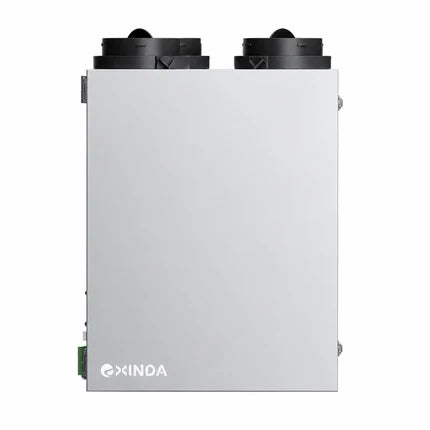
EXINDA Breeze 57-152 CFM Energy Recovery Ventilator
WALL-MOUNTED RESIDENTIAL ENERGY RECOVERY VENTILATION
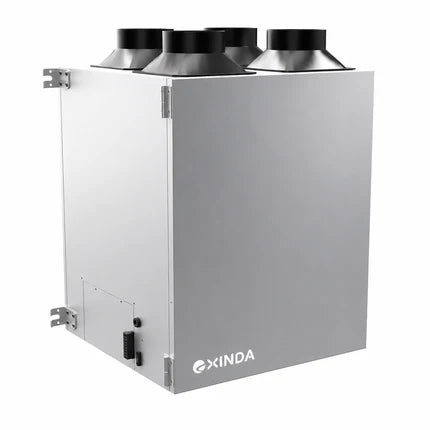
EXINDA Breeze IWMBCOFF1AYE is the largest unit in the Breeze range, a vertical wall-mounted ERV with four 6 in. top ducts and three standard settings of 57, 90 and 152 CFM. Net supply falls only about 11% between 0.4 and 1.2 in. w.g., so it holds its duty on long or restrictive duct runs, and it can be interlocked with a furnace or air handler through 24 V thermostat terminals.
Is this the right 150 CFM wall-mounted ERV for your project?
- The duct run is long or restrictive enough that airflow at high static pressure decides the selection.
- The design calls for up to about 150 CFM of balanced residential ventilation.
- A vertical cabinet with four 6 in. top ducts suits the mechanical room layout.
- Duct-borne noise matters, and the larger duct size lowers air velocity.
Before confirming the model, verify net airflow at project static pressure, top duct routing, wall support and front service clearance.
Breeze ERV Specifications
| Model | IWMBCOFF1AYE |
| Product type | Vertical wall-mounted residential ERV |
| Standard airflow settings | 57 / 90 / 152 CFM at 0.1 / 0.2 / 0.4 in. w.g. |
| Certified net supply at 0.4 in. w.g. (HVI) | 153 CFM |
| Sensible recovery efficiency (HVI) | 77% at 0 °C, at 57 CFM net airflow, 30 W |
| Net supply at 1.2 in. w.g. | 135 CFM |
| Dimensions (H × W × D) | 22 × 19 × 16-1/8 in. |
| Power supply | 120 V / 60 Hz / 1 Ph |
| Duct connection | 6 in., top of cabinet |
| Control interface | Wall controller; 24 V thermostat terminals (C / G / R / W / Y) for furnace or air-handler interlock; optional timer and dehumidistat inputs |
| MCA / MOP | 1.6 A / 15 A |
| Maximum input power | 180 W |
| Sound pressure, HH / H / L | 36 / 33 / 24 dB(A) — per submittal; measurement distance not stated. |
| Outdoor operating range | −18 to 109 °F DB |
| Filters | 2 × washable MERV 8 |
| Energy-recovery core | Cross-flow, non-washable |
| Balancing | Automatic balancing |
| Defrost | Recirculation defrost |
| Net weight | 46 lb |
| Certification references | HVI ID 2005356; CSA certificate 80227354 (UL 1812 safety, CSA C439 performance) |
Airflow and Energy Recovery Performance
Fan curve values show how the high airflow point responds to external static pressure. Energy recovery performance is reported at separate test conditions, each with its own inlet temperature, airflow and power.
| Performance | Net airflow | Power | Recovery metric |
|---|---|---|---|
| 0.1 in. w.g. fan curve | 144 CFM | 111 W | — |
| 0.4 in. w.g. fan curve | 152 CFM | 142 W | — |
| 0.8 in. w.g. fan curve | 149 CFM | 171 W | — |
| 1.0 in. w.g. fan curve | 144 CFM | 170 W | — |
| 1.2 in. w.g. fan curve | 135 CFM | 168 W | — |
| 32 °F inlet supply | 57 CFM | 30 W | 77% SRE / 81% adjusted SRE |
| 32 °F inlet supply | 148 CFM | 111 W | 62% SRE / 67% adjusted SRE |
| 95 °F inlet supply | 55 CFM | 30 W | 63% total / 65% adjusted total recovery |
Breeze ERV Technical Documents
Compare all Breeze residential ERV models
Breeze ERV Selection Questions
How much airflow survives a long or restrictive duct run?
This is the reason to choose this unit. The fan curve reports 152 CFM net supply at 0.4 in. w.g., 149 CFM at 0.8, 144 CFM at 1.0 and 135 CFM at 1.2 — about 11% loss across that whole range. On a long run the duct design sets the usable duty, not the fan running out of pressure.
When is this the right unit instead of the 100 CFM class?
When the calculated ventilation rate approaches 150 CFM, or when the run is long enough that a smaller unit would be selected near the top of its curve. The 6 in. ducts also lower air velocity for the same airflow, which matters where duct-borne noise is a concern.
Can it run with a furnace or air handler rather than as a standalone unit?
Yes. The controller wires to 24 V thermostat terminals (C / G / R / W / Y) and to a furnace 24 V terminal block, so ventilation can follow the HVAC system rather than run on its own schedule. A bathroom timer with 20 / 40 / 60 minute high-speed cycles and an electronic dehumidistat are supported as optional inputs.
What does recovery look like at the high setting?
It drops as airflow rises: 77% SRE at 57 CFM and 30 W, 62% at 148 CFM and 111 W, both at 32 °F inlet. If the design runs continuously near the top of the range, use the 148 CFM row for the energy calculation rather than the headline figure.
Partner With EXINDA
Distributors & Dealers
Expand your HVAC offering with EXINDA heat pumps and ventilation systems, backed by product training and technical support.
Engineering Firms & Contractors
Get the performance data, submittals and engineering support you need to select equipment and move your project forward.
HVAC Brands
Bring your product ideas to market with EXINDA’s engineering, testing and manufacturing expertise.