A successful residential ventilation program depends on more than selecting an ERV by its maximum airflow. For builders and HVAC contractors working in Airdrie, the equipment must also fit the house design, furnace system, available mechanical space, local winter conditions and project documentation process.
The City of Airdrie’s new-home permit resources include a Furnace and Ventilation Setup Report, an HVAC F326 Design Form and an HVAC F326 Installation Form. This makes early coordination between the builder, mechanical designer, HVAC contractor and equipment supplier particularly important.
When selecting an ERV for Airdrie new homes, project teams should evaluate the complete ventilation package—not simply the unit price shown on a quotation.
Why Airdrie New-Home Projects Need Project-Specific ERV Selection
Airdrie includes detached houses, duplexes, townhomes and other growing residential communities. These housing types do not necessarily have the same ventilation loads, duct layouts or mechanical-room constraints.
A compact townhome may need a slim ceiling-mounted unit, while a detached home may provide enough mechanical-room space for a larger side-port or top-port configuration. The appropriate selection also depends on the designed ventilation rate and the external static pressure created by the installed duct system.
An ERV for Airdrie new homes should therefore be selected using project conditions such as:
- Housing type and conditioned floor area
- Number and use of bedrooms
- Designed outdoor-air and exhaust-air quantities
- Available external static pressure
- Furnace or air-handler arrangement
- Dedicated or partially connected duct design
- Mechanical-room or ceiling-space limitations
- Outdoor intake and exhaust termination locations
- Required frost-control sequence
- Access requirements for filters and core maintenance
A unit selected only from its nominal CFM rating may not deliver the required airflow after the duct system, filters, grilles and exterior terminations are installed.
1. Confirm the Required Airflow Before Selecting the Model
The first step is to establish the project ventilation requirement. The mechanical designer or qualified HVAC contractor should determine the required airflow according to the applicable code, design standard and occupancy conditions.
The selected ERV must then be checked at the project’s expected external static pressure—not only at free-air conditions.
For production builders, it is useful to create a model schedule covering several standard house types. A typical schedule might assign different ERV capacities to compact townhomes, mid-size detached homes and larger residential floor plans. This reduces repeated engineering work while keeping each selection connected to an approved design basis.
EXINDA offers residential ERV configurations covering approximately 90–170 CFM, allowing builders and contractors to develop a standardized product schedule across different Airdrie housing models.
Final equipment selection should always be confirmed against the project’s calculated ventilation rate and duct resistance.
2. Review Certified Performance for the Exact ERV Model
Certified ratings help project teams compare residential ventilation equipment using consistent test information. However, the certification must apply to the exact model being submitted—not merely to a similar product in the same series.
For an ERV for Airdrie new homes, the submittal review should confirm:
- Certified airflow at the required test condition
- Sensible recovery efficiency
- Total recovery efficiency, where applicable
- Fan power or electrical consumption
- Low-temperature performance information
- Canadian electrical safety certification
- Model number consistency across the quotation, submittal and certification listing
EXINDA can provide model-specific HVI performance information and Canadian certification documentation for applicable residential ERV models.
Builders and distributors should request these documents before approving a product for a multi-home program. Doing so helps prevent model-number discrepancies from appearing later during plan review, procurement or inspection.
3. Specify Cold-Climate Operation and Frost Control
Airdrie experiences extended winter conditions, so the project team must understand how the ERV manages frost risk when outdoor temperatures fall.
The correct question is not simply whether an ERV “has defrost.” Contractors should review:
- The published minimum operating temperature
- How the unit detects or responds to frost conditions
- Whether the defrost cycle changes supply and exhaust airflow
- How operation resumes after the defrost cycle
- Whether additional preheating is required for the project
- How the control sequence affects indoor pressure balance
EXINDA residential ERVs are designed for cold-climate operation, with selected configurations rated for operation down to approximately −25°C. The exact operating limit and frost-control sequence should be verified for the submitted model.
Cold-climate performance should also be coordinated with the building envelope, exhaust appliances and combustion-safety requirements. The equipment supplier cannot replace project-specific mechanical design.
4. Coordinate the ERV with the Furnace and Duct System
Many Airdrie homes use forced-air heating, making furnace integration an important part of residential ventilation design.
Depending on the approved design, an ERV may use:
- A fully dedicated ventilation duct system
- A partially dedicated system
- A connection to the furnace return-air duct
- Another configuration developed by the mechanical designer
Each method affects duct routing, airflow balancing, controls and furnace-fan operation.
Before ordering an ERV for Airdrie new homes, the contractor should confirm:
- Where outdoor air will enter the distribution system
- How stale air will be collected from the home
- Whether furnace-fan interlocking is required
- How the final airflow will be measured and balanced
- Whether the ERV remains accessible for filter and core service
The City of Airdrie provides ventilation setup and HVAC F326 documentation as part of its new-home resources. Contractors should ensure that the installed configuration, commissioned airflow and submitted design information remain consistent.
5. Match the Product Configuration to the Available Space
Mechanical space is often limited in modern detached homes, duplexes and townhomes. Selecting the enclosure and port arrangement early can reduce field modifications.
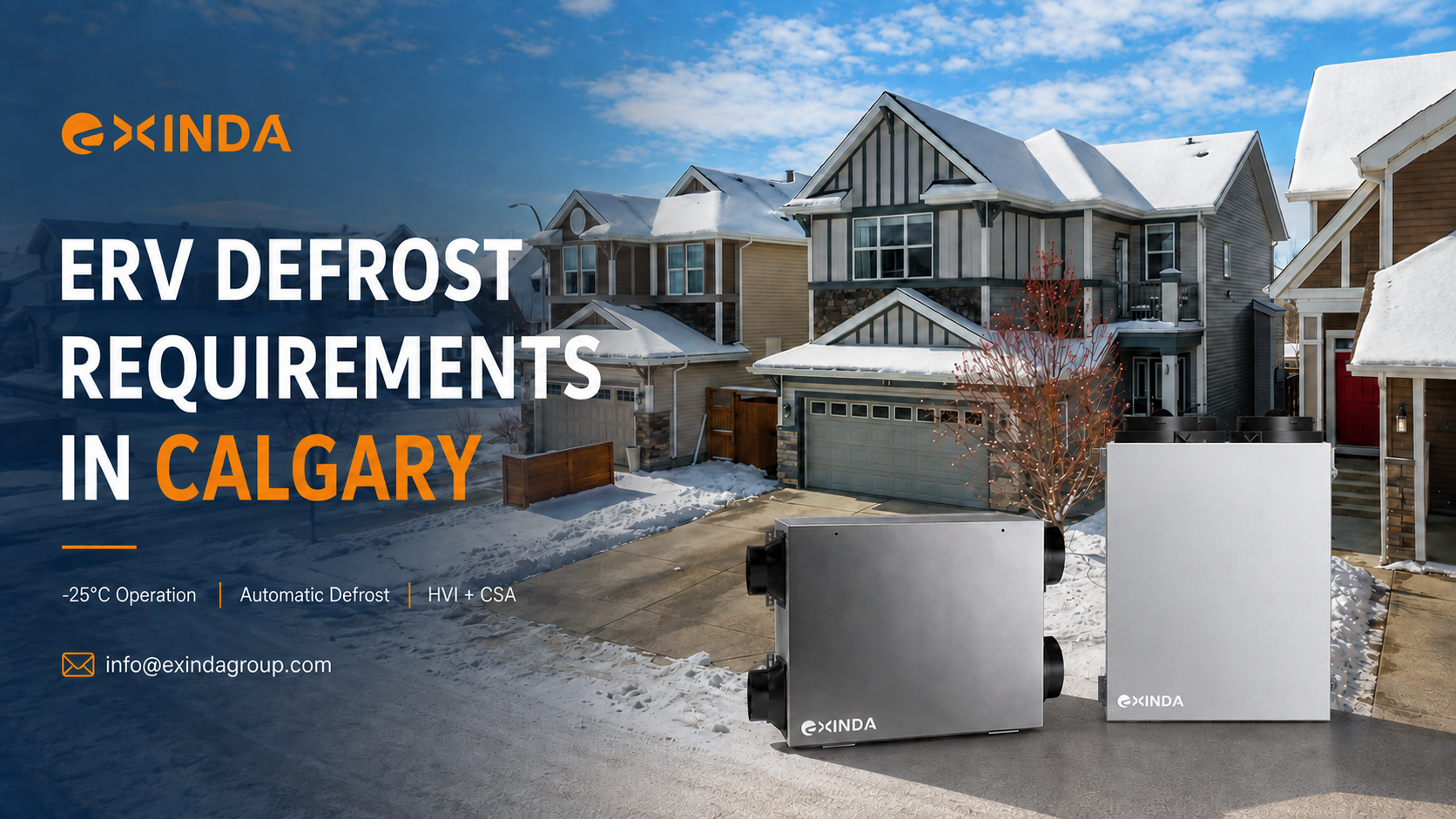
EXINDA offers side-port and top-port residential ERV configurations for different installation conditions. Depending on the model, the equipment may suit mechanical-room, wall-mounted or ceiling-space applications.
The project team should verify:
- Unit dimensions and service clearances
- Port diameter and orientation
- Condensate drainage requirements
- Filter-removal direction
- Core-removal clearance
- Control wiring
- Access-panel location
- Structural support requirements
A compact unit is not automatically the best choice. The contractor must still have adequate space for duct transitions, insulation, balancing dampers, drainage and future maintenance.
6. Define the Submittal Package Before Procurement
For a single custom home, missing information may cause a short delay. For a builder program involving multiple homes, the same omission can affect purchasing, scheduling and inspections across the entire project.
An Airdrie builder or HVAC contractor should request the following before product approval:
| Required information | Project purpose |
|---|---|
| Product submittal | Confirms technical specifications |
| HVI performance data | Verifies rated ventilation performance |
| Electrical certification | Supports Canadian project compliance |
| Fan-performance information | Checks airflow against static pressure |
| Dimensional drawing | Coordinates equipment and duct layout |
| Installation manual | Supports field installation |
| Control sequence | Coordinates ERV and furnace operation |
| Frost-control description | Reviews cold-weather operation |
| Maintenance access requirements | Prevents service conflicts |
| Warranty information | Defines after-sales responsibilities |
A complete submittal package makes the proposed ERV for Airdrie new homes easier to review, approve and repeat across several house models.
7. Standardize the ERV Program Across Multiple Homes
Production builders and installer-led distributors can improve efficiency by standardizing the ventilation package rather than selecting equipment one house at a time.
A repeatable builder program may include:
- A defined ERV model for each house category
- Standard duct-connection details
- Pre-approved control requirements
- Consistent wall controls
- Installation and commissioning checklists
- Replacement filters and service parts
- Batch delivery schedules
- Contractor training and technical support
This approach reduces model substitutions, inconsistent installations and last-minute procurement decisions.
EXINDA can work with Alberta builders, HVAC contractors and regional distributors to build an ERV schedule based on expected housing types, airflow ranges, installation preferences and annual project volume.
Questions to Send an ERV Supplier Before Approval
Before approving an ERV for Airdrie new homes, ask the supplier:
- Is the exact submitted model HVI certified?
- What Canadian electrical certification applies?
- What airflow can the unit deliver at the project static pressure?
- What is the minimum published operating temperature?
- How does the frost-control sequence work?
- Are side-port and top-port versions available?
- What installation and commissioning documents are provided?
- Are replacement filters and service components available?
- Can the supplier support phased or batch deliveries?
- Can the same product platform cover several house types?
The answers help distinguish a project-ready ventilation supplier from a company offering only a catalogue product.
EXINDA ERV Solutions for Airdrie Builders and Contractors
EXINDA develops residential energy-recovery ventilation systems for North American cold-climate applications.
The residential range includes:
- Approximately 90–170 CFM airflow options
- Side-port and top-port configurations
- ECM fan technology
- Cold-climate operation on selected models
- HVI-certified performance for applicable models
- Canadian electrical certification
- Submittals and dimensional drawings
- Airflow-selection and project coordination support
- Builder, contractor and distributor supply programs
The correct model should be selected according to the calculated ventilation requirement, external static pressure, installation arrangement and applicable project requirements.
Request an Airdrie ERV Project Selection
Planning detached homes, duplexes, townhomes or another residential development in Airdrie?
Send EXINDA the following project information:
- Housing type and approximate floor area
- Number of bedrooms
- Required ventilation airflow
- Expected external static pressure
- Furnace or air-handler arrangement
- Preferred side-port or top-port configuration
- Estimated number of homes
- Construction and delivery schedule
EXINDA can provide a recommended model schedule, HVI performance data, product submittals, dimensional drawings and a project quotation.
Contact EXINDA: info@exindagroup.com
FAQ Section
What size ERV is suitable for a new home in Airdrie?
The ERV should be selected from the required ventilation airflow, house design and expected external static pressure. Floor area alone is not sufficient for final equipment selection. EXINDA offers residential options covering approximately 90–170 CFM for different housing types.
Should an Airdrie builder specify an HVI-certified ERV?
An HVI-certified model provides independently published performance information that helps builders, engineers and HVAC contractors review airflow and recovery performance. The exact model number in the certification listing should match the submitted equipment.
Can an ERV be connected to a home’s furnace system?
Yes, an ERV may be integrated with a forced-air furnace when permitted by the approved mechanical design. The connection arrangement, controls, airflow balancing and furnace-fan operation must be coordinated by the project’s qualified HVAC professional.
What documents should an Airdrie HVAC contractor request?
Contractors should request the product submittal, certified performance data, electrical certification, fan-performance information, dimensional drawing, installation manual, frost-control sequence, control information and warranty documentation.
Can EXINDA support multi-home builder projects in Airdrie?
Yes. EXINDA can help establish a residential ERV schedule for several house types and provide technical documentation, contractor coordination and phased supply based on the project plan.