R290 Heat Pumps for an Italian Multi-Family New-Build Project
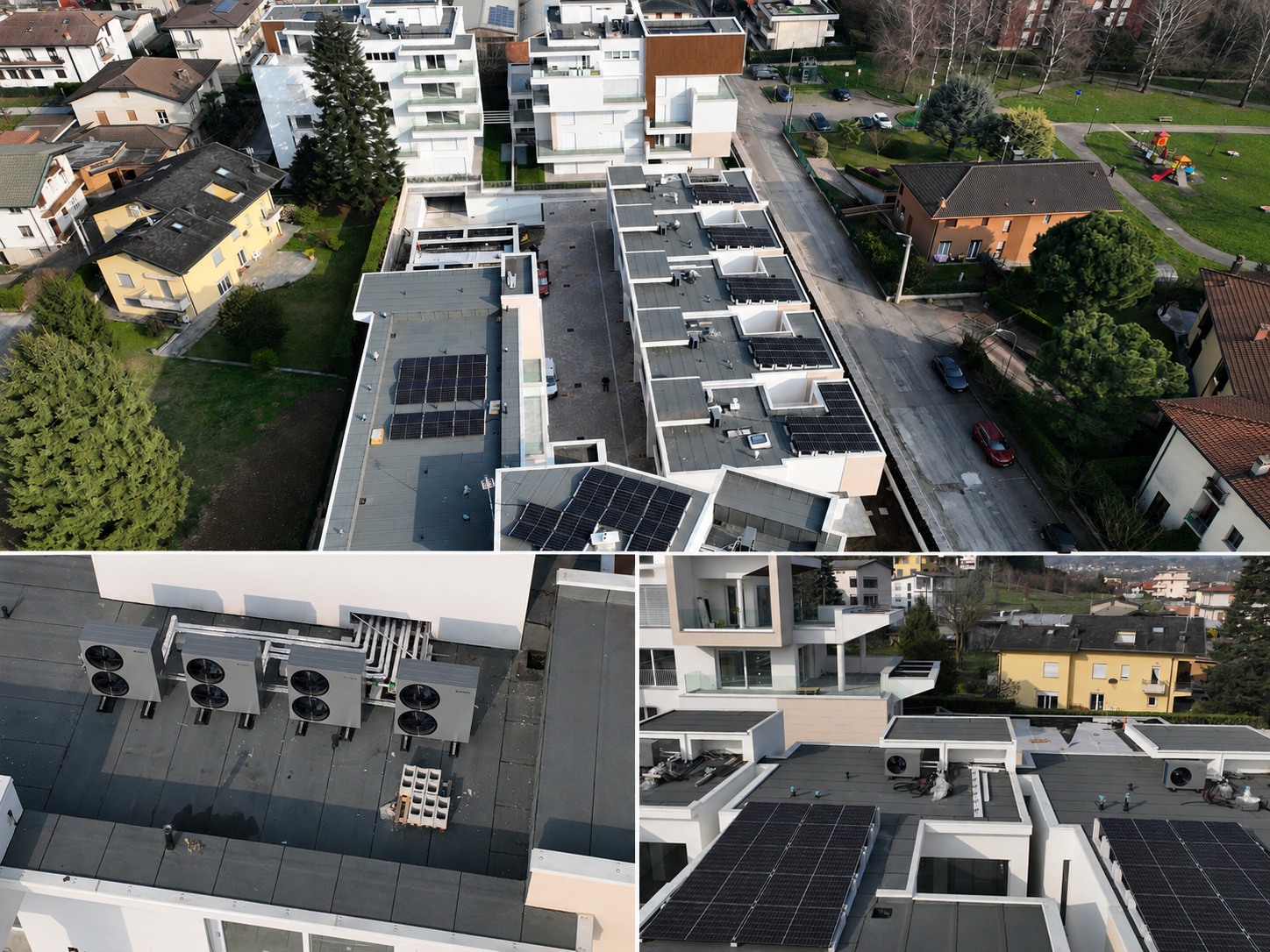
EXINDA R290 air-to-water heat pumps were installed in a newly constructed 1,500 m² multi-family residential building in Italy. The project uses nine EXINDA R290 monobloc heat pumps in a hybrid hydronic design to provide space heating, space cooling and domestic hot water (DHW).
The system combines a central cascade plant for shared building demand with decentralised units for selected residential zones. This project demonstrates how a project-specific R290 heat-pump configuration can support the requirements of an Italian multi-family new build: all-electric building services, hydronic comfort delivery, domestic hot water and independent temperature control.
This is a project-specific system design. Final heat-pump selection for any Italian development must be based on the project location, building heat loss, cooling demand, domestic hot-water profile, hydraulic design and local installation requirements.
Project at a Glance
| Item | Project Detail |
|---|---|
| Project location | Italy |
| Building type | New-build multi-family residential development |
| Building area | 1,500 m² |
| Main application | Space heating, space cooling and domestic hot water |
| Heat-pump technology | EXINDA R290 monobloc air-to-water heat pumps |
| Total installed units | 9 units |
| System approach | Hybrid hydronic architecture: centralised cascade plus decentralised systems |
| Main design objective | Efficient all-electric comfort and hot-water delivery with flexible zone control |
Why R290 Heat Pumps Fit Italian Multi-Family New-Build Projects
Italian new-build residential projects must consider the energy performance of the complete building, not the heat source in isolation. In a multi-family project, the HVAC design must coordinate heating, cooling, domestic hot water, hydraulic distribution, controls and the needs of multiple homes.
| Multi-Family New-Build Requirement | How This Project Responds |
|---|---|
| All-electric building-services design | R290 air-to-water heat pumps provide heating, cooling and DHW without a fossil-fuel boiler. |
| Shared and individual residential loads | A central cascade system serves shared demand, while decentralised units support selected local zones. |
| Cooling as well as heating | The hydronic system was designed for both heating and cooling operation. |
| Domestic hot-water demand | The configuration includes DHW production as part of the overall system design. |
| Independent occupant comfort | Decentralised units allow local control for selected residential areas. |
| Variable annual building load | Cascade operation helps match installed capacity to changing building demand. |
| Long-term serviceability | Multiple units provide operational flexibility and support maintenance planning. |
Installed EXINDA R290 Heat Pump Configuration
| System Segment | EXINDA Equipment | Quantity | Configuration | Primary Function |
|---|---|---|---|---|
| Central plant | EXINDA R290 20 kW heat pump | 4 units | Cascade configuration | Shared heating, cooling and DHW demand |
| Decentralised systems | EXINDA R290 6 kW heat pump | 5 units | Independent local systems | Local heating, cooling and DHW demand |
| Total system | EXINDA R290 air-to-water heat pumps | 9 units | Hybrid hydronic architecture | Building-wide thermal comfort and hot water |
Why Use a Hybrid Centralised and Decentralised Heat-Pump Design?
A multi-family building does not always have one uniform load profile. Common building areas, domestic hot-water demand and individual residential zones may require different control strategies.
In this Italian project, the hybrid design was selected to combine shared plant capacity with local operating flexibility.
| Engineering Decision | Project Value |
|---|---|
| Four 20 kW units in cascade | Supports staged capacity, partial-load operation and operational redundancy for shared demand. |
| Five independent 6 kW systems | Supports localised comfort and domestic-hot-water operation for selected residential zones. |
| Hydronic heat-pump architecture | Connects heat generation with the building’s heating, cooling and DHW distribution system. |
| Weather-compensated control strategy | Can help align water-temperature operation with changing outdoor conditions when correctly commissioned. |
| Hydraulic balancing and commissioning | Helps maintain stable water flow and temperature distribution across multiple circuits. |
Product Documentation for European and Italian Projects
For a multi-family project, technical evidence must be linked to the specific installed model, not to a general product claim.
| Documentation | Why It Matters for the Project |
|---|---|
| Heat Pump KEYMARK certificate | Third-party certification evidence for the applicable EXINDA model or certified product range. |
| CE Declaration of Conformity | Confirms CE documentation for the selected model under applicable EU requirements. |
| ErP and energy-label information | Supports evaluation of the product’s declared seasonal-energy information, where applicable. |
| EN 14511 performance data | Provides performance information under defined test conditions. |
| EN 14825 seasonal-performance data | Supports assessment of seasonal efficiency under defined conditions. |
| Installation and service documentation | Supports planning, installation, commissioning and maintenance. |
Important: Heat Pump KEYMARK scope, CE documentation, ErP information and performance data must be checked against the exact installed EXINDA model.
Engineering Considerations for Italian Multi-Family Heat Pump Projects
Italy includes different climatic conditions and statutory climate zones. A system suitable for one Italian location should not be treated as an automatic sizing template for another project.
| Design Item | Why It Must Be Evaluated |
|---|---|
| Building heat loss | Determines the required heating capacity at the project design condition. |
| Cooling demand | Helps define cooling capacity, hydronic design and control requirements. |
| Location and climate zone | Influences winter heating conditions, summer cooling demand and seasonal operation. |
| Heat emitters | Underfloor heating, fan coils and radiators require different water-temperature strategies. |
| DHW profile | Multi-family DHW demand must be evaluated by occupancy, usage pattern and storage strategy. |
| Hydraulic layout | Buffer tanks, pumps, valves and pipe sizing affect stable operation across multiple circuits. |
| Outdoor-unit location | Requires suitable airflow, service access, acoustic assessment and compliance with local rules. |
| Commissioning | Ensures controls, flow rates and operating parameters are adjusted for the completed building. |
Is an R290 Heat Pump Suitable for an Italian Multi-Family New Build?
Yes—an R290 air-to-water heat pump can be a suitable solution for an Italian multi-family new-build project when the system is designed around the building’s actual heating, cooling and hot-water requirements.
The appropriate question is not simply, “Can an R290 heat pump be used?” The key questions are:
-
What is the calculated building heat loss and cooling demand?
-
How will shared and individual loads be controlled?
-
What water temperatures are required by the selected heat emitters?
-
How will domestic hot water be produced and stored?
-
Which installed model has the required European documentation?
-
How will hydraulic balancing, commissioning and after-sales service be managed?
This EXINDA project shows one practical answer: combine central cascade capacity with decentralised R290 heat-pump systems where the building layout and control needs justify that approach.
Frequently Asked Questions
Can R290 heat pumps be used in Italian multi-family buildings?
Yes. R290 air-to-water heat pumps can be used for heating, cooling and domestic hot water in suitable Italian multi-family projects. Final system design must account for the building location, heat load, cooling demand, DHW demand, hydraulic design and applicable local requirements.
Why are multiple heat pumps used in this project?
The project uses four 20 kW units in a central cascade arrangement and five independent 6 kW units for selected local systems. This hybrid approach combines shared capacity with local operating flexibility.
Is Heat Pump KEYMARK enough to confirm a complete project is compliant?
No. Heat Pump KEYMARK provides product-level certification evidence for the applicable model or range. A complete project also requires correct system design, installation, commissioning and compliance with applicable local requirements.
Does CE marking mean that the heat pump is certified for every European project?
No. CE marking is supported by a Declaration of Conformity for the relevant product and applicable EU requirements. Project suitability must still be assessed for the selected model, application, location and system design.
Can this system be used as a standard design for every Italian apartment building?
No. This is a project case study, not a universal design template. Capacity, hydraulic layout, DHW design and control strategy must be assessed separately for each building.
Discuss an Italian Multi-Family Heat-Pump Project With EXINDA
EXINDA supplies R290 air-to-water heat pump solutions for European residential and multi-family projects, including heating, cooling and domestic hot water applications.
For product documentation, project discussion or distribution enquiries, contact EXINDA.
Website: https://exindagroup.com/
Email: info@exindagroup.com