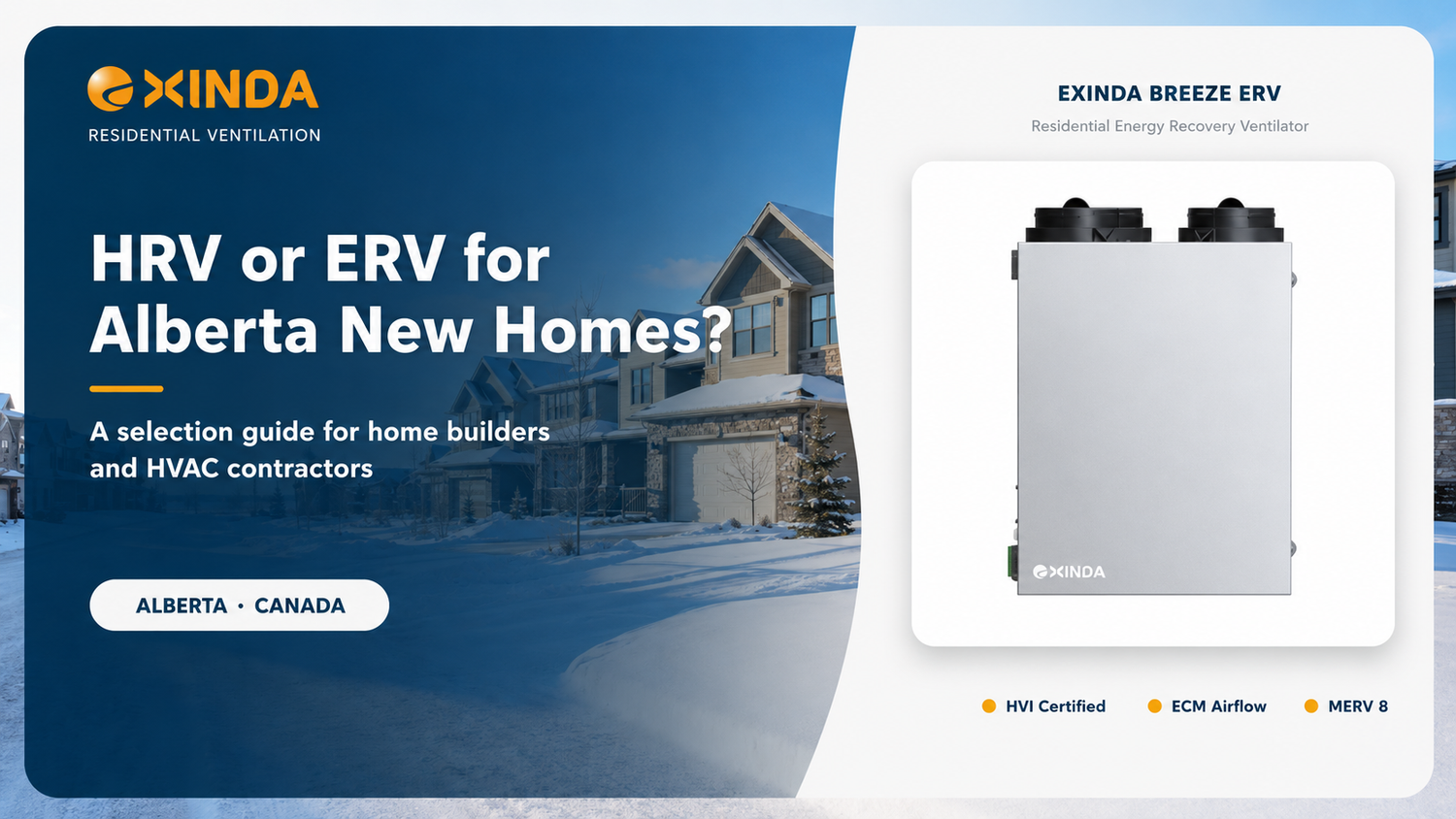
For Alberta home builders and HVAC contractors, choosing between a heat recovery ventilator (HRV) and an energy recovery ventilator (ERV) is not simply a product preference.
The correct choice depends on the local climate, building envelope, occupancy, ventilation rate, indoor humidity target and HVAC system design.
This is particularly important in Calgary, Edmonton and other Alberta communities, where new homes are becoming tighter and more energy efficient while winter conditions create demanding requirements for ventilation equipment.
This guide explains how HRVs and ERVs differ, where each system fits and what builders should review before standardizing a ventilation product across multiple housing projects.
Why Mechanical Ventilation Matters in Alberta New Homes
Modern homes are designed to reduce uncontrolled air leakage. A tighter building envelope can lower heating losses, but it also reduces the amount of natural outdoor air entering the home.
Without properly designed mechanical ventilation, moisture, odours and indoor pollutants may accumulate inside the living space.
A balanced HRV or ERV system addresses this issue by:
- Exhausting stale air from bathrooms, laundry rooms and other selected areas
- Supplying filtered outdoor air to the home
- Recovering energy between the outgoing and incoming air streams
- Helping maintain more predictable indoor air quality
- Reducing the heating penalty associated with uncontrolled ventilation
The National Building Code – 2023 Alberta Edition has been in force since May 1, 2024. The ventilation design for each project should be checked against the applicable Alberta code requirements, local authority requirements and the project’s mechanical design.
What Is the Difference Between an HRV and an ERV?
Both HRVs and ERVs provide balanced mechanical ventilation and recover energy from exhaust air. The main difference is how they handle moisture.
Heat Recovery Ventilator
An HRV transfers sensible heat between the exhaust and supply air streams while keeping the two air streams separated.
During an Alberta winter, warm indoor exhaust air passes through the heat exchanger and transfers part of its heat to the incoming cold outdoor air. This reduces the amount of energy required to bring the outdoor air closer to indoor temperature.
An HRV is commonly considered when:
- Winter humidity removal is important
- The home has frequent high-moisture loads
- Indoor condensation is a concern
- The project follows a traditional cold-climate ventilation strategy
Energy Recovery Ventilator
An ERV transfers sensible heat and a portion of the moisture between the two air streams.
During winter operation, an ERV can retain some indoor moisture instead of exhausting all of it outdoors. This may help reduce excessive indoor dryness in tightly constructed homes.
An ERV may be considered when:
- The home has a very airtight envelope
- Occupants experience excessively dry winter air
- Balanced temperature and moisture recovery are both desired
- The project includes continuous or higher-duration ventilation
- Indoor humidity remains controlled and does not create condensation risk
An ERV does not function as a humidifier or dehumidifier. It moderates moisture transfer, but it cannot replace proper humidity control or correct an improperly sized ventilation system.
Is an HRV Always Better for Alberta’s Cold Climate?
No. Alberta’s cold and generally dry winter conditions often make HRVs a familiar choice, but climate alone should not determine the selection.
Two homes in Calgary can require different ventilation strategies if they have different envelope tightness, floor areas, occupancy levels or moisture loads.
For example, an HRV may suit a home where winter moisture removal is a priority. An ERV may provide better comfort in a very airtight home where continuous ventilation causes excessively dry indoor conditions.
The decision should therefore be based on the whole building rather than a simple province-wide rule.
HRV vs ERV: Alberta Builder Comparison
| Selection Factor | HRV | ERV |
|---|---|---|
| Heat recovery | Yes | Yes |
| Moisture transfer | No significant moisture transfer | Transfers a portion of moisture |
| Winter humidity effect | Removes more indoor moisture | Retains part of the indoor moisture |
| Common Alberta application | Homes where moisture removal and condensation control are priorities | Airtight homes where excessive winter dryness is a concern |
| Summer moisture benefit | Limited | Can moderate moisture transfer under applicable conditions |
| Frost protection | Required for cold-weather operation | Required for cold-weather operation |
| Main selection risk | Excessively dry indoor conditions if ventilation is too high | Excessive indoor humidity if the building has high moisture loads |
This table provides general selection guidance. Final equipment selection should be based on the project design conditions.
Five Factors Builders and Contractors Should Review
1. Building Envelope Tightness
The tighter the home, the more important controlled ventilation becomes.
Airtight homes have less uncontrolled air exchange, so ventilation rates, controls and commissioning have a greater effect on indoor comfort. ERVs may be considered where winter dryness is a recurring concern, but envelope tightness does not automatically make an ERV the correct choice.
2. Occupancy and Moisture Generation
A large family can produce substantially more indoor moisture than one or two occupants living in the same house.
Showers, cooking, laundry and occupant activity all affect indoor humidity. Houses with legal suites or secondary dwelling units may also have different ventilation and control requirements from conventional detached homes.
3. Design Airflow
Ventilation equipment should not be selected only by its maximum advertised airflow.
The contractor should determine the required design airflow and confirm the unit’s available airflow at the project’s actual external static pressure. Duct length, fittings, grilles, filters and installation configuration all affect delivered airflow.
4. Cold-Climate Performance
An Alberta ventilation unit must be evaluated as a cold-climate system—not simply as a fan with a heat exchanger.
Important features include:
- Tested heat or energy recovery performance
- Frost-control or defrost strategy
- Low-temperature operating range
- Fan performance at external static pressure
- Insulated cabinet and drain design
- Accessible filters and service components
- Suitable controls for continuous and boost ventilation
5. Installation and Airflow Balancing
Even a correctly selected HRV or ERV can perform poorly if the duct system is not balanced.
Supply and exhaust airflow should be measured during commissioning. The final settings should reflect the design ventilation rate rather than simply leaving the unit at its factory-default speed.
For builders working across multiple developments, a repeatable commissioning procedure is just as important as the equipment specification.
Why HVI-Certified Performance Matters
Product performance should be based on independently verified ratings rather than catalogue claims alone.
The Home Ventilating Institute’s certified product directory allows contractors, builders and engineers to review certified residential ventilation products and compare published performance data.
Depending on the product category, relevant information may include:
- Airflow at specified external static pressure
- Sensible recovery efficiency
- Total recovery efficiency
- Apparent sensible effectiveness
- Electrical consumption
- Low-temperature test performance
HVI certification does not replace project engineering or commissioning. It provides a consistent basis for comparing equipment before it is specified or purchased.
What About ASHRAE 62.2?
ANSI/ASHRAE Standard 62.2 addresses ventilation and acceptable indoor air quality in residential buildings. It covers dwelling-unit ventilation, local mechanical exhaust and source control.
Although the applicable Alberta building code and local requirements govern a specific project, ASHRAE 62.2 remains a useful engineering reference for residential ventilation design.
Builders should avoid selecting a unit solely because its maximum airflow appears high enough. The complete system—including calculated airflow, duct design, local exhaust, controls and balancing—must work together.
Applications Across the Alberta Housing Market
A builder-ready HRV or ERV program may need to cover more than one housing type.
Detached Homes
Detached homes often require several airflow capacities to cover different floor areas and bedroom counts. The ventilation platform should allow contractors to standardize installation and controls without oversizing smaller houses.
Duplexes and Townhomes
Space constraints, fire separations, duct routing and exterior intake and exhaust locations can affect equipment selection. Compact dimensions and flexible installation arrangements may be particularly important.
Legal Suites and Secondary Units
The ventilation design must consider the separation between dwelling units, occupancy and applicable code requirements. A standard detached-home ventilation layout should not automatically be copied into a secondary-suite project.
Low-Rise Multifamily Projects
These projects may use individual in-suite units or another project-specific ventilation approach. Service access, sound, controls, filtration and repeatable commissioning become important when the same unit is installed across many dwellings.
This range of housing types is increasingly relevant. CMHC reported record annual housing starts in both Calgary and Edmonton in 2025, while its 2026 housing supply analysis found that rows and townhouses represented a significant part of new “missing middle” construction in both cities.
A Practical Selection Process
For a new Alberta housing project, EXINDA recommends the following workflow:
- Identify the housing type, floor area, bedroom count and expected occupancy.
- Confirm the applicable ventilation and local exhaust requirements.
- Establish the project’s indoor and outdoor design conditions.
- Determine whether winter moisture removal or moisture retention is the greater concern.
- Calculate the design airflow.
- Estimate the external static pressure of the installed duct system.
- Review certified airflow and recovery performance.
- Confirm frost-control, drainage, filtration and service requirements.
- Balance and document supply and exhaust airflow during commissioning.
This process allows the builder and HVAC contractor to select equipment based on repeatable engineering criteria rather than changing products from project to project.
EXINDA Residential Ventilation Solutions for Alberta
EXINDA develops residential HRV and ERV solutions for North American homes, including new construction, energy-efficient housing and multi-unit residential applications.
EXINDA’s Alberta ventilation approach focuses on:
- HVI-certified residential ventilation options
- ECM fan technology and stable airflow control
- Cold-climate heat and energy recovery
- Multiple airflow capacities for different housing types
- Practical filtration and service access
- Contractor documentation and airflow-balancing support
- Product programs for builders, HVAC contractors and regional distributors
Our objective is not simply to supply a ventilation unit. We help partners establish a repeatable product selection, installation and commissioning program for Alberta residential projects.
Frequently Asked Questions
Is an ERV suitable for Edmonton’s cold winters?
Yes, an ERV can be suitable for an Edmonton home when its cold-weather operating range, frost-control strategy and certified performance match the project conditions. Indoor moisture loads and condensation risk must also be considered.
Is an HRV better for Calgary because the climate is dry?
Not automatically. Calgary’s dry winter climate may cause an HRV to remove more indoor moisture than desired in some airtight homes. The correct choice depends on occupancy, envelope tightness, ventilation rate and the target indoor humidity.
Can one HRV or ERV model cover every house in a development?
Only when the model’s operating airflow range and fan performance cover all required design conditions. Developments containing detached homes, townhomes and legal suites may require more than one capacity.
Should builders specify CFM only?
No. Airflow should be reviewed at the expected external static pressure. Recovery efficiency, cold-climate operation, controls, filtration, sound, service access and commissioning requirements should also be evaluated.
Does an ERV control indoor humidity?
An ERV moderates moisture transfer between incoming and outgoing air. It is not a dedicated humidifier or dehumidifier and cannot compensate for excessive moisture generation or an incorrectly designed ventilation system.
Build a Repeatable Alberta Ventilation Program
If you are an Alberta home builder, HVAC contractor or installation company expanding into equipment distribution, EXINDA can help you evaluate:
- Required airflow capacities
- HRV and ERV product selection
- Cold-climate performance
- Project submittals
- Installation and balancing procedures
- Builder-volume supply programs
- Regional contractor or distribution cooperation
Talk to EXINDA about an Alberta builder ventilation program for Calgary, Edmonton and Central Alberta.