Real-World Applications Across North America (Quebec, California, New York)
1. Overview
EXINDA air-to-water heat pump (ATW) systems have been deployed across multiple North American climate regions, including Quebec (cold climate zone), California (mild-to-hot climate zone), and New York (mixed climate multifamily zone).
These deployments reflect a broader shift in North American HVAC design toward electrified, hydronic-based system architectures, driven by building decarbonization policies, refrigerant safety regulations, and multifamily energy efficiency requirements.
EXINDA systems are designed to provide integrated:
- Space heating
- Space cooling
- Domestic hot water (DHW)
within a single hydronic platform.
2. System Capability: Heating, Cooling & DHW Integration
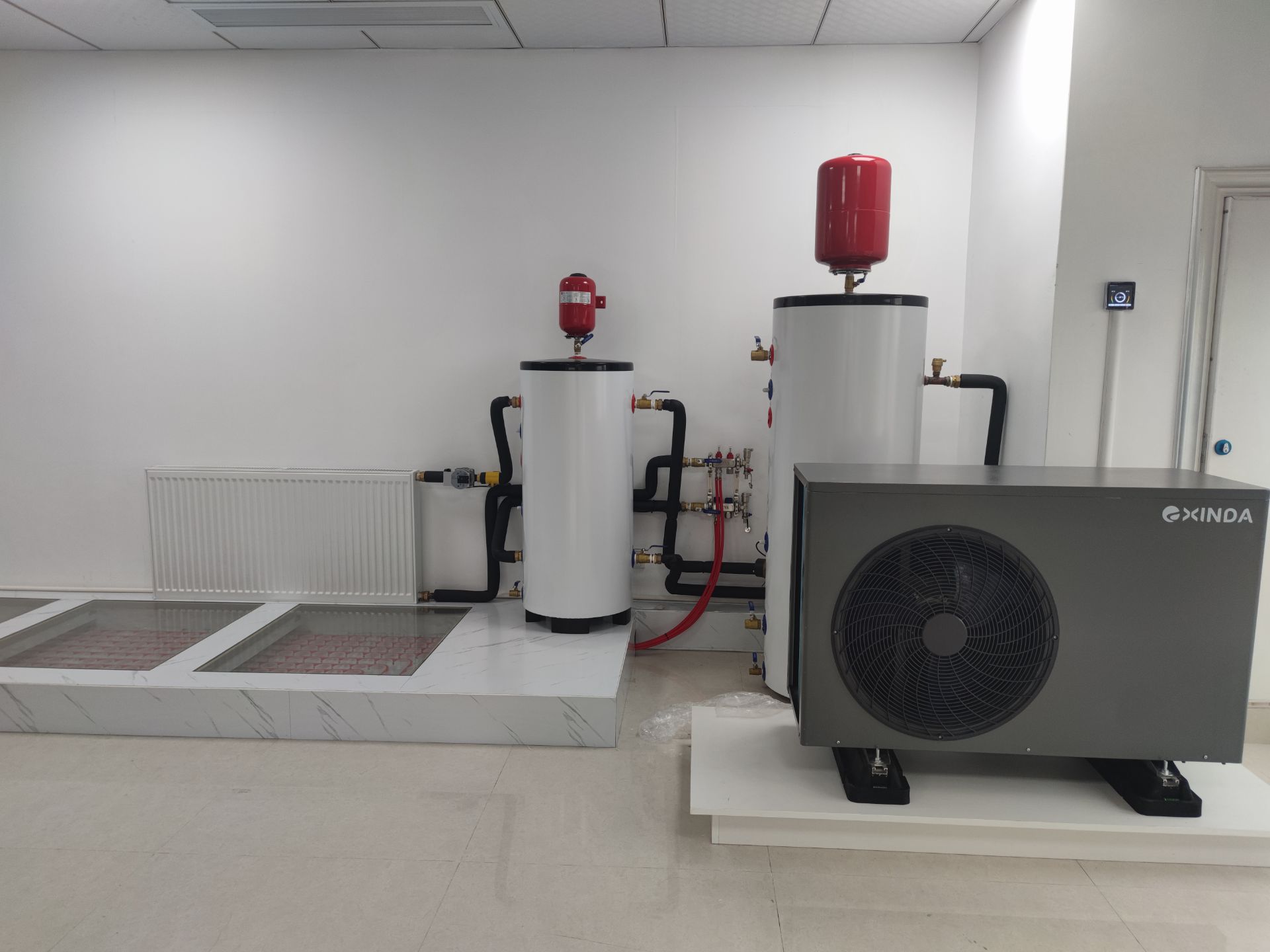
EXINDA ATW systems replace traditional fossil-fuel and refrigerant-heavy HVAC architectures by centralizing building energy functions into a hydronic system.
A single system can support:
- Space heating via radiant floors or hydronic radiators
- Space cooling via fan coil or chilled water loops
- Domestic hot water (DHW) production
- Modular cascade operation for larger multifamily buildings
This integrated structure reduces system fragmentation and simplifies mechanical room design.
3. Regional Application Overview
🇨🇦 Quebec – Cold Climate Hydronic Heating
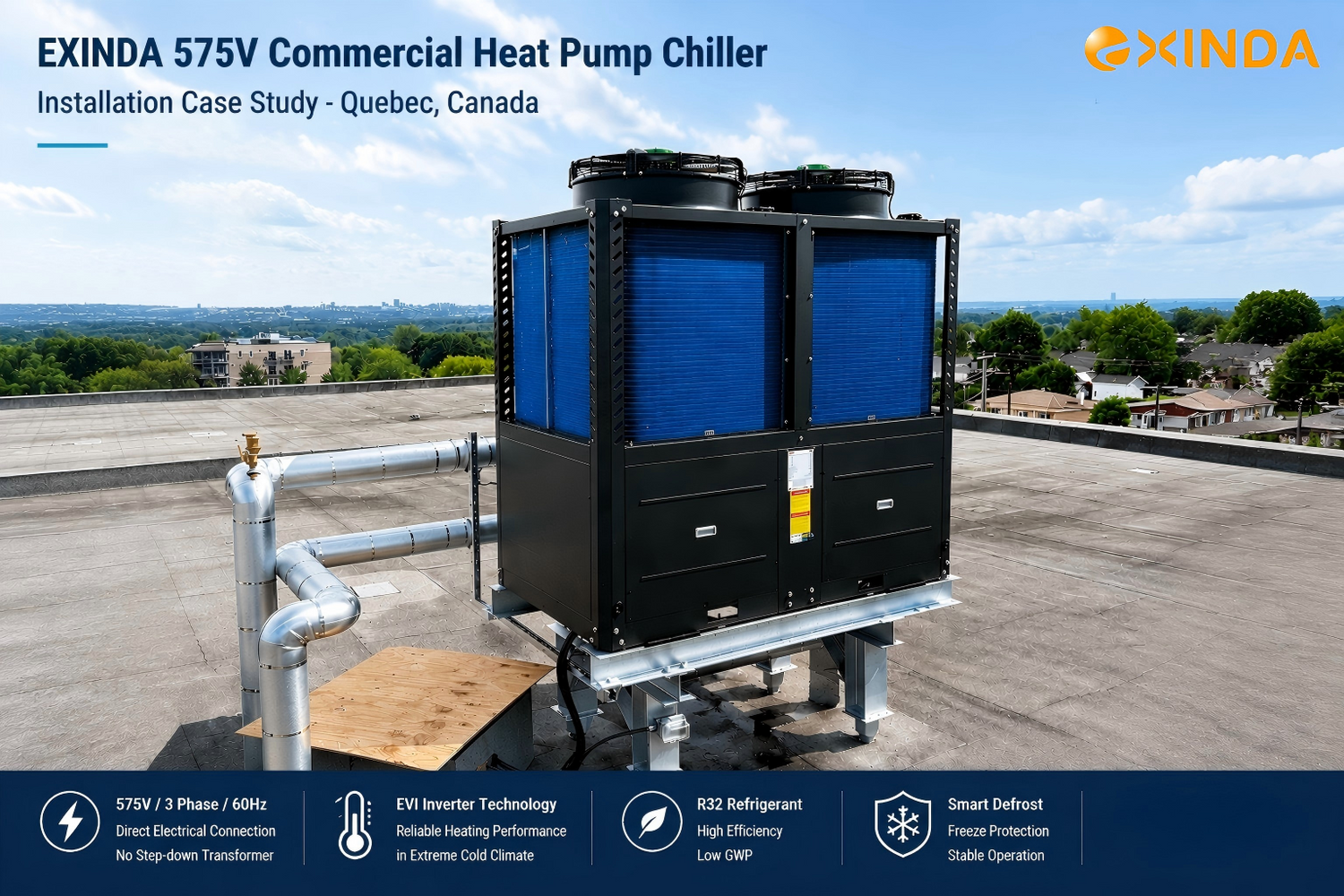
In Quebec, EXINDA ATW systems are used in cold-climate residential environments where heating demand dominates annual energy consumption.
Key characteristics include:
- Low ambient temperature operation
- High seasonal heating load
- Emphasis on system redundancy and stability
- Integration with radiant floor or hydronic radiator systems
Hydronic heat pumps provide a direct alternative to traditional gas boiler systems in electrification-driven cold climate buildings.
🇺🇸 New York – Multifamily Electrification Market
In New York, EXINDA systems are applied in multifamily residential and retrofit developments where electrification policies are accelerating the replacement of fossil fuel-based heating systems.
Typical applications include:
- Centralized boiler replacement systems
- Domestic hot water (DHW) integration
- Multifamily load balancing and zoning control
- Compliance with evolving city and state energy codes
New York represents one of the most active markets for hydronic heat pump adoption in North America.
🇺🇸 California – Electrified High-Efficiency Buildings
In California, EXINDA systems are used in energy-efficient residential and light commercial buildings where both heating and cooling loads are required throughout the year.
Key drivers include:
- Strict state energy efficiency regulations
- Building electrification mandates
- Integration with renewable energy systems
- Year-round balanced HVAC demand profiles
California continues to lead early adoption of full-electric HVAC system architectures.
4. Regulatory Pressure and Refrigerant Safety Requirements (ASHRAE 15 / A2L Transition)
The transition from traditional VRF systems to hydronic air-to-water heat pump systems in North America is strongly influenced by evolving refrigerant safety regulations rather than equipment preference.
The most significant regulatory framework affecting HVAC system design is ASHRAE Standard 15 and ASHRAE 15.2, which define safety requirements for refrigeration systems in occupied spaces.
4.1 Refrigerant Safety Is Based on Concentration, Not Charge Alone
A common misunderstanding in HVAC design is that regulations limit total refrigerant charge.
In reality, North American safety standards are based on a concentration-based risk model, not a fixed weight limit.
Systems are evaluated under a worst-case release scenario, meaning:
- The entire refrigerant charge is assumed to be released into the occupied space
- The resulting concentration is calculated based on room volume
- The system must remain below the Refrigerant Concentration Limit (RCL)
This RCL is typically defined as 25% of the Lower Flammability Limit (LFL) for A2L refrigerants.
4.2 Impact of A2L Refrigerants on VRF System Design
The transition from A1 refrigerants (non-flammable) to A2L refrigerants (mildly flammable) such as R-32 and R-454B has significantly changed HVAC design requirements.
VRF systems, which distribute refrigerant throughout occupied spaces via multiple indoor units, now face increased design scrutiny due to:
- Higher refrigerant exposure potential in occupied zones
- Distributed refrigerant piping across buildings
- Increased compliance complexity under ASHRAE 15
- Requirements for leak detection and shutdown strategies in certain applications
As a result, MEP engineers must evaluate HVAC systems based on failure safety conditions, not only operational efficiency.
4.3 Why Hydronic Systems Reduce Compliance Complexity
Hydronic air-to-water heat pump systems fundamentally change the compliance model by separating refrigerant from occupied spaces.
In a hydronic architecture:
- Refrigerant is contained within outdoor units or mechanical rooms
- Energy is transferred through water loops instead of refrigerant piping
- Occupied spaces are not directly exposed to refrigerant circuits
This significantly simplifies ASHRAE 15 compliance by reducing refrigerant exposure risk in living areas.
4.4 Regulatory Drivers Behind System Transition
The increasing adoption of hydronic heat pump systems is driven by three key factors:
- Refrigerant safety compliance under ASHRAE 15 (A2L transition)
- Electrification policies in major North American cities
- Building decarbonization and gas boiler elimination targets
These forces are reshaping HVAC design from equipment selection to system architecture decision-making.
4.5 Key Engineering Implication
HVAC system selection is increasingly determined by:
refrigerant exposure risk in occupied spaces and system-level safety compliance
rather than only efficiency or equipment performance.
This shift is accelerating the adoption of hydronic heat pump systems in multifamily and electrification-driven developments.
5. System Architecture Advantages
EXINDA ATW systems are designed for modern hydronic HVAC networks, offering:
- Modular cascade operation for scalable capacity
- Stable hydronic loop integration for multifamily buildings
- Reduced refrigerant exposure in occupied environments
- Compatibility with radiators, fan coils, and DHW systems
- Simplified compliance with modern building codes
6. Application Types in North America
EXINDA ATW systems are commonly applied in:
- Multifamily residential buildings
- Boiler replacement retrofit projects
- Electrification-driven developments
- Mixed-use commercial buildings
- Cold climate residential projects (Canada and Northern US)
7. Conclusion
EXINDA air-to-water heat pump systems have demonstrated real-world application across multiple North American regions, including Quebec, California, and New York.
These deployments reflect a broader transition toward hydronic HVAC architectures that integrate heating, cooling, and domestic hot water within a single electrified system.
As building codes evolve and refrigerant safety requirements become more stringent, hydronic heat pump systems are expected to play an increasingly important role in next-generation HVAC design across North America.
Contact
EXINDA is a global HVAC manufacturer specializing in air-to-water heat pump systems for residential and multifamily applications.
Website: https://exindagroup.com
Email: info@exindagroup.com