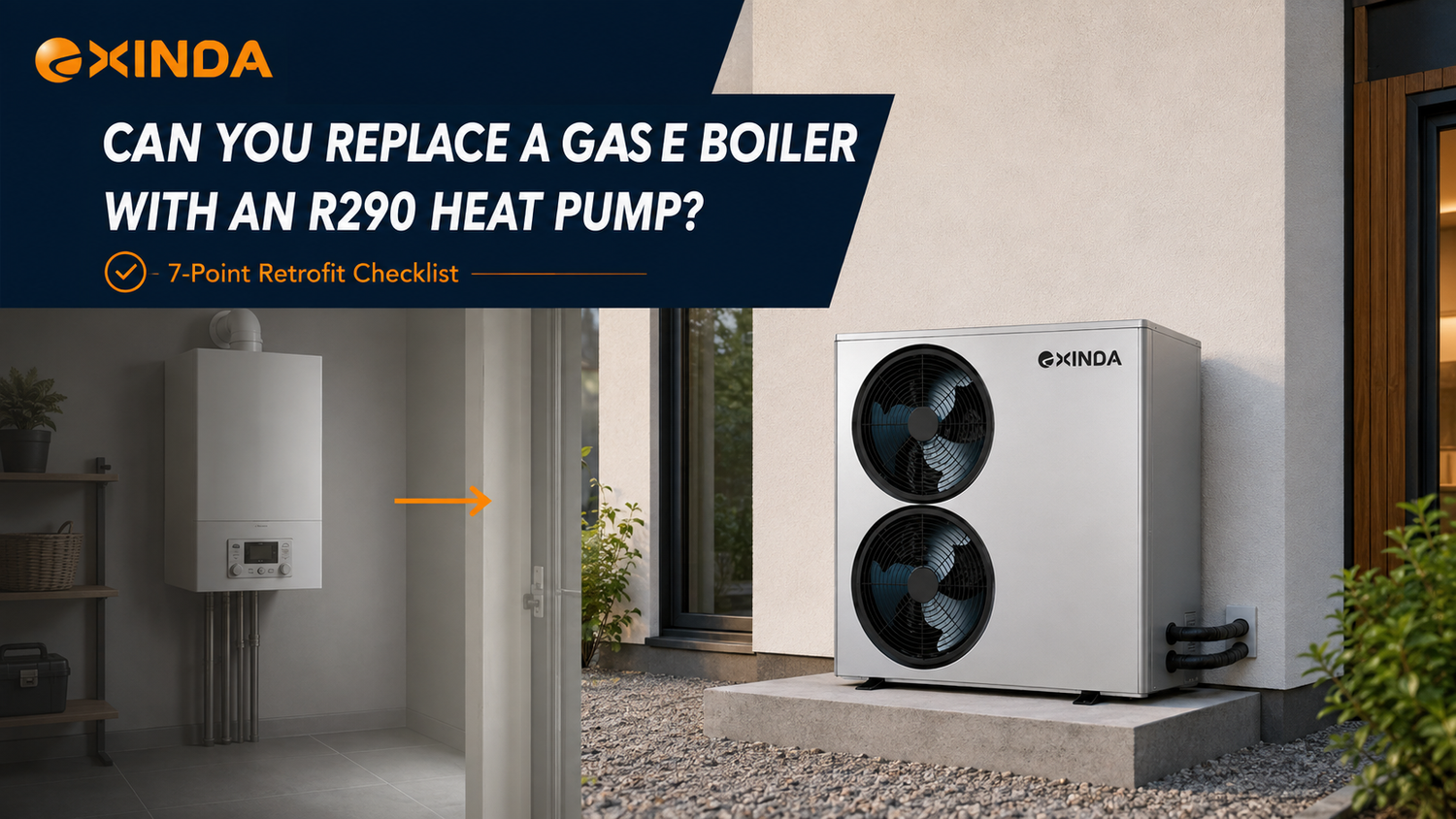
You can replace a gas boiler with R290 heat pump technology when the heat pump can meet the building load at the required winter water temperature and the existing hydronic system can provide sufficient flow and emitter output. Some houses are ready with limited changes; others need radiator, pipework, cylinder or electrical upgrades first.
The decision should not be based on the old boiler rating or property floor area alone. A proper assessment must connect the building heat loss, local climate, radiator output, water temperature, domestic-hot-water demand and electrical supply.
EXINDA supplies R290 monoblock air-to-water heat pumps for European residential retrofit projects through distributors and regional partners. For the complete product and project overview, visit the EXINDA R290 heat pump for boiler replacement page.
This supporting guide focuses on one question: is the existing home ready for conversion?
Quick Answer: Is Your Home Ready?
| Assessment result | Typical condition | Recommended next step |
|---|---|---|
| Ready for conversion | Heat loss is known, emitters work at suitable temperatures, flow and electrical supply are adequate | Complete model selection and system design |
| Suitable after upgrades | Some radiators, pipework, cylinder or electrical components are unsuitable | Complete the defined upgrades before commissioning |
| Better as a hybrid project | Peak load, high water temperature or electrical limits prevent straightforward full replacement | Design controlled heat-pump and boiler operation |
| Not ready for selection | No heat-loss calculation or emitter assessment is available | Collect project data before choosing equipment |
The following seven checks help determine which category applies.
Check 1: What Is the Building’s Real Heat Loss?
The first step is a room-by-room or whole-building design heat-loss calculation. It estimates how much heat the building loses at the local winter design temperature.
Heat loss is affected by:
- Wall, roof and floor insulation
- Window area and glazing
- Airtightness
- Building exposure
- Ventilation and infiltration
- Desired indoor temperature
- Local design outdoor temperature
The old boiler output is not a reliable substitute. Many gas boilers are oversized, and a combi boiler may have a high rating primarily for instantaneous domestic hot water rather than space heating.
Why oversizing the heat pump is a problem
Selecting a heat pump from the boiler nameplate can create:
- Higher equipment cost
- Excessive electrical demand
- Short cycling in mild weather
- Reduced part-load performance
- More complicated buffer and control requirements
- Less stable room temperature
The heat pump should be sized from the calculated load and verified against its output at the required outdoor and leaving-water temperature.
What to record
Before requesting a model, provide:
- Design heat loss in kW
- Design outdoor temperature
- Heated floor area
- Main construction and insulation details
- Planned fabric improvements
If insulation or windows will be upgraded, calculate the post-renovation load rather than selecting equipment for the original building condition.
Check 2: Can the Existing Radiators Heat the Rooms at a Lower Water Temperature?
Existing radiators can often remain, but their output must be checked at the proposed flow and return temperatures.
A radiator that met the room load with a gas boiler at high water temperature will produce less heat when the mean water temperature is reduced. This does not mean every radiator must be replaced. Many boiler systems contain oversized emitters, and only the highest-load rooms may need changes.
Room-by-room radiator assessment
For each room, compare:
- Room design heat loss
- Radiator type and dimensions
- Manufacturer output correction at the proposed temperature difference
- Required flow and return temperatures
- Available water flow
The possible outcomes are:
- Existing radiator is adequate
- Existing radiator is adequate after reducing the room heat loss
- A larger panel radiator is required
- A fan-assisted low-temperature radiator is appropriate
- A fan coil or other emitter is required
A practical pre-assessment
Before the full retrofit, an installer may operate the existing boiler at a reduced weather-compensated flow temperature during cold weather and observe room comfort. This is not a replacement for calculations, but it can reveal whether the current emitters are likely to need attention.
EXINDA’s German luxury-villa heat pump installation provides a relevant application example involving an R290 heat pump, radiator-based hydronic heating and domestic-hot-water storage.
Check 3: What Leaving-Water Temperature Is Actually Required?
The goal is not to find the highest water temperature the heat pump can produce. The goal is to identify the lowest water temperature that maintains comfort at each outdoor condition.
Higher leaving-water temperature generally increases compressor lift and can reduce capacity and efficiency. Therefore, a high-temperature heat pump should still be designed around the lowest practical heating curve.
Use weather compensation
A weather-compensated controller adjusts the water-temperature target as outdoor temperature changes.
For example:
- Mild outdoor weather requires a lower flow temperature
- Colder weather requires a higher flow temperature
- Only the design winter condition should approach the maximum calculated requirement
This is usually better than running a fixed high water temperature throughout the heating season.
Do not rely only on A7/W35
A7/W35 means 7°C outdoor air and 35°C leaving water. It is not representative of every radiator retrofit.
If the project requires operation near −7°C outdoor air and 55°C leaving water, the selection should use performance data at or near A−7/W55. Buyers should check both capacity and COP at the relevant condition.
Check 4: Can the Existing Pipework Provide Enough Water Flow?
A heat pump may require more water flow than a boiler for the same delivered capacity because the heat-pump system often uses a smaller temperature difference between flow and return.
The assessment should review:
- Main flow and return pipe sizes
- Microbore pipe sections
- Circuit lengths
- Thermostatic radiator valves
- Zone valves
- System pressure drop
- Circulation-pump capability
- Hydraulic balancing
- Dirt and sludge condition
- Minimum water volume
Does microbore pipework prevent a heat-pump retrofit?
Not automatically. Some microbore systems can operate successfully, while others cannot deliver the required flow without excessive pressure drop or noise.
The installer should calculate or measure circuit conditions. Possible solutions include:
- Replacing restricted main pipe sections
- Dividing circuits
- Improving hydraulic balancing
- Selecting appropriate pumps
- Replacing restrictive valves
- Separating the heat-pump and emitter circuits hydraulically when justified
Clean the existing system
Older radiator circuits may contain magnetite, sludge or debris. The project should follow the equipment and water-treatment requirements for cleaning, flushing, filtration and corrosion protection before connecting the new heat pump.
Check 5: How Will Domestic Hot Water Be Produced?
Replacing a combi gas boiler changes the domestic-hot-water strategy. An air-to-water heat pump normally works with a storage cylinder instead of providing unlimited instantaneous hot water.
The project team should establish:
- Number of occupants
- Number of bathrooms
- Shower and bath demand
- Peak-use period
- Target storage temperature
- Required cylinder volume
- Reheat time
- Cylinder coil surface area
- Hygiene-cycle strategy
- Supplementary immersion-heater requirement
Can the existing cylinder remain?
It may remain if its heat exchanger, volume and condition are suitable for heat-pump operation. A cylinder designed for a boiler may have a smaller coil that limits heat transfer at lower water temperatures.
The cylinder should be checked rather than assumed compatible.
Hot-water temperature versus space-heating temperature
Domestic-hot-water production normally requires a higher leaving-water temperature than space heating. Controls should prioritize the cylinder for defined periods and then return the heat pump to the lower space-heating curve.
Check 6: Is the Electrical Supply Suitable?
A gas boiler has a relatively small electrical load. A heat pump, circulation equipment and supplementary heater may require substantially more electrical capacity.
Before removing the boiler, confirm:
- Single- or three-phase availability
- Main service capacity
- Heat-pump maximum current
- Electric backup-heater rating
- Cylinder immersion-heater load
- Other major building loads
- Cable size and route
- Protective devices
- Local notification or grid requirements
Electrical suitability must be confirmed for the exact model and system configuration. A nominal heat-pump capacity does not reveal maximum electrical demand.
Consider backup-heater control
An electric heater may support:
- Peak winter demand
- Emergency operation
- Domestic-hot-water hygiene cycles
- Commissioning or frost-protection functions
Its operating logic should be intentional. An oversized heater that runs unnecessarily can increase electricity consumption and exceed the intended building load.
Check 7: Is There a Safe and Practical Outdoor Location?
The outdoor unit needs correct airflow, drainage, service access and safety clearances.
The installer should check:
- Space around air intake and discharge
- Distance from doors and windows
- Proximity to neighbouring properties
- Sound reflection from walls and corners
- Stable base or mounting structure
- Defrost-water drainage
- Snow, ice, flooding and wind exposure
- External pipe insulation and freeze protection
- Future maintenance access
- Model-specific R290 installation requirements
R290 is propane and is classified as flammable. Although a monoblock keeps its sealed refrigerant circuit in the outdoor unit, placement and service must comply with the current installation manual and applicable local requirements.
What Happens After the Seven Checks?
Result A: The home is ready for full conversion
This result is likely when:
- Design heat loss is known
- Heat-pump output covers the load at the design condition
- Radiators meet room loads at the proposed temperature
- Pipework provides adequate flow
- A suitable hot-water cylinder is available
- Electrical supply is sufficient
- Outdoor installation is practical
The project can proceed to detailed model selection, hydraulic design and quotation.
Result B: The home needs defined upgrades first
Common upgrade-first projects require:
- Selected larger radiators
- Insulation or window improvements
- Pipework modifications
- A heat-pump-compatible cylinder
- Electrical-service work
- Drainage or outdoor-base preparation
These upgrades do not mean the building is unsuitable. They should be costed and scheduled before the heat pump is ordered.
Result C: A hybrid solution is more appropriate
A controlled heat-pump and boiler system may be considered when:
- Peak design load is unusually high
- Electrical capacity is restricted
- Some circuits require very high water temperatures
- The building renovation will occur in phases
- The owner wants staged electrification
The controls must define the bivalent temperature, operating priority and handover between heat sources. Keeping a boiler without an intentional control strategy can cause inefficient or conflicting operation.
Read the EXINDA air source heat pump hybrid-heating guide for related system considerations.
What Should the Installer Measure During the Site Survey?
| Survey item | Record required |
| Building | Construction, insulation, glazing and heated area |
| Heat load | Room and whole-building design heat loss |
| Boiler | Type, fuel, controls and current temperature settings |
| Emitters | Type, dimensions and room assignment |
| Hydraulics | Pipe sizes, zones, pumps, valves and system condition |
| Hot water | Occupancy, demand, cylinder and reheating requirements |
| Electrical | Phase, service capacity and available circuits |
| Outdoor location | Clearances, sound, base, drainage and pipe route |
| Controls | Thermostats, zones, weather compensation and backup logic |
Photographs, a hydraulic schematic and the current boiler commissioning settings can help the product team understand the retrofit context.
What Performance Data Should Be Requested?
For the selected R290 heat pump, request model-specific information covering:
- Heating capacity at the design outdoor temperature
- Capacity at the required leaving-water temperature
- COP at the stated test point
- Seasonal-performance data
- Minimum and maximum output
- Required water flow
- Operating envelope
- Electrical input and maximum current
- Sound data and test conditions
- Defrost and freeze-protection requirements
- Backup-heater configuration
- Controller and communication functions
Do not use a certificate or performance table for a different capacity as evidence for the proposed model.
Which European Documents May Be Required?
Requirements vary according to the country and project route.
- CE conformity information should identify the applicable product.
- ErP information should correspond to the exact model and configuration.
- Heat Pump KEYMARK certification should be checked against the certificate scope.
- UK projects may require a current MCS listing for the selected model.
- Installation manuals, wiring diagrams and performance tables should be current.
Certification for selected models should not be presented as covering the complete EXINDA range.
UK installers can review the EXINDA MCS-certified R290 heat pump guide.
Real EXINDA Gas-Boiler Replacement Example
An EXINDA residential project in the United Kingdom replaced a condensing gas boiler with a 12 kW R290 air-to-water heat pump. The retrofit integrated an existing radiator circuit, domestic-hot-water production and project controls.
View the EXINDA UK gas-boiler replacement project.
This project provides evidence of one completed system architecture. It is not a universal sizing template; every property still requires its own heat-loss, emitter, hydraulic and electrical assessment.
How EXINDA Supports Retrofit Enquiries
EXINDA supplies branded R290 monoblock air-to-water heat pumps through distributors and regional partners. Product-side support can include:
- Preliminary application review
- Model selection using project conditions
- Technical submittals and performance data
- Available model-specific certification documents
- Installation and controller manuals
- Commissioning guidance
- Fault-code and diagnostic support
- Spare-parts identification
- Distributor and installer training support
The qualified designer and installer remain responsible for the building assessment, complete system design, installation and local compliance.
For the full product, application and cooperation overview, continue to the EXINDA R290 heat pump for boiler replacement page.
Frequently Asked Questions
Can I replace a gas boiler with an R290 heat pump?
Yes, if the heat pump can meet the building load at the required water temperature and the radiators, pipework, domestic-hot-water system and electrical supply are suitable.
Do I have to replace every radiator?
No. Each radiator should be checked against the room heat loss at the proposed flow and return temperatures. Only insufficient emitters need upgrading.
Can a heat pump work in an old house?
Yes. Building age alone does not determine suitability. Heat loss, emitter output, water temperature, flow and electrical supply are more important.
Can the heat pump use the existing boiler pipes?
Often yes, provided the pipe sizes, condition and pressure drop allow the required water flow. Restricted or contaminated systems may need modification and cleaning.
Will I need a hot-water tank?
Most air-to-water heat-pump systems use a domestic-hot-water cylinder. A home replacing a combi boiler will normally need space for suitable hot-water storage.
Is a high-temperature R290 heat pump always required for radiators?
No. First calculate the water temperature required by the building and emitters. Use high-temperature capability when justified rather than as the default operating setpoint.
Should I select the same kW as my gas boiler?
No. Select the heat pump from the building heat loss and its published capacity at the required outdoor and water condition.
Can I keep the gas boiler as backup?
Yes, in a deliberately designed hybrid system. Controls must define when the heat pump and boiler operate.
Does every R290 heat pump have Heat Pump KEYMARK or MCS certification?
No. Certification must be checked for the exact model and capacity proposed for the project.
What information should I send EXINDA?
Send the project location, design heat loss, outdoor design temperature, radiator details, water temperatures, pipe sizes, domestic-hot-water demand, electrical supply and photos or schematics.
Request a Retrofit Assessment
If you are an installer, heating contractor, distributor or project company evaluating a gas-boiler conversion, provide:
- Company and country
- Project location
- Building type
- Calculated heat loss
- Current boiler and fuel
- Current and required water temperatures
- Radiator schedule or dimensions
- Pipe sizes and heating zones
- Domestic-hot-water demand
- Electrical supply
- Outdoor-unit location
- Project quantity and schedule