Updated September 2026.
The market offers a wide choice of air source heat pump manufacturers, which gives investors, distributors and project buyers plenty of options and plenty of homework.
It helps to know each manufacturer's market background, where its technology is heading, and how seriously it takes efficiency and low-GWP refrigerants. In this article we list leading heat pump producers worldwide, explain what each one is known for, and go through the points to check when choosing a manufacturing partner.
15 Heat Pump Manufacturers Worth Knowing in 2026
The rankings are in no particular order. The list reflects market demand, product performance, qualifications, product range and energy efficiency.
Asia-Pacific:
- EXINDA (China)
- Midea (China)
- Daikin Industries, Ltd. (Japan)
- Mitsubishi Electric Corporation (Japan)
- Panasonic Corporation (Japan)
- Samsung Electronics (South Korea)
North America:
- Carrier Corporation (United States)
- Rheem Manufacturing Company (United States)
- Lennox International (United States)
- Napoleon (Canada)
- Xylem (United States)
Europe:
- Bosch Thermotechnology (Germany)
- NIBE Industrier AB (Sweden)
- Viessmann Group (Germany)
- Johnson Controls (Ireland)
Asia-Pacific
1. EXINDA (China)
Headquarters: Guangdong, China
Year Founded: 2012
Certificates: RoHS, ERP, CE, UL/ETL
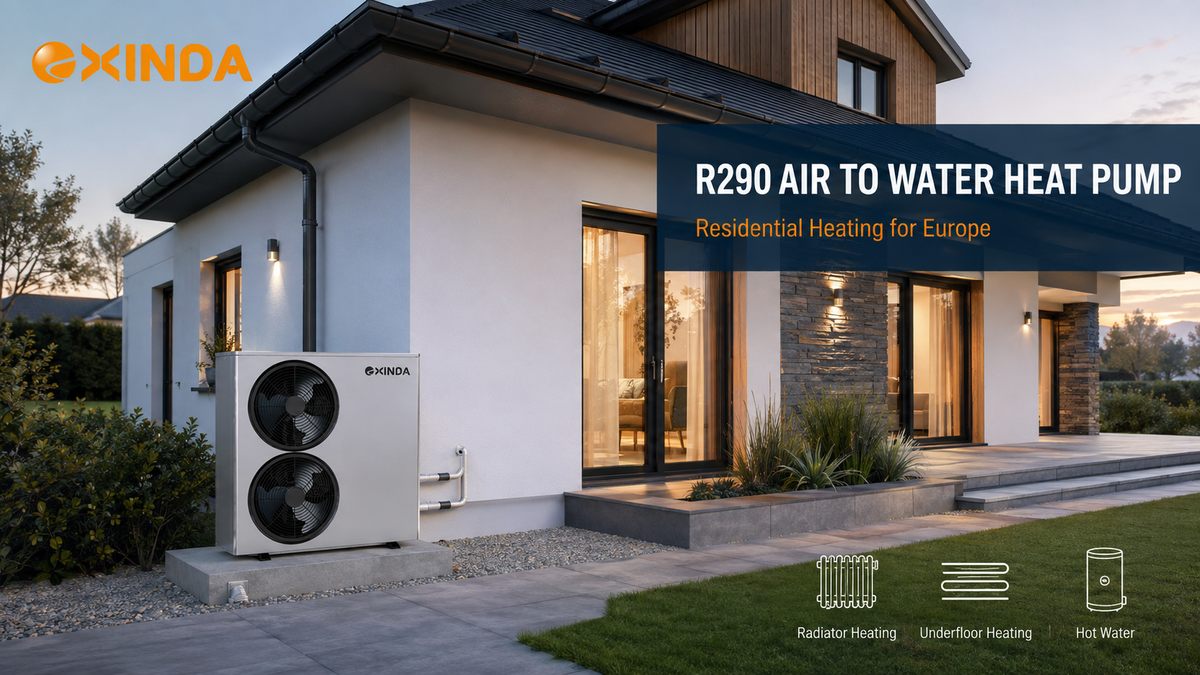
Exinda Group, a subsidiary of Xinda Group, is a heat pump manufacturer and supplier based in Guangdong, China. Founded in 2012, Exinda has spent more than a decade in heating and ventilation equipment for residential and commercial buildings.
Exinda is one of the few manufacturers that builds to a client's specification as standard practice. That covers client-specified water pumps, cabinet and connection changes, and tailored control logic, so a distributor or engineering firm can get a unit that fits the project rather than adapting the project to the unit.
The current range covers R290 inverter air-to-water heat pumps, commercial air-to-water heat pumps and chillers, swimming pool heat pumps, energy recovery ventilators, and the Aura HPERV, a ceiling-ducted heat pump with a built-in ERV and no outdoor unit for apartment buildings. Products are designed for A+++ efficiency and use the low-GWP refrigerants R290, R32 and R454B.
The air-to-water units are engineered to operate down to -25°C, which matters for the Canadian and Northern European projects the company supplies.
2. Midea (China)
Headquarters: Guangdong, China
Year Founded: 1968
Founded in 1968 and headquartered in Beijiao, Shunde District, Foshan, Guangdong, China, Midea Group has established itself as a global giant in the electrical appliance industry.
Today, Midea's business encompasses smart home solutions, HVAC, robotics and automation, smart logistics, and electro-mechanical products. Midea's philosophy revolves around humanizing technology, offering consumer-centric and problem-solving solutions that cater to the ever-changing demands of consumers worldwide.
3. Daikin (Japan)
Headquarters: Osaka, Japan
Year Founded: 1924
Daikin Industries, Ltd., based in Osaka, Japan, is a global leader in the HVAC (Heating, Ventilation, and Air Conditioning) industry, recognized for its innovation in air conditioning and refrigeration technology since its inception in 1924.
The company's product portfolio is comprehensive, encompassing residential and commercial air conditioning systems, advanced air purification units, and high-efficiency chillers. In addition to HVAC products, Daikin has expanded into the chemical sector with a range of fluorocarbon-based products, which are essential in various industrial applications.
Their global operations span several continents, reflecting their capacity to meet diverse climatic and market needs with a broad array of technologically advanced products.
4. Mitsubishi Electric (Japan)
Headquarters: Tokyo, Japan
Year Founded: 1921
Mitsubishi Electric Corporation, headquartered in Tokyo, Japan, was founded in 1921. The company is renowned for its wide range of electrical and electronic products and systems, which are utilized in various fields and applications.
A standout aspect of Mitsubishi Electric is its unwavering commitment to innovation. They've consistently been at the forefront of technological advancements, marked by a strong presence in global patent applications. This focus on research and development allows them to keep pushing the boundaries in various sectors, offering state-of-the-art products.
5. Panasonic (Japan)
Headquarters: Tokyo, Japan
Year Founded: 1918
Panasonic Corporation, established in 1918 and based in Tokyo, Japan, has carved a niche as a frontrunner in the electronics and home appliances sector. Over the years, it has expanded its expertise to include cutting-edge solutions for both business and industrial applications.
What sets Panasonic's heat pumps apart is their integration with renewable energy sources such as solar power, underscoring the company's dedication to eco-friendly solutions. Additionally, these heat pumps are designed to use refrigerants with a lower Global Warming Potential (GWP), aligning with global environmental standards and contributing to the reduction of greenhouse gas emissions.
6. Samsung (South Korea)
Headquarters: Suwon, South Korea
Year Founded: 1969
Samsung Electronics Co., Ltd., headquartered in Suwon, South Korea, was established in 1969 and has since evolved into a global leader in various electronics industry sectors. The company has a rich history in consumer electronics, semiconductors, telecommunications, and digital media devices.
Samsung is actively involved in the heat pump market with products like the Max Heat® 3.0 and the EHS Mono R290. The Max Heat® 3.0 is tailored for extreme cold climates, offering efficient heating capabilities in low-temperature conditions. The EHS Mono R290, on the other hand, utilizes the environmentally friendly R290 refrigerant and is designed to provide high hot water temperatures, suitable for residential heating needs.
North America
7. Carrier (United States)
Headquarters: Florida, USA
Year Founded: 1978
Carrier Corporation, a U.S.-based company, is a notable player in the heating, ventilation, and air conditioning (HVAC) industry. In recent years Carrier has launched a series of high-temperature heat pumps, notable for their wide range of capacities, from 30 kW to 735 kW, and their use of hydrofluoroolefins as refrigerants.
These heat pumps are designed for varied applications, including industrial sites, commercial settings, public buildings, and district heating systems.
8. Rheem (United States)
Headquarters: Atlanta, USA
Year Founded: 1925
Rheem, an American company headquartered in Atlanta. Founded in 1925, Rheem has established itself as a leader in developing heating and cooling solutions.
Rheem's residential heat pump has been noted for delivering outstanding results, particularly for its ability to provide effective heating even at very low temperatures. The heat pump was able to provide 77% of its nominal heating capacity at −15 degrees Fahrenheit and continued to operate uninterruptedly at −23 degrees Fahrenheit.
9. Lennox (United States)
Headquarters: Texas, USA
Year Founded: 1895
Lennox, headquartered in Richardson, Texas, and established in 1895, is renowned in the HVAC sector for their air conditioning, heating, and refrigeration products. Their offerings include air conditioners, furnaces, heat pumps, and indoor air quality systems for both residential and commercial settings.
Lennox stands out for their commitment to incorporating innovative technology in their products, focusing on energy efficiency and performance. They aim to offer environmentally friendly solutions that effectively manage indoor temperatures, emphasizing reducing energy consumption and providing cost-effective options for heating and cooling.
10. Napoleon (Canada)
Headquarters: Ontario, Canada
Year Founded: 1976
Napoleon, originally Wolf Steel Ltd., is a Canadian company founded in 1976 in Barrie, Ontario. They have evolved into a key manufacturer in North America, mainly producing fireplaces, grills, and gas furnaces.
Starting as a steel fabrication business, Napoleon diversified into outdoor heating products, establishing a strong market presence with their fireplaces and grills. They are recognized for innovative heating and cooling products, aiming to enhance home comfort. Their commitment to quality and design is evident in their multiple industry awards, solidifying their significant role in the HVAC industry and home appliance market.
11. Xylem (United States)
Headquarters: New York, United States
Year Founded: 2011
Xylem, a global water technology company headquartered in Rye Brook, New York, United States, is committed to solving critical water and infrastructure challenges through innovation. Founded in 2011, Xylem's business spans utility, industrial, commercial, and residential markets worldwide.
The company has been focusing on sustainable solutions in the building sector, notably in the field of heat pumps. Xylem offers technologies like intelligent pumps and monitoring software to reduce carbon footprints in buildings. Their solutions in the heat pump sector are aimed at enhancing energy efficiency and supporting decarbonization efforts, aligning with global initiatives for a more sustainable future.
Europe
12. Bosch Thermotechnology (Germany)
Headquarters: Wetzlar, Germany
Year Founded: 1886
Bosch Thermotechnology, based in Wetzlar, Germany, is a major provider of energy-efficient heating and cooling solutions. Their range includes heat pumps, boilers, and water heaters, targeting residential and commercial markets.
The company's commitment to innovation and sustainability is evident in its products' popularity and effectiveness. Bosch Thermotechnology's impact is significant in the HVAC industry, particularly in advancing eco-friendly technologies and contributing to energy savings worldwide.
13. NIBE Industrier AB (Sweden)
Headquarters: Markaryd, Sweden
Year Founded: 1952
NIBE Industrier AB, based in Markaryd, Sweden, is a notable company in the global heating technology sector. Founded in 1952, NIBE has grown into a key player, specializing in the development, manufacturing, and marketing of various heating products.
Their range includes heat pumps, water heaters, and other related components and systems. NIBE's focus is on providing sustainable and energy-efficient solutions for both residential and commercial applications.
14. Viessmann (Germany)
Headquarters: Allendorf, Germany
Year Founded: 1917
Viessmann, based in Allendorf, Germany, and established in 1917, specializes in advanced heating and cooling systems. Their product line is well-regarded for including efficient boilers, industrial energy systems, and innovative cooling solutions. Notably, Viessmann's heating systems integrate cutting-edge technology such as digital connectivity and smart home features, enhancing energy efficiency and user control.
This blend of modern technology with a focus on sustainability and energy conservation has made Viessmann a notable name in providing heating solutions for both residential and commercial settings.
15. Johnson Controls (Ireland)
Headquarters: Cork, Ireland
Year Founded: 1885
Johnson Controls, based in Cork, Ireland, and founded in 1885, has become a leader in building technology solutions. Their product offerings encompass HVAC systems, fire protection, security systems, and building management technologies. The company is especially known for its building automation and energy management systems, which incorporate smart and connected technologies.
These innovations are geared towards optimizing building operations and enhancing energy efficiency, making Johnson Controls a key provider of technology-driven solutions for various building types, from residential to commercial structures.
How do you select the right heat pump manufacturer partner?
The Heat Pump Association has emphasized, "Heat pumps are the heart of our green energy future," highlighting their commitment to bringing efficient, renewable, and smart heating and cooling solutions to Europe.
In a market with this many manufacturers, an informed decision matters. These are the criteria that help.
1. Quality Assurance
Assess if the manufacturer holds relevant certifications and complies with industry standards to ensure product quality and safety. Evaluate their quality control processes and the durability of their products through customer feedback and product testing results.
Common Quality Certifications in the Heat Pump Industry:
- ISO 9001
- MCS
- KEYMARK
- RoHS
- ERP
- CE
- UL/ETL
- AHRI (North America)
2. Technology and Innovation
Look for a manufacturer with advanced technological capabilities and a strong focus on research and development. Innovation track record can be gauged through their history of product launches and technological advancements in their field.
Key innovations in the heat pump industry include advanced compressor technology, high-temperature heat pumps, low-GWP refrigerants such as R290 and R32, quiet operation, hybrid solutions, smart control and integration, and practical design improvements.
3. Production Capacity and Scalability
Verify the manufacturer's ability to meet your demand quantities without compromising quality. Consider their scalability potential for future growth and their track record in handling large and variable order sizes.
4. Cost-Effectiveness
Analyze the manufacturer's pricing in relation to the market to ensure competitive and fair pricing. Investigate their cost reduction strategies and how they offer value for money in their products.
5. Sustainability and Environmental Compliance
Examine the manufacturer's commitment to eco-friendly practices and any sustainability certifications they may hold. Review their waste reduction and recycling practices to gauge their environmental responsibility.
6. Customer Service and Support
Assess the manufacturer's post-purchase support quality and responsiveness to customer inquiries and issues. Look for customization options and flexibility in meeting specific product requirements.
7. Supply Chain and Logistics
Evaluate the reliability and efficiency of the manufacturer's supply chain and distribution networks. Analyze their inventory management system to understand how they handle stock availability and delivery times.
8. Reputation and Industry Standing
Consider customer reviews, testimonials, and any industry awards or recognitions the manufacturer has received. Look at their longevity in the market and presence in the industry as indicators of their reputation.
9. Financial Stability and Long-term Viability
Research the financial health of the manufacturer, including their profitability, market share, and risk management strategies. Consider their prospects for future growth and stability to ensure a lasting business relationship.
10. Regulatory Compliance
Ensure the manufacturer adheres to all local and international laws and regulations relevant to their products and industry. Check their commitment to legal and ethical business practices, including labor laws and environmental regulations.
Conclusion
Choosing the right heat pump manufacturer requires careful consideration of multiple factors. Some manufacturers, even those newer to the industry, may emerge as strong contenders.
Selecting the right partner is crucial for success. Whether you prioritize quality, innovation, or sustainability, your decision will play a pivotal role in the future. Feel free to reach out to us for further assistance.
Our team is available to help you make the right choice and achieve your goals.
Disclaimer: This article, titled "Best 15 Heat Pump Manufacturers and Suppliers in 2026," is intended solely for informational and educational purposes. It includes the logos of various heat pump manufacturers and suppliers, which are the property of their respective owners. These logos are used in this article to provide context and enhance the informational value of the content. Their use is not intended to imply any affiliation.
While we endeavor to keep the information up to date and correct, we make no representations or warranties of any kind, express or implied, about the completeness, accuracy, reliability, suitability, or availability with respect to the article or the information, products, services, or related graphics contained in the article for any purpose. Any reliance you place on such information is therefore strictly at your own risk.
We advise readers to conduct their own research and consult with professionals as necessary before making any decisions based on the content of this article. This article is not intended as legal, financial, or business advice. Readers should consult appropriate professionals before making any decisions based on this content. If you have any question, please contact info@exindagroup.com.