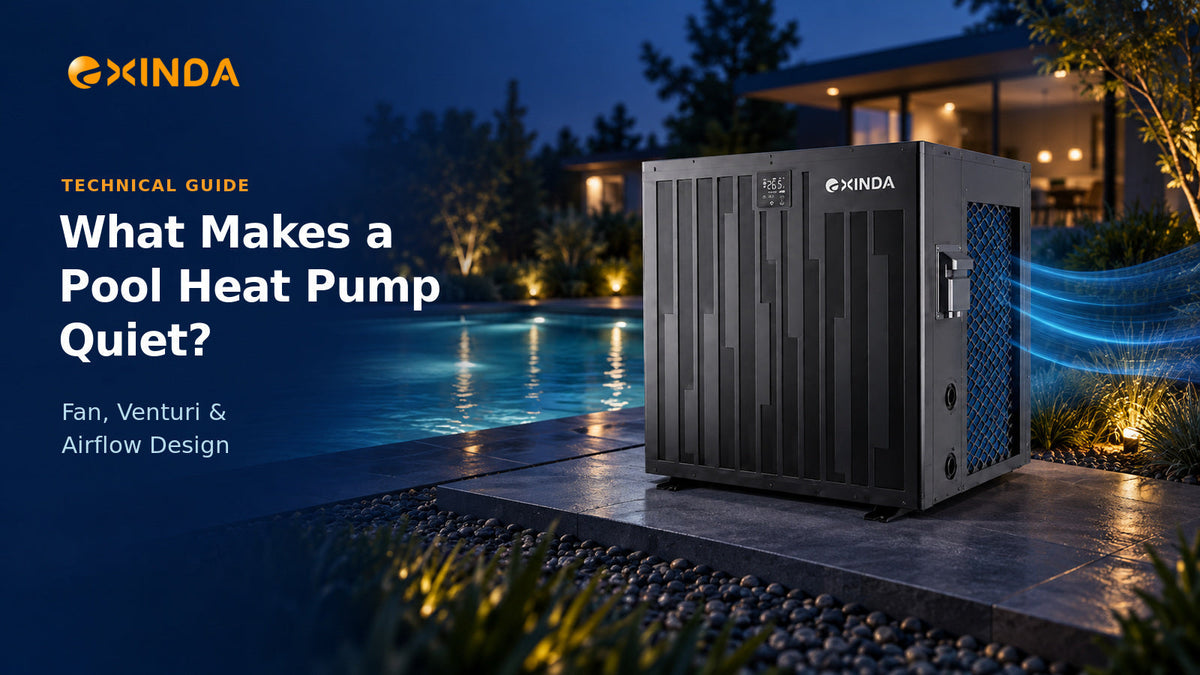
A quiet pool heat pump is not created by adding insulation after the unit has been built. Low-noise operation starts with the complete air system: the fan diameter and speed, blade geometry, Venturi shape, blade-to-Venturi position, coil resistance, protective grille, cabinet airflow path, motor control and installation environment.
For distributors and OEM buyers, this matters because two units with similar published sound values can behave differently beside a pool, wall or patio. EXINDA applies this system-level approach when reviewing its inverter pool heat pumps for North American distribution and OEM projects. The useful question is not simply, “What is the dB(A) rating?” It is: How was the airflow system designed and under what conditions was the sound measured?
What are the main sources of pool heat pump noise?
Pool heat pump sound normally comes from a combination of aerodynamic, mechanical and refrigerant-circuit sources.
| Noise source | What creates it | What buyers should evaluate |
|---|---|---|
| Fan and airflow | Blade loading, tip speed, turbulence, recirculation and flow restrictions | Fan diameter, RPM range, blade profile, Venturi geometry, grille free area and discharge clearance |
| Compressor | Rotation, pressure pulsation and vibration transmitted into the chassis | Compressor control, mounting, piping support and operating frequency |
| Cabinet | Panel resonance and vibration paths | Panel stiffness, fasteners, isolation and structural support |
| Refrigerant circuit | Gas velocity, pressure changes and pipe vibration | Pipe layout, support, operating mode and transient behaviour |
| Installation | Walls, corners, fences and hard surfaces reflecting sound | Clearances, discharge direction, mounting base and distance to occupied areas |
This article focuses on the first category because fan-system design often determines whether sound is a smooth airflow “whoosh” or a more objectionable mix of tonal noise, turbulence and vibration.
Why does fan speed matter so much?
Fan speed affects both airflow and acoustic character. When a smaller fan must rotate quickly to move the required air through the coil and grille, blade-tip velocity rises and aerodynamic noise can become more noticeable. A larger, well-matched fan may deliver the required airflow at a lower rotational speed, but fan diameter alone does not guarantee a quiet result.
The fan must operate at a suitable point for the complete resistance of the unit. If the coil, grille, cabinet opening or discharge path creates excessive resistance, the control may need to increase fan speed to maintain heat transfer. The unit can then use more fan power and generate more noise.
For an inverter pool heat pump, sound should also be reviewed across the operating range—not only at a low-speed marketing condition. Ask for sound data at clearly stated operating conditions and understand how the fan and compressor respond when heating demand, ambient temperature or water temperature changes.
What does the Venturi do in a pool heat pump?
The Venturi, sometimes called the fan ring or shroud, guides air into or out of the axial fan and helps control the pressure field around the blade tips. Its geometry affects how smoothly air approaches the blades, passes through the fan and leaves the cabinet.
A well-designed Venturi generally aims to provide:
-
smooth, rounded transitions rather than abrupt edges;
-
consistent clearance around the blade tips;
-
suitable axial overlap between the fan blade and the ring;
-
sufficient structural rigidity to keep geometry stable;
-
an unobstructed discharge path.
Straight or abrupt inlet and outlet edges can encourage local flow separation. Uneven airflow can load parts of the fan differently, increasing turbulence, vibration and sound while reducing useful airflow. Industry fan guidance describes this broader problem as system effect: actual inlet or outlet conditions disturb the airflow compared with an ideal test arrangement.
How does blade position inside the Venturi affect sound?
Blade-to-Venturi position is a critical design variable, but there is no universal insertion depth that is correct for every fan.
If the blade sits too deep inside the ring, the airflow may interact unfavourably with the shroud and discharge geometry. If it sits too far outside, tip-flow control and pressure recovery may suffer. The result depends on blade chord, pitch, hub geometry, tip clearance, rotational speed and the detailed Venturi profile.
During a design review, engineers may evaluate configurations in which only part of the blade chord overlaps the Venturi—for example, approximately one-third—rather than fully recessing the blade. That proportion should be treated as a prototype variable, not a universal rule. The final position should be confirmed through airflow, input-power, capacity, vibration and sound testing on the complete heat pump.
This is an important distinction for buyers: a visually plausible fan arrangement is not proof of low-noise performance.
Why can airflow restrictions make a pool heat pump louder?
Restrictions increase the pressure the fan must overcome. Common sources include a dense protective grille, insufficient free area, a tight cabinet opening, an obstructed coil, nearby structures and poor discharge clearance.
Uneven or restricted airflow can lead to:
-
higher fan RPM;
-
greater turbulence at the blade and grille;
-
recirculation of discharged air;
-
reduced airflow through part of the coil;
-
additional vibration or tonal sound;
-
lower heat-transfer performance under the affected condition.
This creates a real engineering trade-off. A grille must provide appropriate physical protection, but reducing every opening without checking free area and pressure drop can harm airflow. The complete assembly—not the grille opening alone—should therefore be assessed for safety, airflow, sound and service life.
Can quieter airflow also improve heating performance?
Potentially, yes—but the improvement must be measured. Smoother airflow and lower unnecessary pressure loss can help the fan deliver more uniform air through the evaporator coil for a given operating point. This may reduce the need for excessive fan speed and can support heat-transfer performance.
However, it is not credible to claim a specific capacity, efficiency or noise improvement from a Venturi change without comparative testing. Fan geometry changes can shift airflow, power input and the balance between aerodynamic and mechanical noise. EXINDA therefore recommends evaluating these variables together rather than approving a change from appearance or a single sound reading.
What sound data should distributors request?
A useful supplier review should go beyond one dB(A) number. Request the following information for the applicable model and configuration:
-
Measurement quantity: sound pressure level or sound power level.
-
Test condition: ambient temperature, inlet and outlet water temperatures, operating mode and compressor/fan speed.
-
Measurement position: distance, direction and microphone arrangement.
-
Installation condition: free field, reflective surface, test room or other stated environment.
-
Operating range: sound at low, rated and higher-load operation where available.
-
Acoustic character: whether tonal noise, vibration or cycling behaviour was observed.
-
Complete-unit confirmation: whether the production grille, cabinet, fan ring and control software were installed during testing.
Sound pressure depends strongly on distance and surroundings. Sound power describes the source differently and should not be treated as interchangeable with sound pressure. Buyers should compare like with like under equivalent conditions.
How should a fan and Venturi change be validated?
The strongest validation compares the original and revised assemblies under the same controlled conditions.
| Validation item | Why it matters |
|---|---|
| Air volume and airflow distribution | Confirms that the change does not create dead zones or recirculation |
| Fan RPM and electrical input | Shows whether airflow is being achieved efficiently |
| Sound pressure and, where available, sound power | Quantifies acoustic change under stated conditions |
| Frequency or tonal analysis | Identifies annoying tones that an overall dB(A) value may hide |
| Heating capacity and COP | Checks whether acoustic changes affect thermal performance |
| Motor and electronic-component temperature | Confirms adequate cooling inside the cabinet |
| Vibration at fan, panel and piping locations | Helps distinguish aerodynamic noise from structure-borne noise |
| Multiple operating points | Prevents optimisation at one condition from causing problems elsewhere |
CFD can help engineers visualise separation, recirculation and non-uniform velocity before tooling changes. It should support—not replace—physical tests on a complete prototype.
Why does electronic-compartment airflow also matter?
Airflow design must protect more than the evaporator coil. In inverter equipment, the power electronics also require an appropriate thermal environment. Relocating an electronic control assembly to a better-ventilated and more serviceable area may support cooling and maintenance access, but the change must also consider weather protection, water paths, electrical clearances, wiring length and service safety.
A quiet design should not be achieved by starving another compartment of cooling air or by creating a new water-ingress risk. Thermal measurements at demanding operating conditions are needed before the layout is released for production.
How does installation change real-world pool heat pump noise?
Even a well-designed unit can sound louder when installed in a reflective corner or with inadequate airflow clearance. Walls, fences and hard decks can reflect sound toward occupied areas. Discharged air can also recirculate into the coil if the outlet is obstructed, forcing the equipment away from its intended operating condition.
Installers should follow the model-specific clearance instructions, use a stable and level base, avoid transmitting vibration into lightweight structures, and direct discharge away from walls or neighbouring properties where possible. A top-discharge unit and a side-discharge unit also interact differently with the site, so the installation plan should match the airflow configuration.
What should buyers look for in a low-noise pool heat pump supplier?
Look for a supplier that can explain the design and validation process—not only provide a headline sound figure. For North American distributors and OEM partners, a practical review should cover:
-
model-specific sound data and stated measurement conditions;
-
fan, Venturi, grille and cabinet design review;
-
performance across inverter operating points;
-
airflow and thermal validation after structural changes;
-
access to drawings, submittals and service information;
-
sample evaluation and issue tracking before mass production;
-
spare-parts, training, warranty and technical-support planning.
How does this relate to EXINDA pool heat pumps?
EXINDA’s North American pool heat pump range includes inverter models in approximately 65,000, 96,000, 121,000 and 150,000 Btu/h capacity classes. Available features vary by model and configuration, but the range can include R32 refrigerant, titanium water heat exchangers, Wi-Fi control and North American electrical and safety configurations. Applicable certification status must be confirmed for the exact model and destination market.
For quiet-operation evaluation, EXINDA can work with distributors and OEM partners on the complete airside assembly rather than treating the fan as an isolated component. The review may include fan and Venturi geometry, blade position, protective-grille resistance, cabinet airflow, inverter operating points, internal component temperatures and service access.
This engineering process is especially relevant when a buyer requests a change to the cabinet, grille or fan assembly. A structural change that appears quieter can also affect airflow, power input, heat-transfer performance or electronics cooling. EXINDA therefore recommends confirming the revised production configuration through a controlled sample-validation plan before mass production.
Depending on the selected model and project scope, EXINDA can support:
-
capacity and model selection for the target pool and climate;
-
model-specific technical data and documentation review;
-
sample and revised-structure validation;
-
OEM/private-label product development;
-
distributor training, service planning and spare-parts coordination.
EXINDA positions its pool heat pump programme as a product-and-engineering partnership for North American channel customers—not simply a catalogue supply offer. Final sound, performance and certification claims remain subject to the applicable model documentation and stated test conditions.
Conclusion
A quiet pool heat pump is the result of balanced engineering. Fan diameter and RPM matter, but so do the Venturi profile, blade position, tip clearance, coil resistance, protective grille, cabinet path, control logic and installation surroundings.
The most reliable purchasing decision is based on comparable sound conditions and complete-unit validation. A rounded Venturi or revised blade position may improve airflow, but the real answer must come from measured sound, airflow, power, capacity, temperature and vibration data.
Discuss Your Pool Heat Pump Project
Are you evaluating a low-noise pool heat pump range for distribution, OEM branding or a specific project? Send EXINDA your target pool volume or required Btu/h capacity, destination market, electrical supply, installation layout, expected operating conditions, quantity and certification requirements. EXINDA can recommend the relevant model class and prepare the appropriate technical-document and sample-validation path.
Email: info@exindagroup.com
FAQ
What makes a pool heat pump quiet?
A quiet pool heat pump combines a properly selected fan, moderate operating speed, smooth Venturi transitions, suitable blade position, low airflow resistance, vibration control and correct installation. The published sound value is meaningful only when its test and operating conditions are stated.
Does a larger fan always make a pool heat pump quieter?
No. A larger fan can sometimes deliver the required airflow at a lower RPM, but blade design, motor control, Venturi geometry, resistance and operating point still determine the result. The complete unit must be tested.
What is a Venturi on a pool heat pump?
The Venturi is the shaped ring or shroud around an axial fan. It guides airflow and influences blade-tip flow, pressure recovery, turbulence and sound.
Should the fan blade be fully inside the Venturi?
Not necessarily. The optimum axial position depends on the complete fan and shroud geometry. Partial blade overlap may be evaluated during development, but no single ratio should be applied without prototype airflow, power, vibration and acoustic testing.
Why is my pool heat pump louder at certain times?
An inverter pool heat pump changes fan and compressor speed with operating demand. Higher load, airflow obstruction, coil condition, installation reflections or vibration can change both sound level and tone.
Can a restrictive safety grille increase noise?
Yes. If a grille significantly reduces free area or creates uneven flow, it can increase pressure loss and turbulence. Grille design must balance physical protection with airflow, acoustic and performance requirements.
How should pool heat pump noise levels be compared?
Compare the same acoustic quantity under equivalent conditions. Confirm whether the value is sound pressure or sound power, and check operating mode, fan/compressor speed, measurement distance, direction and test environment.
Can installation make a quiet pool heat pump sound loud?
Yes. Reflective walls, corners, fences, unstable bases and inadequate discharge clearance can amplify or redirect sound and may cause air recirculation. Follow the model-specific installation instructions.