
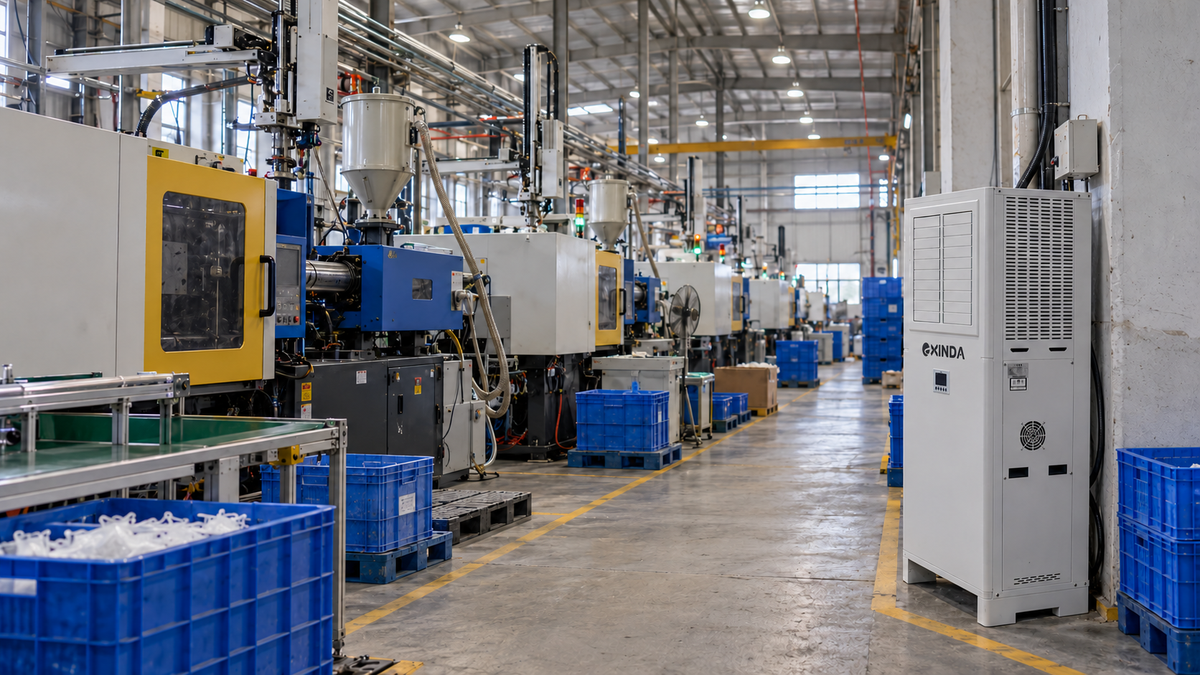
Plastic Injection Molding Factory Cooling Solutions
Plastic injection molding factories often face high indoor temperatures caused by continuous production, heat-generating machinery and inadequate airflow.
For factories in hot climates, maintaining suitable working conditions while managing electricity costs can be challenging, particularly in large workshops with multiple injection molding machines.
Plastic injection molding factory cooling solutions generally involve a combination of process cooling, ventilation and industrial air conditioning. Each serves a different purpose.
This guide explains how to cool injection molding workshops, compare industrial cooling technologies and choose a suitable air conditioning solution for manufacturing facilities.
1. Why Do Plastic Injection Molding Factories Get So Hot?
Injection molding workshops contain several sources of heat that can increase indoor temperatures.
Heat from Injection Molding Machines
Plastic injection molding machines use heating elements to melt plastic materials before injection into molds.
During production, heat can be released from:
-
Heating barrels and processing equipment
-
Hydraulic systems and electric motors
-
Mold temperature controllers
-
Plastic dryers and auxiliary machinery
-
Other production equipment
Even when machines have dedicated process cooling systems, some heat may still be released into the surrounding workshop.
Large Workshop Areas
Plastic manufacturing facilities often have large floor areas, high ceilings and multiple production lines.
Poor roof insulation, solar heat gain and insufficient ventilation can further increase indoor temperatures.
Continuous Production
Many injection molding factories operate extended shifts or continuous production schedules.
This creates a need for cooling equipment capable of supporting the required operating hours and maintaining suitable conditions in occupied working areas.
2. Process Cooling vs Workshop Air Conditioning
One of the most important considerations in injection molding factory cooling is understanding the difference between process cooling and workplace air conditioning.
These systems are designed for different applications.
| Application | Cooling Solution | Main Purpose |
|---|---|---|
| Injection molds | Process chiller or mold temperature control system | Maintain required molding temperatures |
| Hydraulic systems | Process-water cooling | Remove heat from machinery |
| Production workshop | Industrial air conditioning | Reduce indoor air temperature |
| Operator workstations | Spot or localized air cooling | Improve working conditions |
| Factory ventilation | Exhaust and fresh-air systems | Provide air exchange and remove unwanted heat |
Process cooling is not the same as workshop air conditioning.
Process chillers remove heat from injection molding equipment and tooling. Industrial air conditioning systems cool the air surrounding workers and production areas.
A factory may require both systems to support its manufacturing operations.
For further information on machinery cooling, the British Plastics Federation's Process Cooling Guide explains common cooling requirements in plastics manufacturing.
3. What Cooling Systems Are Suitable for Injection Molding Workshops?
Different industrial cooling solutions offer different advantages depending on the building, climate and required indoor conditions.
Industrial Ventilation Systems
Industrial exhaust fans and ventilation equipment help remove accumulated warm air and introduce replacement air.
Ventilation can improve air circulation and help manage heat buildup.
However, ventilation alone may not achieve the desired indoor temperature when outdoor air is hot or internal heat loads are high.
Direct Evaporative Air Coolers
Direct evaporative coolers use water evaporation to cool incoming air.
These systems can be suitable for certain industrial applications, particularly where the outdoor air has relatively low humidity.
However, their cooling capability is limited by outdoor wet-bulb temperature.
Direct evaporative coolers also add moisture to the supplied air, which may be undesirable in some manufacturing environments.
Conventional Industrial Air Conditioning
Conventional direct expansion (DX) air conditioners use a refrigerant-based cooling cycle to remove heat from indoor air.
They can provide mechanical cooling and, under suitable conditions, dehumidification.
For large industrial facilities, the required refrigeration capacity, equipment placement and air distribution should be carefully evaluated.
Hybrid Evaporative-Assisted DX Air Conditioning
Hybrid evaporative-assisted DX systems combine compressor-based refrigeration with evaporative heat-rejection technology.
In EXINDA's industrial water-cooled DX configuration, indoor air is cooled by a refrigerant evaporator.
Heat from the refrigeration system is transferred to circulating cooling water through a water-cooled condenser and then rejected through an outdoor heat-rejection system.
For the wet-curtain configuration, water evaporation and outdoor airflow assist in removing heat from the circulating water.
Unlike direct evaporative air coolers, this arrangement does not use wet curtains to directly cool the indoor supply air.
It provides another industrial air conditioning option for factories evaluating mechanical cooling and evaporative-assisted heat rejection.
4. How Does EXINDA Hybrid Evaporative Air Conditioning Work?
EXINDA's Industrial Hybrid Evaporative Air Conditioner uses a refrigeration cycle, a water-cooled condenser and an outdoor heat-rejection system.
The illustrated wet-curtain arrangement operates through the following stages.
Step 1: Indoor Air Cooling
Warm indoor air passes through the refrigeration evaporator.
The refrigerant absorbs heat from the air, and the supply fan delivers cooled air into the workshop.
When the evaporator surface is below the entering air's dew point, moisture can also condense and be removed through the drainage system.
Step 2: Refrigerant Compression and Condensation
The compressor raises the pressure and temperature of the refrigerant vapor.
The high-temperature refrigerant then enters the water-cooled condenser, where it releases heat to circulating cooling water and condenses.
The refrigerant subsequently passes through an expansion device, reducing its pressure and temperature before returning to the evaporator.
Step 3: Outdoor Evaporative Heat Rejection
The circulating water carries condenser heat to the outdoor heat-rejection unit.
In the illustrated configuration, outdoor air moves through wetted cooling media while a fan helps remove heat and moisture from the outdoor section.
Water evaporation assists the heat-rejection process, lowering the circulating water temperature.
Step 4: Continuous Water Circulation
The cooled circulating water returns to the water-cooled condenser to absorb more heat from the refrigerant.
The process repeats during normal cooling operation.
The key distinction is that the indoor refrigeration evaporator produces the cooled supply air, while the outdoor evaporative section helps reject condenser heat.
The outdoor heat-rejection air and the conditioned indoor supply air remain separate.
System performance depends on indoor cooling loads, outdoor dry-bulb and wet-bulb conditions, condenser-water temperature and the complete system design.
5. Spot Cooling or Whole-Workshop Cooling?
Not every injection molding factory requires uniform air conditioning throughout the entire building.
The cooling approach should reflect actual production conditions.
Whole-Workshop Cooling
Whole-workshop cooling is intended to maintain suitable indoor conditions across larger production areas.
It may be appropriate for:
-
Workshops with multiple occupied production lines
-
Factories where operators frequently move between workstations
-
Manufacturing areas with specified environmental requirements
-
Production spaces requiring relatively consistent indoor conditions
This approach requires an assessment of the overall building cooling load, air distribution and ventilation requirements.
Spot Cooling for Operators
Spot cooling focuses conditioned air on selected working areas instead of uniformly cooling the entire workshop.
Typical locations include:
-
Injection molding machine operating stations
-
Inspection and quality-control areas
-
Product assembly stations
-
Packaging and manual handling areas
For facilities with large open spaces, localized cooling may be considered as part of a targeted workshop cooling strategy.
The effectiveness of either approach depends on equipment placement, airflow distribution and site conditions.
6. Cooling Injection Molding Factories in Southeast Asia
Plastic manufacturing facilities in Vietnam, Thailand, Malaysia, Indonesia and the Philippines often operate in hot and humid environments.
These climate conditions affect industrial cooling system selection.
Outdoor Temperature and Humidity
Direct evaporative air cooling becomes less effective as the available difference between dry-bulb and wet-bulb temperatures decreases.
In evaporative-assisted DX systems, the indoor refrigeration cycle provides the air cooling, but the outdoor heat-rejection process is still influenced by wet-bulb temperature.
Therefore, both indoor cooling requirements and outdoor design conditions must be considered.
Factory Heat Loads
Injection molding workshops can have substantial internal heat gains from machinery and production activities.
Equipment selection should consider the heat actually released into the workshop, including any heat already removed by process-water systems.
Water and Maintenance Requirements
Water-cooled DX systems require appropriate condenser-water circulation and heat rejection.
The installation must consider water quality, filtration, water treatment, drainage, pump requirements and routine maintenance.
For these reasons, industrial cooling equipment should be evaluated using the actual project conditions rather than climate or building area alone.
7. EXINDA Industrial Air Conditioning Solutions
EXINDA provides Industrial Hybrid Evaporative Air Conditioners for factories, warehouses and large industrial spaces.
The product range uses water-cooled DX refrigeration technology with separate condenser-water heat rejection.
Available nominal cooling capacities include:
19.5 kW | 28 kW | 38 kW | 56 kW
EXINDA offers floor-standing and ceiling-suspended configurations with different air-distribution options.
Floor-Standing Louvered Type
Designed for floor-standing installation with adjustable air-discharge direction.
This configuration can be considered for production workshops requiring direct airflow into occupied working areas.
Floor-Standing Long-Throw Jet Type
Designed to deliver conditioned air over longer distances.
It can be considered for larger open workshops where airflow distribution is an important factor.
Ducted Air Supply Type
Designed for projects requiring air distribution through ductwork.
This configuration can be considered when conditioned air needs to reach specific workstations or multiple areas.
Ceiling-Suspended Type
Provides an installation alternative where keeping floor space available for machinery and production activities is important.
Ceiling-suspended models are also available with louvered, long-throw jet and ducted air-delivery configurations.
The appropriate model should be selected according to calculated cooling loads, airflow requirements, condenser-water conditions and installation constraints.
Explore the complete EXINDA Industrial Hybrid Evaporative Air Conditioner Range.
8. How to Select an Industrial Cooling System for a Plastic Factory
Before selecting an industrial air conditioner, factory owners and HVAC contractors should review the following information.
| Project Information | Selection Consideration |
|---|---|
| Factory location | Outdoor temperature and humidity |
| Floor area and ceiling height | Building size and air-distribution requirements |
| Machine quantity and type | Internal equipment heat loads |
| Production operating hours | Required cooling operating schedule |
| Target indoor con |

