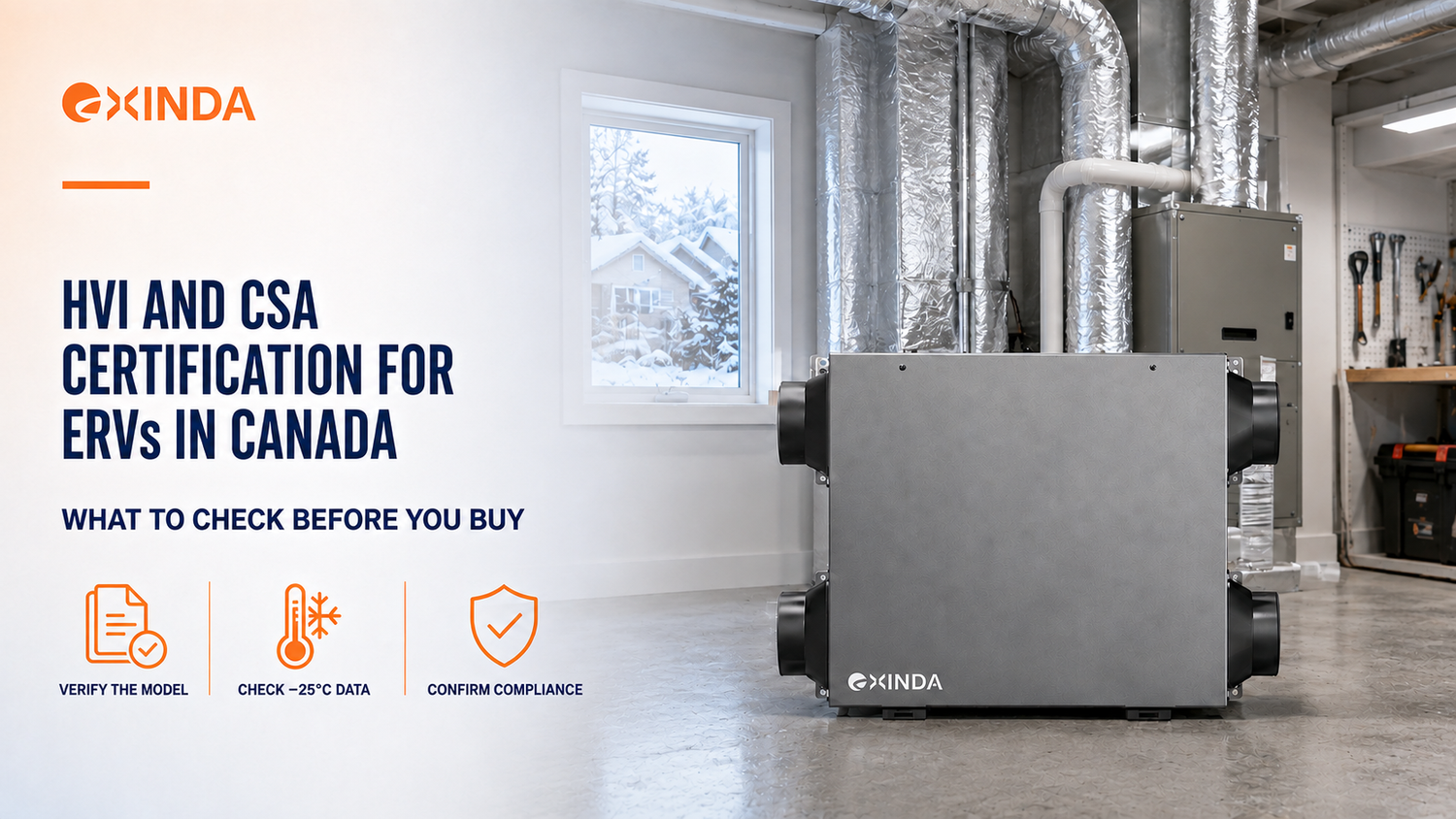
When selecting an ERV for a Canadian home or multifamily project, certification should be checked at the model level—not accepted as a general statement about an entire product series.
HVI ratings help buyers compare independently tested ventilation performance. CSA requirements address a different part of product compliance. Buyers must also verify cold-weather airflow, frost control, external static pressure and electrical certification before making a final selection.
For Canadian builders, HVAC contractors, distributors and mechanical consultants, the following checks can reduce product-selection and installation risks.
What Is HVI Certification for an ERV?
The Home Ventilating Institute, or HVI, provides certified performance ratings for residential ventilation products.
An HVI listing can help verify important ERV data such as:
Net supply airflow
Sensible Recovery Efficiency, or SRE
Energy consumption
Apparent Sensible Effectiveness
Performance at specified temperatures and airflow settings
The exact model number is important. An HVI-certified model does not automatically mean that every ERV made by the same manufacturer has the same certification or performance.
Before purchasing an ERV, compare the model number on the quotation, product label, submittal and HVI listing. Differences in airflow, motor, controller, voltage or product configuration may affect the applicable certification.
What Does CSA Compliance Mean for an ERV?
HVI certification and CSA compliance are not interchangeable.
CSA C439 is a Canadian standard used for laboratory methods of testing the performance of heat recovery ventilators and energy recovery ventilators. A product tested according to CSA C439 has undergone performance testing under defined conditions.
Electrical safety certification is a separate issue. Depending on the product and project, buyers may need to verify an applicable CSA, cUL or cETL certification mark and confirm that the exact model, voltage and controller are covered.
Therefore, buyers should ask two separate questions:
Is the ERV performance tested and listed through HVI using the applicable test standard?
Does the exact electrical configuration carry an acceptable Canadian safety certification?
A statement such as “tested according to CSA C439” should not be treated as proof of electrical safety certification.
Six Items to Check Before Buying an ERV in Canada
1. Confirm the exact certified model
Do not rely only on a product-series name or general certification logo.
Check:
Complete model number
Rated airflow
Voltage and frequency
Motor and controller configuration
HVI listing
Applicable Canadian safety certificate
The supplied unit should match the model shown in the supporting documentation.
2. Check SRE at the correct test condition
Sensible Recovery Efficiency indicates how effectively an ERV recovers sensible heat while accounting for factors such as fan energy and air transfer.
A manufacturer may state an SRE of “up to 75%,” but buyers should still verify:
Which model achieved that rating
The test temperature
The tested airflow
The selected speed
Whether the figure is certified or internally tested
A maximum SRE value should not be assumed to apply at every airflow setting or outdoor temperature.
3. Verify performance at −25°C
Cold-climate operation is particularly important for Canadian projects.
However, “operates at −25°C” does not automatically mean that the ERV maintains its full rated airflow or maximum SRE at −25°C. Buyers should check the HVI data for:
SRE at −25°C
Net supply airflow at −25°C
Power consumption
Frost-control operation
Airflow during the defrost cycle
The required ventilation rate must still be satisfied under the project’s design conditions. This is especially important where provincial, municipal or project specifications require a minimum cold-weather airflow.
4. Review the frost-control sequence
Moisture can freeze inside an ERV core when warm indoor exhaust air meets very cold outdoor air.
An ERV for a cold Canadian climate therefore needs a defined frost-control strategy. Depending on the design, the unit may use recirculation, fan sequencing, airflow reduction, preheating or periodic defrost.
Buyers should ask:
At what temperature does frost control start?
How long does each defrost cycle last?
Does the supply airflow stop or decrease?
How does the unit return to normal operation?
Is the sequence automatic?
A clearly documented frost-control sequence is more useful than a general “cold-climate” claim.
5. Check airflow at the project static pressure
A catalogue airflow value may be measured under a different external static pressure from the actual installation.
Duct length, elbows, grilles, filters and terminals all increase resistance. Buyers should therefore review the airflow performance curve and confirm that the ERV can deliver the required ventilation rate at the project’s calculated static pressure.
An automatic balancing function can simplify commissioning by adjusting the supply and exhaust fans to maintain balanced airflow. It can reduce manual balancing work, but it does not eliminate the need for correct duct design and final airflow verification.
6. Review installation and control requirements
Certification alone does not guarantee a successful installation.
Before purchasing, check:
Top-port or side-port configuration
Unit dimensions and service clearance
Duct connection sizes
Filter access
Drainage requirements
Wall control functions
Operating modes
Noise data
Installation and commissioning instructions
For multifamily developments, access for filter replacement and future servicing should be reviewed before the ceiling or mechanical room layout is finalized.
How EXINDA ERVs Support Canadian Projects
EXINDA offers residential ERVs for single-family homes, condominiums and multifamily applications, with airflow options approximately from 90 to 170 CFM and both top-port and side-port configurations.
Key product features include:
Sensible Recovery Efficiency of up to 75% under applicable rated conditions
Stable operation at outdoor temperatures down to −25°C on applicable models
Automatic cyclic frost-control operation
Automatic airflow balancing to simplify installation and commissioning
Intelligent controls with multiple operating modes
High-efficiency ECM motors for lower energy consumption and quieter operation
HVI certification on applicable models
Product configurations designed to meet applicable CSA requirements
Certification and performance must still be confirmed against the exact EXINDA model selected for the project. EXINDA can provide model-specific submittals, HVI information, cold-weather performance data and applicable compliance documents for technical review.
Why Automatic Airflow Balancing Matters
A balanced ventilation system should supply and exhaust approximately equal quantities of air. Significant imbalance can create unwanted positive or negative pressure inside the building.
Traditional commissioning may require technicians to adjust each fan manually. An automatic balancing system can compensate for differences in duct resistance and help maintain the intended supply-to-exhaust relationship.
For builders and HVAC contractors, this may provide several practical benefits:
Less manual adjustment during commissioning
More consistent airflow between installations
Reduced installation time
Easier adaptation to moderate differences in duct resistance
Better control of building pressure
The final installed airflow should still be measured to confirm compliance with the mechanical design.
Questions to Ask an ERV Supplier
Before placing an order, request the following documents:
HVI listing for the exact model
SRE and net supply airflow at 0°C and −25°C
Airflow data at the required external static pressure
Frost-control sequence
Applicable CSA, cUL or cETL documentation
ENERGY STAR labelling for H/ERVs is available in Canada only. EXINDA is not currently ENERGY STAR listed.
Product submittal and installation manual
Electrical data and wiring diagram
Noise data
Warranty and replacement-parts information
A supplier should be able to connect each performance or certification claim to a specific model and document.
Frequently Asked Questions
Is HVI certification the same as CSA certification?
No. HVI certification covers independently verified ventilation performance. CSA standards may relate to performance-testing methods or electrical safety requirements. The exact documentation must be reviewed to determine what has been tested or certified.
Does an ERV that operates at −25°C maintain full airflow?
Not necessarily. The unit may enter frost-control mode, reduce airflow or alternate its fan operation. Check the certified net supply airflow and SRE at −25°C rather than relying only on the minimum operating-temperature statement.
Is an SRE of 75% considered at every temperature?
No. An “up to 75%” rating represents performance under a particular test condition, model and airflow setting. The −25°C SRE may be different and should be checked separately.
Can automatic balancing eliminate commissioning?
It can reduce manual balancing work, but the installed airflow should still be measured. Duct design, filters, grilles and external static pressure continue to affect system performance.
Are EXINDA H/ERVs ENERGY STAR listed in Canada?
EXINDA is not currently ENERGY STAR listed. Tested to CSA C439-18 — the same standard used for HVI certification and for the ENERGY STAR H/ERV specification. Selected models meet the ENERGY STAR SRE thresholds at both 0 °C and −25 °C. ENERGY STAR labelling for H/ERVs is available in Canada only.
Select an ERV Based on Verified Project Conditions
The correct ERV cannot be selected from maximum airflow or a certification logo alone. Canadian buyers should verify the exact model, certified airflow, low-temperature SRE, frost-control sequence, static-pressure performance and Canadian electrical compliance.
For an EXINDA ERV recommendation, provide the required ventilation airflow, project location, winter design temperature, estimated external static pressure and preferred top-port or side-port configuration. EXINDA can then recommend an appropriate model and provide the corresponding technical and certification documents for review.