
How Hybrid Evaporative Cooling Air Conditioner Works
For large industrial and commercial spaces, traditional air conditioning systems often face challenges such as high energy consumption, limited airflow coverage, and high operating costs.
A Hybrid Evaporative Cooling Air Conditioner provides an alternative cooling approach by combining evaporative cooling technology and DX refrigeration technology in one integrated system.
By using water evaporation as a pre-cooling stage and refrigeration technology for additional cooling performance, hybrid evaporative cooling systems can provide efficient cooling solutions for factories, workshops, warehouses, and other large spaces.
What Is a Hybrid Evaporative Cooling Air Conditioner?
A hybrid evaporative cooling air conditioner is a cooling system that combines two technologies:
- Evaporative cooling
- Refrigeration cooling
Unlike traditional air conditioners that rely only on compressors and refrigerant cycles, hybrid evaporative cooling systems first use water evaporation to reduce incoming air temperature before the air enters the refrigeration section.
This combined approach helps reduce the cooling load on the refrigeration system while maintaining strong cooling performance.
A typical hybrid evaporative cooling system includes:
- Water circulation system
- Cooling pad or evaporative cooling module
- Compressor
- Refrigerant circuit
- Evaporator coil
- High airflow fan system
How Does a Hybrid Evaporative Cooling Air Conditioner Work?
A hybrid evaporative cooling air conditioner works through three main cooling stages.
1. Evaporative Pre-Cooling Stage
The first stage uses water evaporation to reduce the temperature of incoming outdoor air.
The water pump circulates water through the cooling pad or evaporative cooling module. When hot outdoor air passes through the wet surface, part of the water absorbs heat from the air and evaporates.
This process reduces the air temperature before it enters the refrigeration system.
The main benefits include:
- Lower inlet air temperature
- Reduced refrigeration load
- Improved energy efficiency
- Better cooling performance in dry climates
2. DX Refrigeration Cooling Stage
After evaporative pre-cooling, the air passes through the refrigeration cooling section.
The refrigerant system works through a standard refrigeration cycle:
- The compressor compresses the refrigerant.
- The condenser releases heat from the refrigerant.
- The expansion valve reduces refrigerant pressure.
- The evaporator coil absorbs heat from the air.
The refrigerant absorbs additional heat from the air, providing further cooling before the air is supplied into the space.
By combining evaporative cooling and refrigeration cooling, the system can achieve stronger cooling performance compared with pure evaporative cooling systems.
3. High Airflow Cooling Distribution
After cooling, the fan delivers conditioned air into the target area.
Unlike conventional comfort air conditioners designed for small rooms, hybrid evaporative cooling air conditioners are developed for large spaces that require:
- High airflow volume
- Long-distance air distribution
- Large-area cooling coverage
Typical applications include:
- Industrial workshops
- Manufacturing facilities
- Warehouses
- Commercial buildings
- Production areas
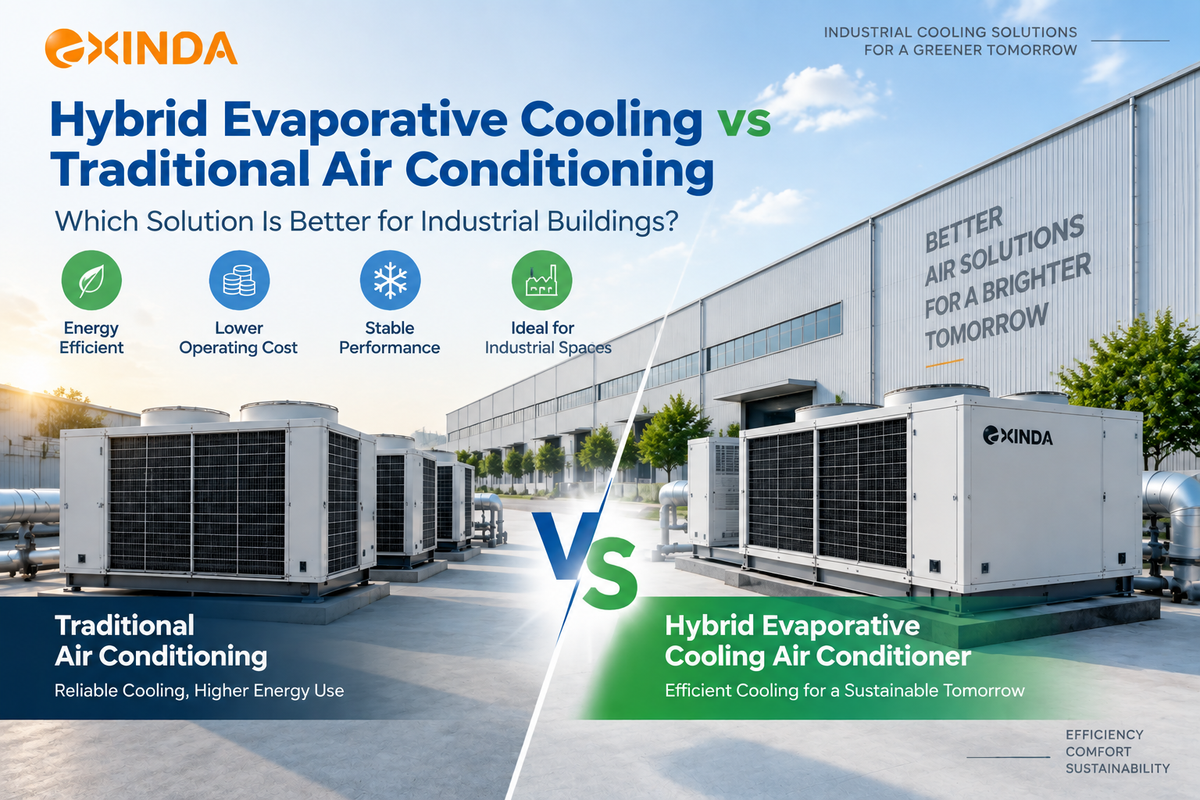
Hybrid Evaporative Cooling vs Traditional Air Conditioning
| Feature | Hybrid Evaporative Cooling Air Conditioner | Traditional Air Conditioner |
|---|---|---|
| Cooling method | Water evaporation + refrigeration | Refrigeration only |
| Main cooling source | Evaporative cooling combined with DX system | Compressor refrigeration system |
| Airflow capacity | High airflow design | Standard airflow design |
| Suitable applications | Large industrial and commercial spaces | Residential and small commercial spaces |
| Energy efficiency potential | Higher through evaporative pre-cooling | Depends mainly on refrigeration efficiency |
| Cooling approach | Large-area cooling | Individual space cooling |
Why Use Hybrid Evaporative Cooling for Industrial Applications?
Industrial buildings often have different cooling requirements compared with residential spaces.
Factories and warehouses usually have:
- Large floor areas
- High ceilings
- Continuous heat generation from equipment
- Large ventilation requirements
A conventional air conditioner may require multiple units to provide sufficient cooling coverage.
Hybrid evaporative cooling air conditioners provide advantages through:
Large Air Volume
High airflow helps distribute cooled air across larger areas and improve overall working conditions.
Energy-Efficient Cooling
The evaporative cooling stage reduces the temperature of incoming air before refrigeration, helping reduce compressor workload.
Long-Distance Air Supply
High-speed airflow allows cooling air to reach areas farther away from the unit, making it suitable for open industrial environments.
Factors Affecting Hybrid Evaporative Cooling Performance
The cooling performance of a hybrid evaporative cooling system depends on several factors.
Outdoor Temperature
Higher outdoor temperatures increase the cooling demand of the building.
Relative Humidity
Evaporative cooling performance is influenced by humidity levels.
Dry air has more capacity to absorb moisture, allowing greater temperature reduction through evaporation.
Airflow Requirement
Large spaces require sufficient airflow to achieve effective cooling distribution.
Building Structure
Factors such as:
- Building height
- Insulation
- Heat sources
- Door opening frequency
will influence the final indoor temperature.
Applications of Hybrid Evaporative Cooling Air Conditioner
Hybrid evaporative cooling air conditioners are suitable for many industrial and commercial applications.
Manufacturing Workshops
Provide cooling solutions for production environments where workers and equipment generate heat.
Warehouses
Improve temperature conditions in large storage areas with high ceilings.
Commercial Spaces
Support cooling requirements for open areas such as exhibition halls and commercial facilities.
Industrial Facilities
Provide energy-efficient cooling solutions for spaces requiring large airflow and continuous operation.
Why Choose EXINDA Hybrid Evaporative Cooling Solutions?
EXINDA focuses on providing integrated climate solutions for global industrial and commercial applications.
With engineering experience in HVAC system development, EXINDA provides:
- Hybrid cooling system solutions
- Industrial air conditioning products
- Customized OEM/ODM support
- Engineering cooperation for different market requirements
EXINDA continues to develop energy-efficient HVAC solutions combining advanced cooling technologies with practical application needs.
Frequently Asked Questions
What is a hybrid evaporative cooling air conditioner?
A hybrid evaporative cooling air conditioner combines evaporative cooling technology with refrigeration technology to provide efficient cooling for industrial and commercial spaces.
Does a hybrid evaporative cooling air conditioner use refrigerant?
Yes. Unlike traditional evaporative coolers, hybrid systems combine water evaporation cooling with a refrigerant-based cooling cycle.
What is the difference between evaporative cooling and traditional air conditioning?
Evaporative cooling uses water evaporation to reduce air temperature, while traditional air conditioning relies mainly on refrigerant compression cycles. Hybrid systems combine both technologies.
Can hybrid evaporative cooling systems work in humid climates?
Performance depends on local temperature and humidity conditions. The refrigeration section helps improve cooling capability compared with pure evaporative cooling systems.
Where are hybrid evaporative cooling air conditioners used?
They are commonly used in factories, warehouses, workshops, production areas, and other large industrial or commercial spaces requiring high airflow cooling.
Conclusion
Hybrid evaporative cooling air conditioners combine the advantages of evaporative cooling and refrigeration technology.
By using water evaporation for pre-cooling and DX refrigeration for additional cooling performance, these systems provide an energy-efficient solution for large industrial and commercial spaces.
For factories, warehouses, and facilities requiring high airflow cooling, hybrid evaporative cooling technology offers a practical approach to improving indoor conditions while reducing cooling energy consumption.
EXINDA provides hybrid evaporative cooling air conditioning solutions designed for global industrial and commercial HVAC applications.