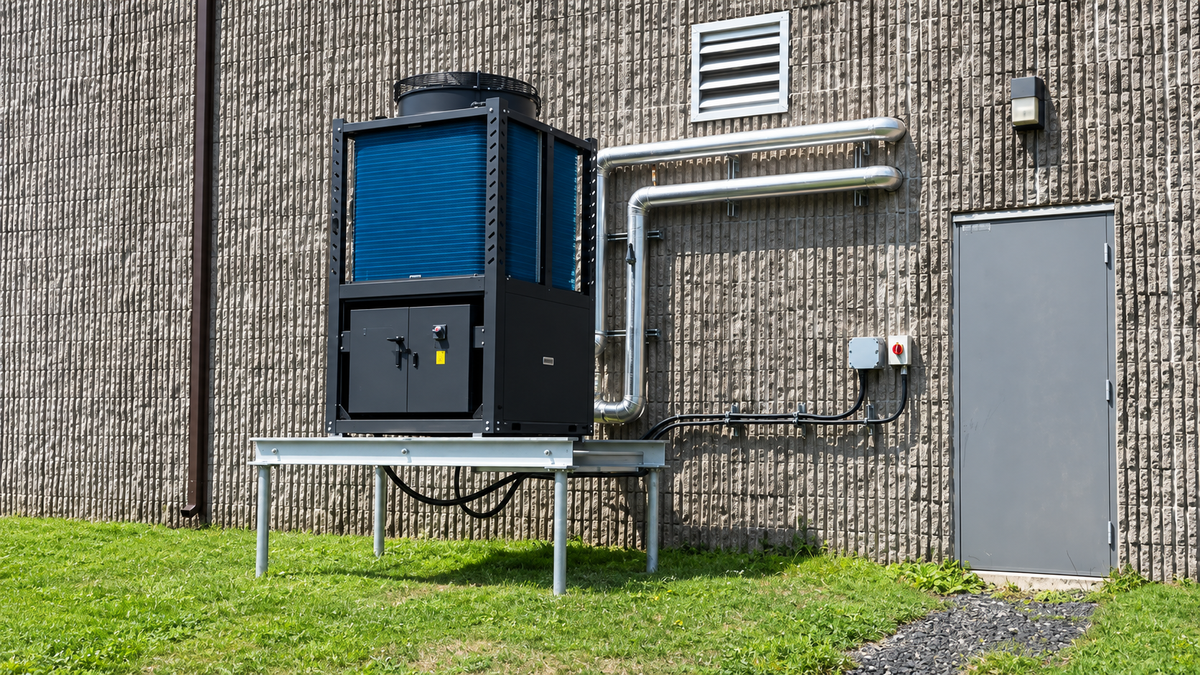
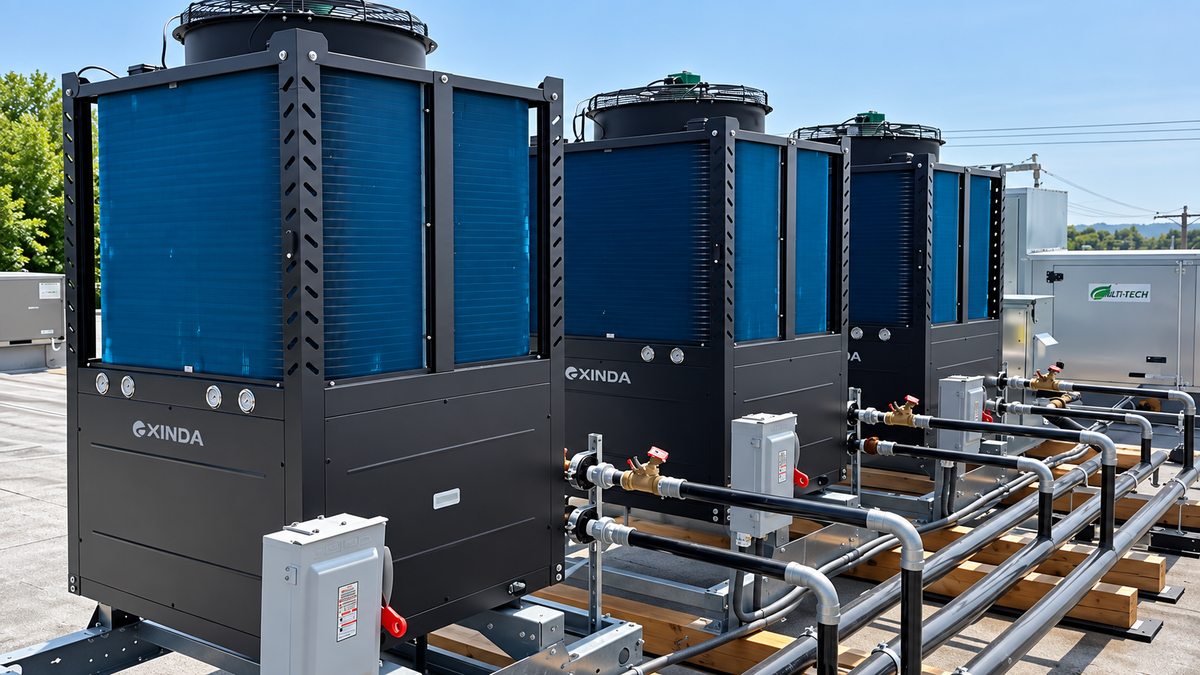
Four EXINDA cold-climate air-to-water heat pump modules operate in parallel on the rooftop of a commercial building in Québec, anchored by a Tim Hortons location. In service since 2024, the system has run through two full heating seasons, maintaining a 45°C return water temperature with leaving water reaching 50°C at the coldest conditions recorded. An electric auxiliary heater is installed and has not been called into operation — including during a three-day cold snap in 2025 that reached −28°C, below the units' published −25°C operating range.
EXINDA FLEX 12 Ton R32 Modular Heat Pump Chiller ↗
The Building
The building runs on a schedule set by its tenants rather than by office hours. Food service opens early and closes late, kitchen equipment adds heat the building did not ask for, and entrance doors open and close all day in a climate where every opening costs something. Demand rises sharply in the early morning, flattens once the space and the equipment are both warm, and does not follow the smooth curve a single-use building would produce.
The heating plant was specified as an all-electric hydronic system from the start. This is not a boiler conversion; there was never a combustion system to fall back on, which is why the heat pumps' behaviour in the coldest weather was the question the design had to answer.
Why the Roof
The modules sit on the roof. In a Québec winter that means snow accumulating around the units, meltwater that can refreeze at the base, and drainage that has to keep working at −25°C. It also means the equipment is exposed for the whole season, with no sheltered plant room moderating anything.
For an operating commercial building, the roof answers the more immediate question of where the plant could go at all — interior floor space is revenue. But it puts every part of the installation under conditions an indoor plant room never sees. The modules are mounted on steel rails over timber sleepers and spring-isolated from the roof deck, with a shared header running the length of the array and an individual disconnect at each unit, so any module can be worked on without shutting down the others. Two winters in that position is a harder result than the same two winters indoors.
Four Modules, Not One
Capacity here is assembled rather than specified as a single block. Four modules share the load, staging up and down with demand instead of cycling one large machine, and any module can be isolated for service while the rest continue to carry the building. The FLEX platform supports up to eight modules in parallel.
This is the other half of the auxiliary-heat result. The system has not needed its backup heater in two winters — and it also has not depended on any single compressor to get there.
What the System Holds
| Recorded | Value |
|---|---|
| Configuration | 4 modules in parallel |
| Heating seasons in service | 2, since 2024 |
| Return water temperature | 45°C, maintained throughout |
| Maximum leaving water temperature | 50°C, at approximately −25°C outdoor |
| Lowest outdoor temperature recorded | −28°C, over three days in 2025 |
| Units' published operating range | down to −25°C (−13°F) |
| Auxiliary electric heat | installed; not called into operation |
| Unplanned shutdowns | None recorded |
The 45°C return temperature is the figure worth reading closely. It did not dip during the cold snap and recover afterwards — it held. The system met the building's load at an outdoor temperature 3°C below what the units are published to operate at, and it did so without help.
Auxiliary Heat: Installed, and Still Waiting
The design included electric auxiliary heat. That was the right decision — in a Québec project with no combustion backup, a second path is what lets a building operate without depending on a single assumption about the weather.
Two seasons later, it has not been needed. Both facts belong in the same sentence: the redundancy exists, and the heat pumps have not required it. A system that never had a backup is a different and less comfortable story than a system whose backup has never been called.
What −28°C Means Here
Québec's winter design temperatures generally fall between −23°C and −27°C depending on location. A −28°C event is therefore beyond design conditions rather than a routine winter reading — and it lasted three days, not three hours. The figure is an on-site thermometer reading taken at the installation.
The units' published operating range extends to −25°C. Operating below that figure is a field observation, not a rated capability, and it should not be read as an extension of the product's specification. What it does show is how the equipment behaves when the weather moves past the envelope: it kept running, and the water temperature held.
Local Support
EXINDA's products in Québec are distributed by SERL (Société d'Expertise en Réfrigération et Climatisation), whose technical team and contractor network provide local service, parts and training. For a rooftop array working through Québec winters, that proximity is part of the result described above.
EXINDA's Quebec distribution partnership ↗
Where This Result Applies — and Where It Doesn't
The 45°C return and 50°C leaving water temperatures in this case are the operating conditions of this building — set by its terminals, its load and its water flow. They are not the rated parameters of the equipment, and another project will arrive at different numbers.
This configuration suits projects where:
- hydronic terminals are sized for supply water in the 45–55°C range
- an all-electric design is intended from the outset, rather than a conversion from higher-temperature radiators
- 575 V or 480 V three-phase power is available
- roof mounting is structurally viable and winter service access can be maintained
- capacity is better assembled from modules than specified as a single machine
It is not the right starting point where existing radiators require higher supply temperatures. Those projects should be reviewed against the FLEX R515B range, which supplies hot water up to 85°C (185°F).
Where a building already has a radiant slab and an existing boiler, the arithmetic changes again: a Montréal project runs a single 12-ton unit at 35°C supply and keeps the original gas boiler as backup, locked out above −25°C — see The gas boiler stayed — it just stopped running above −25°C.
Discuss Your Project
Tell us your winter design temperature, heating load, terminal type and required supply and return temperatures, and we will provide performance data at your project's conditions.
Contact our engineering team ↗
This case study describes a single installation. EXINDA is not affiliated with, endorsed by or sponsored by Tim Hortons or its parent company.