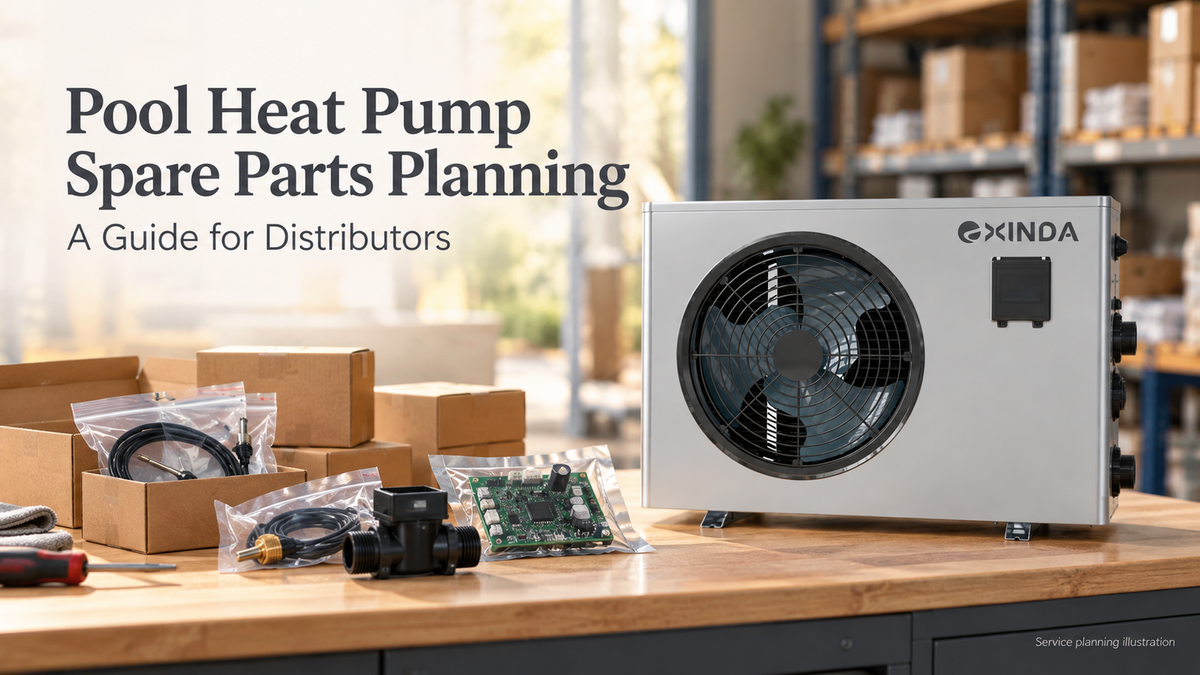
Pool heat pump spare parts planning helps distributors prepare for repairs, control inventory costs and keep customers supported throughout the swimming season. A practical plan considers the models sold, component compatibility, replacement costs and replenishment lead times, together with both warranty and non-warranty service needs.
For distributors evaluating EXINDA pool heat pumps, we recommend reviewing the spare-parts list alongside the proposed model mix and equipment quotation. This makes the service investment easier to assess before placing an order.
Plan for Both Warranty and Non-Warranty Repairs
Customers need access to replacement parts whenever equipment requires repair. The reason for the damage determines how the repair is handled and paid for, while the availability of the correct component affects how quickly service can proceed.
A distributor’s inventory review should therefore consider:
- Components required for approved warranty repairs.
- Replacement parts for accidental damage during handling or delivery.
- Water-side components that may require replacement following inadequate winterization.
- Cabinet panels, grilles and mounting parts damaged during storage or installation.
- Parts needed to support equipment after its warranty period.
Keeping a component in stock does not determine whether a repair qualifies for warranty coverage. Coverage should be assessed separately under the applicable written terms.
Group Pool Heat Pump Spare Parts by Service Need
Different components deserve different stocking decisions. Small electrical parts, major refrigeration components and structural items vary considerably in cost, compatibility and replacement requirements.
The following categories provide a useful starting point.
| Spare Parts Category | Typical Components | Suggested Planning Approach |
|---|---|---|
| Service and control parts | Main control boards, inverter drive boards, display controllers, sensors, flow switches, fan motors, EEVs and valve coils | Prioritize components needed to restore operation. Review quantities against the applicable model population and service experience. |
| Compressors | Compressors matched to the relevant equipment configuration | Review each confirmed compressor platform separately. Consider replacement cost, local repair capability and replenishment time when setting minimum stock. |
| Water-side heat exchangers | Titanium pool-water heat exchangers | Assess stock against the installed model mix and local winterization requirements. Confirm the exact replacement assembly before ordering. |
| Air-side heat exchangers | Finned-tube coils | Consider handling exposure, storage space, protective packaging and replacement lead time. |
| Structural and installation parts | Cabinet panels, air grilles, base pans, fan brackets, terminal blocks and drain accessories | Identify which items should be held locally and which can be replenished when needed. Include appearance-related repairs as well as operational repairs. |
These are planning recommendations. The final list should identify each part and its agreed quantity for the selected models.
Use Stocking Ratios as a Starting Point
A percentage of equipment purchases can help establish an initial service-parts allowance. It becomes useful when translated into an itemized list.
Before applying a ratio, define:
- Which equipment models use the component.
- Whether the calculation uses an individual order or an agreed installed population.
- Whether the allowance applies to each selected part number.
- How whole-piece quantities and minimum stock will be handled.
- How much compatible stock is already available.
For major components, a minimum quantity per confirmed platform may be more practical than a percentage alone. A distributor may choose a higher reserve where replenishment takes longer or seasonal service demand is concentrated.
Review these starting quantities as actual replacement records become available. The aim is to keep useful stock available without accumulating parts that rarely move.
Confirm Parts Prices Before Finalizing Quantities
An equipment-volume forecast alone does not show the cost of supporting a new product line. Distributors should also request an itemized spare-parts quotation.
A useful planning sheet includes:
| Information to Request | Why It Matters |
|---|---|
| Part number and description | Identifies the component clearly |
| Compatible models and production versions | Helps prevent incorrect ordering |
| Unit price and proposed quantity | Makes the opening inventory budget visible |
| Existing usable stock | Helps avoid duplicate purchases |
| Replenishment lead time | Supports minimum-stock decisions |
| Package dimensions and storage requirements | Helps plan warehouse space and transport |
| Replacement instructions or document reference | Supports correct identification and service preparation |
Calculate the initial parts budget from the quoted unit prices and selected quantities, then include applicable freight and handling costs.
For expensive components, also consider the practical cost of replacement, including technician time and any specialist work required. This helps distributors assess the service approach before a repair becomes urgent.
Check Compatibility Before Combining Quantities
Shared components can simplify inventory across several pool heat pump models. Compatibility should be confirmed by part number and the manufacturer’s applicable documentation.
Similar appearance or matching heating capacity is not sufficient evidence that two parts are interchangeable. Control boards may require different software, while compressors, motors and heat exchangers may differ in electrical specifications, connections or configuration.
We recommend maintaining a simple compatibility list that connects each stocked part to the relevant equipment models and production versions. When a component changes, update that list before placing the next replenishment order.
Include Seasonal and Handling Risks
The service environment should influence the inventory mix.
In seasonal pool markets, review winterization guidance and the availability of the corresponding water-side replacement components before the next operating season. For equipment moving through several warehouses or delivery stages, consider access to replacement panels, grilles and air-side coils.
These considerations should guide planning without assuming every damaged item needs replacement. Inspection and diagnosis should establish the appropriate repair first.
Protective storage also matters. Keep replacement components clearly labeled and packaged to prevent damage, especially exposed coils, electronic boards and finished cabinet panels.
Set a Simple Replenishment Process
Opening inventory is only the first step. A workable parts plan also defines when to reorder.
For each stocked item, record the quantity on hand, parts already allocated to repairs, incoming stock and the reorder point. A useful starting method is to cover expected demand during the replenishment period, with an additional reserve suited to the service risk.
Review usage before the main swimming season and after periods of heavier service activity. Separate warranty replacements from accidental damage and other paid repairs so future stock decisions reflect the actual reasons parts are being used.
FAQ
Which pool heat pump spare parts should distributors stock first?
Start with model-compatible components that support timely repairs, such as sensors, flow switches, controllers and control boards. Then assess motors, major components and structural parts according to cost, service requirements and replenishment time.
Is one stocking percentage suitable for every component?
A single percentage is only a preliminary planning tool. Final quantities should account for each component’s compatibility, replacement demand, price and lead time. Major components may benefit from a separate minimum-stock review.
Should spare-parts inventory include non-warranty repairs?
Yes. A service inventory should consider paid repairs and accidental damage as well as warranty work. Payment responsibility and warranty eligibility should be handled separately from the stocking decision.
Can several pool heat pump models share the same spare parts?
Some components may be shared, but compatibility should be confirmed by part number, model and production version. Confirmed common parts can be planned against the combined applicable equipment population.
What should a distributor prepare before requesting a spare-parts recommendation?
Provide the intended model and capacity mix, expected sales volume, service area and existing parts stock. Include any local service priorities so the proposed list can be reviewed against the actual operating conditions.
Plan Your Pool Heat Pump Inventory with EXINDA
Building a new pool heat pump range? Discuss spare-parts planning at the same time as product selection.
Share your target market, expected sales volume and preferred capacity mix with EXINDA to request a model-specific spare-parts recommendation and quotation. Together, we can review compatible components, proposed quantities and replenishment needs to support your local service operation.
Explore EXINDA pool heat pumps, or review the Pool Heat Pump Warranty and Service Guide for questions to address when evaluating supplier support.
Contact: info@exindagroup.com