Introduction
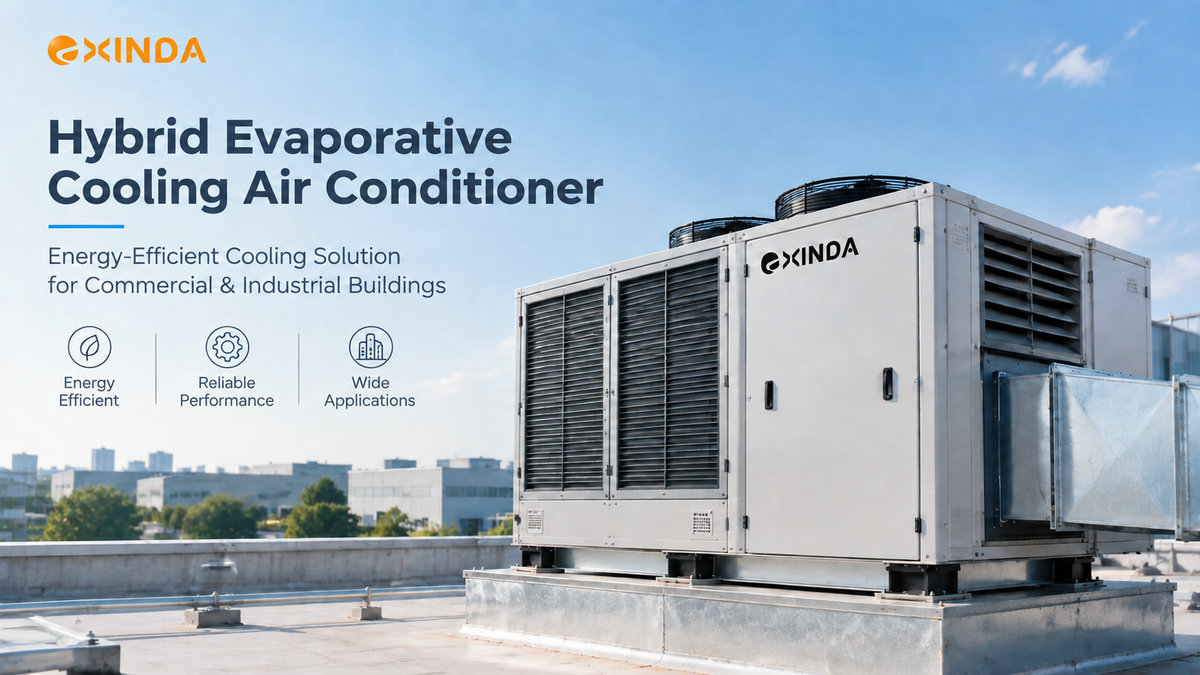
Hybrid evaporative cooling air conditioners are energy-efficient cooling solutions designed for commercial and industrial buildings. EXINDA manufactures hybrid evaporative cooling air conditioners for factories, warehouses, and large-space cooling applications.
Cooling demand continues to increase in commercial and industrial buildings, while businesses are seeking reliable alternatives to traditional air conditioning systems with improved energy efficiency and lower operating costs.
EXINDA develops advanced HVAC solutions incorporating hybrid evaporative cooling technology for commercial buildings, industrial facilities, and large-space cooling applications.
By combining evaporative cooling technology with modern HVAC engineering, hybrid evaporative cooling systems provide energy-efficient cooling solutions with flexible operation under different climate conditions.
What Is a Hybrid Evaporative Cooling Air Conditioner?
A hybrid evaporative cooling air conditioner combines evaporative cooling technology with advanced HVAC engineering to improve cooling efficiency and application flexibility.
Unlike traditional air conditioners that rely mainly on a refrigeration cycle, hybrid evaporative cooling systems utilize the natural cooling effect of water evaporation as part of the cooling process.
The basic cooling principle includes:
- Outdoor air intake and filtration
- Heat reduction through water evaporation
- Additional cooling enhancement when required
- Conditioned air supply to the indoor space
This hybrid approach allows the system to adjust cooling performance according to outdoor temperature, humidity conditions, and building requirements.
How Does Hybrid Evaporative Cooling Technology Work?
A typical hybrid evaporative cooling air conditioner operates through multiple cooling stages to improve cooling efficiency and maintain stable indoor conditions.
Stage 1: Outdoor Air Intake
Warm outdoor air enters the cooling system through the air intake section, where it is filtered and prepared for the cooling process.
Stage 2: Evaporative Cooling Process
Water evaporation absorbs heat from the air, naturally reducing air temperature through evaporative cooling.
This process can reduce reliance on compressor-based cooling and improve overall energy efficiency in suitable climate conditions.
Stage 3: Cooling Enhancement
When additional cooling performance is required, the system can adjust the cooling operation to maintain stable indoor temperature conditions.
Stage 4: Conditioned Air Supply
The conditioned air is delivered into the building through the ventilation system to provide comfortable indoor conditions.
This multi-stage cooling approach helps balance energy efficiency, cooling performance, and indoor comfort.
Hybrid Evaporative Cooling Air Conditioner vs Traditional HVAC Systems
Traditional air conditioning systems and hybrid evaporative cooling systems use different cooling principles. The best choice depends on building type, climate conditions, cooling requirements, and energy efficiency goals.
|
Feature |
Traditional Air Conditioning |
Hybrid Evaporative Cooling Air Conditioner |
|
Cooling method |
Refrigeration-based cooling cycle |
Evaporative cooling combined with additional cooling technologies |
|
Energy efficiency |
Mainly depends on compressor operation |
Improved efficiency through multi-stage cooling operation |
|
Cooling operation |
Refrigeration-based cooling operation |
Flexible cooling operation based on outdoor conditions and cooling demand |
|
Suitable applications |
Residential, commercial, and various building applications |
Commercial buildings, industrial facilities, and large-space applications |
|
Operating cost |
Higher operating costs depending on cooling demand and operating conditions |
Potential for lower operating costs in suitable climate conditions |
Hybrid evaporative cooling is not intended to replace all traditional air conditioning systems. Instead, it provides an alternative solution for projects where energy efficiency, large-space cooling, and operating cost optimization are important considerations.
Advantages of Hybrid Evaporative Cooling Air Conditioners for Commercial Applications
1. Energy-Efficient Commercial Cooling Solution
Hybrid evaporative cooling technology uses natural evaporation as part of the cooling process, helping reduce reliance on compressor-based cooling during suitable operating conditions.
For commercial buildings and industrial facilities with large cooling requirements, improved energy efficiency can help reduce operating costs over the system lifetime.
2. Suitable for Large Spaces and Industrial Applications
Large open spaces often require high airflow volume and stable cooling performance, creating challenges for traditional cooling systems.
Hybrid evaporative cooling systems are suitable for applications including:
- Manufacturing facilities
- Warehouses and logistics centers
- Workshops
- Commercial halls
- Sports facilities
- Large public buildings
3. Flexible Cooling Performance
Outdoor conditions vary throughout the year.
A hybrid cooling system can adjust operation according to:
- Outdoor temperature
- Humidity conditions
- Cooling demand
- Building requirements
This flexibility helps maintain stable cooling performance while improving overall system efficiency.
4. Sustainable HVAC Cooling Technology
With increasing demand for low-carbon buildings and energy-efficient HVAC systems, hybrid evaporative cooling provides an alternative solution for organizations seeking to improve cooling efficiency and reduce environmental impact.
Applications of Hybrid Evaporative Cooling Systems for Commercial and Industrial Buildings
Industrial Buildings
Factories and production facilities often require continuous cooling for:
- Worker comfort improvement
- Manufacturing environment control
- Equipment heat load management
- Maintaining suitable indoor conditions
Hybrid evaporative cooling can provide energy-efficient cooling solutions for large industrial spaces where high airflow and continuous ventilation are required.
Commercial Buildings
Applications include:
- Shopping centers
- Exhibition halls
- Sports facilities
- Large public spaces
- Commercial complexes
The technology helps maintain comfortable indoor conditions while improving cooling efficiency and managing operating costs.
Hot Climate Regions
Hybrid evaporative cooling solutions are particularly suitable for regions where cooling demand is high, including:
- Middle East
- Australia
- Southern United States
- Dry and semi-dry climate regions
Performance depends on local climate conditions, humidity levels, and system design requirements. Hybrid solutions provide greater flexibility compared with traditional evaporative cooling systems.
How to Select a Hybrid Evaporative Cooling Air Conditioner?
Before selecting a hybrid evaporative cooling air conditioner, project engineers should evaluate cooling requirements, airflow design, climate conditions, and installation conditions.
1. Cooling Capacity
The required cooling capacity depends on:
- Building size and layout
- Cooling load calculation
- Occupancy level
- Internal heat sources
Proper cooling capacity selection helps ensure stable performance and avoid unnecessary energy consumption.
2. Airflow Requirement
Airflow volume is a key factor for large-space cooling.
Important parameters include:
- Required airflow volume (m³/h or CFM)
- Air distribution design
- Space height and layout
Proper airflow design helps deliver consistent cooling performance throughout large spaces.
3. Climate Conditions
Evaporative cooling performance depends on outdoor temperature, humidity level, and local climate conditions.
Project location should always be evaluated during system selection to ensure the selected solution matches local operating conditions.
4. Installation Environment
Selection should consider:
- Indoor or outdoor installation requirements
- Available installation space
- Water supply conditions
- Maintenance accessibility
Proper installation planning helps improve system reliability and long-term operation.
Why Choose EXINDA as Your Hybrid Evaporative Cooling Air Conditioner Manufacturer?
As a hybrid evaporative cooling air conditioner manufacturer, EXINDA supports global partners with customized HVAC manufacturing, engineering development, and project-based cooling solutions.
Our engineering capabilities support:
- Customized HVAC product development
- OEM and ODM manufacturing cooperation
- Commercial and industrial cooling projects
- System design support and technical consultation
With HVAC manufacturing experience and international project support capabilities, EXINDA helps customers develop reliable cooling solutions for different market requirements.
Frequently Asked Questions
What is a hybrid evaporative cooling air conditioner?
A hybrid evaporative cooling air conditioner combines evaporative cooling technology with additional cooling methods to improve cooling efficiency, temperature control, and application flexibility for commercial and industrial buildings.
What are the advantages of hybrid evaporative cooling systems?
The main advantages include improved energy efficiency, flexible cooling operation, reduced reliance on compressor-based cooling under suitable conditions, and suitability for large commercial and industrial spaces.
Is evaporative cooling suitable for humid climates?
Traditional evaporative cooling performs best in dry climates because evaporation efficiency decreases when humidity is high. Hybrid systems can improve adaptability by combining additional cooling methods. System selection should consider local climate conditions, humidity levels, and cooling requirements.
Where can hybrid evaporative cooling air conditioners be used?
They are commonly used in factories, warehouses, commercial buildings, logistics facilities, workshops, and other large-space cooling applications.
Can EXINDA provide customized HVAC cooling solutions?
Yes. EXINDA provides OEM, ODM, and customized hybrid evaporative cooling solutions for distributors, contractors, and commercial HVAC project partners worldwide.
Conclusion
Hybrid evaporative cooling air conditioners provide a practical cooling solution for commercial and industrial buildings seeking improved energy efficiency, flexible operation, and reliable cooling performance.
As a hybrid evaporative cooling air conditioner manufacturer, EXINDA develops customized cooling solutions supported by HVAC engineering expertise, manufacturing capabilities, and global project support.
EXINDA works with distributors, contractors, and project developers worldwide to provide customized hybrid evaporative cooling solutions designed for different market requirements.