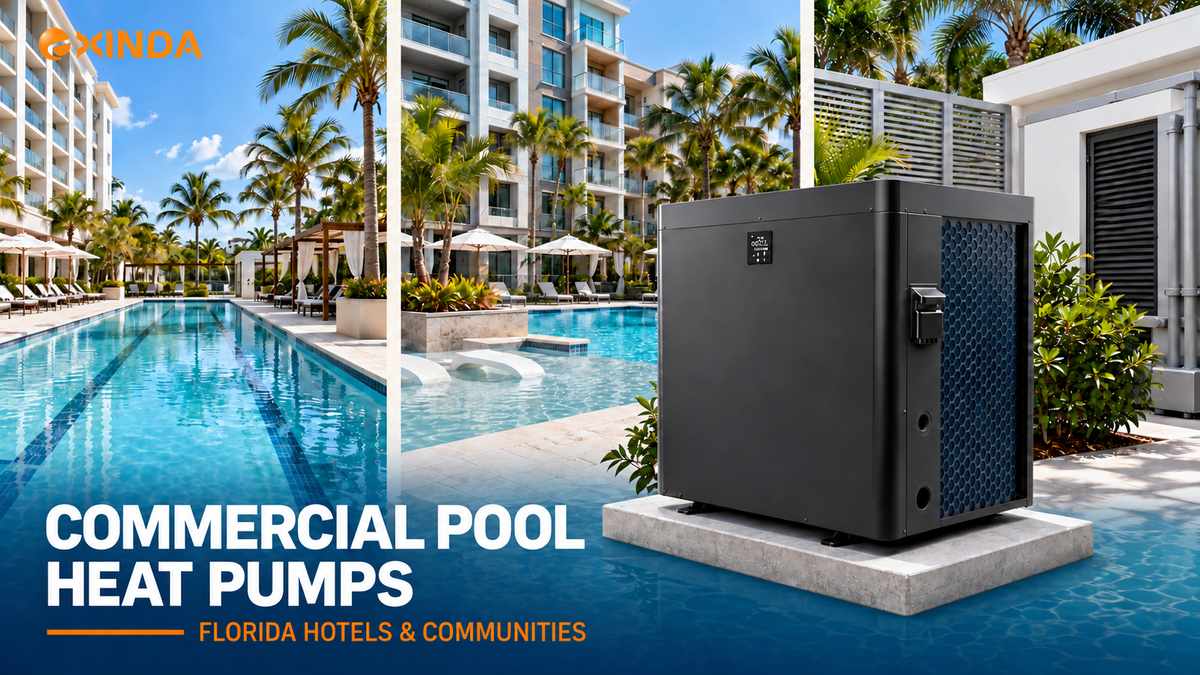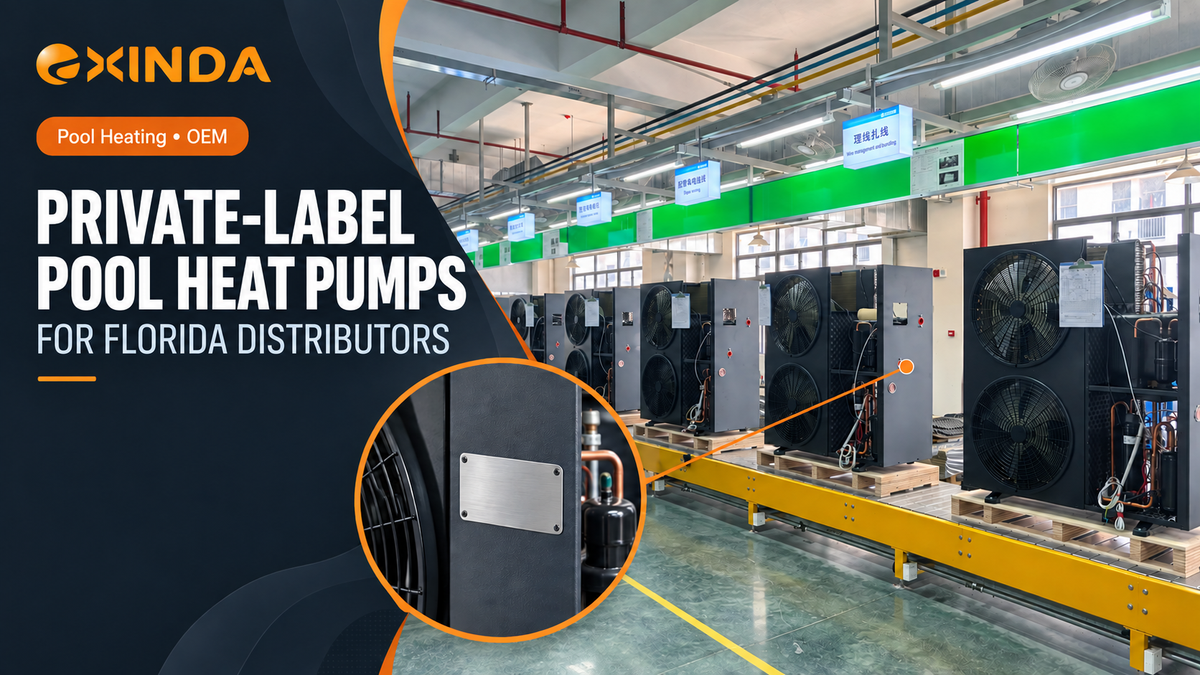
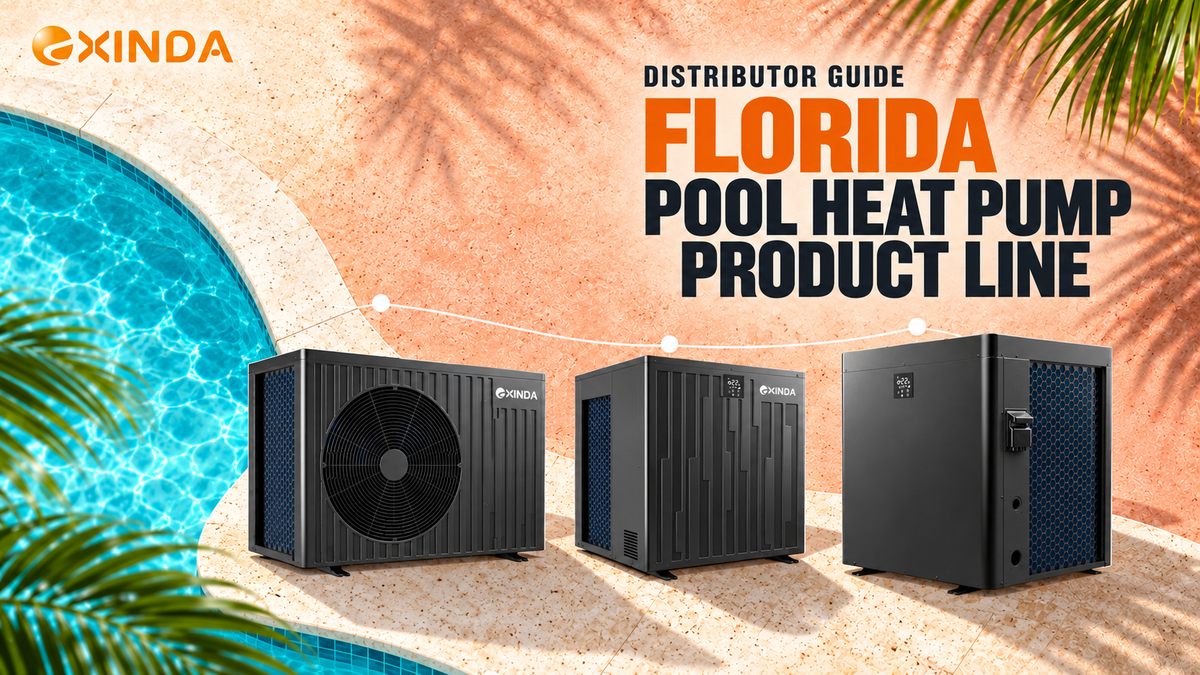
Florida pool heat pump product line planning should start with application coverage, not the number of models in a catalog. For most distributors, a four-capacity lineup can cover a useful range of residential and light-commercial opportunities while keeping inventory, training, and spare-parts requirements manageable. The final unit selection, however, must still be based on the individual pool and operating conditions.
For EXINDA distributors serving Florida, a practical Florida pool heat pump product line starts with 65,000, 96,000, 121,000, and 150,000 Btu/h. These capacities create clear good-better-best selling steps without forcing one model into every project.
Why Build a Florida Pool Heat Pump Product Line?
Florida’s warm climate extends the potential swimming season, but it does not eliminate pool heat loss. Outdoor pools lose heat through evaporation, especially during cooler nights, windy conditions, and periods of low air temperature. Customer expectations also vary: a homeowner maintaining comfortable water temperature has a different requirement from a hotel, community, or fitness facility that needs predictable recovery and operating schedules.
A distributor therefore needs more than a capacity list. The product plan should connect each model with a defined application range, a repeatable sizing process, code documentation, installation support, and the spare parts needed for fast field service.
How Should a Florida Pool Heat Pump Product Line Cover Capacity?
| Capacity tier | Primary sales role | Typical opportunity | Distributor value |
|---|---|---|---|
| 65,000 Btu/h | Entry capacity | Smaller residential pools and space-limited replacements, subject to sizing | Lower inventory commitment and a clear starting option |
| 96,000 Btu/h | Core residential | Mid-size residential applications requiring more heating capacity | Useful middle tier for routine contractor quotations |
| 121,000 Btu/h | High-capacity residential | Larger pools, greater temperature rise, or faster recovery requirements | Bridges standard residential and demanding applications |
| 150,000 Btu/h | Premium / light commercial | Large residential pools and selected light-commercial projects | Supports higher-load opportunities without overloading the core range |
These descriptions are portfolio positions, not automatic sizing rules. Pool volume alone is not enough to select a heat pump.
Use a consistent sizing form before quoting
Every distributor or contractor should collect the same project inputs before recommending a model:
- Pool location and whether the site is inland or coastal
- Surface area, volume, shape, and average depth
- Desired water temperature and expected starting temperature
- Required heat-up or recovery time
- Operating months and daily operating schedule
- Wind exposure, shading, and enclosure conditions
- Whether a pool cover will be used
- Plumbing distance, pipe size, water flow, and equipment-pad layout
- Available voltage, phase, breaker capacity, and installation requirements
Surface area and environmental conditions are especially important because evaporation is a major source of heat loss. A covered pool may need a different heating strategy from an uncovered pool of the same volume. Published capacity and COP must also be compared at the stated rating condition; a headline Btu/h value does not describe performance at every air and water temperature.
How Should a Florida Pool Heat Pump Product Line Balance Inventory?
A first order does not need the same quantity of every capacity. Distributors can place more inventory in the two capacities expected to serve routine residential work, keep a smaller number of entry units for smaller applications, and carry the largest model selectively for higher-load quotations.
A practical launch process is:
- Map historical inquiries. Group recent requests by pool size, desired temperature, property type, electrical supply, and requested recovery time.
- Choose two core capacities. Stock the models that match the largest share of qualified local demand.
- Add one entry and one upper tier. Use them to avoid losing smaller jobs or oversizing every larger application.
- Review sell-through after one season. Adjust the mix using quotations, won orders, lost orders, and service records—not impressions alone.
This approach reduces slow-moving inventory while preserving a credible product range.
What Compliance Documents Does a Florida Pool Heat Pump Product Line Need?
Efficiency and safety documentation should be reviewed at the exact model and configuration level. Florida’s pool-heater provisions include a minimum low-temperature coefficient of performance requirement for heat pump pool heaters, with testing tied to the applicable pool heat pump rating procedure. Distributors should verify the current code edition, local permitting requirements, electrical listing, performance documentation, and the scope of any certification before placing an order or advertising compliance.
Do not treat a family-level brochure statement as proof for every capacity. Keep the certificate or listing, model mapping, electrical data, installation manual, and performance table together in the sales file for each stocked unit.
Build the sales package with the equipment
A strong product line is easier to sell when contractors receive the information needed to specify and install it. Each capacity tier should have:
- A model-specific submittal and performance table
- Dimensions, clearances, water connections, and electrical data
- A quick sizing questionnaire
- Installation and commissioning guidance
- Error-code and troubleshooting information
- Warranty terms and claim procedure
- Parts identification and ordering support
- Product images and contractor-facing marketing material
For coastal applications, the sales discussion should also cover equipment location, drainage, maintenance, exposure to salt-laden air, and the verified corrosion-protection configuration. A titanium water heat exchanger supports pool-water compatibility, but it does not make every external component immune to coastal corrosion.
Standardize controls and service parts
Too many control versions can make a small product line difficult to support. Where possible, distributors should choose a consistent control platform, Wi-Fi option, user interface, error-code structure, and installation workflow across the range.
The initial spare-parts plan should be based on the actual model architecture and service recommendations. Commonly reviewed categories include sensors, flow switches, control boards, user interfaces, contactors or relays, and other replaceable electrical or water-circuit components. Final stocking quantities should be agreed with EXINDA after the model mix and first-order volume are confirmed.
How EXINDA supports a Florida distributor lineup
EXINDA’s North American pool heat pump range includes 65,000, 96,000, 121,000, and 150,000 Btu/h capacity classes. Selected configurations include a titanium heat exchanger, Wi-Fi control, and the documentation required for distributor and contractor review. Exact performance, electrical requirements, certification status, and available options must be confirmed against the current submittal for the selected model.
EXINDA can support distributors with model selection, technical documentation, sample evaluation, installation guidance, troubleshooting, spare-parts planning, and EXINDA-brand or OEM cooperation.
Frequently asked questions
Can a Florida pool heat pump product line include only one size?
One size may cover a narrow customer group, but it can lead to undersizing smaller-capacity models for demanding pools or oversizing larger models for modest applications. A tiered range gives contractors clearer choices while keeping the portfolio manageable.
Is pool volume enough to choose the correct heat pump?
No. Pool volume is only one input. Surface area, target temperature, ambient conditions, wind, cover use, operating season, recovery time, plumbing, and electrical supply also affect the recommendation.
Which capacity should a new distributor stock most heavily?
The answer should come from qualified local inquiry and quotation data. Start with the capacities that match the largest share of residential projects, then adjust the mix after reviewing sell-through and lost-order reasons.
Why is a pool cover relevant to product selection?
A cover can substantially reduce evaporation and heat loss when used correctly. Its expected use should be recorded during sizing rather than assumed.
What should be verified before advertising a model for Florida?
Verify current model-specific performance, the applicable low-temperature COP requirement, electrical safety listing, certification scope, installation instructions, and local permitting requirements. Use the current submittal and official documents for the exact configuration.
Can the 150,000 Btu/h model serve every commercial pool?
No. Some commercial pools may require multiple units or a different engineered solution. Load, operating schedule, redundancy, hydraulic design, and local requirements should be reviewed project by project.
Related Florida Pool Heat Pump Resources
For project-level capacity selection, read the Florida pool heat pump sizing guide for distributors. It explains why pool volume alone is not enough and which operating inputs should be collected before quoting.
Discuss Your Florida Pool Heat Pump Product Line
To build a capacity and inventory recommendation, send EXINDA the target customer type, common pool sizes, typical electrical supply, expected annual volume, preferred brand or OEM format, and required launch schedule.
Email: info@exindagroup.com