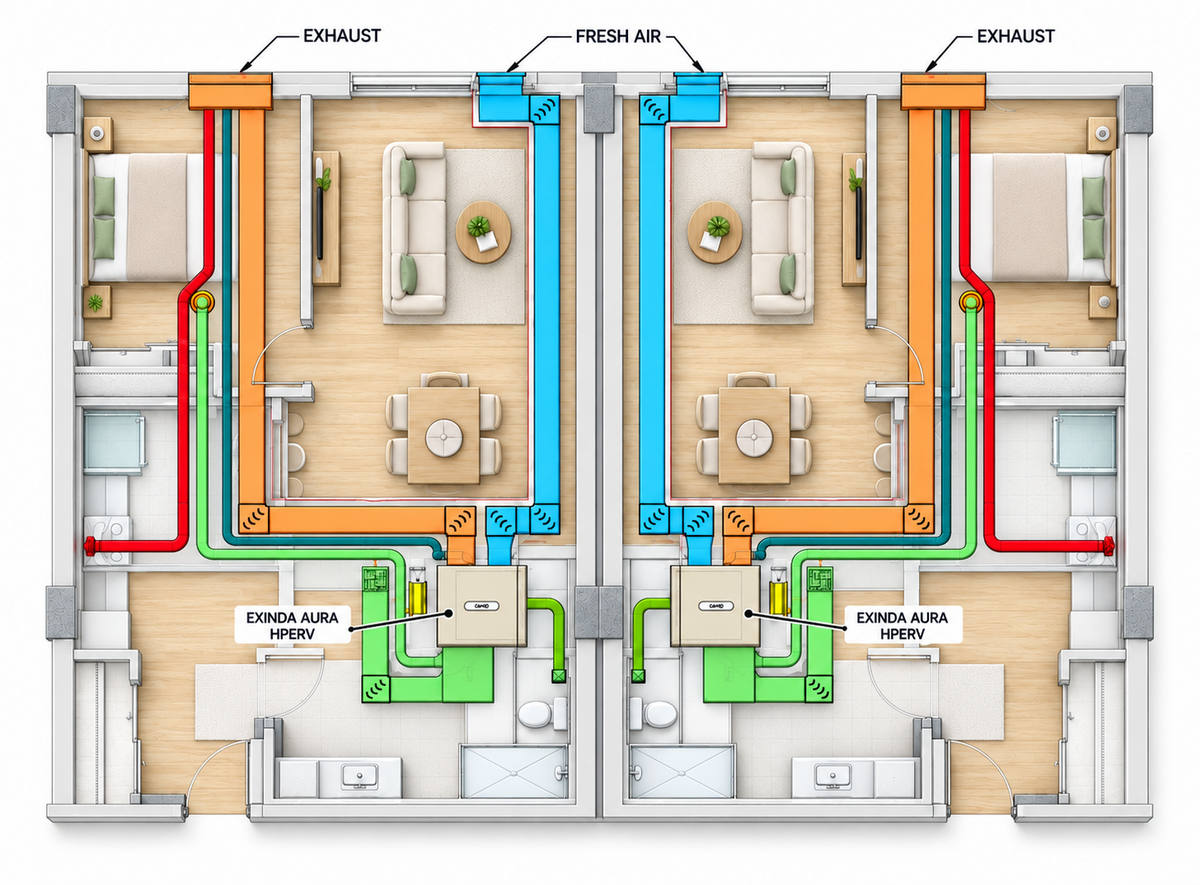

Custom ERV integration allows fan coil manufacturers to add energy recovery ventilation to their equipment with a layout developed around the host cabinet, airflow requirements and control interface. EXINDA offers custom ERV development for manufacturers planning an integrated ventilation option for a new or existing fan coil platform.
For a product team, the practical question is straightforward: Can an ERV fit inside our equipment, deliver the required ventilation airflow and work with our controls?
That is the starting point for an EXINDA customization discussion. Cabinet drawings, available space and operating requirements give the project a useful foundation—even before the complete product specification is finished.
Can an ERV be designed around an existing fan coil?
Yes. An existing fan coil cabinet can be the starting point for a custom ERV design.
This is particularly relevant when a manufacturer wants to add ventilation to an established product range while retaining its cabinet dimensions, installation arrangement or service panel. A standard standalone ventilator may have suitable airflow, but its casing, duct connections or maintenance access may not suit the available space.
A custom development can address those integration requirements together. The objective is to fit the ventilation assembly into the equipment while preserving the functions that already work well: coil access, blower operation, electrical servicing and filter replacement.
For a vertical stack fan coil, for example, the available space needs to be considered alongside water piping, the drain pan, wiring and the route through which a technician will remove components. A ventilation module that fits within the cabinet dimensions still needs enough room to be installed, connected and serviced.
What can be customized?
EXINDA’s ERV manufacturing and OEM/ODM capabilities include custom airflow, controls and casing. For a fan coil integration project, these become specific design decisions:
| Integration requirement | What the custom design needs to address |
|---|---|
| Cabinet space and mounting | Available dimensions, mounting points and assembly access |
| Air connections | Port locations, connection sizes and routing within the host equipment |
| Ventilation performance | Required supply and exhaust airflow at the intended operating resistance |
| Controls and power | Electrical supply, ventilation commands and interaction with the host controller |
| Filters and maintenance | Filter specification, removal direction and access to serviceable components |
These decisions are connected. Moving a connection can improve assembly access but create a tighter internal air passage. Choosing a different filter can change the pressure requirement. Reducing cabinet depth can affect both component selection and maintenance access.
Reviewing these relationships early helps establish a design that the manufacturer can build and support.
Will the ERV deliver its airflow once installed inside the cabinet?
The useful selection point is airflow at the resistance of the intended installation.
For an integrated ERV, that includes the relevant air passages inside the host equipment as well as the external duct system. Filters, transitions, grilles and bends all contribute to the resistance that the fans must overcome.
The design review should distinguish the four air connections: outdoor air entering the ERV, ventilation supply air leaving it, indoor extract air entering it and exhaust air discharged outdoors. Their routes and connection pressures need to be understood before the assembly layout is finalized.
This matters when comparing a standalone unit with a custom module. A published airflow figure cannot establish performance in a different cabinet by itself. The development target should state the required supply and exhaust airflow, the applicable pressure conditions and the filter configuration.
For manufacturers serving North America, Europe, Australia or New Zealand, that target can be provided in CFM, L/s or m³/h, with the corresponding pressure units. The intended market, electrical supply and test requirements should accompany it.
How will ventilation work with the fan coil controls?
The first decision is whether the ventilation air uses the fan coil blower for distribution.
Where the design relies on that blower, the ERV and host controller need a coordinated operating sequence. Ventilation may need to run when there is no heating or cooling demand. A temporary ventilation boost may also need to return to the previous operating state when it ends.
Those functions should be agreed as part of the integration design, alongside the electrical interface. This avoids leaving installers to interpret how two independently developed controllers are supposed to work together.
EXINDA’s existing guide to ERV interlock and fan coil blower control explains the interlock considerations in more detail. For a custom product, the final sequence is developed around the host controller and the intended user experience.
Should the project start with a complete ERV or an integrated module?
Start with how the manufacturer wants to assemble and service the finished equipment.
A separately housed ERV can suit a product where space allows an accessible ventilation section. A more closely integrated module can suit a platform where cabinet dimensions and connection positions are already established.
If the manufacturer intends to retain responsibility for its own casing, controls or air-moving components, identify that scope at the beginning. EXINDA can then assess the requested development and supply arrangement. Individual component supply should be confirmed against the project’s actual requirements.
This gives both engineering teams a clear division of work and gives purchasing a defined basis for quotation.
What should be verified before production?
The most valuable evidence is performance from the agreed integrated configuration.
A sample review should demonstrate that the assembly fits, its connections are accessible, filters can be removed and the controls behave as intended. Performance verification should address airflow, pressure, recovery performance, electrical input and sound under defined conditions.
For a product intended for several markets, identify the required approvals and testing early. Changes to the enclosure, fans, filters or controls can affect which existing results remain applicable and what needs further evaluation.
The result should be a product specification that engineering, purchasing and production can all use.
Discuss your fan coil platform with EXINDA
If you are adding energy recovery ventilation to a fan coil range, send EXINDA your cabinet drawing or 3D model and the space available for the ERV.
Include your target ventilation airflow, expected pressure resistance, electrical supply and preferred control arrangement. If some of those inputs are still open, identify them—we can begin with the information already available.
Also tell us the intended market, estimated annual quantity and target sample date. These help frame the development scope and commercial discussion.
Contact info@exindagroup.com to discuss custom ERV integration for your equipment.
Frequently asked questions
Can we start without a finished ERV specification?
Yes. Share the host cabinet drawing, available space and ventilation objective. The initial discussion can identify the remaining design inputs.
Is customization limited to branding and casing color?
No. EXINDA offers custom ERV development addressing airflow, casing and controls. A fan coil integration project translates these into an equipment-specific layout and interface.
Can the same custom ERV be used across several fan coil models?
A shared module can be a development objective. Compare the available space, airflow requirements, connection positions and control interfaces across the models to establish where a common design is practical.