Written for the mechanical engineer and the design-build contractor on a new commercial building that will have no gas service, and for the owner's engineer weighing a four-pipe heat pump against a two-pipe heat pump with electric or gas backup.
The building that needs heating and cooling at the same time
An office with a glazed perimeter and a deep interior: the interior zones call for cooling most of the year while the perimeter calls for heat on a winter morning. A school with a data room, a kitchen and classrooms on the shaded side. A hotel that makes domestic hot water all day while the guest rooms are cooled. A hospital or lab with reheat coils on every air handler. In all of these the loads overlap for most of the operating hours, and an all-electric plant has to serve both without a boiler.
A two-pipe reversible heat pump can only be in one mode at a time, so the plant either runs two machines or adds electric heat. A four-pipe heat pump moves heat from the chilled-water side to the hot-water side inside the unit and only goes to the outdoor coil for the difference. Specifications describe it as an air-to-water inverter scroll heat pump, four-pipe, with simultaneous heating and cooling and load balancing through the air-source coil.
How the specification reads
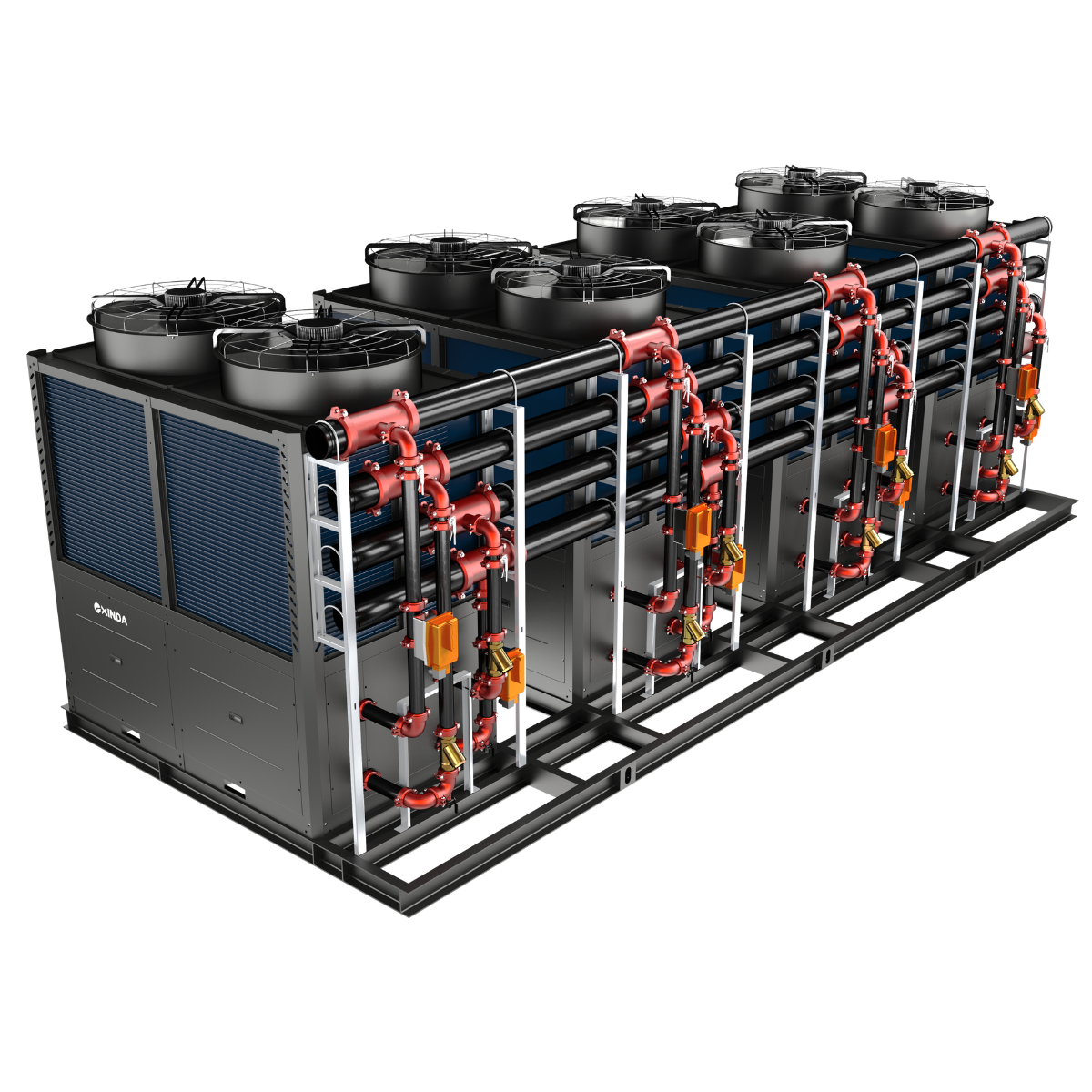
- Air-cooled, outdoor, self-contained; each unit with inverter scroll compressors, a chilled-water heat exchanger, a hot-water heat exchanger, air-source coils and a microprocessor control panel in one frame
- Four-pipe operation: cooling only, heating only, simultaneous heating and cooling, with automatic changeover between them as the loads move; defrost when the air-source coil is working as an evaporator
- Low-GWP refrigerant (R-454B) in independent circuits
- Modular: several units on one hydronic system under one control group, with capacity staged across them
- Hot-water temperature and heating capacity stated at the winter design ambient, not only at 47°F
- Building-automation interface for scheduling and setpoints
How the simultaneous mode is rated
Three sets of numbers describe a four-pipe unit and they should be read separately. Cooling-only capacity at 95°F ambient with 54/44°F entering and leaving chilled water; heating-only capacity at 47°F ambient with 105°F leaving hot water; and the simultaneous rating, cooling and heating delivered at the same time with the combined COP that results from serving both loads from one compressor input. The simultaneous COP is the figure that decides the plant's annual energy; the cooling-only and heating-only ratings size the unit for the two peaks.
EXINDA FLEX 40 Ton four-pipe: the rated data
Model FBMBHTF4B2C5, North American configuration, 208 / 460 / 575 V, 3 Ph, 60 Hz. Two independent R454B circuits with dual DC inverter scroll compressors and separate cooling and heating heat exchangers.
| Mode | Condition | Capacity |
|---|---|---|
| Cooling only | 95°F ambient, 54/44°F water | 35 Ton |
| Heating only | 47°F ambient, 105°F leaving water | 40 Ton |
| Simultaneous | Rated conditions per submittal | 34 Ton cooling and 48 Ton heating, combined COP up to 8.2 |
Hot water to 140°F at ambients of −4°F and above, and to 130°F between −13 and −4°F. Cooling operation from −4 to 110°F; heating operation from −13 to 100°F. Stepless inverter capacity control, intelligent defrost and freeze protection, cascade control for up to eight units on one system, and BMS integration. The 575 V submittal and the Revit family are on the product page. CSA certified; AHRI certification in progress.
Selecting for the building
- Office. Size the cooling-only rating to the summer peak and check the winter morning: perimeter heating with interior cooling is the simultaneous case, and the 105°F hot water suits fan-coil and reheat coils sized for low-temperature heating.
- School. The heating-only rating at the design ambient governs; check the 130°F hot-water limit between −13 and −4°F against the coil selection and add units in cascade rather than oversizing one.
- Hotel. Domestic hot water is the constant heating load; the simultaneous mode makes it from the guest-room cooling for most of the year. Confirm the 140°F ceiling against the storage-tank setpoint and any legionella control regime.
- Healthcare and labs. Reheat is the simultaneous load; the combined COP is what the energy model should carry, not the heating-only COP.
Confirm the electrical service first: the 575 V configuration is the usual choice for Canadian projects and is the version the published submittal covers.
What to send for a selection
- Project location and winter and summer design temperatures
- Peak cooling load, peak heating load and the estimated hours of overlap
- Chilled-water and hot-water design temperatures
- Electrical service voltage
- Space available for the outdoor units and the number of units planned
Send it to info@exindagroup.com or through the contact page. The reply is the unit count, performance at the project conditions in the three modes, the submittal for the project voltage and the Revit family.