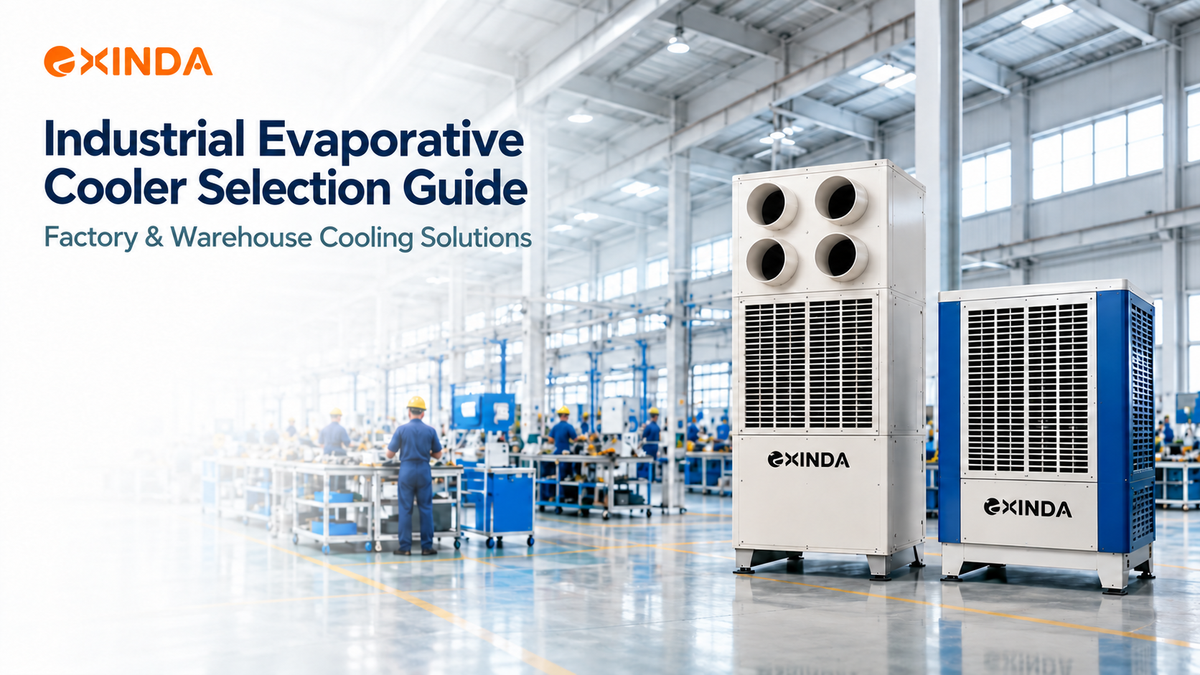
Industrial Evaporative Cooler Selection Guide for Factories and Warehouses
Industrial facilities such as factories, workshops and warehouses often face challenges caused by high temperatures, equipment heat generation and insufficient air circulation. Choosing the right cooling solution is essential for maintaining a comfortable and productive working environment.
What Is an Industrial Evaporative Cooler?
An industrial evaporative cooler is an efficient cooling solution designed for factories, warehouses and large commercial spaces where traditional air conditioning systems may require high installation and operating costs.
Unlike conventional air conditioning systems that mainly cool enclosed rooms, an industrial evaporative cooler uses evaporative cooling technology and high-volume airflow to reduce heat while improving ventilation across large open areas.
By combining cooling, fresh air movement and energy-efficient operation, industrial evaporative cooling systems provide an economical solution for applications where large-scale cooling is required.
Why Choose Industrial Evaporative Cooling for Large Spaces?
Traditional air conditioning systems can become expensive when applied to large industrial buildings due to:
- Large cooling loads
- High electricity consumption
- Complex ductwork requirements
- Higher maintenance costs
For factories and warehouses with open layouts, cooling the entire building with conventional AC may not always be the most practical approach.
An industrial evaporative cooler focuses on:
- High airflow circulation
- Direct cooling for occupied areas
- Improved ventilation
- Lower energy consumption
This makes it suitable for many industrial and commercial environments.
How to Select the Right Industrial Evaporative Cooler
Choosing the correct cooling system requires evaluating several factors, including cooling capacity, airflow requirements, installation conditions and the operating environment.
1. Evaluate Your Cooling Requirements
Before selecting an industrial cooling system, consider:
- Building size
- Ceiling height
- Indoor heat sources
- Number of workers
- Equipment heat generation
- Required operating hours
Different industrial environments have different cooling requirements.
For example:
Manufacturing Workshops
Production equipment may generate significant heat. Cooling solutions should provide:
- Strong airflow circulation
- Continuous operation capability
- Improved worker comfort
Warehouses and Logistics Centers
Large warehouses often require:
- Wide-area airflow coverage
- Heat reduction in open spaces
- Efficient operation during long working hours
Commercial and Agricultural Facilities
Applications such as processing areas and large commercial spaces may benefit from:
- Fresh air circulation
- Temperature reduction
- Lower operating costs
2. Select the Correct Cooling Capacity and Airflow
Industrial evaporative coolers are selected according to cooling capacity, airflow volume and application requirements.
Choosing the correct industrial evaporative cooler model helps ensure efficient cooling performance and stable operation.
EXINDA XDZFL series provides multiple capacity options:
| Model | Cooling Capacity | Maximum Airflow |
|---|---|---|
| XDZFL-19LS | 19.5 kW | 5,500 m³/h |
| XDZFLB-28LS | 28 kW | 6,500 m³/h |
| XDZFLB-38LS | 38 kW | 7,500 m³/h |
| XDZFLB-56LS | 56 kW | 12,000 m³/h |
The correct model depends on:
- Cooling area
- Air exchange requirements
- Building structure
- Local climate conditions
A larger capacity unit is not always the best choice. Proper system selection helps achieve better cooling performance and operating efficiency.
3. Consider Airflow Distribution
For large industrial spaces, airflow distribution is as important as cooling capacity.
A suitable industrial cooling system should provide:
High Air Volume
Large airflow helps:
- Move hot air away from working areas
- Improve indoor air circulation
- Reduce heat accumulation
Wide Cooling Coverage
Proper installation and airflow planning can help:
- Reduce temperature differences
- Improve worker comfort
- Create a more stable working environment
4. Check Installation Requirements
Before selecting equipment, consider the installation environment.
Power Supply
Industrial cooling equipment normally requires three-phase AC power.
Example:
380V AC / 3Phase + Neutral / 50Hz
Water Supply
The evaporative cooling process requires a stable water supply.
Different models use different water pipe sizes:
- DN25
- DN32
- DN40
- DN50
Installation Location
Depending on project requirements, systems can be installed in:
- Factory workshops
- Warehouses
- Production areas
- Commercial buildings
Industrial Evaporative Cooler vs Traditional Air Conditioning
Understanding the difference between cooling solutions helps customers select the right system.
| Item | Industrial Evaporative Cooling | Traditional Air Conditioning |
|---|---|---|
| Cooling Method | Evaporative cooling technology | Refrigeration cycle |
| Energy Consumption | Lower operating energy | Higher power demand |
| Airflow Volume | High airflow circulation | Lower airflow volume |
| Large Space Application | Suitable for open areas | Higher installation investment |
| Ventilation Effect | Fresh air circulation | Mainly recirculated air |
For large open industrial spaces, evaporative cooling can provide an efficient alternative where full-building air conditioning may not be economical.
Applications of Industrial Evaporative Cooling Systems
Factory Cooling
Industrial evaporative cooling systems are widely used in:
- Manufacturing plants
- Assembly workshops
- Machinery production areas
- Automotive facilities
Benefits include:
- Improved workplace comfort
- Better airflow circulation
- Reduced heat stress
Warehouse Cooling
Warehouses often experience heat accumulation due to:
- Large building volume
- Limited natural ventilation
- Continuous material handling activities
An industrial evaporative cooler can provide:
- High-volume airflow
- Large-area cooling coverage
- Efficient temperature management
Other Commercial Applications
Suitable applications include:
- Logistics centers
- Processing facilities
- Agricultural buildings
- Large workshops
- Industrial service areas
Why Choose EXINDA Industrial Cooling Solutions?
EXINDA develops and manufactures industrial cooling solutions for commercial and industrial applications.
The XDZFL series provides:
- Cooling capacity from 19.5kW to 56kW
- Maximum airflow up to 12,000 m³/h
- Industrial-grade construction
- Multiple model options
- OEM and ODM manufacturing capability
With engineering experience in HVAC equipment, EXINDA supports project selection, product customization and international distribution.
Conclusion
Selecting the right industrial evaporative cooler requires more than checking cooling capacity.
A suitable solution should match:
- Building size
- Cooling demand
- Airflow requirements
- Installation conditions
- Operating environment
For factories, warehouses and large commercial spaces, properly selected evaporative cooling systems can provide efficient airflow management and economical temperature control.
EXINDA industrial cooling solutions help businesses create more comfortable and productive working environments with reliable industrial cooling technology.
Related Products
- EXINDA Industrial Evaporative Cooling Air Conditioner
- Hybrid Evaporative Cooling Air Conditioner vs Traditional AC
- How Does an Industrial Evaporative Cooling Air Conditioner Work?
- EXINDA Industrial Cooling Manufacturer