Airtight construction has made mechanical ventilation unavoidable in North American homes, and the first decision on the mechanical schedule is usually ERV or HRV. Both recover energy from the exhaust stream. They differ in one respect — whether moisture moves across the core — and that single difference decides which one suits a climate.
What the two do differently
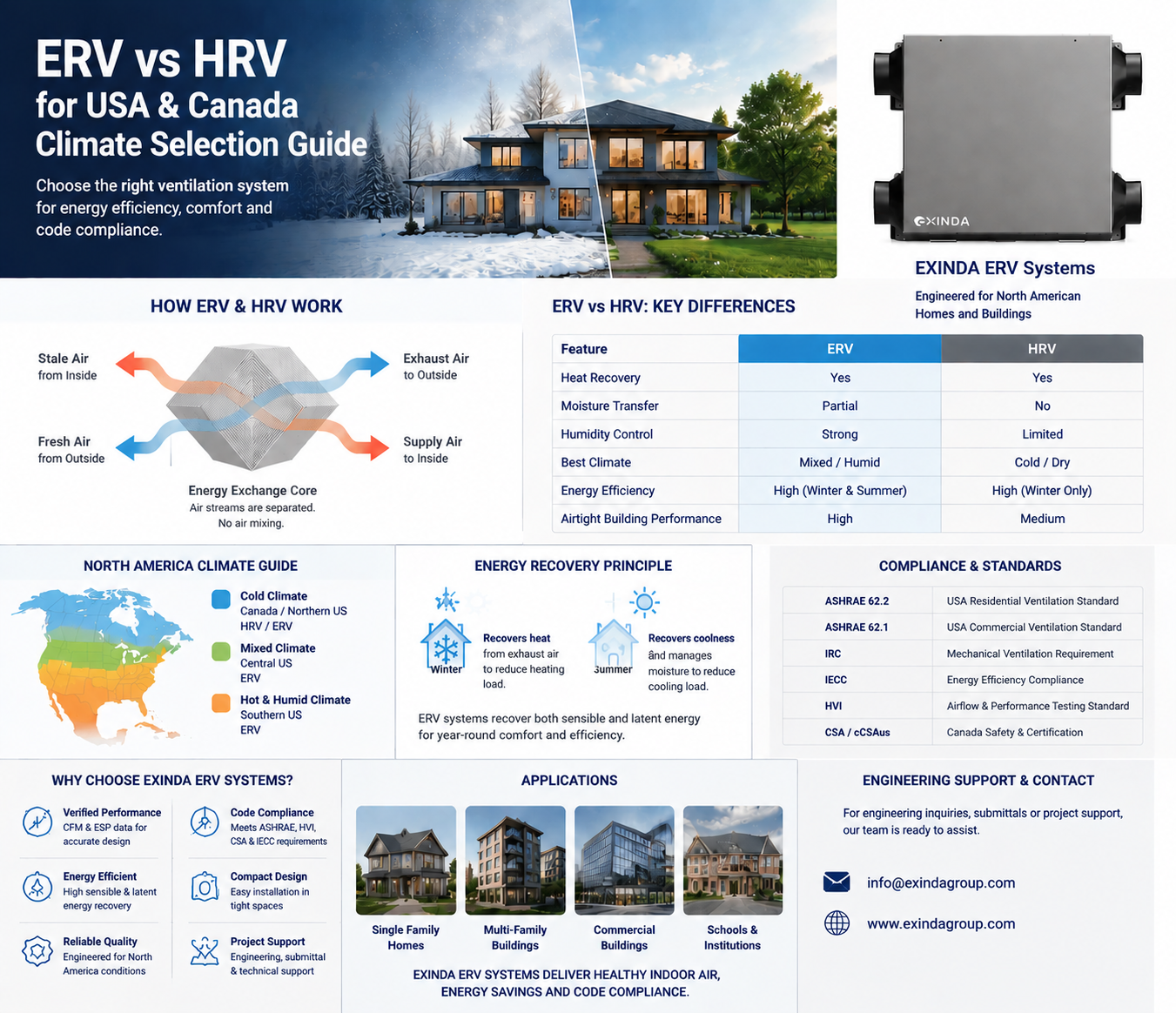
Supply and exhaust stay fully separated in both. Both pass through a recovery core that preconditions incoming air, so the heating or cooling plant sees a smaller load. An HRV moves sensible heat only. An ERV moves heat and part of the moisture.
| Feature | ERV | HRV |
|---|---|---|
| Sensible heat recovery | Yes | Yes |
| Moisture transfer | Partial, through the core | None |
| Summer latent load | Reduced | Not reduced |
| Winter indoor humidity | Retains some moisture indoors | Dries the house further |
| Condensate drain | Often not required | Normally required |
The drain row matters more on site than most specifications admit. All five EXINDA Breeze models are listed with no condensate pipe connection, which removes a drain run, a trap and a freeze risk from every suite in a multifamily building. Confirm it against the model submittal before the mechanical layout is fixed.
Which one for which climate
| Climate | Region | Usual choice | Reason |
|---|---|---|---|
| Cold | Canada, northern US | HRV or ERV | Heating load dominates. An ERV is chosen where winter dryness is a complaint; an HRV where the house runs humid. |
| Mixed | Central US | ERV | Both seasons matter, and latent recovery helps in summer without hurting winter. |
| Hot and humid | Southern US, coastal | ERV | Outdoor air carries the latent load; an HRV brings all of it indoors. |
The old rule that cold climates always take an HRV has softened as houses have tightened. In a very airtight Alberta or Manitoba home, winter indoor humidity often falls too low, and the moisture an ERV returns is useful rather than a liability.
What the code asks for
| Reference | Scope | What it governs |
|---|---|---|
| ASHRAE 62.2 | US residential | Minimum whole-house ventilation rate |
| ASHRAE 62.1 | US commercial | Ventilation design for non-residential |
| IRC / IECC | US | Mechanical ventilation requirement and energy compliance |
| HVI | North America | Third-party airflow and recovery ratings |
| UL 1812 / CSA C439 | US and Canada | Safety certification and performance test method |
For approval, the reviewer wants airflow at a stated external static pressure and a rating that can be checked against a third-party listing, not a catalogue maximum.
The EXINDA ERV range, with its certified numbers
Five residential models, each with its own HVI listing. Net supply is the HVI certified value at 0.4 in. w.g.; SRE is the HVI rated value at 0 °C, measured at the airflow shown beside it. All five are certified to UL 1812 and CSA C439 under CSA certificate 80227354.
| Model | Installation | Net supply at 0.4 in. w.g. | SRE (at airflow) | HVI ID |
|---|---|---|---|---|
| ICMBCNF1AYE | Ceiling, 4 in. | 95 CFM | 77% at 66 CFM | 2005353 |
| ICMBCOFF1AYE | Ceiling, 6 in. side ports | 136 CFM | 74% at 64 CFM | 2005359 |
| ICMBCOFF1AYS | Ceiling, 6 in. side ports | 170 CFM | 86% at 42 CFM | 2005500 |
| IWMBCOOF1AYE | Wall, 4 in. top ports | 102 CFM | 72% at 66 CFM | 2005360 |
| IWMBCOFF1AYE | Wall, 6 in. top ports | 153 CFM | 77% at 57 CFM | 2005356 |
Every SRE figure belongs to its own airflow. ICMBCOFF1AYS reads 86% at 42 CFM and 65% at 135 CFM — same unit, same core. Compare models at the airflow the project needs.
Three of the five — the ceiling models — also publish a −13 °F (−25 °C) recovery test point, which is what a cold-climate specification usually asks for. Full airflow-versus-static-pressure tables are on each model page, or compare the range.
Getting a model checked against your design
Send the building type and location, the required airflow in CFM, the design external static pressure in in. w.g. and where the unit will be mounted. EXINDA returns a model recommendation with the airflow at that operating point, the submittal, the dimensional drawing, a copy of CSA certificate 80227354 and lead time. Floor plans and duct details can follow once a model is shortlisted.
Request ERV selection support · info@exindagroup.com
Frequently asked questions
What is the difference between an ERV and an HRV?
An ERV transfers heat and part of the moisture between the two air streams. An HRV transfers heat only.
Which is better for Canada?
Both are used. HRVs have the longer track record in cold regions; ERVs are chosen more often in very airtight houses where winter indoor humidity would otherwise drop too low. Decide from the building's measured or expected humidity behaviour, not the climate zone alone.
Does an ERV need a condensate drain?
Not always. All five EXINDA Breeze models are listed with no condensate pipe connection; an HRV normally needs one. Confirm against the model submittal.
Is an ERV required by code in the US?
Mechanical ventilation is required; the code sets a rate, not a technology. ERV or HRV is a design choice made on climate and humidity grounds.
How do I verify a manufacturer's performance claim?
Look the model up in the HVI Certified Products Directory by model number or HVI ID, and check the certified net supply and SRE against what the supplier quoted — including the airflow the SRE was measured at.