Overview
Energy Recovery Ventilator (ERV) is a mechanical ventilation system used in HVAC applications to provide continuous fresh air while reducing heating and cooling energy loss.
In the United States and Canada, ERV systems are commonly used in airtight residential and commercial buildings where natural ventilation is limited due to energy efficiency requirements.
Energy Recovery Ventilator (ERV) technology is part of energy recovery ventilation systems used to improve indoor air quality and reduce HVAC load.
How Energy Recovery Ventilator (ERV )works
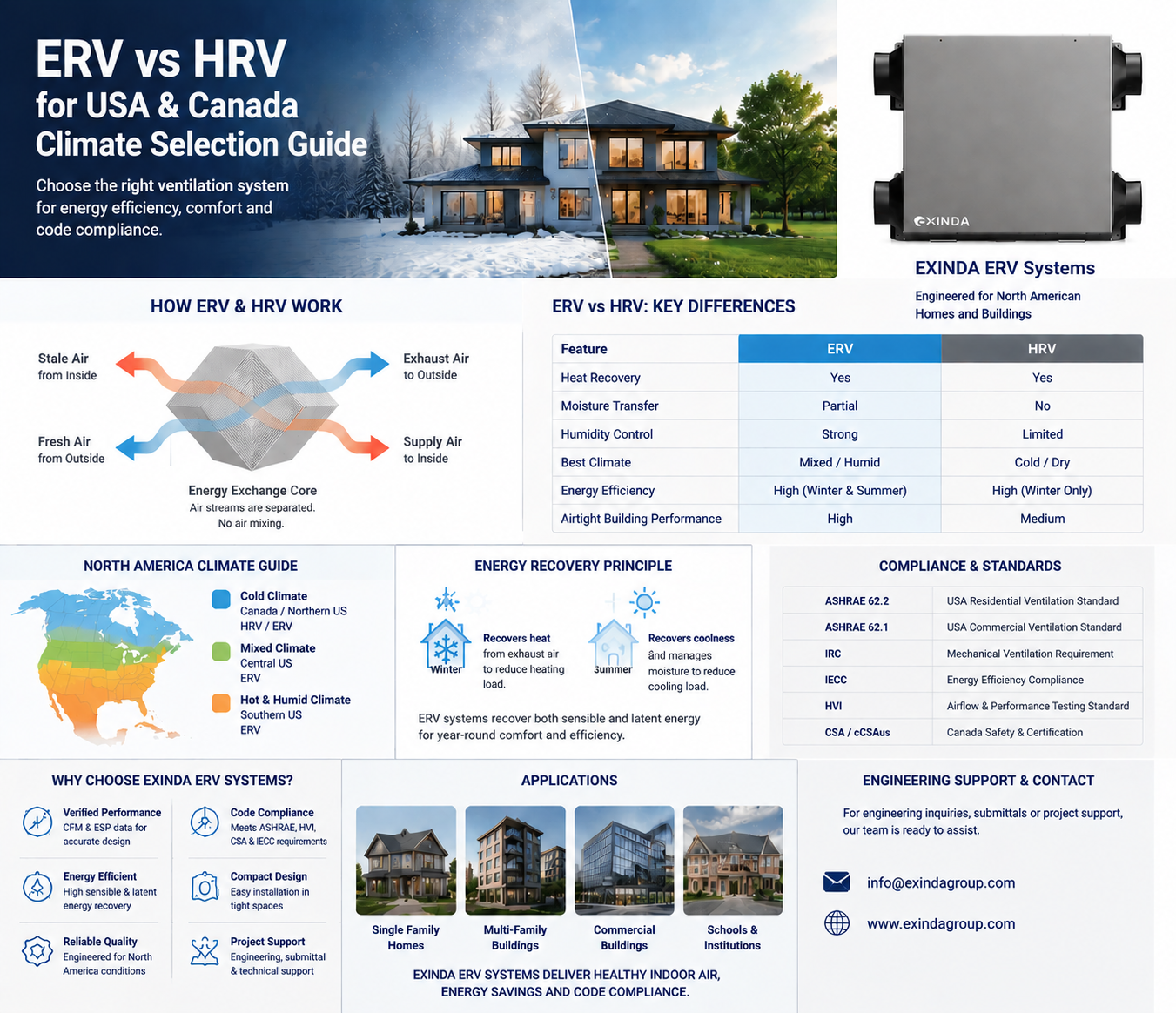
An Energy Recovery Ventilator (ERV) system uses two separate air streams:
- Indoor exhaust air leaving the building
- Outdoor fresh air entering the building
Both air streams pass through an energy recovery core.
During operation:
- Heat is transferred between air streams
- Moisture is partially balanced depending on indoor and outdoor conditions
- Air streams remain physically separated at all times
The result is pre-conditioned fresh air supplied back into the building with reduced load on the HVAC system.
Energy recovery principle
Energy Recovery Ventilator recover two types of energy:
- Sensible energy (temperature)
- Latent energy (humidity)
This reduces the temperature and humidity difference between incoming outdoor air and indoor air conditions.
Result:
- Reduced heating demand in winter
- Reduced cooling demand in summer
- More stable indoor humidity levels
Application in North America
ERV systems are widely used in:
- Single-family residential homes
- Multi-family housing and apartments
- Condominiums
- Hotels and hospitality projects
- Light commercial buildings
Typical climates include:
- Cold climates in Canada
- Mixed climates in northern United States
- Hot and humid climates in southern United States
Modern airtight building construction increases the need for mechanical ventilation systems like ERV.
ERV vs HRV
| Item | ERV | HRV |
|---|---|---|
| Heat recovery | Yes | Yes |
| Moisture transfer | Yes | No |
| Best climate | Mixed / humid | Cold / dry |
| North America usage | Increasing adoption | Traditional use in cold regions |
ERV is typically selected when humidity control is required in addition to heat recovery.
Compliance and engineering requirements
ERV systems used in USA and Canada are commonly evaluated based on:
- HVI airflow and performance testing methods
- ASHRAE ventilation standards
- IECC energy code requirements (USA)
- NECB building code requirements (Canada)
- CSA / cCSAus certification frameworks
In most HVAC projects, engineering submittals are required for approval.
Standard submittal data includes:
- Airflow (CFM) performance
- External static pressure (ESP) curves
- Efficiency data
- Electrical specifications
- Installation and system integration data
EXINDA ERV systems
EXINDA supplies ERV systems for HVAC projects in North America.
Our systems are designed for:
- Residential and light commercial applications
- Compact installation space requirements
- Standard HVAC duct integration
- Energy recovery performance suitable for USA and Canada climates
EXINDA supports project-based supply and distributor cooperation.
Project supply capability
We support:
- Project-based HVAC equipment supply
- Distributor and contractor partnerships
- Product customization based on project requirements
- North America compliance and documentation support
- Engineering submittals (CFM / ESP / performance data)
All support is based on project specifications and HVAC design requirements.
Engineering support
For HVAC engineers, builders, and distributors, EXINDA provides:
- Product selection based on airflow requirements
- Submittal packages for mechanical approval
- Performance data for HVAC system design
- Installation and integration documentation
Project inquiry
To support quotation and technical selection, please provide:
- Building type (residential / commercial)
- Required airflow (CFM or ACH)
- Installation location (USA or Canada)
- HVAC system configuration if available
Technical documentation and pricing can be provided based on project requirements.
FAQ
What is an ERV system?
An ERV is a ventilation system that supplies fresh air while recovering heat and moisture from exhaust air.
How does an ERV work?
It transfers heat and moisture between incoming and outgoing air streams through an energy recovery core without mixing the air.
Is ERV required in North American homes?
In many airtight buildings, mechanical ventilation is required by energy codes, and ERV is commonly used to meet ventilation requirements.
What is the difference between ERV and HRV?
ERV transfers both heat and moisture, while HRV only transfers heat. ERV is more suitable for mixed and humid climates.
Does ERV reduce HVAC energy consumption?
Yes. It reduces heating and cooling load by pre-conditioning incoming outdoor air.
Where is ERV commonly used?
ERV systems are widely used in residential, multi-family, and commercial buildings across the USA and Canada.
Can EXINDA support engineering submittals?
Yes. EXINDA provides full engineering submittals including CFM, ESP, and performance data for project approval processes.
Contact
For technical support, project evaluation, or engineering documentation requests, please contact EXINDA.
Our team supports HVAC engineers, contractors, and distributors in North America with product selection and system integration.
EXINDA HVAC Systems
Email: info@exindagroup.com
Response time is typically within 24 hours for project and technical inquiries.