1. Overview
Commercial Heat Pump Chiller in North America HVAC applications are characterized by high adaptability, electrical standardization, and engineering-driven performance requirements across different climate zones.
In North America, Commercial Heat Pump Chiller commonly operate under 480V and 575V three-phase configurations depending on country and application scale. The United States predominantly uses 480V for commercial and industrial HVAC systems, while Canada widely applies 575V for large-scale HVAC infrastructure.
In Europe, similar commercial heat pump chiller are deployed under local grid standards, typically based on 380V–400V three-phase electrical infrastructure for commercial HVAC applications.
EXINDA is an engineering supplier providing Commercial Heat Pump Chiller for North America HVAC projects, with primary focus on 480V and 575V electrical integration and cold climate hydronic applications.
2. System Architecture (North America 480V / 575V Platform)
EXINDA commercial heat pump chiller systems are designed as integrated HVAC energy platforms for North American commercial infrastructure, supporting both 480V three-phase commercial HVAC systems in the United States and 575V three-phase commercial HVAC systems in Canada.
The system architecture integrates:
| Technology Module | Engineering Type | Function Description | HVAC System Role |
|---|---|---|---|
| EVI Inverter Compressor Technology | Compressor System | Enhanced Vapor Injection for low-temperature heating performance | Improves heating capacity and stability under sub-zero ambient conditions |
| R32 Refrigerant Cycle | Refrigeration System | Low-GWP refrigerant with improved thermodynamic efficiency | Increases energy efficiency and reduces environmental impact |
| Smart Defrost & Freeze Protection | Control System Logic | Intelligent defrost cycle and freeze protection strategy | Ensures stable operation in cold climate HVAC environments |
| Hydronic Water Loop Integration | System Architecture | Water-based heat distribution system for centralized HVAC | Enables building-wide heating and cooling distribution |
| Inverter-Driven Compressor Control | Variable Load Control | Dynamic compressor speed adjustment based on demand | Optimizes energy consumption under partial and full load conditions |
These components operate as a unified system designed for stable heating and cooling performance under North American commercial HVAC conditions.
3. North America Cold Climate Engineering
EXINDA commercial heat pump chiller systems are designed for North American HVAC applications driven by electrification of heating systems and replacement of fossil fuel boilers. The system integrates compressor control, refrigerant thermodynamics, and system-level defrost logic into a unified operational strategy, ensuring efficiency in North America HVAC Systems.
Under low-temperature conditions, the system manages:
- Stable heating capacity under sub-zero ambient operation
- Refrigerant cycle optimization for enhanced heat transfer efficiency
- Adaptive defrost activation based on coil condition monitoring
- Freeze protection logic for hydronic system stability
- Variable load adaptation under continuous HVAC demand conditions
This integrated control strategy ensures reliable operation in both Canadian and northern United States winter environments.
4. Energy Efficiency System
EXINDA commercial heat pump chillers use a combined energy system integrating EVI inverter compressor technology and R32 refrigerant.
Within the thermodynamic system:
- EVI technology enhances low-temperature heating performance through refrigerant injection optimization.
- R32 refrigerant provides higher efficiency and lower global warming potential compared to R410A.
- Inverter compressor control enables dynamic capacity adjustment based on building load requirements.
This system architecture supports energy efficiency compliance and electrified HVAC transition requirements in North American building applications.
5. Compliance and Engineering Standards
EXINDA systems are designed in alignment with North American HVAC and electrical engineering standards.
Relevant frameworks include:
| Compliance Category | Description |
|---|---|
| ASHRAE HVAC System Design & Energy Efficiency Standards | Industry standards defining HVAC system design methodology, energy efficiency performance, ventilation requirements, and system sizing principles. |
| cETLus / cULus Certification Compliance | Electrical and mechanical safety certification requirements ensuring HVAC equipment meets US and Canada installation safety standards. |
| CSA / cCSAus Electrical Safety Standards | Canadian electrical safety certification framework for HVAC equipment used in commercial and industrial applications. |
| AHRI Performance Rating Standards | Standardized HVAC performance testing and rating system used to verify heat pump capacity, efficiency, and operational performance. |
| Local Mechanical and Building Code Requirements | Regional building and mechanical codes in the United States and Canada governing HVAC system approval, installation, and permitting. |
Engineering submittal documentation typically includes:
| Engineering Category | Data Type | Description | HVAC Engineering Function |
|---|---|---|---|
| Thermal Performance Data | Performance Curve | Thermal capacity under variable ambient conditions | Defines system heating/cooling output across different climate conditions |
| Electrical Specifications | Power System Data | 480V / 575V three-phase electrical configuration | Electrical design for North America commercial HVAC systems |
| Hydronic Flow & Pressure Drop | Hydraulic Calculation | Flow rate, pressure drop, and system resistance values | Hydronic loop design for water-based HVAC distribution |
| System Integration Schematics | Mechanical Design Drawing | Mechanical room layout and system piping/equipment integration | HVAC system installation and centralized plant design |
| Operation Documentation |
Control System Engineering | Defrost logic, freeze protection, and operational algorithms | Ensures stable system operation under low-temperature conditions |
6. EXINDA System Capability (Engineering Supplier Positioning)
EXINDA is an engineering supplier providing commercial heat pump chiller systems for North America HVAC projects.
The system is positioned as a cold climate hydronic HVAC solution designed for:
| Application Category | Engineering Type | Description | HVAC System Context |
|---|---|---|---|
| Electrical Infrastructure Compatibility | Power System Integration | 480V and 575V commercial electrical infrastructure compatibility | North American commercial HVAC power systems (US 480V / Canada 575V, 3-phase, 60Hz) |
| Gas Boiler Replacement | Electrification Transition | Replacement of fossil fuel boiler systems with heat pump HVAC systems | Electrified heating systems for decarbonization in commercial buildings |
| Central Plant Integration | System Architecture | Integration into centralized mechanical plant HVAC systems | Hydronic chillers for commercial and institutional building infrastructure |
| Low-Carbon Transition Projects | Sustainability Engineering | HVAC systems supporting carbon reduction and energy efficiency targets | Electrified heating and cooling systems aligned with climate policy requirements |
EXINDA supports HVAC consultants, engineers, contractors, and distributors through:
| Execution Function | Description |
|---|---|
| Engineering Submittal Documentation Alignment | Preparation of HVAC engineering submittals aligned with North American compliance requirements including technical, electrical, and performance documentation for approval processes. |
| System Selection Based on Load & Electrical Infrastructure | HVAC system selection based on thermal load requirements (kW/TR) and electrical system configuration (480V / 575V) for optimal system matching. |
| Project-Based Supply Coordination | Coordination of HVAC equipment supply for commercial projects including scheduling, logistics alignment, and contractor/distributor collaboration. |
| Technical Integration Support | Engineering support for hydronic systems and electrical integration, ensuring compatibility between mechanical design and HVAC system architecture. |
| Regulatory Approval Documentation Support | Provision of documentation required for project approval in the United States and Canada, aligned with mechanical and building code requirements. |
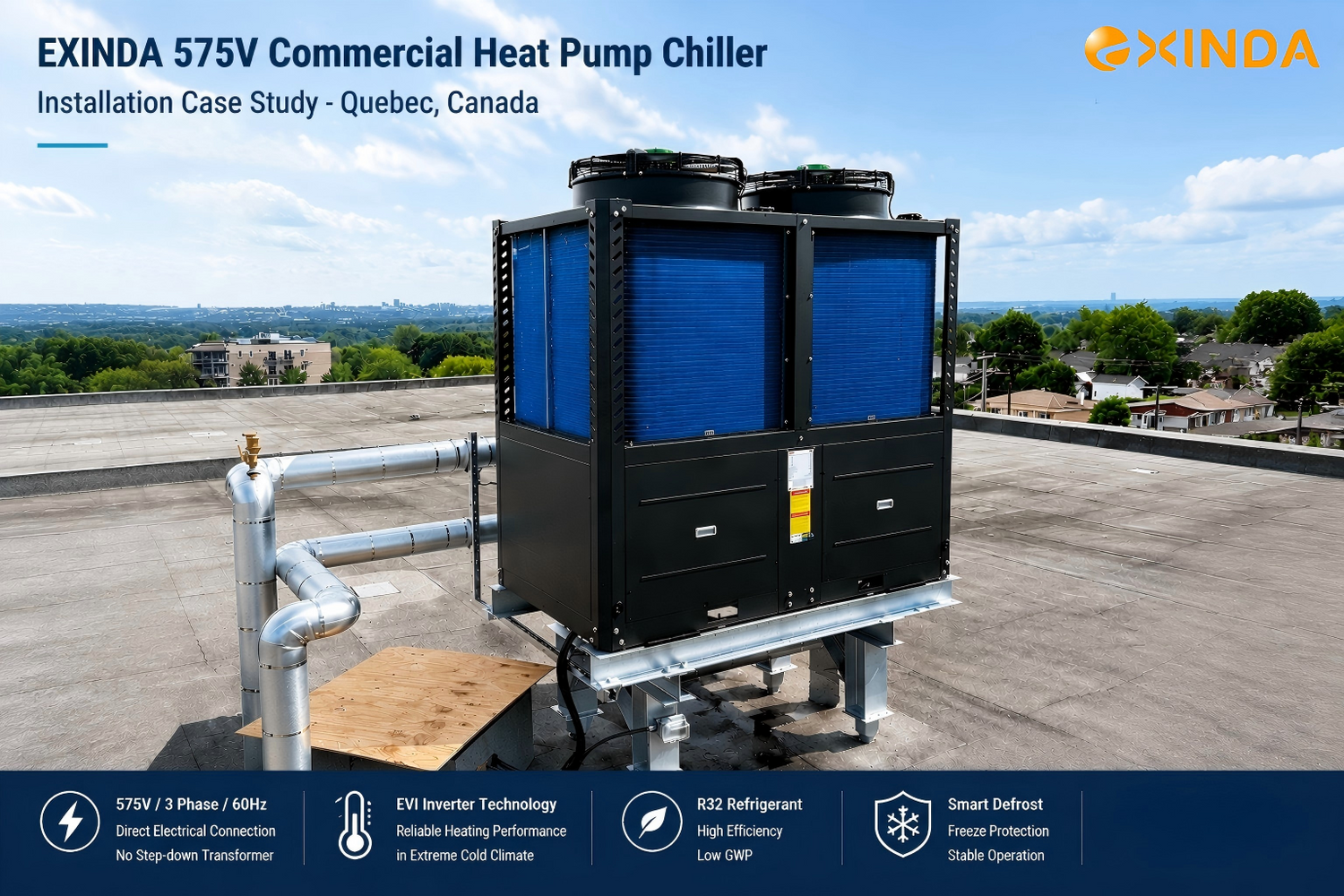
7. Project Case Study: Quebec, Canada Cold Climate Installation
A recent EXINDA commercial heat pump chiller installation was completed in Quebec, Canada, representing a cold climate North American HVAC application under 575V commercial infrastructure. The system was deployed in a centralized hydronic HVAC configuration serving a commercial building with continuous heating demand during extreme winter conditions.
Operators confirmed:
| Performance Outcome | Description |
|---|---|
| Stable Heating Performance under Sub-Zero Ambient Conditions | System maintains consistent heating output under sustained sub-zero outdoor temperatures in cold climate regions. |
| Low Acoustic Noise Operation | HVAC system operates with reduced sound levels during continuous operation cycles, suitable for residential and commercial environments. |
| Reliable Variable Load Performance | System maintains stable and efficient operation under fluctuating HVAC load conditions across different operating scenarios. |
| High Acceptance from Contractors and Building Owners | System performance and installation reliability are positively recognized by mechanical contractors and building stakeholders. |
This project demonstrates EXINDA system capability in real-world cold climate HVAC applications in Canada.
8. Project Inquiry and Engineering Support
For commercial heat pump chiller applications, system selection requires engineering-level project input. Required information includes:
| Item | Description |
|---|---|
| Building Type and Application Scenario | Commercial / Institutional / Industrial HVAC application (e.g., office building, hospital, multi-family, factory, etc.) |
| Heating and Cooling Load Requirements | Total system capacity requirement in tonnage (TR) or kilowatts (kW), including peak and part-load conditions |
| Electrical System Configuration | North American commercial power supply: 480V (USA) / 575V (Canada), 3-phase, 60Hz |
| Hydronic System Design Parameters | System flow rate (GPM or L/s), supply/return water temperature differential (ΔT), and pressure drop requirements |
| Installation Location | Project site location (United States or Canada), including climate zone classification if available |
EXINDA provides engineering-based system selection, submittal documentation, and technical coordination support for HVAC consultants, contractors, and distributors. All project support is based on engineering design requirements and system performance specifications.
Contact
EXINDA provides engineering support for commercial heat pump chiller projects across North America.
Email: info@exindagroup.com
EXINDA supports HVAC engineers, contractors, and distributors with system selection, engineering submittals, and project-based HVAC integration support.
9. FAQ
1) What is a commercial heat pump chiller system:
It is a centralized hydronic HVAC system designed for heating and cooling in commercial and institutional buildings using electric heat pump technology.
2) What voltages do EXINDA systems support in North America:
EXINDA systems are designed for 480V in the United States and 575V in Canada.
3) What is the advantage of 480V and 575V systems:
They enable direct integration into North American commercial electrical infrastructure without step-down transformers.
4) How does the system perform in cold climates:
The system uses EVI inverter technology, R32 refrigerant, and integrated defrost logic to maintain stable operation in low-temperature environments.
5) What is the role of EVI technology:
EVI enhances low-temperature heating capacity and improves compressor efficiency under extreme conditions.
6) Why is R32 used in EXINDA systems:
R32 provides higher energy efficiency and lower environmental impact compared to traditional refrigerants.
7) Does EXINDA provide engineering submittals?
Yes. EXINDA provides full HVAC engineering submittal packages for North American project approval processes.