Quick Answer
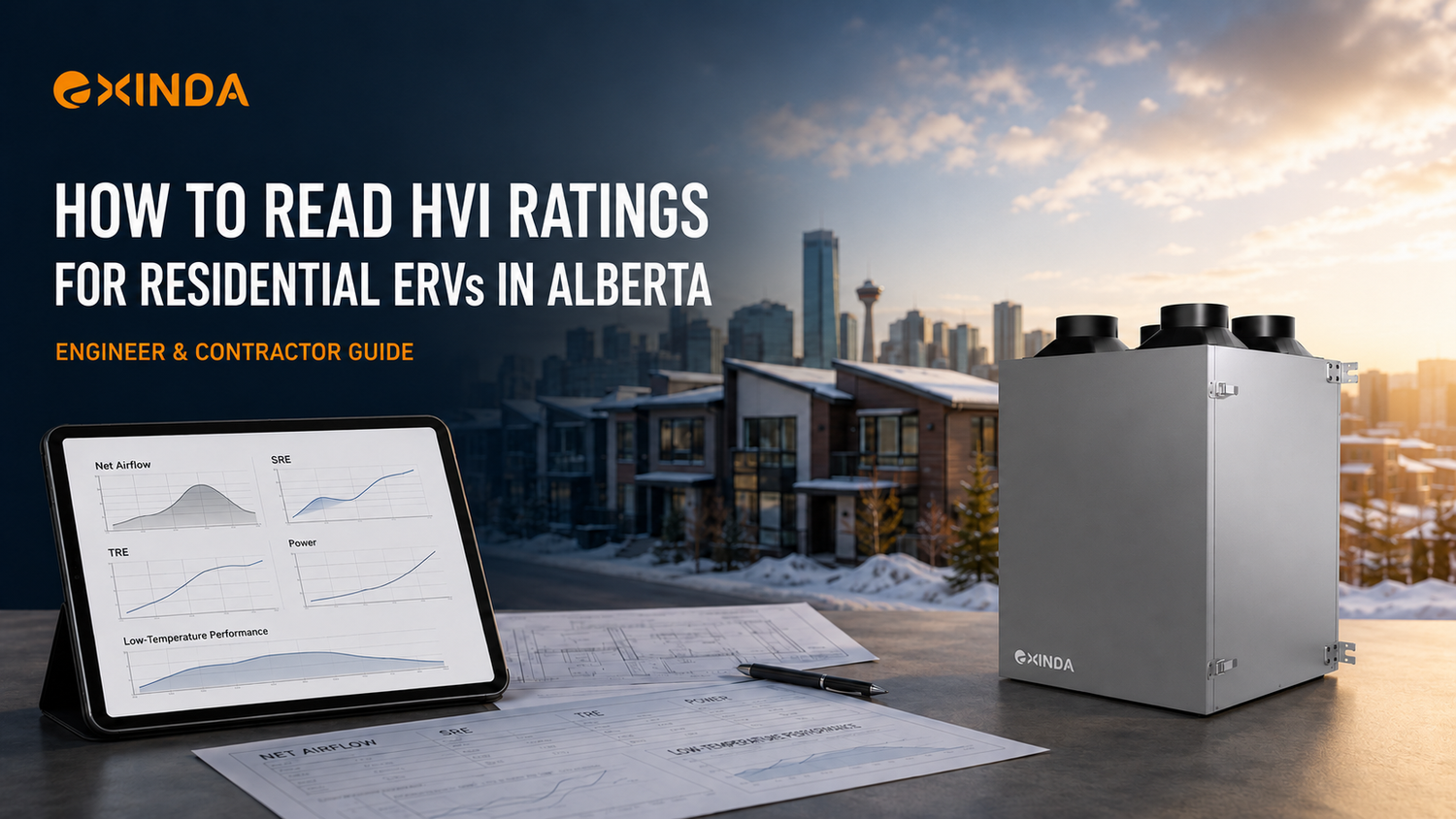
For Alberta residential projects, HVI ratings help engineers and HVAC contractors determine whether an ERV can deliver the required ventilation airflow, recovery efficiency and cold-weather performance under standardized test conditions.
The most important values to review are:
-
Net supply airflow at the required external static pressure
-
Net exhaust airflow
-
Sensible Recovery Efficiency, or SRE
-
Total Recovery Efficiency, or TRE
-
Apparent Sensible Effectiveness
-
Electrical power consumption
-
Performance at low outdoor temperatures
-
The exact model and configuration covered by the certification
An ERV should not be selected for an Alberta home based only on its maximum advertised CFM or highest efficiency percentage. The certified data must be matched to the building’s design airflow, duct resistance and winter operating conditions.
Why HVI Ratings Matter in Alberta
Alberta residential ventilation systems operate under demanding conditions. Calgary, Edmonton and many surrounding communities experience long heating seasons, low outdoor temperatures and large indoor-to-outdoor temperature differences.
For engineers and contractors, an ERV must do more than move air. It must:
-
Deliver the scheduled outdoor airflow
-
Overcome the installed duct resistance
-
Maintain balanced supply and exhaust airflow
-
Recover useful energy during the heating season
-
Manage frost under low-temperature conditions
-
Integrate correctly with the home’s furnace or dedicated duct system
-
Remain accessible for filter and core maintenance
HVI-certified ratings provide a standardized starting point for evaluating these requirements. They help prevent comparisons based only on manufacturer advertising or free-air airflow.
Models listed in the official HVI-Certified Products Directory have been tested according to defined HVI procedures.
However, HVI certification is model-specific. A product described as “tested according to HVI standards” is not necessarily an actively certified model. Engineers should verify the exact brand and model in the directory.
The Main HVI Values to Review
| HVI value | What it means | Alberta project relevance |
|---|---|---|
| Net Supply Airflow | Outdoor air actually delivered by the ERV | Confirms that the unit can meet the required residential ventilation rate |
| Net Exhaust Airflow | Indoor air exhausted under the rated condition | Supports balanced ventilation and building-pressure control |
| External Static Pressure | Resistance applied during airflow testing | Helps match the ERV to Alberta residential duct systems |
| SRE | Net sensible energy recovered by the supply airstream | Important for heating-season energy performance |
| TRE | Total energy recovery, including sensible and latent energy | Helps evaluate combined temperature and moisture recovery |
| Apparent Sensible Effectiveness | Temperature-based sensible effectiveness | Useful for heat-exchanger analysis but should not replace SRE |
| Power Consumption | Electrical input at the tested operating point | Supports operating-cost and energy-model comparisons |
| Low-Temperature Rating | Performance under a specified cold-air condition | Important for Alberta winter selection |
1. Start with the Alberta Design Airflow
Before reviewing an ERV’s HVI data, the engineer should determine the required ventilation airflow for the home.
This may be based on:
-
Applicable Alberta code requirements
-
Project ventilation schedules
-
Number of bedrooms
-
Occupied floor area
-
Exhaust requirements
-
Builder or consultant specifications
-
Applicable residential ventilation standards
The required airflow should be established before selecting the ERV.
A unit advertised as a “150 CFM ERV” is not automatically suitable for a project requiring 150 CFM. The engineer must confirm how much net airflow the unit can deliver against the resistance of the installed duct system.
The correct question is:
What net supply airflow does this ERV deliver at the project’s estimated external static pressure?
2. Compare Net Airflow at the Required Static Pressure
Maximum airflow is often measured at a low external static pressure. Actual airflow can decrease after the ERV is connected to:
-
Exterior intake and exhaust hoods
-
Insulated outdoor-air ducts
-
Supply and exhaust grilles
-
Filters
-
Elbows and transitions
-
Balancing dampers
-
Branch ducts
-
Furnace return-air connections
This is especially important in Alberta homes where the ERV may be installed in a basement mechanical room and connected to relatively long outdoor ducts.
For example, if the project requires 120 CFM at 0.4 in. w.g., the engineer should verify the model’s certified or documented airflow at that pressure. A nominal 150 CFM unit that delivers only 110 CFM at the required resistance would be undersized.
Contractors evaluating substitutions should use the same method. Two ERVs with similar nominal capacities may perform differently when installed in the same duct system.
3. Understand SRE for Alberta Heating Conditions
Sensible Recovery Efficiency represents the net sensible energy recovered by the supply airstream. The calculation accounts for more than the temperature difference across the recovery core.
SRE is especially relevant in Alberta because residential ERVs operate through a long heating season. A higher SRE can reduce the amount of additional heating required to bring incoming outdoor air toward the indoor temperature.
However, SRE should never be reviewed without its test conditions.
Confirm:
-
Outdoor test temperature
-
Indoor test temperature
-
Supply airflow
-
Exhaust airflow
-
External static pressure
-
Electrical power consumption
-
Airflow balance
A high SRE at a low airflow does not prove that the ERV will provide the same efficiency at the project’s scheduled airflow.
4. Do Not Confuse SRE with Apparent Sensible Effectiveness
SRE and Apparent Sensible Effectiveness are not equivalent values.
Apparent Sensible Effectiveness mainly reflects the change in supply-air temperature through the ERV. It may appear higher than SRE because it does not represent the same net-energy calculation.
For Alberta engineering comparisons, SRE is generally the more useful value for evaluating practical heating-season performance.
Engineers should avoid comparing:
-
One manufacturer’s SRE with another manufacturer’s apparent effectiveness
-
Ratings taken at different airflows
-
Ratings taken at different outdoor temperatures
-
Maximum published efficiency with design-condition efficiency
The metric and test condition must be the same before two ERVs can be compared fairly.
5. Use TRE Carefully in Alberta’s Dry Climate
Total Recovery Efficiency includes both sensible and latent energy transfer. It helps engineers evaluate the combined energy-recovery performance of an ERV.
Latent recovery can be useful during an Alberta winter because an ERV may transfer part of the moisture from the outgoing indoor air to the incoming outdoor air. This can reduce the rate at which ventilation removes indoor moisture.
However, an ERV is not a humidifier.
Indoor relative humidity will still depend on:
-
Outdoor temperature
-
Occupant density
-
Showering and cooking
-
Building airtightness
-
Ventilation airflow
-
Furnace operation
-
Indoor moisture generation
-
Dedicated humidification equipment
TRE should therefore be treated as one part of the building’s energy and moisture analysis. It should not be used to promise a specific indoor humidity level.
6. Review the Low-Temperature Test Point
A room-temperature efficiency rating does not confirm that an ERV is suitable for an Alberta winter.
Engineers and contractors should separately review:
-
Recovery performance at the available low-temperature test point
-
Manufacturer-stated minimum operating temperature
-
Frost-control activation temperature
-
Defrost method
-
Defrost cycle duration
-
Supply-air behaviour during defrost
-
Exhaust-air behaviour during defrost
-
Drainage requirements
-
Preheater requirements, if applicable
An ERV may show strong recovery performance under moderate test conditions but behave differently when frost control becomes active.
For applicable EXINDA models, documented cold-climate operation is available down to −25°C. The exact operating limit, certified performance and defrost sequence must still be verified against the selected model’s submittal.
7. Understand the Defrost Strategy
The defrost method affects how the ventilation system operates during Alberta winter conditions.
Fan Defrost
A fan-defrost sequence may temporarily adjust or stop one airstream to warm the recovery core. Engineers should determine whether normal outdoor-air delivery is reduced during the cycle.
Recirculation Defrost
A recirculation-defrost system may temporarily circulate indoor air through the core instead of supplying outdoor air. This helps clear frost but can temporarily interrupt normal ventilation.
The HVI rating provides standardized performance information, but the complete defrost sequence should be reviewed in the manufacturer’s technical documentation.
For Alberta projects, the sequence of operation should answer:
-
When does defrost start?
-
How long does it operate?
-
Is outdoor-air supply interrupted?
-
Does the ERV create temporary building pressure?
-
Is supplemental preheating required?
-
How does the unit return to normal operation?
8. Check Supply and Exhaust Airflow Balance
Balanced ventilation is particularly important in airtight Alberta homes.
Excessive negative pressure may contribute to:
-
Cold-air infiltration
-
Drafts around doors and windows
-
Combustion-appliance concerns
-
Reduced ventilation performance
-
Uncontrolled moisture movement through the enclosure
Excessive positive pressure may drive indoor moisture into wall or roof assemblies during cold weather.
Installed airflow may be affected by:
-
Different supply and exhaust duct lengths
-
Exterior hood resistance
-
Dirty filters
-
Incorrect damper positions
-
Furnace fan operation
-
Wind pressure
-
Installation differences
ECM motors, constant-airflow control and automatic-balancing functions can improve airflow stability. However, contractors should still measure and document the final supply and exhaust airflow during commissioning.
9. Verify the Exact HVI-Certified Model
HVI certification should not be assumed to cover every model within an ERV product family.
The project submittal should be checked against the directory for:
-
Brand
-
Exact model number
-
Airflow configuration
-
Recovery-core type
-
Motor and control version
-
Tested airflow points
-
SRE and TRE values
-
Electrical input
-
Port arrangement, where applicable
Top-port and side-port ERVs may have similar nominal capacities but different internal airflow paths and installation requirements.
Canadian electrical certification should also be verified for the exact model being submitted. It should not be assumed based only on the certification of another unit in the same series.
Alberta ERV Review Workflow
Engineers and contractors can use the following process for residential projects:
-
Determine the required ventilation airflow.
-
Estimate the external static pressure of the complete duct system.
-
Locate the exact ERV model in the HVI directory.
-
Verify net supply airflow at the relevant pressure.
-
Review net exhaust airflow and balance.
-
Compare SRE at matching airflow and temperature conditions.
-
Review TRE when latent recovery is relevant.
-
Check electrical input at the selected operating point.
-
Confirm minimum operating temperature and defrost strategy.
-
Verify Canadian electrical certification for the exact model.
-
Review port arrangement, drainage and service clearances.
-
Include airflow measurement and balancing in commissioning.
Alberta ERV Submittal Checklist
| Review item | Required verification |
|---|---|
| Project airflow | Meets the required continuous and boost ventilation rates |
| Static pressure | Required airflow is available at the estimated duct resistance |
| HVI listing | Exact brand and model are shown in the directory |
| SRE | Reviewed at the relevant airflow and temperature |
| TRE | Applied correctly to total energy-recovery analysis |
| Cold-weather operation | Minimum temperature and defrost sequence are documented |
| Electrical certification | Confirmed for the exact Canadian model |
| Duct arrangement | Top-port or side-port configuration suits the mechanical room |
| Service access | Filters, core, drain and controls remain accessible |
| Commissioning | Supply and exhaust airflow will be measured and recorded |
EXINDA Residential ERVs for Alberta Projects
EXINDA provides residential ERV options for Alberta new homes, multifamily housing and builder projects.
Available configurations include:
-
Side-port and top-port arrangements
-
Approximately 90–170 CFM capacity options
-
ECM motor technology
-
Constant-airflow control
-
Automatic-balancing functions on applicable models
-
Fan-defrost or recirculation-defrost strategies
-
Practical filter and service access
-
Cold-climate operation down to −25°C on applicable models
-
HVI-certified options
-
Canadian electrical certification for designated models
All certification, airflow, filtration and low-temperature claims should be confirmed against the exact model selected for the project.
EXINDA can support Alberta engineers and contractors with:
-
Model-specific submittals
-
HVI-certified performance data
-
Airflow tables
-
Dimensional drawings
-
Installation manuals
-
Defrost descriptions
-
Port and service-clearance information
-
Initial model selection and balancing support
Frequently Asked Questions
Are HVI ratings required for Alberta residential ERV projects?
Requirements depend on the applicable code, energy program and project specification. Even when HVI certification is not explicitly required, engineers may use HVI-certified data as an independent basis for comparing airflow and recovery performance.
Does the highest SRE identify the best ERV for Alberta?
No. The unit must also provide the required airflow at the project’s external static pressure. Power consumption, defrost operation, installation arrangement and service requirements must also be considered.
Can an ERV rated at 150 CFM always deliver 150 CFM after installation?
No. Installed airflow depends on duct resistance, filters, exterior hoods, fittings and system configuration. Engineers should review the airflow data at the expected static pressure, and contractors should verify the final airflow in the field.
Does an ERV eliminate the need for a humidifier in Alberta?
Not necessarily. An ERV can moderate indoor moisture loss, but it does not actively generate humidity. The need for a humidifier depends on outdoor temperature, building airtightness, occupancy and the owner’s indoor-humidity requirements.
Does HVI certification confirm operation at −25°C?
Not by itself. HVI data must be reviewed together with the manufacturer’s documented operating range and frost-control sequence. The minimum operating temperature should be confirmed for the exact model.
Is field balancing required for an automatic-balancing ERV?
Yes. Automatic balancing can improve airflow stability, but the installed supply and exhaust airflow should still be measured and documented during commissioning.
Engineer and Contractor Summary
HVI Ratings for Residential ERVs in Alberta should be treated as a complete set of performance data—not as a single efficiency percentage.
A reliable selection should confirm:
-
Required net airflow
-
External static pressure
-
SRE and TRE under matching conditions
-
Electrical power consumption
-
Low-temperature operation
-
Defrost behaviour
-
Exact model certification
-
Installed airflow balance
This approach helps Alberta engineers prepare defensible equipment specifications and helps contractors avoid undersized units, unsuitable substitutions and commissioning problems.
CTA
Planning a residential or multifamily ventilation project in Alberta?
Contact EXINDA to request model-specific HVI performance data, ERV submittals, dimensional drawings and airflow-selection support for your next Calgary, Edmonton or Alberta housing project.