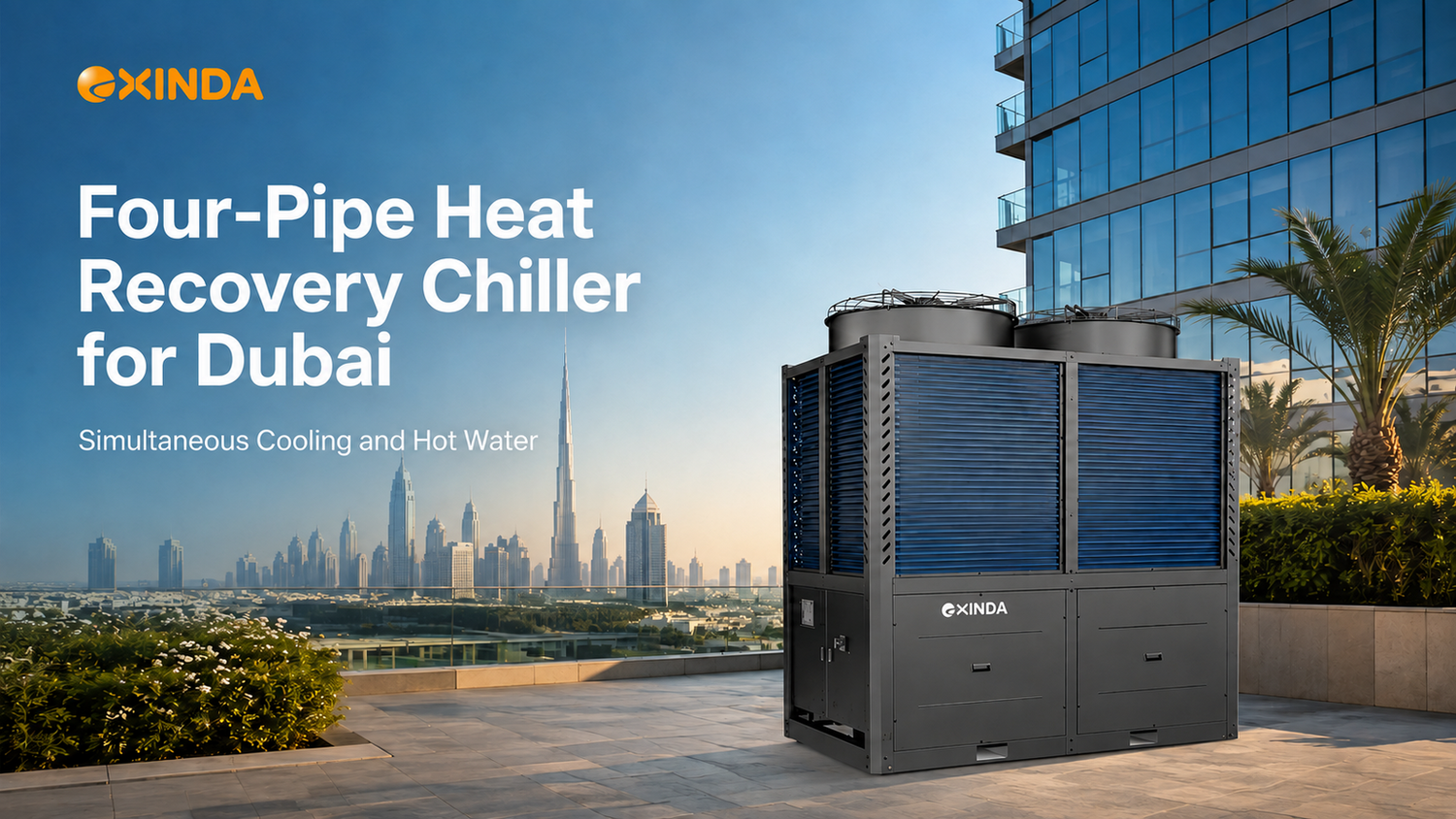
A four-pipe heat recovery chiller in Dubai can provide chilled water and hot water simultaneously for hotels, hospitals and mixed-use buildings.
Hotels, hospitals, schools, residential developments and mixed-use buildings in Dubai require substantial cooling, but many of these facilities also consume hot water throughout the year.
A four-pipe heat recovery chiller can produce chilled water and hot water simultaneously. Instead of rejecting all the heat removed during cooling, the system transfers useful heat to a separate hot-water circuit.
The EXINDA 140 kW R454B Four-Pipe Air-to-Water Heat Pump Chiller provides 119 kW of cooling and 168 kW of heating during simultaneous operation, with a combined COP of up to 8.2 at the specified test condition.
For Dubai projects, EXINDA can also evaluate high-ambient operation, electrical compatibility, control requirements and project-specific customization based on the consultant’s design conditions.
What Is a Four-Pipe Heat Recovery Chiller?
A conventional two-pipe heat pump normally provides either chilled water or hot water at a given time.
A four-pipe heat recovery chiller uses two independent hydronic circuits:
One circuit supplies chilled water.
One circuit supplies hot water.
Cooling and heating can operate independently.
Both circuits can operate simultaneously.
Heat removed from the chilled-water circuit can be recovered and used by the hot-water circuit.
This configuration is particularly valuable in buildings where cooling and hot-water demand occur during the same operating period.
For example, a Dubai hotel may require chilled water for guest rooms, restaurants and public areas while also requiring hot water for guest rooms, kitchens, laundries and spa facilities.
Instead of operating a separate chiller and water-heating system independently, a four-pipe heat recovery chiller can serve both hydronic loads from one integrated system.
Why Heat Recovery Matters in Dubai
Cooling is one of the largest energy requirements in Dubai’s commercial buildings. At the same time, hotels, healthcare facilities, restaurants, laundries and residential developments need significant quantities of hot water.
In a conventional air-cooled chiller, the heat removed from the building is normally rejected to the outdoor air.
A heat recovery system makes part of this energy useful.
During simultaneous operation, the system:
Removes heat from the chilled-water circuit.
Uses the recovered heat as an energy source.
Transfers that energy to the hot-water circuit.
Reduces the amount of heat rejected outdoors.
Reduces reliance on a separate electric heater, boiler or heat pump water heater.
The greatest benefit is achieved when cooling and hot-water loads occur at the same time.
The Dubai Green Building Regulations aim to improve building performance and reduce energy and water consumption throughout the Emirate. These requirements make efficient chiller selection, system controls and energy monitoring increasingly important for large commercial projects. Dubai Municipality Green Building Regulations
EXINDA 140 kW R454B Four-Pipe Heat Pump Chiller
The EXINDA four-pipe heat pump chiller is a commercial air-to-water system designed for hydronic cooling, heating and heat recovery.
It combines dual DC inverter EVI scroll compressors, two independent refrigerant circuits and separate chilled-water and hot-water heat exchangers within a single outdoor unit.
Main Performance Data
| Performance item | EXINDA specification |
|---|---|
| Product | EXINDA 140 kW R454B Four-Pipe Air-to-Water Heat Pump Chiller |
| System type | Commercial four-pipe heat recovery chiller |
| Nominal cooling capacity | 123 kW |
| Cooling rating condition | 35°C ambient, 12/7°C entering/leaving chilled water |
| Nominal heating capacity | 140 kW |
| Heating rating condition | 8/6°C ambient, 41°C leaving water |
| Simultaneous cooling capacity | 119 kW |
| Simultaneous heating capacity | 168 kW |
| Combined COP | Up to 8.2 |
| Cooling EER | Up to approximately 2.93 W/W |
| Heating COP | Up to 3.64 |
| Maximum leaving hot-water temperature | 60°C |
| Minimum chilled-water leaving temperature | 4°C |
| Standard cooling operating range | –20°C to 43°C ambient |
| Heating operating range | –25°C to 38°C ambient |
| Refrigerant | R454B |
| Refrigerant circuits | Two independent circuits |
| Compressors | Dual DC inverter EVI scroll compressors |
| Power supply | 380 V / 3-phase / 50 Hz |
| Fans | Two EC inverter axial fans |
| Total airflow | 45,194 m³/h |
| Hydronic connections | 2½-inch flanged connections |
| Sound power level | 86 dB(A) in cooling mode |
| Modular control | Up to six units |
The “140 kW” product designation refers to the nominal heating capacity. The nominal cooling capacity is 123 kW at the stated cooling condition.
Simultaneous Cooling and Hot-Water Production
The EXINDA unit can deliver:
119 kW of useful cooling
168 kW of useful heating
Combined COP up to 8.2
These values apply to the specified simultaneous heating and cooling condition.
Combined COP represents the total useful cooling and heating output relative to the electrical input during simultaneous operation. It is not the cooling-only EER, heating-only COP or seasonal efficiency.
For project selection, performance must be evaluated using the required:
Outdoor ambient temperature
Chilled-water entering and leaving temperatures
Hot-water entering and leaving temperatures
Cooling load
Hot-water load
Water flow rates
Simultaneous load ratio
This is especially important for Dubai hotels, where cooling demand may be continuous but hot-water consumption can change significantly throughout the day.
Suitable Applications in Dubai and the UAE
Hotels and Resorts
Hotels are one of the strongest applications for four-pipe heat recovery chillers because they frequently require cooling and hot water at the same time.
The chilled-water circuit can support:
Guest-room air conditioning
Restaurants
Lobbies and public areas
Conference facilities
Kitchens
Fitness centres
Spas
Back-of-house areas
The hot-water circuit may support:
Guest-room hot water
Kitchens
Laundry facilities
Cleaning operations
Spa facilities
Swimming-pool water heating
Preheating of domestic hot water
The heat recovery chiller can be integrated with a storage tank and supplementary heater to accommodate peak consumption and hygiene-temperature requirements.
Hospitals and Healthcare Facilities
Hospitals can experience continuous cooling demand from occupied areas, ventilation systems, medical equipment and internal heat gains.
They also require hot water for:
Patient rooms
Kitchens
Laundry
Cleaning
Sanitation
Clinical support areas
A four-pipe heat recovery chiller can become part of the central cooling and hot-water plant. Critical healthcare projects must also include suitable redundancy, backup heating, alarms, water hygiene controls and BMS integration.
Mixed-Use Developments
Mixed-use projects combine apartments, hotels, retail areas, restaurants and offices within one development.
These different spaces have different operating schedules and thermal demands. A four-pipe system allows the chilled-water and hot-water circuits to respond independently while recovering energy when the two loads overlap.
Multi-Residential Buildings
Apartments and serviced residences may require year-round chilled water and domestic hot water.
A central heat recovery system may reduce dependence on individual water heaters, subject to the building layout, domestic hot-water storage design, metering strategy and load profile.
Schools and Universities
Educational buildings can have cooling demand in classrooms, offices, laboratories and public spaces while requiring hot water for kitchens, changing rooms, sports facilities and residential accommodation.
Inverter control helps the system respond to changing occupancy and part-load conditions.
Industrial Facilities
The EXINDA four-pipe platform can also be evaluated for industrial projects requiring simultaneous process cooling and hot water, including:
Food and beverage processing
Commercial laundries
Manufacturing facilities
Pharmaceutical operations
Cleaning and sanitation processes
Temperature-controlled storage
Water temperatures, process stability, operating hours and heat-exchanger requirements must be confirmed for each industrial application.
Why Use an Air-Cooled Heat Recovery Chiller?
Air-cooled chillers do not require a cooling tower or condenser-water circuit.
This can be useful for Dubai commercial projects where the developer wants to:
Reduce cooling-tower water consumption
Avoid condenser-water treatment
Simplify the plant arrangement
Reduce cooling-tower maintenance
Install the unit outdoors
Add modular capacity
Retrofit an existing building with limited plant-room space
Air-cooled systems must still be selected carefully for high outdoor temperatures, dust, sand, acoustic limits and airflow recirculation.
Dubai High-Ambient Project Evaluation
Dubai Municipality specifies an outdoor design condition of 46°C dry bulb and 29°C wet bulb for air-conditioning load calculations.
The standard EXINDA model has a published cooling operating range up to 43°C. For Dubai projects designed at higher outdoor temperatures, EXINDA can evaluate a project-specific high-ambient configuration.
The engineering evaluation may include:
Compressor operating-envelope review
Condenser-coil sizing
Fan-airflow evaluation
Refrigerant-charge review
High-pressure control settings
Electrical-component temperature limits
Controller protection logic
Cooling-capacity derating
Maximum current at high ambient
Coil protection for dusty or corrosive environments
The final equipment selection must be based on verified project conditions and approved technical data.
To evaluate a Dubai high-ambient version, the project team should provide:
Required design ambient temperature
Required cooling capacity at design temperature
Chilled-water entering and leaving temperatures
Required hot-water temperature
Simultaneous cooling and heating loads
Installation location
Available electrical supply
Required certification
Quantity and project timeline
Dual DC Inverter EVI Scroll Compressors
The unit uses two DC inverter EVI scroll compressors with stepless capacity control.
Inverter technology allows the compressors to adjust output as the building load changes. This is important for hotels, mixed-use buildings and institutional projects, where the chiller may operate below peak capacity for a large portion of the year.
The system can provide:
Variable capacity control
Improved part-load response
Reduced on/off cycling
More stable water-temperature control
Flexible response to simultaneous loads
Better coordination in modular installations
The EVI compressor design also extends the heating operating range to –25°C, allowing the platform to serve projects in multiple regional climates.
Two Independent Refrigerant Circuits
The EXINDA unit uses two independent R454B refrigerant circuits.
This configuration provides:
Refrigerant-circuit staging
More flexible capacity control
Reduced dependence on one refrigeration circuit
Partial operation when operating conditions permit
Easier coordination of changing system loads
Two circuits should not be described as full plant redundancy. Projects requiring N+1 redundancy should use multiple units or a separately engineered backup system.
R454B Refrigerant
R454B is a lower-GWP alternative to R410A for commercial HVAC equipment.
The refrigerant supports the transition toward lower-emission heating and cooling technology while maintaining suitability for inverter scroll-compressor applications.
Because R454B is classified as an A2L refrigerant, system design, installation, servicing and refrigerant handling must follow the applicable safety requirements and local project regulations.
For each Dubai or UAE project, the consultant should confirm:
Applicable refrigerant requirements
Equipment location
Refrigerant-charge limits
Service access
Ventilation requirements
Leak-detection requirements
Local authority approval
Contractor qualification
Modular Capacity for Larger Commercial Projects
The EXINDA controller supports cascade operation for up to six units.
A six-unit configuration can provide nominal capacities of up to:
738 kW nominal cooling
840 kW nominal heating
Actual combined capacity must be calculated at the project’s required operating conditions.
A modular arrangement can provide:
Capacity staging
Improved part-load control
Partial availability during maintenance
Flexible rooftop layouts
Easier future expansion
Multiple refrigeration circuits across the plant
The hydraulic system must be designed with suitable pumps, isolation valves, buffer capacity, flow control and equipment sequencing.
Control and BMS Integration
Large commercial buildings in Dubai frequently require central control and monitoring of the chiller plant.
The project team should confirm the required:
Start and stop control
Cooling and heating mode selection
Chilled-water temperature setpoint
Hot-water temperature setpoint
Operating-status feedback
Compressor status
Pump interlocks
Alarm reporting
Energy monitoring
Modular sequencing
Remote monitoring
BMS communication protocol
The full BMS point list and communication requirements should be submitted before production.
Electrical Compatibility for Dubai Projects
The standard EXINDA unit is rated at 380 V / 3-phase / 50 Hz.
Dubai commercial projects commonly use a nominal 400 V / 3-phase / 50 Hz electrical supply. EXINDA should therefore review the site voltage and acceptable tolerance before final equipment selection.
The project submittal should confirm:
Rated voltage range
Maximum operating current
Recommended circuit protection
Cable requirements
Electrical-panel protection
Phase-loss protection
Voltage-imbalance limits
High-ambient electrical derating
Project-specific electrical customization can be evaluated when required.
Dust, Sand and Coil Maintenance
Outdoor HVAC equipment in Dubai is exposed to dust, sand and elevated ambient temperatures.
Installation and maintenance planning should include:
Adequate coil-cleaning access
Regular condenser inspection
Suitable fin spacing
Protective coil treatment where required
Prevention of hot-air recirculation
Sufficient clearance around the unit
Cleaning schedules based on site conditions
Inspection of electrical cabinets and filters
A dirty condenser coil reduces heat transfer and can increase compressor pressure and power consumption. Maintenance access should therefore be considered during the initial equipment layout.
Sound and Installation Planning
The unit has a published cooling-mode sound power level of 86 dB(A).
Sound power level is not the same as the sound pressure level measured at a particular distance. Project acoustic performance depends on:
Distance from the equipment
Number of units
Rooftop or ground-level installation
Nearby façades
Acoustic barriers
Reflected sound
Night-time limits
Vibration isolation
Hotels, hospitals, schools and residential buildings should include a project-specific acoustic review. Low-noise customization or acoustic treatment can be evaluated according to the installation requirements.
Four-Pipe Chiller or Conventional Chiller?
| Project requirement | Conventional chiller | Four-pipe heat recovery chiller |
|---|---|---|
| Chilled-water production | Yes | Yes |
| Heating or hot-water production | Separate equipment normally required | Available from the same system |
| Simultaneous cooling and heating | Limited | Yes |
| Useful heat recovery | Optional or limited | Core operating function |
| Independent hot- and cold-water circuits | No | Yes |
| Best application | Cooling-dominated building without useful heating load | Building with overlapping cooling and hot-water demand |
| System complexity | Lower | Higher |
| Energy-saving opportunity | Based mainly on cooling efficiency | Based on cooling efficiency and useful heat recovery |
A four-pipe chiller should be selected because the project has a genuine simultaneous load—not simply because its combined COP is higher than the cooling COP of a conventional chiller.
Information Required for Dubai Chiller Selection
To prepare a project-specific selection, please provide:
Project name and location
Building type
Required cooling capacity
Required heating or hot-water capacity
Simultaneous cooling and heating load
Chilled-water entering and leaving temperatures
Hot-water entering and leaving temperatures
Outdoor design temperature
Daily operating schedule
Available electrical supply
Required quantity
BMS communication requirements
Installation and acoustic restrictions
Certification and consultant requirements
Expected project timeline
The simultaneous load is particularly important. Peak cooling capacity plus peak heating capacity does not necessarily represent the actual operating requirement if those peaks occur at different times.
Frequently Asked Questions
What is a four-pipe heat recovery chiller?
A four-pipe heat recovery chiller has separate chilled-water and hot-water circuits. It can provide cooling, heating or both services simultaneously. When both loads are present, heat removed during cooling can be transferred to the hot-water circuit.
Can the EXINDA chiller produce cooling and hot water simultaneously?
Yes. At the specified simultaneous operating condition, the unit provides 119 kW of cooling and 168 kW of heating, with a combined COP of up to 8.2.
Is the EXINDA 140 kW chiller suitable for Dubai hotels?
It can be evaluated for hotels that require chilled water and hot water simultaneously. Final suitability depends on the project’s outdoor design temperature, cooling load, water temperatures, electrical supply and acoustic requirements.
Can EXINDA customize the chiller for Dubai’s high ambient temperature?
EXINDA can evaluate project-specific high-ambient customization based on the required capacity at the Dubai design condition. The evaluation requires the design temperature, chilled-water condition, required capacity, installation information and project quantity.
What does combined COP of 8.2 mean?
Combined COP represents the total useful cooling and heating output relative to electrical input during simultaneous operation. It should not be compared directly with cooling-only EER, heating-only COP or seasonal efficiency.
Does the 140 kW model provide 140 kW of cooling?
No. The product name refers to its nominal heating capacity of 140 kW. Its nominal cooling capacity is 123 kW at 35°C ambient and 12/7°C entering and leaving chilled-water temperatures.
Can it produce domestic hot water?
The unit can provide leaving hot water up to 60°C under its specified operating conditions. A complete domestic hot-water system may also require storage, supplementary heating and hygiene-temperature control.
Is the unit suitable for a 400 V Dubai power supply?
The standard model is rated at 380 V / 3-phase / 50 Hz. Compatibility with a nominal 400 V supply must be confirmed according to the unit’s allowable voltage range or through project-specific electrical customization.
Can several units operate together?
Yes. Modular cascade control is available for up to six units. The hydraulic system, BMS interface and sequencing strategy must be coordinated during project design.
Who can purchase EXINDA commercial chillers in the UAE?
EXINDA works with HVAC distributors, MEP consultants, contractors, developers, OEM partners and project owners. Commercial equipment is selected according to the project conditions rather than sold as an unselected standard appliance.
Request a Dubai Commercial Chiller Selection
Are you planning a hotel, hospital, school, mixed-use building, residential development or industrial project in Dubai or the UAE?
EXINDA can evaluate a four-pipe heat recovery chiller based on your project’s cooling load, hot-water demand, outdoor design temperature and electrical requirements.
Send us the following information:
Required cooling capacity
Chilled-water temperatures
Required hot-water capacity and temperature
Simultaneous cooling and heating load
Dubai design ambient temperature
Project electrical supply
Quantity and timeline
Our engineering team can prepare a project-specific selection, including high-ambient customization evaluation, performance data, dimensional drawings, electrical information and technical submittals.
Explore the EXINDA 140 kW R454B Four-Pipe Air-to-Water Heat Pump Chiller.
View the complete EXINDA commercial heat pump and chiller range.
Contact EXINDA to discuss your next Dubai or UAE commercial HVAC project.