Who needs it
Newer apartments, condominiums and small homes are built tight. That keeps the heating bill down, but the air inside no longer changes on its own: cooking, showers and people load it with moisture and CO₂, and residential codes now require mechanical ventilation to move it out. Pushing warm air out and pulling cold air in is a heating load of its own. An energy recovery ventilator handles both: it exchanges the air continuously and passes part of the heat and moisture from the outgoing stream to the incoming one. The Breeze 54–100 CFM is HVI Certified at a sensible recovery efficiency of 72% (HVID 2005360), so the ventilation adds a fraction of the load that an exhaust fan and an open window would.
For a dwelling of this size the design questions are practical: where the unit goes, how the installer reaches the filters, and whether it still delivers the design airflow once ducts, hoods and filters add resistance. The Breeze 54–100 CFM is EXINDA's unit for this case.
What EXINDA provides
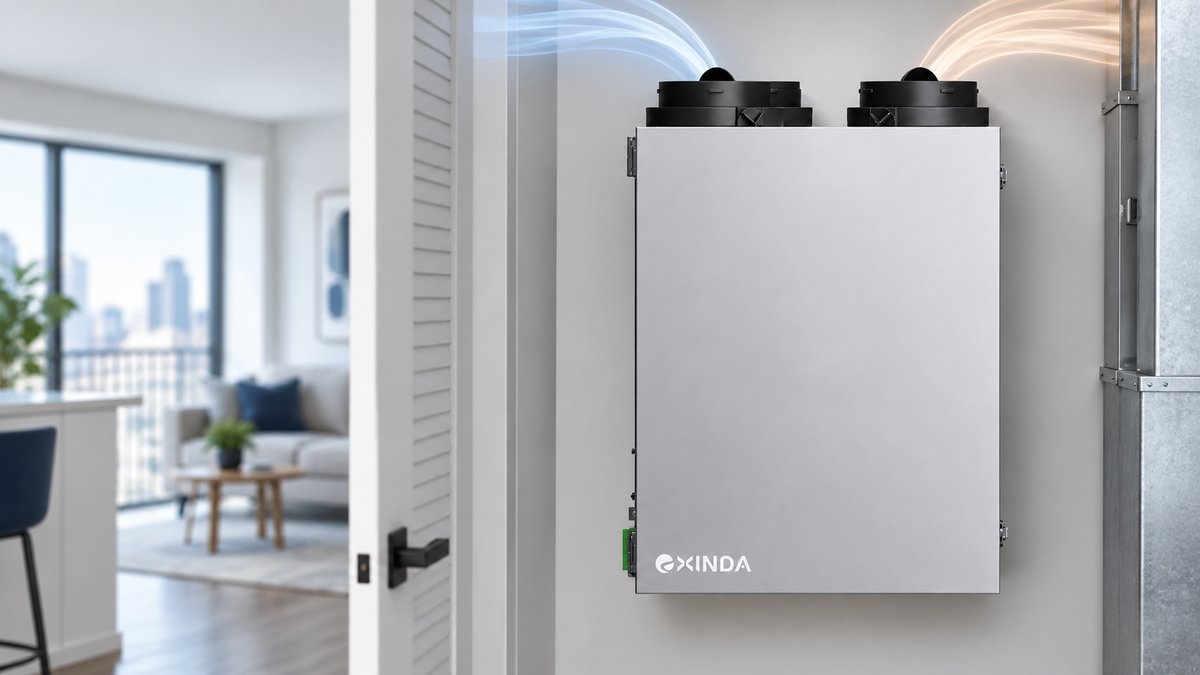
EXINDA Breeze IWMBCOOF1AYE is a wall-mounted energy recovery ventilator with three airflow settings — 100 CFM at 0.4 in. w.g., 70 CFM at 0.2 in. w.g. and 54 CFM at 0.1 in. w.g. — on a 120 V / 60 Hz supply. It supplies filtered outside air, exhausts stale air from bathrooms and kitchen, and recovers heat and moisture through an ERV core. The unit is certified to UL 1812 for safety and CSA 439 for performance under CSA certificate 80227354, and is listed in the HVI Certified Products Directory under HVID 2005360.
Both references can be checked directly: the HVI listing by HVID, and the CSA certificate by number. EXINDA supplies the technical submittal and the certificate copy on request.

How it installs and runs
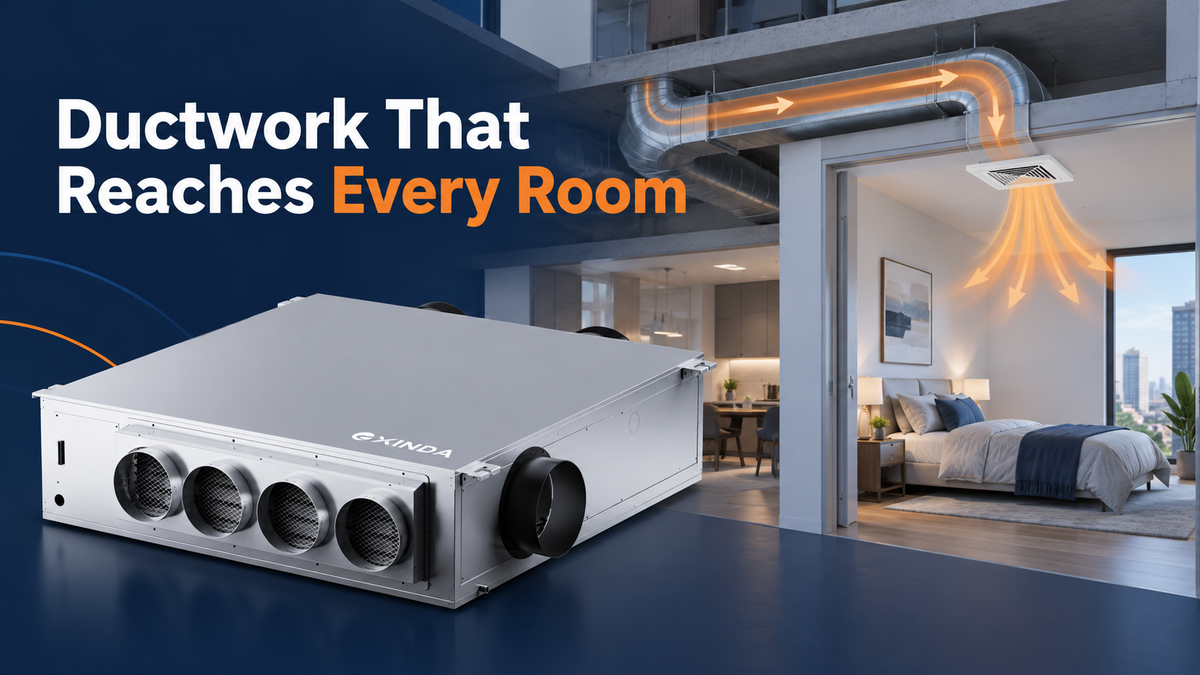
The unit is designed for wall mounting, with horizontal installation as an alternative, and has its four 4 in. duct connections on the top of the cabinet. In a utility closet or mechanical corner that puts the ducts straight up into the ceiling or joist space and keeps the wall around the unit free. Confirm the mounting orientation, the height and the space in front of the service door against the dimensional drawing in the submittal before fixing the location; filter access depends on how and where the unit is mounted.
The fans are ECM with constant-airflow control: within the unit's rated external static pressure range, the set airflow is held as duct resistance changes. Outside that range airflow falls, so the duct design still has to keep the operating point inside it. Recirculation defrost is fitted for cold-weather operation, and the rated outdoor operating range is −18 to 109 °F. The occupant has a three-speed wall control; a bathroom timer that runs the unit on high for 20, 40 or 60 minutes is an option on the Breeze series.

The numbers behind it
| Item | Listed configuration |
|---|---|
| Model | IWMBCOOF1AYE, Breeze series |
| Airflow settings | 100 CFM at 0.4 in. w.g. / 70 CFM at 0.2 in. w.g. / 54 CFM at 0.1 in. w.g. |
| Net supply airflow at 0.4 in. w.g. (HVI) | 102 CFM |
| Sensible recovery efficiency (SRE) | 72% at 0 °C, at 66 CFM net airflow (HVI rated point) |
| Power and efficacy at the rated SRE point | 36 W; 1.8 CFM/W |
| Power supply | 120 V / 60 Hz / 1 ph; MCA 1.4 A, MOP 15 A |
| Sound pressure | 30 / 27 / 23 dBA at the three settings |
| Dimensions and weight | 20-5/8 × 16-5/8 × 16-9/16 in. (H×W×D); 44 lb |
| Mounting | Wall-mounted or horizontal; four 4 in. top-port duct connections |
| Fans | ECM, constant-airflow control within rated static range, three speeds |
| Filters | MERV 8 washable, 2 off |
| Listings | UL 1812 (safety) and CSA 439 (performance), CSA certificate 80227354; HVI Certified, HVID 2005360 |
The full airflow-versus-static-pressure table, recovery efficiency at each test point, power draw and the dimensional drawing are in the technical submittal on the Breeze 54–100 CFM ERV product page. Larger dwellings are covered by the rest of the Breeze range, up to 153 CFM net supply at 0.4 in. w.g. Select by the airflow at your design static pressure, not by the maximum rating.
New to the category? Heat and energy recovery ventilation: how to choose explains the difference between HRV and ERV; this note explains why an ERV is not an air purifier.
Evaluate it for your project
Project customers: send the project location, the type of dwelling, the design ventilation rate and where you intend to mount the unit. EXINDA confirms the model and the airflow at your operating point and sends the submittal and certification documents. Floor plans and duct details can follow once the unit is shortlisted.
Distributors and manufacturer's reps: ask for the Breeze product information pack, sample-unit terms and the conditions for working together.