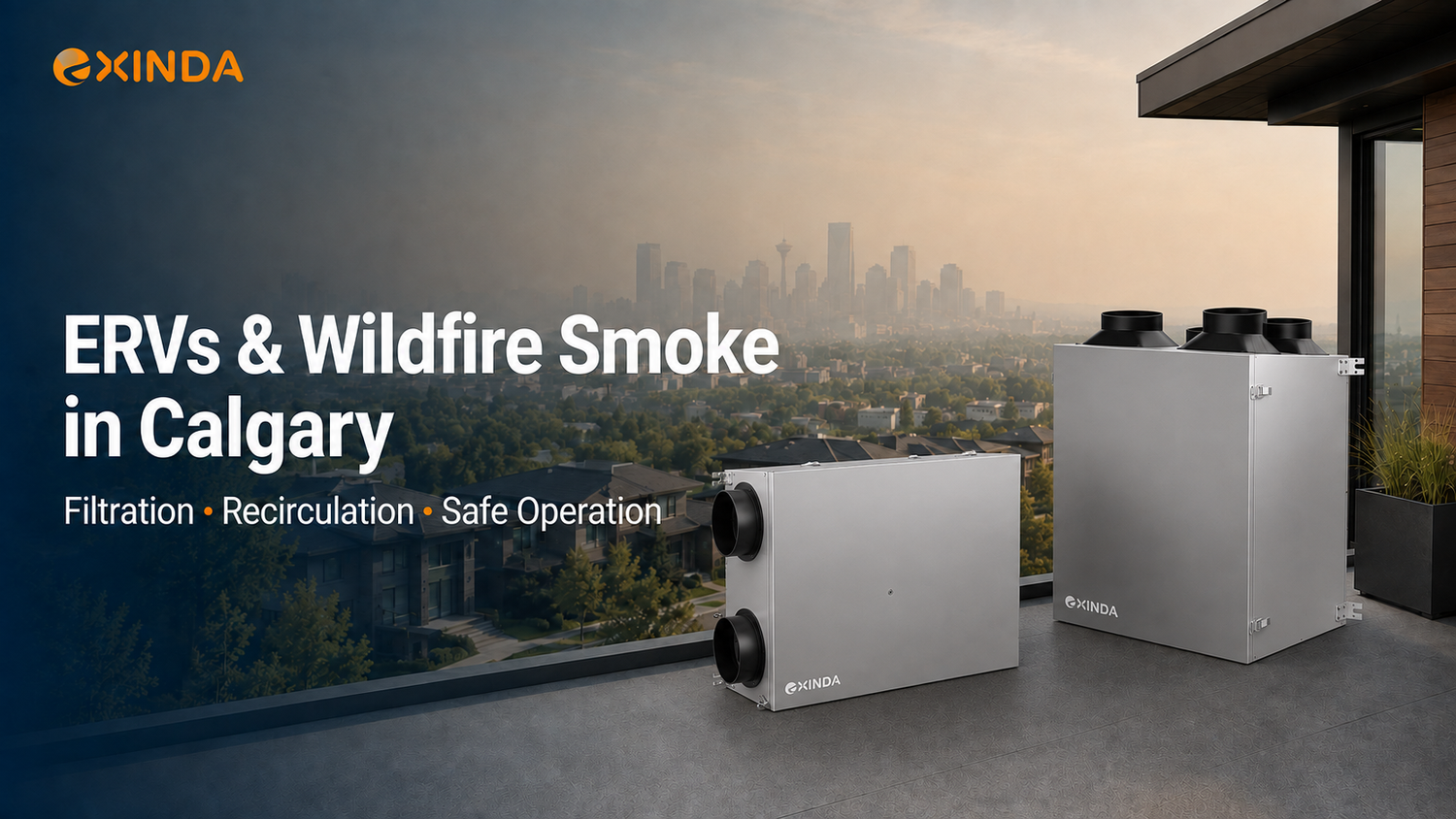
An energy recovery ventilator should not be treated as a wildfire-smoke air cleaner. An ERV normally improves indoor air quality by replacing stale indoor air with outdoor air, but during a Calgary smoke event that outdoor air may contain elevated levels of fine particulate matter. The correct response is usually to limit smoky outdoor-air intake, keep windows and doors closed, and filter recirculated indoor air through a compatible central filter or portable HEPA air cleaner. Whether an ERV should be switched off, reduced or placed in a dedicated recirculation setting depends on its controls and the home's complete HVAC design. Do not assume that an ERV's “recirculation defrost” function is a selectable smoke-protection mode.
Why wildfire smoke changes the ventilation strategy
Under normal outdoor conditions, balanced ventilation is valuable. An ERV exhausts moisture, odours and pollutants generated indoors while supplying outdoor air and recovering part of the heat and moisture exchanged between the two air streams.
Wildfire smoke reverses one part of that logic: outdoor air is temporarily no longer the cleaner air source.
The main concern is PM2.5 - fine particles with an aerodynamic diameter of 2.5 micrometres or less. These particles can penetrate deep into the lungs. Health Canada recommends keeping indoor PM2.5 as low as possible during smoke events and reducing the infiltration of polluted outdoor air.
For Calgary homes, the ventilation strategy therefore needs two operating states:
-
Normal ventilation mode: provide balanced outdoor air when the outdoor air is acceptable.
-
Smoke response mode: reduce uncontrolled outdoor-air entry and clean the indoor air through recirculation filtration or portable air cleaning.
The change should be based on actual outdoor conditions rather than the appearance or smell of the air alone. Calgary residents and building operators can monitor the official Calgary Air Quality Health Index and check local air-quality alerts before changing system operation.
Should you turn off an ERV during wildfire smoke in Calgary?
When outdoor smoke is affecting air quality, Alberta Health Services advises people to avoid operating fresh-air ventilation systems that bring additional smoky air indoors. The City of Calgary similarly advises closing fresh-air intakes and using recirculation where available.
For many residential ERV systems, this means temporarily switching the ERV to standby or using a manufacturer-approved smoke setting. However, the correct action depends on how the ERV is connected to the furnace, air handler, kitchen exhaust, bathroom exhaust and combustion appliances.
Do not permanently block ducts or modify dampers without understanding the system. In some homes, exhaust equipment can depressurize the building and increase infiltration through envelope leaks. Homes with fuel-burning appliances also require particular care to avoid pressure and combustion-safety problems.
If the controls are unclear, the safest project-level approach is to have a qualified Calgary HVAC contractor identify:
-
which control stops the outdoor-air supply;
-
whether the exhaust side also stops;
-
whether a true indoor recirculation path exists;
-
how the furnace or air-handler fan operates during smoke mode;
-
which filter receives the recirculated air;
-
and how normal balanced ventilation will be restored after outdoor conditions improve.
Recirculation mode and recirculation defrost are not the same thing
This distinction is important when reviewing an ERV submittal.
A dedicated recirculation mode is an operating sequence designed to circulate indoor air without intentionally bringing in outdoor air. When paired with an appropriate filter, it may form part of a home's smoke-response strategy.
Recirculation defrost, by contrast, is a cold-weather protection sequence. It temporarily changes airflow to help prevent frost accumulation in the heat-recovery core. A submittal that lists “recirculation defrost” does not, by itself, prove that the homeowner can select a smoke-mode recirculation function.
Contractors should confirm the control sequence, damper arrangement and airflow path before promising recirculation capability to a builder or homeowner.
Is the filter inside an ERV enough for wildfire smoke?
Usually, no.
Many residential ERVs use washable filters intended primarily to protect the fans and heat-exchange core from larger dust and debris. Fine wildfire particles require a more capable filtration strategy.
Health Canada recommends MERV 13 or higher for removing fine particulate matter where the HVAC system can accommodate it. Calgary's climate-readiness guidance also recommends a MERV 13 furnace filter, or the highest rating that the system fan and filter slot can support.
That final condition matters. A higher-efficiency filter normally creates more airflow resistance. Installing a dense filter in a slot or ERV not designed for it can reduce airflow, disturb supply/exhaust balance and increase fan load. Contractors should verify:
-
the filter's actual dimensions and face area;
-
clean and loaded pressure drop;
-
available fan static pressure;
-
airflow at the required external static pressure;
-
access for inspection and replacement;
-
and the manufacturer's permitted filter options.
Do not simply insert a MERV 13 filter into an ERV designed around a lower-resistance filter. In many homes, the better smoke-control arrangement is a compatible MERV 13 filter in the central recirculating furnace or air-handler system, supplemented by a correctly sized portable HEPA air cleaner.
A practical operating sequence for a Calgary home
The following is a general decision framework, not a substitute for the equipment manual or a site-specific HVAC assessment.
| Outdoor condition | ERV / fresh-air action | Indoor-air cleaning action | Other actions |
|---|---|---|---|
| Outdoor air is acceptable | Operate the ERV at the normal commissioned setting | Use normal HVAC filtration | Maintain balanced airflow and clean filters |
| Smoke is forecast or beginning | Check controls, filters and local AQHI | Prepare the central recirculation system and portable HEPA units | Close windows and doors; reduce indoor pollution sources |
| Smoke is affecting local air quality | Stop or reduce outdoor-air intake using approved controls | Recirculate indoor air through the highest compatible filtration; run portable HEPA cleaners | Limit bathroom/kitchen exhaust where safe and practical; continue monitoring |
| Outdoor air improves | Restore outdoor air deliberately | Continue filtration while indoor particle levels fall | Inspect filters and replace or clean them as required |
The City of Calgary recommends keeping windows and doors closed, checking furnace filters and using HEPA air purifiers when available. It also advises closing fresh-air intakes and setting air conditioning to recirculate during smoke events.
Why “turn it off and forget it” is not a complete plan
Temporarily limiting outdoor air can reduce smoke entry, but an occupied home continues to generate carbon dioxide, moisture, cooking pollutants, odours and volatile organic compounds. A smoke event may also coincide with hot weather, increasing the need for cooling.
The goal is therefore not to eliminate ventilation indefinitely. It is to minimize exposure while outdoor conditions are poor and restore controlled ventilation when the air improves.
For homes occupied by people with asthma, heart or lung conditions, pregnant people, young children, seniors or others who are more susceptible to smoke, follow public-health advice and consider professional guidance. A portable air cleaner should be correctly sized for the room and should not generate ozone.
Smoke-ready ventilation design for Calgary builders
The most effective time to plan for wildfire smoke is before the home is occupied. A Calgary builder or mechanical contractor can make the system easier to operate by documenting a clear smoke-response sequence.
1. Give the homeowner an identifiable outdoor-air control
The homeowner should know how to stop or reduce outdoor-air intake without disconnecting wiring or closing an undocumented manual damper. The control label and homeowner instructions should explain how and when to restore normal ventilation.
2. Separate ventilation from particle removal
An ERV exchanges air; it is not automatically a high-efficiency air cleaner. The design should identify where fine-particle removal occurs - for example, at a compatible central return filter or through portable HEPA units.
3. Check filter pressure drop during design
“MERV 13” is not enough information on its own. Filter area, depth and airflow determine pressure drop. The furnace, air handler and duct system must be able to deliver the required airflow as the filter loads.
4. Commission the balanced airflow
Normal ERV operation should be balanced at the installed duct resistance. Constant-airflow motors and automatic balancing can simplify commissioning, but installers should still verify terminal airflow and the interaction with other exhaust equipment.
5. Make maintenance access obvious
Smoke can load filters quickly. Filters should be accessible without dismantling major components, and the homeowner should receive clear inspection and replacement instructions.
6. Provide a written restart procedure
After the smoke clears, the homeowner should know how to reopen the outdoor-air path, restore the ERV's normal operating mode and inspect the filters. A system that remains unintentionally disabled cannot provide its normal indoor-air-quality function.
How EXINDA supports Calgary residential ventilation projects
EXINDA supplies residential energy recovery ventilators for cold-climate applications and supports builders, HVAC contractors and distributors with model selection, submittals, airflow data and system-integration information.
For a Calgary project, EXINDA can help the project team review the required ventilation airflow, available external static pressure, duct layout, installation orientation, furnace interface and cold-weather control requirements. The final ERV model should be selected only after these project conditions have been confirmed.
Wildfire-smoke protection must be evaluated separately from normal ventilation performance. EXINDA does not represent a residential ERV as a complete smoke-filtration system unless the specific model, filter configuration and control sequence have been verified for that purpose. Where a project requires MERV 13 filtration, a dedicated smoke mode or integration with central recirculation, those requirements should be identified during design and checked against the applicable equipment documentation.
This approach allows EXINDA to support the ventilation part of a smoke-ready HVAC strategy without overstating what an ERV can do on its own.
Frequently asked questions
Does an ERV filter wildfire smoke?
An ERV may capture some particles depending on its filter, but its primary function is balanced ventilation and energy recovery, not smoke cleaning. Many residential ERV filters are intended to protect the equipment from larger dust. During wildfire smoke, fine-particle control normally requires the highest compatible central HVAC filtration and/or a properly sized portable HEPA air cleaner.
Should I switch off my ERV when Calgary's air quality is poor?
When outdoor smoke is affecting air quality, public guidance recommends limiting systems that bring smoky outdoor air inside. Switching the ERV to standby may be appropriate, but the correct control action depends on the system design. Confirm whether the unit stops both supply and exhaust and whether other exhaust equipment could depressurize the home.
Is recirculation defrost the same as recirculation mode?
No. Recirculation defrost is a temporary cold-weather sequence used to protect the ERV core from frost. A true recirculation mode is intended to circulate indoor air without outdoor-air intake. Contractors should verify the control logic and airflow path before describing an ERV as having a smoke-ready recirculation mode.
Can I replace an ERV's MERV 8 filter with MERV 13?
Only if the equipment manufacturer confirms that the unit can accommodate the filter's dimensions and pressure drop. A more restrictive filter can reduce airflow and disrupt balance. In many Calgary homes, MERV 13 filtration is better located in a compatible furnace or air-handler return, where filter area and fan capability can be properly evaluated.
What is the best way to monitor smoke conditions in Calgary?
Use the official Calgary AQHI and local air-quality alerts rather than relying only on smell or visibility. Conditions can change over a short period. Where possible, an indoor PM2.5 monitor can help show whether the home's filtration and smoke-response measures are keeping indoor particle levels below outdoor levels.
When should normal ERV ventilation restart after a smoke event?
Restore normal ventilation when local outdoor air has improved, following the manufacturer's control instructions. Continue indoor filtration while particle levels decline, inspect filters for loading and confirm that the ERV has returned to its commissioned setting. Do not leave the system unintentionally disabled after the event.
What should a Calgary builder include in a smoke-ready ventilation package?
The package should include an identifiable outdoor-air control, a documented smoke-response sequence, compatible central filtration, space for filter service, balanced-airflow commissioning and clear homeowner instructions. The ERV, furnace or air handler, exhaust equipment and portable air-cleaning plan should be treated as one coordinated system.
Plan the complete system, not just the ERV
Wildfire-smoke resilience depends on control, filtration, airflow and homeowner instructions working together. EXINDA can review the required ventilation airflow, duct configuration, external static pressure and furnace interface to help contractors select an appropriate ERV and define the information needed for a smoke-ready HVAC sequence.
Send EXINDA your Calgary project airflow requirements and duct layout to request a model-specific submittal and ventilation integration review. Final system design, installation and commissioning should be completed by a qualified local professional.