ERV Supplier British Columbia selection is becoming increasingly important for building-supply companies serving energy-efficient homes, townhouses and multifamily developments across BC.
As British Columbia buildings become more airtight, builders need controlled ventilation that can introduce outdoor air, exhaust stale indoor air and reduce ventilation-related energy loss.
For wholesalers and building-material suppliers, adding Energy Recovery Ventilators can create a new opportunity to serve:
- Residential builders
- HVAC and ventilation contractors
- Townhouse developers
- Multifamily project owners
- Modular-home manufacturers
- Mechanical consultants
- Energy-efficient renovation companies
However, selecting an ERV product line requires more than comparing purchase price and maximum airflow. BC distributors should evaluate HVI-published performance, SRE at 0°C, cold-weather operation, external static pressure, filtration, installation configurations and manufacturer support.
Why Are BC Building-Supply Companies Adding ERVs?
Airtight construction can reduce heating energy loss, but it also reduces uncontrolled natural air leakage.
Without properly designed mechanical ventilation, moisture, odours and indoor pollutants may accumulate inside the building. An ERV provides balanced ventilation while transferring sensible heat and moisture between the exhaust and incoming air streams.
This makes ERVs a natural extension for companies already supplying:
- Mechanical equipment
- HVAC accessories
- Ductwork and ventilation products
- Insulation and building-envelope materials
- Electrical products
- Indoor-air-quality solutions
A qualified ERV Supplier British Columbia partner should help the distributor develop a complete product category—not simply sell individual units.
Why Does SRE at 0°C Matter in British Columbia?
Sensible Recovery Efficiency, or SRE, measures how effectively an ERV recovers sensible heat under defined test conditions.
SRE at 0°C is an important comparison point in British Columbia because it provides builders, contractors and energy advisors with a standardized winter-performance reference.
Applicable BC Building Code provisions have historically referenced at least 60% sensible heat-recovery efficiency at an outdoor test temperature of 0°C for qualifying residential systems. Colder locations may also require performance evaluation at −25°C.
However, many high-performance projects and energy-conscious buyers look beyond the basic minimum.
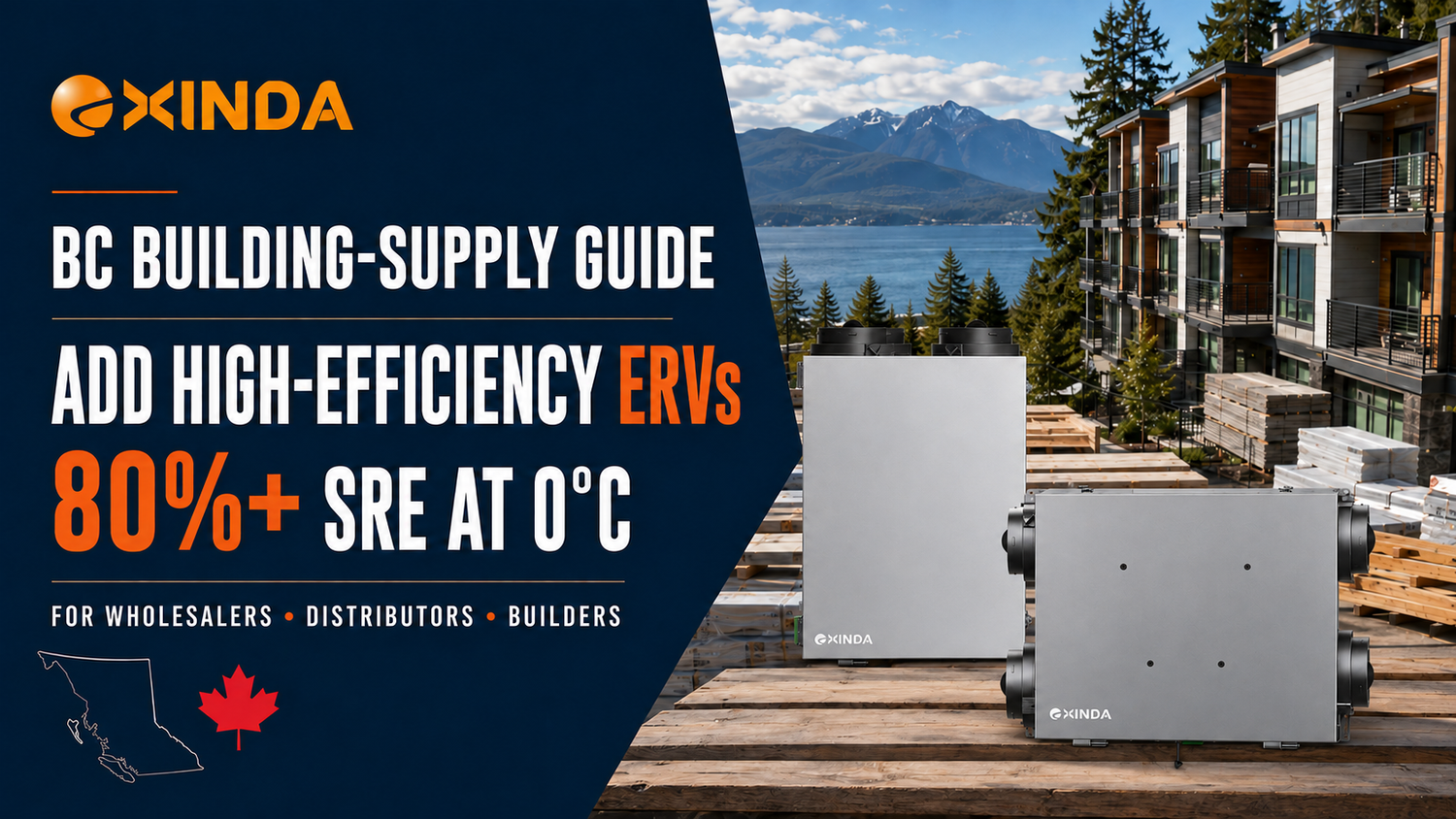
Selected ERVs with published SRE of 80% or higher at 0°C may help distributors serve:
- High-performance residential construction
- Energy-efficient renovation projects
- Builders offering premium ventilation packages
- Projects with demanding energy targets
- Customers seeking lower ventilation-related heat loss
- Vancouver-area projects using energy-upgrade criteria
The City of Vancouver’s renovation energy-upgrade checklist identifies ERV or HRV equipment exceeding 80% SRE at 0°C as a higher-efficiency upgrade option.
An 80% SRE rating is not a universal legal minimum for every project in BC. Requirements can vary according to the building type, municipality, permit pathway and project specification.
A distributor should therefore check the published performance of the exact model at the required airflow rather than relying only on the highest efficiency shown in a product brochure.
What HVI Data Should a BC Distributor Check?
A reliable ERV Supplier British Columbia programme should provide model-specific performance data that can be reviewed by builders, contractors and mechanical consultants.
Before adding an ERV to a catalogue, check the following:
| Performance Information | Why It Matters in BC |
|---|---|
| SRE at 0°C | Supports standardized energy-performance comparison |
| SRE at −25°C | Important for colder BC locations and project specifications |
| Rated airflow | Confirms whether the model matches the dwelling |
| External static pressure | Shows whether airflow can be maintained through the duct system |
| HVI listing | Provides independently published performance data |
| Frost-control sequence | Explains operation during freezing conditions |
| Power consumption | Supports energy modelling and operating-cost evaluation |
| Supply and exhaust balance | Supports correct field commissioning |
| Sound data | Important for bedrooms, apartments and compact homes |
| Filter specification | Supports filtration and replacement planning |
A high SRE number alone does not make an ERV suitable for every project.
The SRE value should be reviewed at the project’s required airflow. Recovery efficiency, power consumption and external static capability may change at different fan speeds.
Why Is HVI-Listed Performance Important?
HVI-listed performance gives distributors and project professionals a standardized source for reviewing ventilation equipment.
Depending on the listed model, published data may include:
- Supply airflow
- Exhaust airflow
- Sensible Recovery Efficiency
- Total Recovery Efficiency
- Power consumption
- Performance at defined outdoor temperatures
- Rated operating conditions
This helps a building-supply company present an ERV to contractors and consultants using verifiable data instead of unsupported marketing claims.
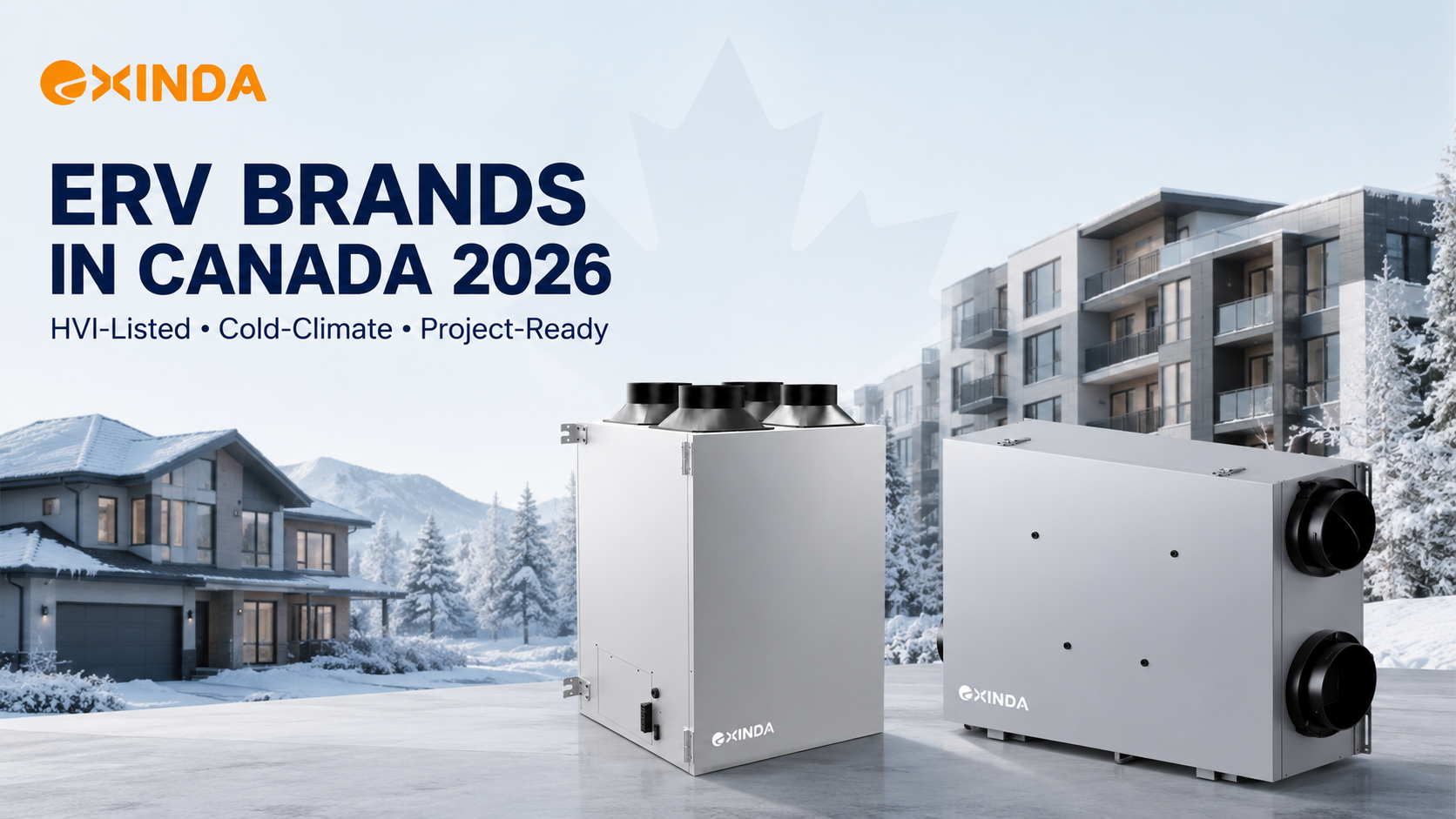
EXINDA offers HVI-listed residential ERVs for Canadian projects. Certification, SRE and airflow data should always be checked for the exact model being proposed.
BC Needs More Than One ERV Configuration
British Columbia has a diverse range of housing and installation conditions.
Vancouver apartments may have limited mechanical space. Townhouse developments need repeatable installation layouts. Detached homes may use basement, utility-room or suspended installations. Modular homes need compact equipment with predictable duct connections.
A practical ERV Supplier British Columbia range should include:
- Multiple residential airflow capacities
- Top-port and side-port configurations
- Compact casing dimensions
- Accessible filters and service panels
- Field-adjustable airflow
- Wall-controller options
- Cold-weather frost control
- Installation flexibility
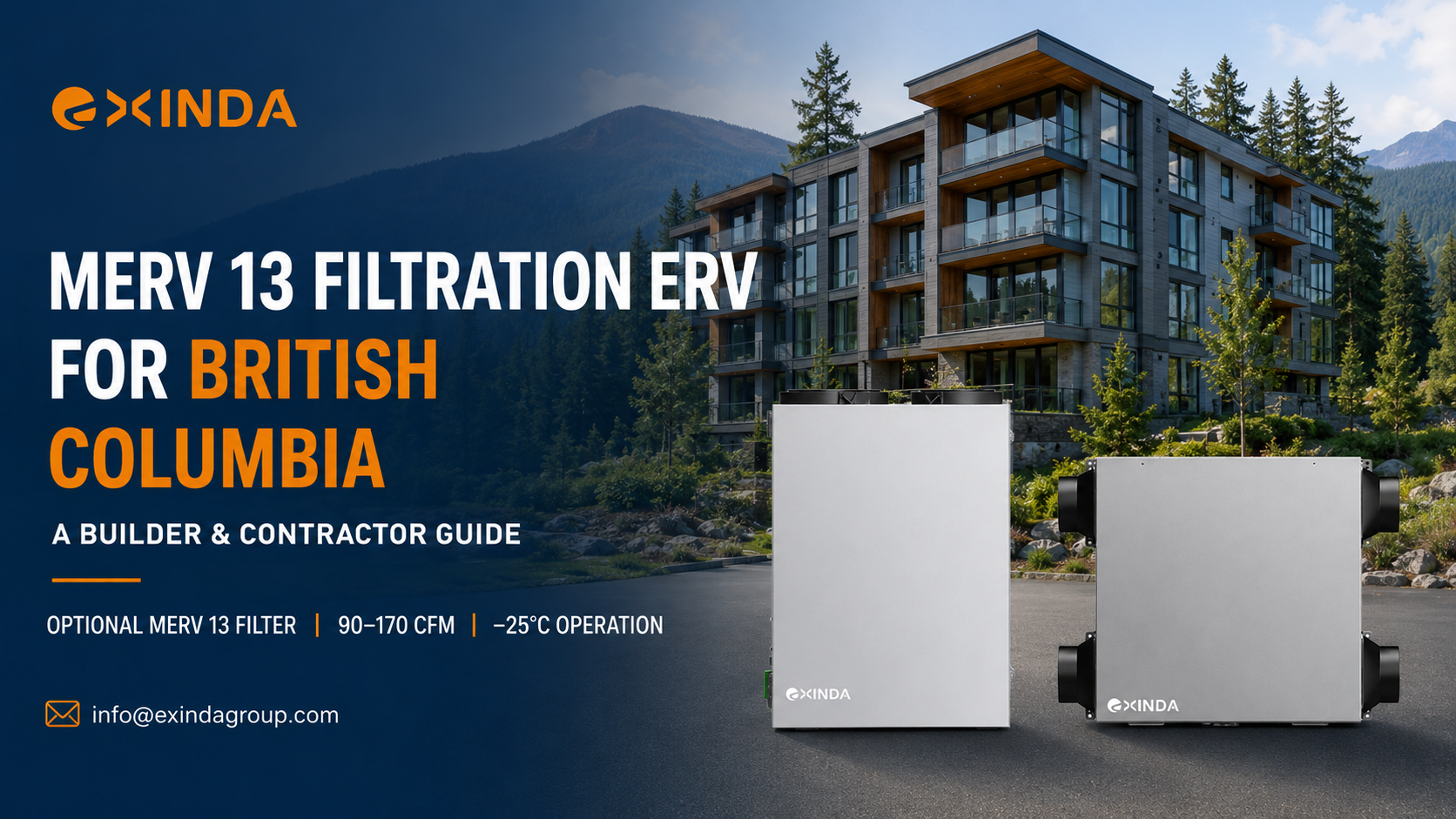
EXINDA offers residential ERV configurations in approximately the 90–170 CFM range for Canadian projects, including top-port and side-port models.
This allows wholesalers to serve several residential applications without using one oversized model for every home.
Why Is MERV 13 Relevant in British Columbia?
During wildfire season, BC builders and homeowners may ask for higher-efficiency outdoor-air filtration.
MERV 13 can be a useful option for projects concerned about smoke and fine particulate matter. However, higher-efficiency filtration also introduces additional resistance to airflow.
Before offering MERV 13, confirm:
- Available external static pressure
- Airflow with the selected filter installed
- Filter dimensions
- Replacement interval
- Fan-speed adjustment requirements
- Whether certified performance uses the standard or optional filter
MERV 13 should be treated as a project-specific option rather than automatically fitted to every ERV.
A qualified ERV Supplier British Columbia partner should explain the relationship between filtration, pressure drop and delivered airflow.
What Distributor Support Should Be Included?
Building-supply companies need more than product availability. They need documentation and support that allow them to sell, specify and service the equipment.
Sales and selection support
- Canadian product catalogue
- Model-selection guidance
- Builder and project quotations
- Top-port and side-port comparisons
- Airflow and external-static-pressure data
- Sample-unit support
Engineering documentation
- Product submittals
- HVI performance references
- Dimension drawings
- Wiring diagrams
- Installation manuals
- Revit or BIM files where available
- Control sequences
- Commissioning guidance
After-sales support
- Service manuals
- Troubleshooting guidance
- Replacement filters
- Controllers and sensors
- Motors and control boards
- Recommended spare-parts list
- Warranty procedures
- Technical training
Marketing support
- Product photography
- Canadian specification sheets
- Catalogue content
- Builder presentations
- Product comparison tables
- Dealer and showroom materials
These resources allow a distributor to build a supported ERV category instead of selling an isolated imported product.
EXINDA Brand or Private Label?
Building-supply companies generally have two cooperation options.
| Cooperation Model | Best Suited For | Main Advantage |
| EXINDA-branded ERVs | New distributors, regional dealers and project suppliers | Faster entry with established product identity and technical documentation |
| Private-label ERVs | Established HVAC brands with sufficient volume and service capability | Greater control over branding, packaging and market positioning |
For most new BC partners, starting with EXINDA-branded products is the more practical approach.
The distributor can first evaluate:
- Local market demand
- Installer feedback
- Builder acceptance
- Suitable model mix
- Replacement-filter demand
- Warranty requirements
- Local stocking volume
Private-label cooperation can be evaluated after territory, expected volume, certification responsibilities and after-sales obligations are clearly defined.
How Should a BC Distributor Start?
A lower-risk launch can follow four steps.
1. Select the initial models
Choose models covering the most common residential airflow requirements. Include top-port and side-port configurations when serving different housing types.
2. Review the technical package
Check HVI performance, SRE at the required airflow, external static pressure, frost control, dimensions, electrical requirements and filtration options.
3. Test a sample unit
Use the sample for installer training, showroom demonstration, airflow verification and feedback from builders or mechanical consultants.
4. Prepare local inventory and parts
Stock frequently requested models together with replacement filters, controllers and essential spare parts.
A responsive ERV Supplier British Columbia partner should support this staged market-entry process rather than requiring a distributor to select a large product mix without local validation.
Why Work With EXINDA in British Columbia?
EXINDA supports Canadian residential and multifamily ventilation applications with:
- HVI-listed ERV models
- Selected models with published SRE of 80% or higher at 0°C
- Cold-climate operation down to −25°C on applicable models
- Residential airflow options from approximately 90 to 170 CFM
- Top-port and side-port configurations
- Field-adjustable airflow
- Optional higher-efficiency filtration
- Product submittals and technical documentation
- Builder, contractor and distributor support
- Spare-parts and after-sales cooperation
- EXINDA-branded and qualified OEM cooperation options
The final model should always be selected according to required airflow, external static pressure, climate, filtration, duct configuration and project requirements.
Frequently Asked Questions
Is 80% SRE at 0°C mandatory for every BC ERV?
No. An SRE of 80% at 0°C is not a universal minimum for every building in British Columbia.
However, 80% or higher can be a valuable high-performance benchmark for energy-conscious projects and distributor product differentiation.
Should a distributor verify the HVI listing?
Yes. The HVI listing allows distributors, builders and consultants to review performance under standardized conditions.
Check the exact model and rated airflow rather than relying on a product-family claim.
Is MERV 13 suitable for British Columbia?
MERV 13 can be valuable for wildfire-smoke and higher-filtration applications, but it increases pressure drop. The ERV should be evaluated to ensure that it maintains the required airflow.
Are top-port and side-port ERVs both necessary?
Offering both configurations provides greater flexibility for detached homes, townhouses, apartments and modular construction. Selection depends on duct routing, available space and service access.
Can a BC distributor begin with sample units?
Yes. Sample units allow the distributor to confirm installation, controls, airflow, sound and documentation before establishing local inventory.
Partner With an ERV Supplier in British Columbia
Choosing an ERV Supplier British Columbia partner requires more than comparing unit price.
The strongest programme combines:
HVI data → SRE at 0°C → airflow and static pressure → BC installation flexibility → filtration → technical documentation → parts and service
EXINDA works with British Columbia building-supply companies, HVAC wholesalers, builders and contractors to provide model selection, technical documentation, sample support and product-range planning.
For an EXINDA Canadian ERV catalogue, model recommendation or distribution discussion, contact:
Email: info@exindagroup.com