How to Select an ERV for an Alberta New Home
A practical guide for HVAC contractors covering airflow, cold-climate performance, duct configuration and commissioning
Quick Answer
When selecting an ERV for an Alberta new home, contractors should confirm:
-
Required ventilation airflow
-
Airflow at the expected static pressure
-
Applicable certification and compliance documentation
-
Cold-weather operation and defrost method
-
Top-port or side-port configuration
-
Furnace integration requirements
-
Airflow balancing and maintenance access
The correct ERV should match the home’s ventilation design, duct resistance and installation layout—not only its floor area.
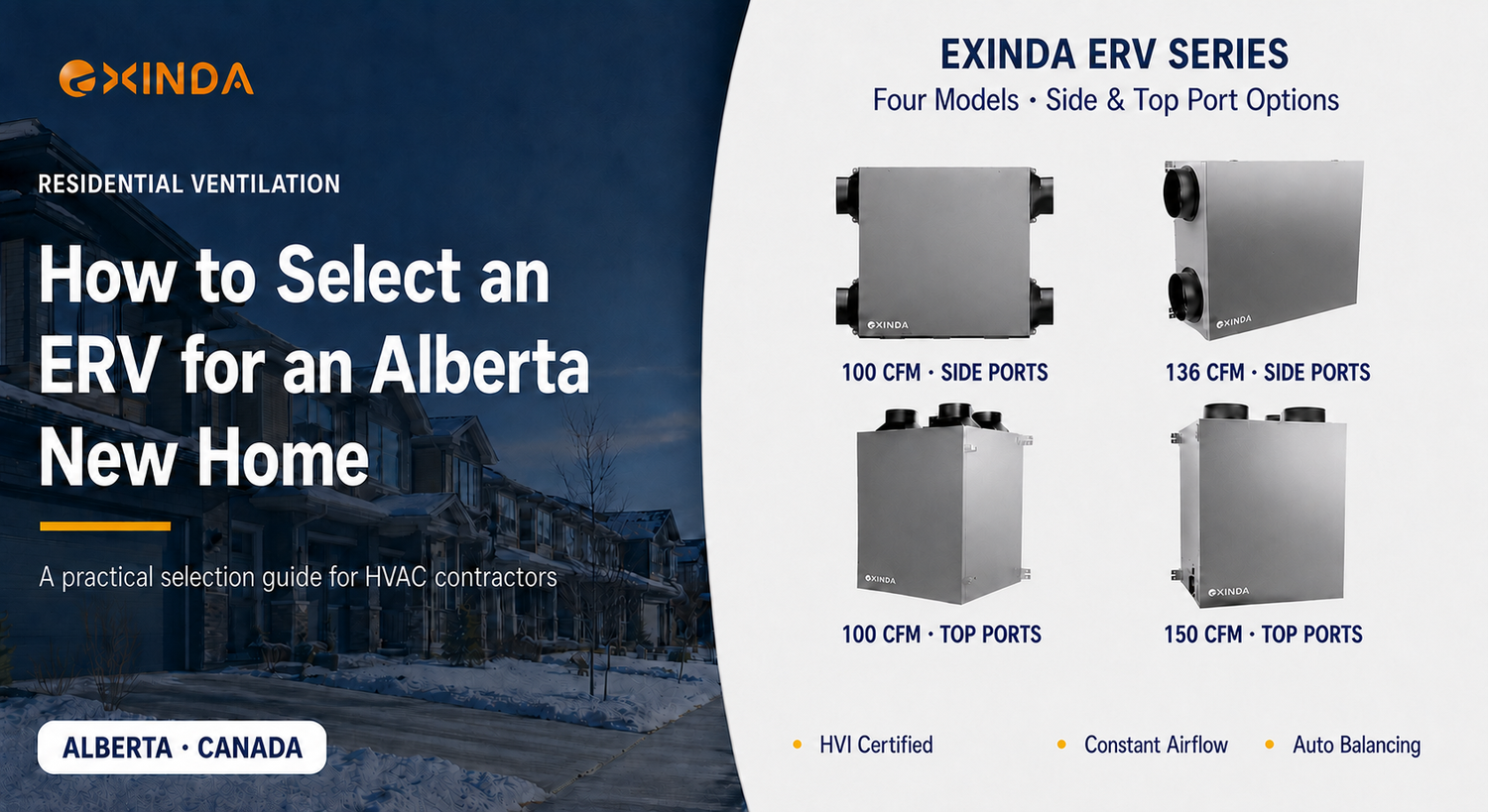
EXINDA offers residential ERVs with rated airflow from 160 to 260 m³/h at 100 Pa, approximately 100 to 150 CFM. The range includes side-port and top-port configurations, ECM motors, constant-airflow control and automatic airflow balancing.
Why ERV Selection Matters in Alberta New Construction
Modern Alberta homes are built with tighter envelopes to reduce heating loss. While this improves energy efficiency, it also increases the need for controlled mechanical ventilation.
An ERV supplies outdoor air, exhausts stale indoor air and transfers energy between the two air streams. However, ducts, elbows, filters, grilles and exterior hoods can reduce actual airflow.
For contractors, ERV selection is therefore a system-design decision—not simply a comparison of maximum airflow ratings.
Alberta currently applies the National Building Code – 2023 Alberta Edition. Final ventilation design and equipment selection should follow the project documents and local authority requirements. Government of Alberta
Step 1: Determine the Required Ventilation Airflow
Start with the project’s ventilation calculation.
Consider:
-
Conditioned floor area
-
Number of bedrooms
-
Continuous ventilation airflow
-
Bathroom boost requirements
-
Exhaust locations
-
Furnace or dedicated-duct integration
Avoid selecting a unit that must operate continuously at maximum speed. Some additional capacity allows for duct resistance, filter loading and field balancing.
Step 2: Check Airflow at External Static Pressure
The maximum airflow shown in a brochure may not represent actual installed performance.
Pressure loss can be created by:
-
Long or undersized ducts
-
Elbows and transitions
-
Exterior intake and exhaust hoods
-
Filters and grilles
-
Balancing dampers
Contractors should review the airflow-performance data and confirm that the ERV can deliver the required airflow at the project’s expected external static pressure.
| Selection check | Why it matters |
|---|---|
| Required airflow | Establishes the ventilation target |
| Airflow at static pressure | Confirms installed performance |
| Adjustable airflow | Supports system balancing |
| Available capacity | Allows for duct and filter resistance |
EXINDA ERV airflow ratings are stated at 100 Pa, providing contractors with a defined pressure condition for initial model comparison.
Step 3: Use Verified Performance Data
Before approving an ERV, contractors should review the model-specific technical documentation rather than relying only on general marketing claims.
Request:
-
Airflow data at the stated pressure
-
Thermal-efficiency data
-
Electrical information
-
Defrost method
-
Installation instructions
-
Wiring diagram
-
Balancing procedure
-
Applicable certification and compliance documents
The required certification may vary by project and jurisdiction. Contractors should confirm acceptance with the consultant, builder and local authority before final equipment approval.
Step 4: Evaluate Cold-Climate Operation and Defrost
During Alberta winters, moisture in the exhaust air can freeze inside the recovery core. The ERV therefore needs an appropriate frost-protection strategy.
Confirm:
-
Defrost method
-
Defrost activation conditions
-
Airflow behaviour during defrost
-
Condensate requirements
-
Cold-side duct insulation
-
Winter maintenance access
EXINDA ERVs use either fan defrost or recirculation defrost, depending on the model. Contractors should confirm the applicable operating conditions in the model-specific technical submittal.
Step 5: Choose the Correct Port Configuration
Port configuration affects duct routing, installation time and system resistance.
Top-Port ERV
A top-port model is generally suitable when the main ducts run overhead and sufficient vertical clearance is available.
Side-Port ERV
A side-port model may be preferable when ducts run horizontally or ceiling clearance is limited.
| Configuration | EXINDA airflow options |
|---|---|
| Side port | 160 or 250 m³/h @ 100 Pa |
| Top port | 170 or 260 m³/h @ 100 Pa |
Selecting the port configuration before duct rough-in can reduce unnecessary elbows and simplify future maintenance.
Step 6: Decide How the ERV Will Work with the Furnace
Before selecting the ERV, determine whether the system will use dedicated ventilation ducts or connect to the furnace ductwork.
Contractors should confirm:
-
Fresh-air supply locations
-
Stale-air extraction locations
-
Furnace blower operation
-
ERV and furnace control interlock
-
Bathroom boost controls
-
Approved duct arrangement
The installation should follow the ERV manufacturer’s instructions and the project’s mechanical design.
Step 7: Plan for Balancing and Commissioning
Even a correctly sized ERV can perform poorly if it is not balanced.
During commissioning:
-
Confirm that all ducts are connected and sealed.
-
Check the intake and exhaust terminals.
-
Measure supply and exhaust airflow.
-
Adjust the system to the design airflow.
-
Test boost mode and furnace interlock.
-
Record the final settings.
-
Explain filter and core maintenance to the homeowner.
EXINDA ERVs include constant-airflow control and automatic airflow balancing, helping the system respond to changes in duct pressure and filter resistance. Final field measurements should still be completed according to the project requirements.
ERV Selection Checklist for Alberta Contractors
Before approving an ERV, confirm:
-
Required continuous and boost airflow
-
Airflow at the expected static pressure
-
Applicable certification and compliance documents
-
Thermal-efficiency data
-
Cold-weather operating conditions
-
Defrost method
-
Top-port or side-port configuration
-
Furnace integration method
-
Filter and maintenance access
-
Balancing procedure
-
Technical submittal and wiring diagram
-
Warranty and technical support
Which EXINDA ERV Is Suitable for an Alberta New Home?
EXINDA offers four residential ERV configurations with rated airflow from 160 to 260 m³/h at 100 Pa, approximately 94 to 153 CFM.
| Model | Airflow at 100 Pa | Approx. airflow | Port configuration | Thermal efficiency |
|---|---|---|---|---|
| ICMBCNF1AYE | 160 m³/h | 95 CFM | Side port | 77% |
| ICMBCOFF1AYE | 250 m³/h | 136 CFM | Side port | 77% |
| IWMBCOOF1AYE | 170 m³/h | 102 CFM | Top port | 72% |
| IWMBCOFF1AYE | 260 m³/h | 153 CFM | Top port | 77% |
All four models feature:
-
ECM motors
-
Constant-airflow control
-
Automatic airflow balancing
-
Front-access maintenance
-
Model-specific frost protection
-
Multiple controller options
Final model selection should be based on the required airflow, duct resistance, installation space and applicable project requirements.
FAQ
Can an ERV be selected by house size alone?
No. Bedroom count, ventilation rate, duct resistance and boost requirements must also be considered.
Why is airflow at static pressure important?
It shows how much airflow the ERV can deliver after resistance from ducts, filters, grilles and exterior hoods is included.
Does an Alberta ERV need defrost?
An appropriate frost-control strategy is required when the recovery core may be exposed to freezing conditions.
What is the difference between top-port and side-port ERVs?
Top-port models are generally suited to overhead ductwork. Side-port models support horizontal duct routing or installations with limited vertical clearance.
Can an ERV connect to furnace ductwork?
Yes, when the installation follows the approved duct arrangement and control requirements.
What documents should contractors request?
Request the technical submittal, airflow data, thermal-efficiency data, defrost information, wiring diagram, installation manual and applicable compliance documents.
Contractor Summary
The right ERV for an Alberta new home should:
-
Deliver the required airflow at the expected static pressure
-
Include appropriate compliance documentation
-
Use a suitable frost-protection strategy
-
Match the available duct layout
-
Integrate correctly with the furnace
-
Be easy to balance, commission and maintain
EXINDA supports residential ventilation projects with side-port and top-port ERVs rated from 160 to 260 m³/h at 100 Pa, approximately 100 to 150 CFM. The range features ECM motors, constant-airflow control, automatic balancing and model-specific fan or recirculation defrost.
Planning an Alberta New-Home ERV Project?
Send EXINDA the required airflow, expected static pressure and mechanical-room layout. Our team can recommend the appropriate 160, 170, 250 or 260 m³/h ERV model and provide the relevant technical submittal for project review.
Talk to EXINDA about an Alberta builder ventilation program for Calgary, Edmonton and Central Alberta.