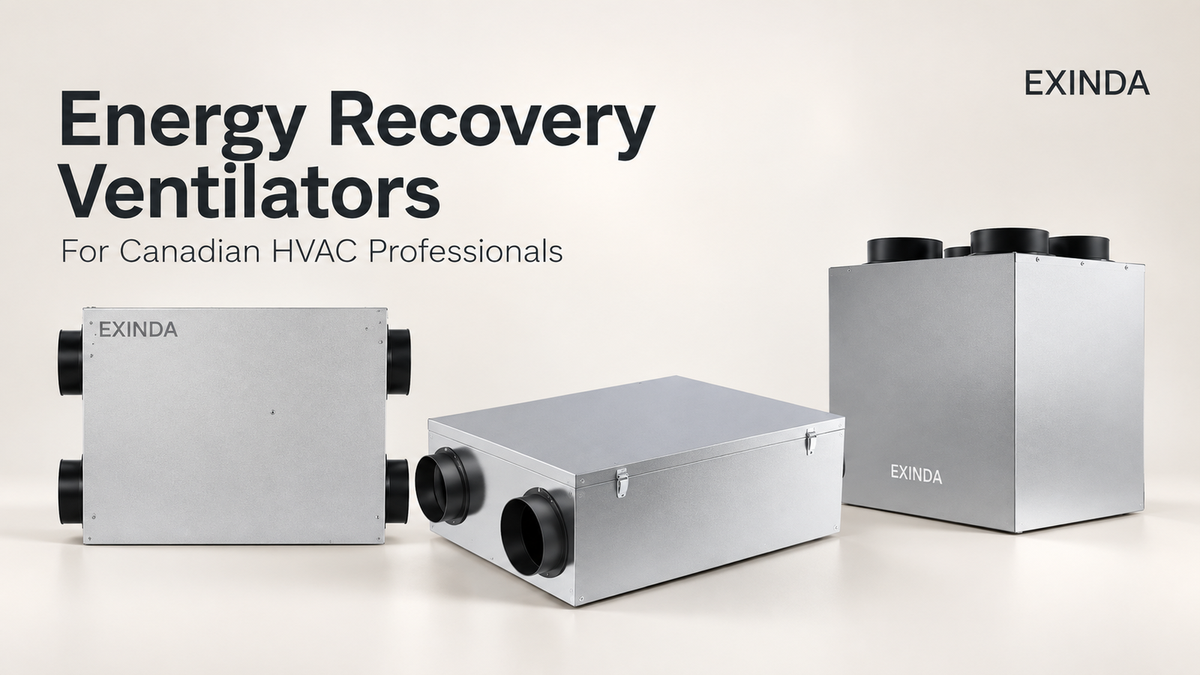
EXINDA is an HVI-listed ERV brand supplying residential energy recovery ventilators for Canadian homes, multifamily buildings and HVAC contractors.
EXINDA ERVs are designed for cold-climate ventilation applications, with residential airflow options for typical Canadian projects, top-port and side-port configurations, ECM fan technology, frost-control strategies and model-specific HVI performance documentation.
For Canadian contractors comparing ERV brands, the key considerations include certified airflow, SRE, performance at low outdoor temperatures, external static pressure, frost control, duct configuration, controls, service access and applicable Canadian safety certification.
Shortlist ERV Brands by Canadian Project Requirements
A useful supplier shortlist starts with the conditions the equipment must meet together: model-specific documentation, winter operation, airflow at design pressure and the available installation space. Use the following checks before comparing commercial proposals.
Model Records and Project Documentation
Match the full model designation to its HVI record and applicable Canadian safety documentation. Keep performance test references, including CSA C439 where applicable, separate from electrical safety listings. The project team should identify the locally applicable requirements and requested submission documents.
Winter Operation and Frost Control
Compare the selected model’s published low-temperature data and defrost sequence with the project conditions. Review how frost control affects outdoor-air delivery, rather than selecting on a minimum-temperature claim alone.
Ceiling Space, Ducts and Service Access
For apartments and retrofits, compare cabinet depth, duct connections, mounting space and access for filters and core removal. Cabinet depth alone does not establish the required ceiling void. Compare ceiling and side-port units with wall-mounted, top-port alternatives where utility space is available.
Airflow at the Installed Resistance
Use supply and exhaust airflow at the design external static pressure, together with the required continuous and boost settings. Account for the proposed duct arrangement and filters when reviewing the selection.
Sample, Delivery and Service Arrangements
For distributors and HVAC brands, review the product range alongside sample evaluation, spare-parts arrangements, training, written warranty coverage and repeat-order support. Agree the responsibilities and terms for the selected model and market rather than assuming that a performance listing covers delivery or service.
EXINDA Products and Support
Compare the five EXINDA Breeze residential ERVs by standard airflow settings, installation layout and duct size. Contractors can follow the submittal preparation guide; distributors and HVAC brands can explore support for HVAC brands and distributors.
For the choice between heat and energy recovery, see the ERV vs HRV selection guide. Request a Canadian ERV selection review with your location, application and required airflow.
ERV Brands to Evaluate
The following brand overview is a starting point for research, not a performance ranking. Compare individual products and local support against the same project requirements.
EXINDA
EXINDA supplies residential energy recovery ventilators for Canadian houses and multifamily applications, with ceiling and wall-mounted configurations and model-specific technical documentation.
Renewaire (USA) – Pioneer in ERV Technology
Based in the United States, Renewaire has been at the forefront of ERV technology for decades. Their residential and light commercial ERVs are known for durability, simple installation, and excellent energy recovery performance. They remain one of the most recognized ERV brands in North America.
Panasonic (Japan) – Household Name, Reliable Ventilation
Panasonic delivers ERVs primarily for residential and light commercial use. Their systems emphasize low energy consumption, quiet operation, and reliability。
Lifebreath (Canada) – Cold Climate Specialist
Lifebreath is widely recognized across Canada and the U.S. for ERVs and HRVs engineered for freezing climates. Their systems integrate seamlessly into homes, ensuring year-round fresh air without excessive energy loss — a key selling point in colder regions.
Venmar (Canada) – Residential Focused Solutions
As part of the Broan-NuTone group, Venmar offers a wide range of ERVs for single-family homes, apartments, and small multi-residential projects. Their distribution network and brand reputation make them a trusted name in North America.
Broan-NuTone (USA) – Long-Established Ventilation Brand
Broan has been providing residential ventilation systems for decades. Their ERVs combine affordability with broad availability, making them a go-to option for builders and contractors working on large residential developments.
Carrier (USA) – HVAC Giant with Integrated ERV Systems
As one of the world’s largest HVAC manufacturers, Carrier integrates ERV technology into its packaged HVAC systems as well as offering stand-alone models. Their ERVs are particularly common in commercial and institutional projects.
Fantech (Canada/USA) – Flexible Ventilation Solutions
Fantech specializes in flexible, easy-to-install ERV and HRV systems. Their product range covers small to medium residential applications, and their units are often chosen for retrofit projects due to compact sizing.
Vents-US (Europe/USA) – Global Ventilation Player
Vents (Ventilation Systems JSC) is a European ventilation giant with a strong presence in the U.S. through Vents-US. Their portfolio includes a wide variety of ERVs and HRVs, with models suitable for both residential and commercial applications.
Choose the Model and Support for Your Project
Use the same airflow, winter-operation, installation and documentation checks for every candidate. Contact EXINDA to review the Breeze range for your project or discuss distribution and HVAC brand requirements.