Apartment HVAC Without Outdoor Condenser: What Contractors Should Know
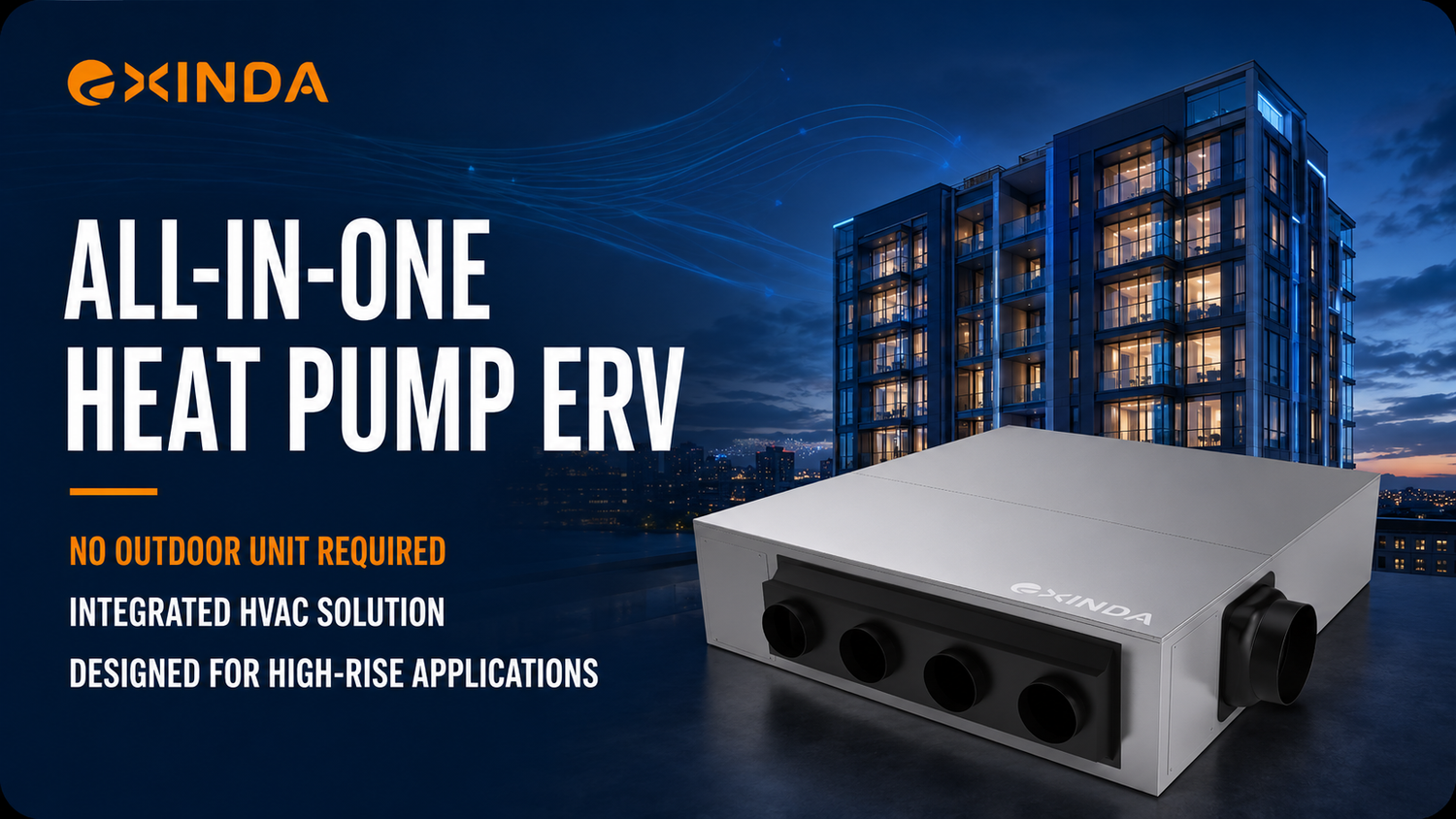
Apartment HVAC without an outdoor condenser is possible when a project uses a ceiling-ducted all-in-one heat pump ERV that combines heating, cooling, fresh-air ventilation and energy recovery in one indoor unit.
For apartment buildings where a conventional split-system outdoor condenser is difficult to place on a balcony, façade, roof or service area, this approach can provide a more concealed, apartment-level HVAC solution. EXINDA AURA is a ceiling-ducted all-in-one heat pump ERV designed for projects that need conditioned air, fresh air and energy recovery without a separate apartment-level outdoor condenser.
However, “no outdoor condenser” does not mean that the system has no connection to the outdoors. Contractors must still coordinate outdoor intake and exhaust duct routes, louvres, air separation, condensate drainage, ceiling access and project-specific airflow requirements.
Why Apartment Projects May Not Allow Conventional Outdoor Condensers
A conventional split air-conditioning system typically requires an outdoor condenser for each apartment or a shared external condenser arrangement. This can become difficult in multi-family projects when the design team needs to manage several competing requirements:
- Clean building façades with limited visible equipment
- Restricted balcony, roof or external service space
- Apartment-level heating, cooling and fresh-air ventilation
- Concealed ceiling installation rather than window-based equipment
- Bathroom and toilet exhaust-air coordination
- Separate controls for each apartment
- Repeatable HVAC layouts across multiple apartment types
These constraints do not automatically mean an all-in-one system is the correct answer. They mean the contractor and consultant should evaluate whether a decentralized, ceiling-ducted system offers a better fit than the alternatives available for that specific project.
What Does “No Outdoor Condenser” Actually Mean?
A ceiling-ducted all-in-one heat pump ERV does not use a conventional, separately installed outdoor condenser beside each apartment.
Instead, the main equipment is installed inside the apartment ceiling space. The unit uses engineered duct connections to move air between the system and the outdoors, while indoor ductwork distributes conditioned supply air to the apartment rooms.
| System Element | What It Means for the Project |
|---|---|
| Indoor equipment location | The main HVAC unit is installed above the ceiling rather than on a façade or balcony. |
| No separate outdoor condenser | A conventional apartment-level outdoor condensing unit is not required. |
| Outdoor air path | Outdoor intake and exhaust ducts, external louvres and adequate air separation are still required. |
| Indoor air distribution | Supply-air ductwork must be designed for room layout, airflow and available static pressure. |
| Condensate management | Drain route, trap, fall and any required condensate pump must be coordinated. |
| Service access | The ceiling layout must allow access for filters, electrical service and inspection. |
This distinction is important at tender stage. A contractor should not assume that removing a visible outdoor condenser removes the need for external coordination. It changes the type of coordination required.
How a Ceiling-Ducted All-In-One Heat Pump ERV Works
A ceiling-ducted all-in-one heat pump ERV integrates several functions that are often provided by separate systems.
| Function | How It Supports an Apartment Project |
|---|---|
| Heating and cooling | Conditions apartment air through a ceiling-ducted air-distribution system. |
| Fresh-air ventilation | Supplies outdoor air as part of the apartment ventilation design. |
| Energy recovery | Recovers energy from exhaust air to reduce the heating or cooling load associated with ventilation. |
| Exhaust-air connection | Can be coordinated with project-specific bathroom or toilet exhaust-air requirements. |
| Ceiling-concealed installation | Keeps the primary equipment above the ceiling and reduces visual impact on the apartment interior and exterior. |
| Apartment-level control | Supports a project-specific approach to individual apartment comfort control. |
The exact capacity, airflow, external static pressure, sound level, electrical supply and duct arrangement must be confirmed against the published data for the selected model and the actual project design conditions.
When Is an All-In-One Heat Pump ERV Suitable for an Apartment Project?
A ceiling-ducted all-in-one heat pump ERV is typically worth evaluating when the project has the following characteristics:
| Project Condition | Why the System May Be Suitable |
|---|---|
| No practical location for a conventional outdoor condenser | The project can avoid a separate apartment-level outdoor condenser. |
| Concealed HVAC is preferred | The primary equipment can be coordinated above the ceiling. |
| Fresh air is required within each apartment | Heating, cooling and ventilation can be considered as one system. |
| Repeated apartment layouts | Similar unit types can support repeatable design and installation planning. |
| Multi-room apartment distribution | Conditioned air can be ducted to compact multi-room layouts, subject to duct design. |
| Independent apartment operation is preferred | Each apartment can be evaluated as an individual HVAC zone. |
| Exterior intake and exhaust paths are available | The design can accommodate louvres, duct routes and required air separation. |
Typical applications include apartments, condominiums, student housing, boutique hotels, compact multi-room suites and selected retrofit projects.
When Should Contractors Consider Another HVAC Approach?
An all-in-one heat pump ERV is not a universal replacement for every apartment HVAC configuration. Another solution may be more appropriate when:
- The apartment heating or cooling load exceeds the selected unit’s published capacity.
- The project has insufficient ceiling height, structural support or service-access space.
- Outdoor intake and exhaust duct routes cannot be coordinated.
- Required duct static pressure exceeds the available fan performance.
- The building needs a large central plant or a different ventilation strategy.
- Local electrical, approval, fire, acoustic or installation requirements cannot be met by the proposed configuration.
- The project programme does not allow adequate time for equipment selection, duct design and technical review.
This is why project selection should begin with the mechanical schedule and building layout, not only with a nominal capacity comparison.
Key Design Checks Before Selecting an All-In-One Heat Pump ERV
Before including a ceiling-ducted all-in-one system in a tender or submittal, the mechanical contractor should verify the following items.
| Review Item | What the Contractor Should Confirm |
|---|---|
| Heating and cooling load | The required duty for each apartment is calculated at the project design conditions. |
| Ventilation airflow | Outside-air supply and exhaust-air requirements are confirmed for the apartment type. |
| Indoor supply airflow | Airflow and room distribution suit the duct layout and grille selection. |
| Indoor external static pressure | The selected unit has sufficient available ESP for the proposed indoor ductwork. |
| Outdoor duct static pressure | Intake and exhaust duct pressure, including louvre losses, are within the unit’s available performance. |
| Outdoor louvres and air separation | Intake and exhaust locations are coordinated to avoid unacceptable recirculation. |
| Bathroom exhaust | Bathroom and toilet exhaust routing is reviewed as part of the complete system design. |
| Ceiling space and service access | Installed height, weight, access panel and maintenance clearance are allowed for. |
| Condensate drainage | Drainage route, trap, fall and pump requirement are coordinated. |
| Electrical supply | Voltage, phase and frequency match the selected regional model. |
| Noise and vibration | Equipment location, duct attenuation and vibration isolation suit the project requirement. |
| Controls | Wall controller, temperature sensing and any required control interface are defined. |
These checks help prevent a common tender-stage risk: selecting equipment based on a headline capacity while overlooking airflow, duct pressure, electrical supply or maintenance access.
EXINDA AURA for Ceiling-Ducted Apartment HVAC
EXINDA AURA is a ceiling-ducted all-in-one heat pump ERV for apartment and multi-room residential projects where heating, cooling, fresh-air ventilation and energy recovery need to be coordinated in one indoor system.
AURA can be evaluated for projects seeking:
- A ceiling-concealed HVAC configuration
- No conventional separate outdoor condenser
- Apartment-level heating, cooling and fresh-air ventilation
- Ducted air distribution to compact multi-room layouts
- Technical submittal information for project review
- Model-specific fan curves, dimensional drawings and installation data
The correct AURA configuration depends on the project location, electrical supply, climate, apartment load, airflow requirement, duct static pressure and installation layout. Regional model availability and applicable certification documentation should always be confirmed before final selection.
What Technical Information Should Be Requested Before Tender?
A contractor or consultant should request the following information before approving or pricing an all-in-one heat pump ERV solution:
| Required Information | Why It Matters |
|---|---|
| Model-specific technical submittal | Confirms the proposed equipment configuration and published performance data. |
| Heating and cooling data | Allows capacity review at the stated design conditions. |
| Indoor and outdoor fan curves | Supports duct and external-static-pressure calculations. |
| Dimensional and duct-connection drawings | Helps coordinate ceiling space, duct routing and service access. |
| Installation requirements | Clarifies support, vibration isolation, condensate and maintenance requirements. |
| Electrical and controls information | Confirms voltage, frequency, controller and interface compatibility. |
| Regional certification documentation | Supports project review for the applicable market and model. |
| Project-specific technical review | Identifies issues before tender submission or site installation. |
Providing these documents early is not only a sales step. It is a risk-reduction step for the contractor, consultant and developer.
Frequently Asked Questions
Can an apartment have air conditioning without an outdoor condenser?
Yes. An apartment can use a ceiling-ducted all-in-one heat pump ERV that provides heating and cooling from an indoor unit without a conventional separate outdoor condenser. The suitability of the system depends on project load, outdoor duct routing, electrical supply, ceiling space and installation requirements.
Does a ceiling-ducted all-in-one heat pump ERV still require outdoor ducts?
Yes. Although the system does not use a separate outdoor condenser, it requires properly designed outdoor intake and exhaust duct connections, external louvres and suitable air separation.
Is an all-in-one heat pump ERV suitable for high-rise apartments?
It can be suitable for selected high-rise apartment projects where independent apartment HVAC, concealed ceiling installation and limited outdoor equipment space are priorities. The project team must verify load, airflow, ESP, external air paths, structural support, acoustics and local requirements.
Can one unit serve multiple rooms in an apartment?
A ceiling-ducted unit can distribute conditioned air to compact multi-room layouts when the duct system, airflow and external static pressure are designed for the apartment plan. Final suitability should be confirmed through project-specific duct and load review.
What should a mechanical contractor verify before selecting the system?
The contractor should verify heating and cooling load, outside-air and exhaust airflow, indoor and outdoor ESP, duct routes, louvre pressure drop, electrical supply, ceiling access, condensate drainage, controls, noise and applicable regional documentation.
Can EXINDA review an apartment HVAC schedule before tender?
Yes. EXINDA can review project information such as apartment quantity, mechanical schedule, design load, airflow, ESP, electrical supply and drawings to help determine whether an AURA configuration can be evaluated for the project.
Request an Apartment HVAC Project Review
If you are pricing or reviewing an apartment project without practical space for conventional outdoor condensers, send EXINDA your mechanical schedule or layout for an initial technical review.
Please include the project location, required voltage and frequency, apartment quantity, heating and cooling load, outside-air and exhaust airflow, duct static pressure, and available drawings.
Contact: info@exindagroup.com