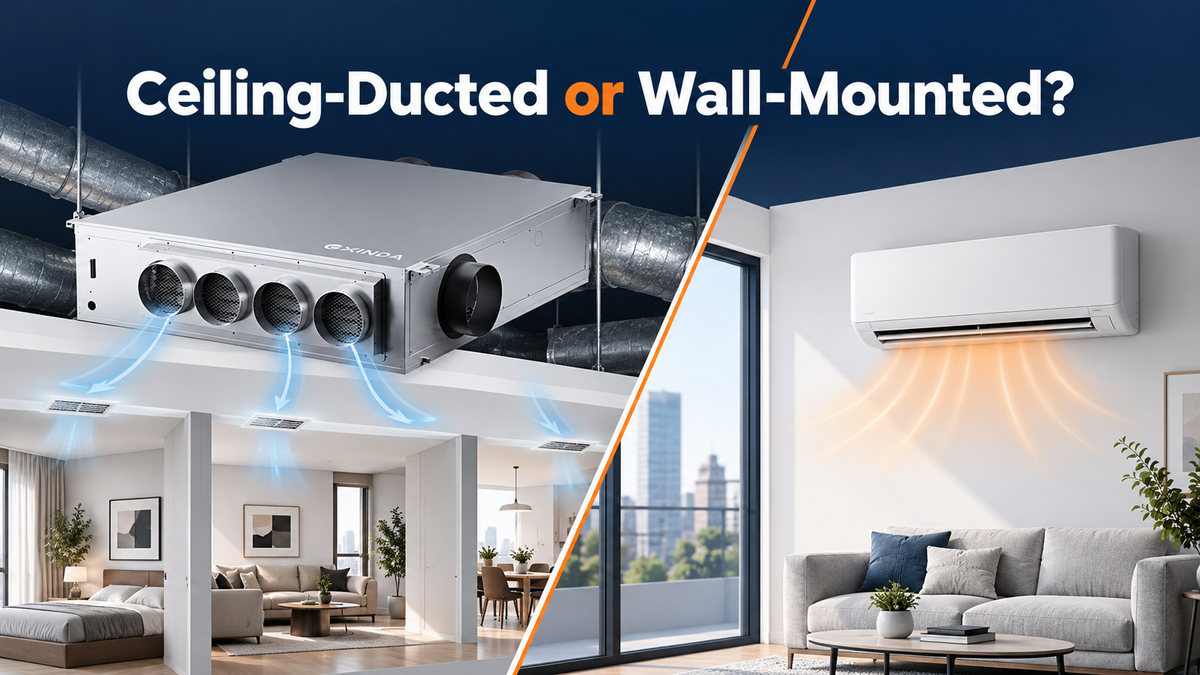
Both types put the whole heat pump inside the apartment and only need two holes in the exterior wall. That is where the similarity ends. Here is how they differ and when each one makes sense.
Wall-mounted all-in-one
The unit hangs on an exterior wall, low or high, with the intake and exhaust grilles directly behind it. Air is conditioned and blown straight into the room it sits in.
- One unit, one room. A two-bedroom needs three units.
- Fastest install. No ductwork, a few hours per unit.
- Fresh air is optional and usually a separate module.
- The unit is visible, and the wall behind it has to face outside.
- Noise is in the room with the tenant.
Good for studios, retrofits where nothing above the ceiling can be touched, and buildings where every room has an exterior wall.
Ceiling-ducted all-in-one with ERV
The unit sits above a suspended ceiling or in a bulkhead, usually near the exterior wall. Supply ducts run to each room, return comes back through a grille, and an ERV core inside the cabinet brings in filtered outside air and exhausts the bathroom.
- One unit for the suite. A studio or one-bedroom runs on a single 12,000 Btu/h unit; larger suites use two or a higher-capacity model.
- Fresh air can be part of the machine. Ducted units from Innova and EXINDA have the ERV core inside the cabinet, so continuous outdoor air is covered without a second product. Check this per model; it is not true of every ducted unit.
- Nothing on the wall. Only diffusers and a return grille are visible.
- Noise stays above the ceiling. The EXINDA HPERV measures 48 dB(A) at 1 m through gypsum board.
- Needs ceiling depth (the HPERV is 11-1/8 in tall) and a service opening.
- Static pressure matters. Check that the unit's rated external static covers your duct run. The HPERV supplies 430 CFM at 0.30 in. w.g., which is roughly 39 ft of equivalent duct.
Good for new high-rise and mid-rise apartments, window-wall buildings, and any project where the mechanical engineer has to show a fresh-air path.
Quick decision checklist
- Does the code require mechanical fresh air to each suite? If yes, go ducted with a built-in ERV, or budget a separate ERV with a wall unit.
- Is there 12 in or more above the ceiling near the exterior wall? If no, wall-mounted.
- How many rooms per suite? One room, either works. Two or more, ducted is cheaper per suite once you count units and wall openings.
- Will the tenant see and hear it? If that matters to the developer, ducted.
- Cold climate? Compare heating capacity at 5°F and 17°F, and confirm the backup heater size. Do this for either type.
Where to go from here
- EXINDA Aura HPERV — ceiling-ducted heat pump with built-in ERV, rated data and duct sizing on the page.
- All-in-one heat pumps with no outdoor unit for apartments: how to choose (2026) — brand comparison and datasheet checklist.
- PTHP with integrated ERV for new multifamily construction — how the specification is written, unit count per suite and substitution.
- Aura HPERV for PHIUS multifamily and modular homes — the data an energy modeler needs.
Have a project to size? Send suite count, project location, design requirements and a typical unit plan to info@exindagroup.com and ask for project selection support.