Textile factory cooling solutions help manufacturers manage heat, airflow and indoor environmental conditions in large production facilities. Choosing the right textile factory cooling solutions requires more than lowering room temperature. Manufacturers must also consider humidity requirements, ventilation, machinery heat loads and the specific needs of different production areas.
For factory owners, HVAC contractors and industrial equipment distributors, selecting suitable textile factory cooling solutions starts with understanding the production environment, evaluating available cooling technologies and balancing operating costs with performance requirements.
1. Why Do Textile Factories Need Industrial Cooling?
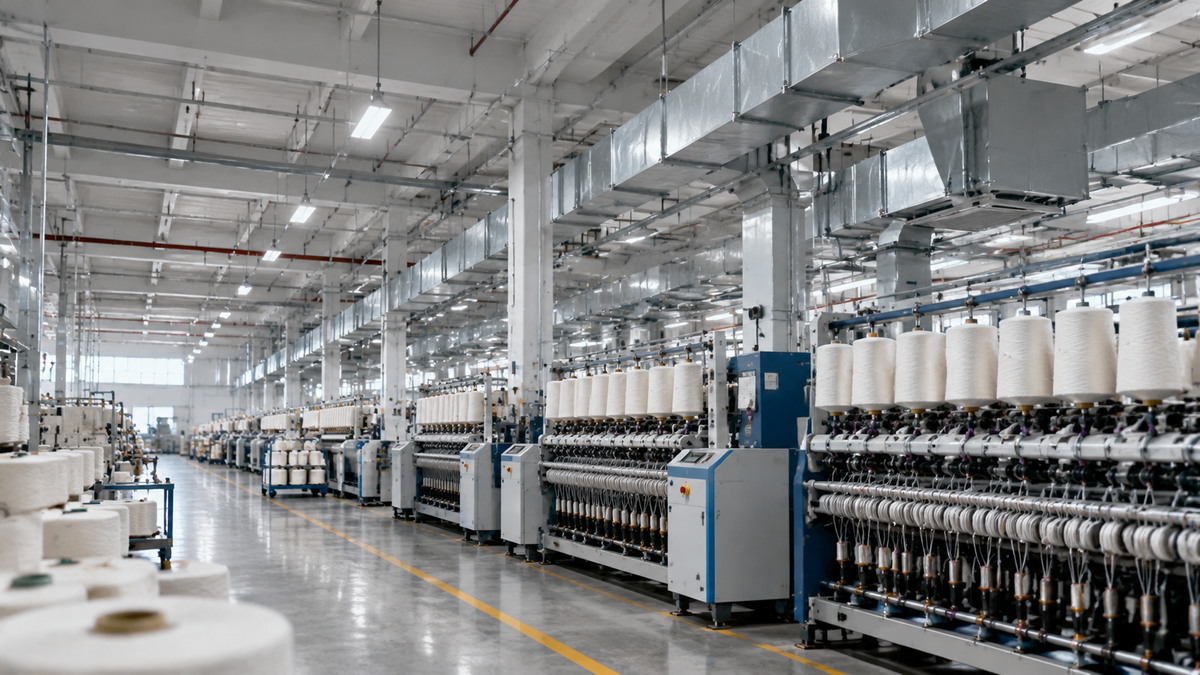
Textile production areas can accumulate heat from spinning machines, weaving equipment, motors, lighting and other production processes. In facilities with high ceilings and limited air movement, heat may be distributed unevenly across the production floor.
Common cooling challenges include:
High temperatures around operating machinery
Uneven temperatures between production zones
Poor air circulation in large or densely equipped areas
High energy consumption from continuously operating cooling equipment
Different temperature and humidity requirements across production processes
An effective industrial cooling system should address these conditions while supporting production requirements and maintaining practical operating costs.
2. Why Humidity Control Matters in Textile Manufacturing
Unlike many general industrial workshops, textile factories may require specific relative humidity levels to support fibre processing, yarn strength, static control and product quality.
The required conditions depend on the materials and production processes involved. Spinning, weaving, finishing and storage areas may have different environmental requirements.
Before selecting cooling equipment, factory operators should establish whether each area needs:
General temperature reduction for worker comfort
Controlled relative humidity for production quality
Dedicated process air conditioning
Dust and lint management
A combination of cooling, ventilation and humidity control
Important: A cooling system designed for general factory comfort should not automatically be treated as a process humidity-control system. Where production depends on tightly controlled temperature and relative humidity, the HVAC design must be evaluated against those requirements.
3. What Cooling Options Are Available for Textile Factories?
Different cooling technologies serve different purposes. The appropriate solution depends on the outdoor climate, indoor design conditions, production heat load and required level of environmental control.
| Cooling option | Main characteristics | Considerations |
|---|---|---|
| Industrial ventilation fans | Move air and help remove accumulated heat | Do not provide mechanical refrigeration or precise temperature control |
| Direct evaporative cooling | Uses water evaporation to cool incoming air | Adds moisture to the supply air; suitability depends on outdoor humidity and indoor requirements |
| Conventional DX air conditioning | Uses a refrigeration cycle to cool indoor air | Capacity, energy consumption and operating costs depend on design conditions and system efficiency |
| Hybrid evaporative-assisted cooling | Combines mechanical refrigeration with evaporative heat rejection | Can be considered for suitable industrial spaces; actual performance depends on climate, system design and operating conditions |
These technologies are not interchangeable. In particular, direct evaporative cooling and evaporative-assisted heat rejection use evaporation differently.
For EXINDA's Industrial Hybrid Evaporative Air Conditioner, DX refrigeration cools the indoor air, while evaporative cooling is used in the condenser heat-rejection process. This is different from a direct evaporative cooler that introduces moisture into the supply air.
The distinction matters when evaluating equipment for textile production areas with specific humidity requirements.
4. How Does Hybrid Evaporative Cooling Work in Industrial Applications?
In a hybrid evaporative cooling air conditioner, the refrigeration cycle provides indoor cooling. An evaporative section supports heat rejection from the condenser.
The system configuration can help industrial facilities evaluate an alternative to conventional air-cooled refrigeration equipment, particularly where operating costs and cooling demand are important considerations.
Potential evaluation areas include:
General production spaces where mechanical cooling is required
Large industrial areas with substantial internal heat loads
Facilities seeking to assess energy consumption under local operating conditions
Projects where air distribution must be adapted to the factory layout
However, evaporative heat rejection does not eliminate the refrigeration cycle. It also does not guarantee a fixed percentage of energy savings. Actual performance should be evaluated using the equipment's technical data, local design conditions and expected operating profile.
For textile areas requiring precise process humidity control, the complete HVAC system may need additional equipment or a separate dedicated solution.
5. Air Distribution Is Critical in Large Textile Factories
Even when the installed cooling capacity is sufficient, poor air distribution can leave certain work areas warmer than others.
Production machinery, structural columns, high ceilings and changing factory layouts can all affect airflow.
Two air distribution approaches may be considered for suitable industrial applications:
Louver air supply
Adjustable louvers help direct supply air toward selected production or working areas. This arrangement can be useful when the airflow direction needs to accommodate a particular installation layout.
Long-throw jet air supply
Jet air outlets are designed to deliver air over longer distances. They can be evaluated for large open production areas where the distance between the air outlet and occupied zones is an important design consideration.
Actual air coverage depends on supply airflow, outlet design, installation height, temperature difference and obstructions. Air distribution should therefore be assessed as part of the overall cooling design, rather than selected by outlet type alone.
6. How to Select the Right Textile Factory Cooling Solution
Before requesting equipment selection or a quotation, factory owners and HVAC contractors should prepare the following information.
Factory dimensions
Provide the building length, width, ceiling height and production layout.
Location and outdoor design conditions
Identify the project location and relevant outdoor temperature and humidity conditions.
Indoor requirements
Specify the target temperature and, where applicable, the required relative humidity and allowable variation.
Production heat loads
List the main machinery, operating schedules and significant sources of internal heat.
Ventilation requirements
Describe existing exhaust fans, fresh-air systems, doors and other openings that affect air movement.
Utilities and maintenance
Confirm the available electrical supply, water availability where required, drainage arrangements and maintenance access.
Process limitations
Identify any production areas that require dedicated humidity control, dust management or other environmental conditions.
This information helps determine whether a general industrial cooling system is appropriate or whether additional process-specific HVAC equipment is needed.
7. EXINDA Industrial Hybrid Evaporative Cooling Solutions
EXINDA develops industrial cooling equipment for manufacturing facilities, workshops and other large-space applications.
Our Industrial Hybrid Evaporative Air Conditioner combines DX refrigeration with evaporative condenser heat rejection. Depending on the project requirements, available air distribution configurations include louver air supply and long-throw jet air supply.
For textile factories, the initial assessment should focus on the intended application area, required indoor conditions, machinery heat load and airflow layout. Areas with strict process humidity requirements should be evaluated separately to establish whether additional environmental control is necessary.
EXINDA can work with HVAC contractors, industrial equipment distributors and project developers to review project information and assess a suitable equipment configuration.
Frequently Asked Questions
Is hybrid evaporative cooling suitable for textile factories?
It may be suitable for selected general production or working areas where mechanical cooling is required. Suitability depends on the heat load, climate, indoor temperature requirements and any process-specific humidity limitations.
Does a hybrid evaporative air conditioner add moisture to the indoor air?
In EXINDA's hybrid configuration, evaporative cooling supports condenser heat rejection rather than directly humidifying the indoor supply air. This differs from direct evaporative cooling, where water evaporation occurs in the supply-air stream.
Can evaporative cooling maintain the humidity required for spinning or weaving?
Not by itself in every application. Textile processes can require specific humidity conditions. The complete system must be evaluated against the requirements of the relevant production process.
What information is needed to select industrial cooling equipment?
The main inputs include factory dimensions, location, outdoor design conditions, indoor temperature and humidity requirements, machinery heat loads, ventilation arrangements and available utilities.
Can one cooling system serve the entire textile factory?
That depends on the factory layout and production requirements. Where different areas have different temperature, humidity or ventilation needs, separate zones or dedicated systems may be more appropriate.
Discuss Your Industrial Cooling Project with EXINDA
Planning a cooling system for a textile factory or another industrial facility?
Share your factory dimensions, project location, cooling requirements and production layout with EXINDA. Our team can review the application and help assess suitable industrial cooling configurations.
Contact EXINDA to discuss your project requirements.