How to Select the Right Pool Heat Pump Capacity for Florida Residential Pools
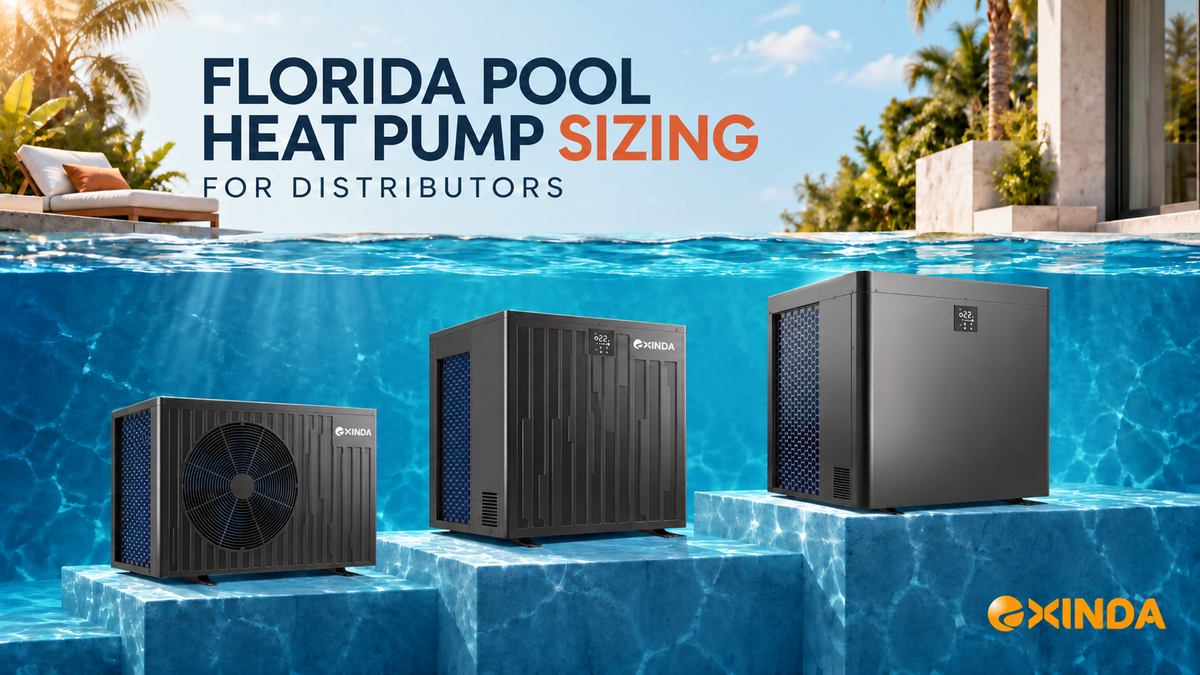
Florida pool heat pump sizing is one of the most important considerations for pool distributors, contractors, and builders recommending residential pool heating solutions.
Florida is one of the largest swimming pool markets in the United States, with thousands of residential pools requiring comfortable water temperatures throughout an extended swimming season.
Choosing the correct pool heat pump capacity helps customers achieve:
- Faster temperature recovery
- More stable water temperature
- Better swimming comfort
- Fewer service complaints
- Higher customer satisfaction
However, many pool heating issues are not caused by equipment quality. They are often related to incorrect sizing, unsuitable installation conditions, or unrealistic customer expectations.
This guide explains how Florida distributors can select the right pool heat pump size based on pool volume, climate conditions, installation environment, and customer requirements.
Quick Answer: What Size Pool Heat Pump Do Florida Pools Need?
Start with the project heating requirement:
Pool gallons alone do not establish a recommended capacity. Calculate the heating requirement using surface area, weather, cover use, target temperature and recovery time; then compare model output at those conditions.
However, Florida pool heat pump sizing should not be based only on pool gallons.
Professional distributors should also evaluate:
- Pool surface area
- Pool location
- Wind exposure
- Pool cover usage
- Desired water temperature
- Swimming season expectations
The correct capacity is the balance between pool conditions and customer expectations.
How Florida Pool Heat Pump Sizing Works
Florida has a unique pool heating environment compared with colder regions.
Although Florida has warmer weather, residential pools still experience heat loss during:
- Winter months
- Cool nights
- Windy conditions
- Extended swimming seasons
- Periods with lower humidity
The largest heat loss source for many outdoor pools is evaporation from the water surface.
Important factors affecting pool heat loss include:
Pool Surface Area
A larger water surface creates more evaporation and greater heat loss.
Two pools with the same water volume may require different heat pump capacities if their surface areas are different.
Outdoor Conditions
Pool location affects heating demand.
For example:
South Florida:
- Longer warm season
- Higher average temperatures
- Lower heating demand
North Florida:
- Cooler winter conditions
- Longer heating periods
- Higher capacity requirements
Pool Cover Usage
A pool cover reduces heat loss significantly.
Distributors should always ask:
- Is the pool covered overnight?
- Is the pool exposed to wind?
- Does the customer want heating during cooler months?
A pool without a cover may require a larger heat pump compared with a similar pool using a cover.
How Many BTU Pool Heat Pumps Do Florida Pools Need?
Pool heat pump capacity is measured in:
BTU/h (British Thermal Units per Hour)
A higher BTU/h rating means the heat pump can transfer more heat into the pool water within the same operating period.
For Florida residential applications, common capacity ranges include:
65,000 BTU/h Pool Heat Pump
Recommended for:
- Smaller residential pools
- Backyard pools
- Seasonal pool users
- Customers with moderate heating requirements
96,000 BTU/h Pool Heat Pump
Recommended for:
- Typical Florida residential pools
- Standard pool builder applications
- Customers looking for balanced performance and efficiency
Suitability depends on the calculated load and available model output at the selected air and water temperatures.
121,000 BTU/h Pool Heat Pump
Recommended for:
- Larger residential pools
- Customers requiring faster temperature recovery
- Extended swimming season applications
150,000 BTU/h Pool Heat Pump
Recommended for:
- Large residential pools
- Premium pool projects
- Higher heating demand applications
Why a Gallon-Only Size Chart Is Not a Final Selection
Pool volume is the first step in pool heat pump selection.
However, professional sizing requires more than a gallon calculation.
Pool gallons alone do not establish a recommended capacity. Calculate the heating requirement using surface area, weather, cover use, target temperature and recovery time; then compare model output at those conditions.
Use a project-specific sizing review.
Final selection should consider the complete application.
Why Pool Size Alone Is Not Enough for Heat Pump Selection
A common mistake is selecting a pool heat pump only by gallons.
For example:
Pool A
- 20,000 gallons
- Screen enclosure
- Pool cover used at night
- Moderate temperature requirements
Pool B
- 20,000 gallons
- Open outdoor installation
- No pool cover
- Customer wants 86°F water temperature during cooler months
Although both pools have the same volume, Pool B has higher heat loss and may require a larger capacity heat pump.
For Florida pool heat pump sizing, distributors should evaluate the complete application rather than only matching pool volume.
How Customer Expectations Affect Pool Heat Pump Sizing
Different customers have different heating expectations.
Seasonal Pool Users
Typical requirements:
- Pool use mainly during warmer months
- Occasional temperature adjustment
- Longer heating time acceptable
A standard capacity heat pump may be suitable.
Extended Season Pool Users
Typical requirements:
- Comfortable swimming during spring and fall
- More stable temperature
- Frequent pool usage
A larger capacity unit is usually recommended.
Premium Residential Customers
Typical requirements:
- Faster heating response
- Higher comfort expectations
- Maximum temperature stability
A higher capacity model may provide a better customer experience.
Common Pool Heat Pump Sizing Mistakes Distributors Should Avoid
Mistake 1: Selecting the Smallest Unit to Reduce Price
A lower capacity model may reduce initial purchase cost.
However, it may create:
- Longer heating times
- Difficulty maintaining temperature
- Customer dissatisfaction
- Additional service requests
The lowest equipment cost does not always create the lowest total project cost.
Mistake 2: Ignoring Pool Cover Usage
Pool cover availability can significantly affect heating demand.
Always confirm:
- Pool cover usage
- Overnight coverage
- Wind exposure
before recommending a capacity.
Mistake 3: Ignoring Installation Conditions
Even the correct heat pump size requires proper installation.
Important considerations include:
Airflow Clearance
The unit requires sufficient fresh air circulation.
Restricted airflow can reduce performance.
Discharge Air Recirculation
The discharged cold air should not return into the heat pump air intake.
Water Flow
Correct water flow is necessary for stable heat transfer and reliable operation.
EXINDA Pool Heat Pump Capacity Recommendations for Florida Applications
EXINDA provides residential pool heat pump solutions covering common Florida residential applications.
65K BTU/h Class
Suitable for:
- Small residential pools
- Backyard applications
- Seasonal heating requirements
96K BTU/h Class
Suitable for:
- Standard Florida residential pools
- Pool builders and distributor applications
- Balanced heating performance
121K BTU/h Class
Suitable for:
- Larger residential pools
- Faster temperature recovery requirements
150K BTU/h Class
Suitable for:
- Large residential pools
- Premium projects
- Higher heating demand applications
As a pool heat pump manufacturer, EXINDA supports distributors, contractors, and OEM partners with residential pool heating solutions designed for different market requirements.
Distributor Checklist Before Recommending a Pool Heat Pump
Before selecting a model, distributors should collect:
Pool Information
□ Pool volume (gallons)
□ Pool dimensions
□ Pool surface area
□ Indoor or outdoor installation
Customer Requirements
□ Desired water temperature
□ Swimming season length
□ Heating speed expectation
□ Pool cover availability
Installation Conditions
□ Florida location
□ Wind exposure
□ Equipment installation space
□ Water flow conditions
A complete evaluation helps distributors recommend the correct capacity and reduce future service issues.
FAQ
What size pool heat pump do I need for a 20,000 gallon pool in Florida?
A 20,000-gallon volume alone is insufficient to select capacity. Confirm surface area, location, cover use, wind exposure, starting and target water temperatures, and required recovery time.
Is a larger pool heat pump better?
A larger pool heat pump can provide faster heating and better temperature recovery. However, the final selection should match the pool application and customer requirements.
What is the most common pool heat pump size in Florida?
There is no single capacity suitable for all Florida pools. Use project-specific heating requirements and the selected model’s performance data.
Do Florida pools need heat pumps?
Not every pool requires heating. The need depends on the desired water temperature and swimming season; a heat pump is one option when additional heating is required.
How do distributors choose the right pool heat pump size?
Professional distributors evaluate pool volume, surface area, climate conditions, pool cover usage, installation environment, and customer expectations before recommending a capacity.
Explore EXINDA North American Pool Heat Pumps
Compare the following nominal capacity classes. Final selection requires performance at the project conditions, not the capacity label alone.
- 65,000 Btu/h R32 inverter pool heat pump
- 96,000 Btu/h R32 inverter pool heat pump
- 121,000 Btu/h R32 inverter pool heat pump
- 150,000 Btu/h R32 inverter pool heat pump
Contact: info@exindagroup.com