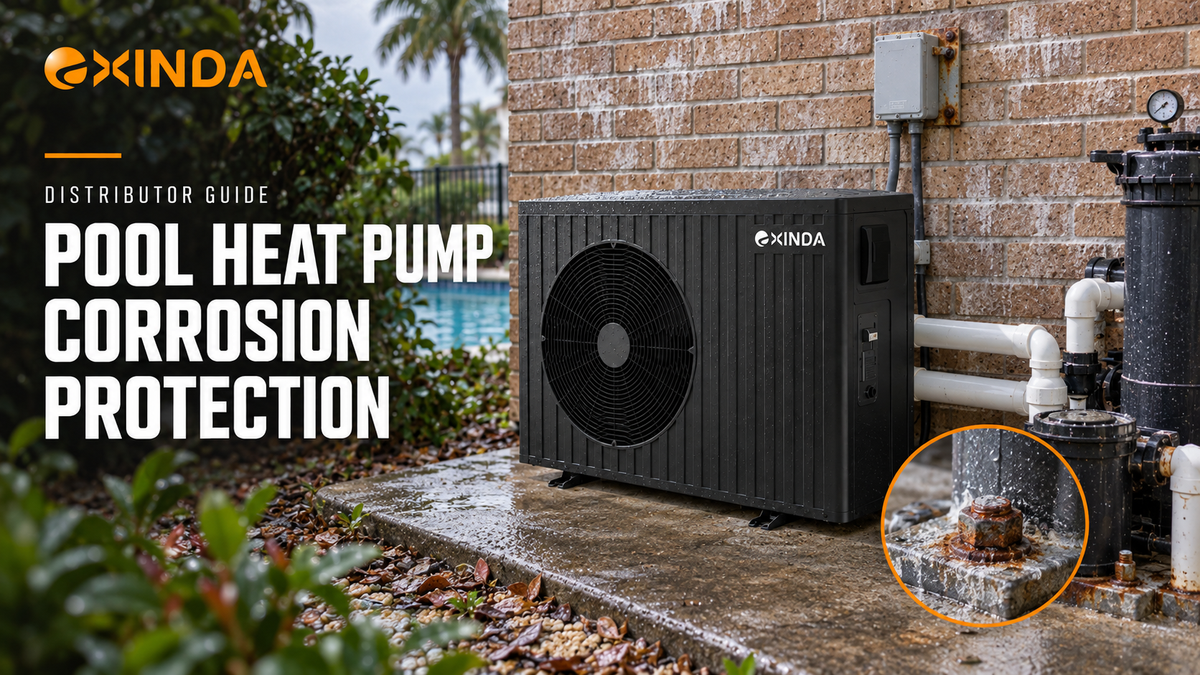
Pool heat pump corrosion protection should be evaluated as a complete system, not as a single material or coating claim. A titanium water heat exchanger is important, especially for saltwater pools, but distributors should also examine the cabinet, protective grilles, base frame, fasteners, welded areas, coil protection, drainage design and manufacturing process.
For North American pool equipment distributors, corrosion resistance directly affects product appearance, storage condition, field reliability, service demand and long-term customer confidence. This is particularly important in coastal regions, high-humidity climates, areas with frequent rainfall and applications where pool chemicals may be present around the equipment.
Why Corrosion Protection Matters to Distributors
A pool heat pump normally operates outdoors and may be exposed to several corrosive influences at the same time:
-
Salt-laden coastal air
-
High relative humidity
-
Rain and condensation
-
Pool chemicals and cleaning products
-
UV exposure and temperature cycling
-
Water retained around the base or drainage path
-
Long periods of warehouse or seasonal storage
-
Moisture trapped during ocean transportation
These conditions do not affect every component in the same way. A plastic cabinet, coated steel grille, galvanized base frame, stainless steel fastener and aluminum coil each have different corrosion mechanisms and protection requirements.
For this reason, a distributor should not rely only on a general statement such as “corrosion-resistant design.” The supplier should be able to explain which materials and protective processes are used for each critical component.
What Should a Pool Heat Pump Corrosion Review Cover?
A complete evaluation should cover both the pool-water circuit and the airside structure.
| Component | What distributors should verify | Common risk areas |
|---|---|---|
| Water heat exchanger | Material and approved pool-water applications | Pool chemistry, salinity and improper water balance |
| Main cabinet | Substrate, pretreatment, primer and topcoat | Cut edges, bends, panel joints and scratches |
| Fan grille | Material, coating process and edge coverage | Welded intersections and exposed wire ends |
| Coil guard | Substrate and coating specification | Cut edges, mounting points and chemical exposure |
| Evaporator coil | Fin and tube materials and protective treatment | Salt deposits, moisture retention and cleaning damage |
| Base frame and feet | Material, coating and drainage clearance | Standing water, ground contact and installation debris |
| Screws and fasteners | Material, plating or corrosion class | Dissimilar-metal contact and exposed threads |
| Refrigerant and electrical areas | Enclosure, cable routing and protection | Condensation, water entry and damaged insulation |
This component-by-component review gives distributors a clearer picture of field risk than one broad corrosion claim.
Pool Heat Pump Corrosion Protection Starts with Material Selection
The first question is not simply whether a component is coated. Distributors should first identify the base material.
Common pool heat pump cabinet materials include coated metal and UV-resistant polymer materials. Each has advantages and limitations. Polymer cabinets can reduce the risk of visible cabinet rust, while metal structures may provide strength for larger-capacity units but require a well-controlled pretreatment and coating process.
Metal grilles, mounting feet, brackets and fasteners still require attention even when the external cabinet is made from a non-metallic material. One unprotected bracket or fastener can become the first visible point of corrosion.
The water side must be evaluated separately. A titanium heat exchanger provides strong resistance to properly maintained freshwater and saltwater pool applications, but it does not protect the external cabinet, coil, wiring, fasteners or base frame from atmospheric corrosion.
What Makes a Coating System Credible?
A useful coating specification should describe the complete system rather than only the color or final paint layer.
North American distributors should ask the manufacturer to document:
-
The substrate material
-
Surface cleaning and preparation
-
Pretreatment method
-
Primer type
-
Exterior topcoat type
-
Nominal dry-film thickness
-
Curing process
-
Inspection and adhesion testing
-
Salt-spray or cyclic-corrosion test method
-
Acceptance criteria after testing
Pretreatment is especially important because a high-quality topcoat cannot fully compensate for oil, contamination, scale or incomplete surface preparation underneath it.
Coating thickness should also be evaluated carefully. A nominal thickness measured on a flat panel may not represent protection at bends, holes, sharp edges and welded joints. These difficult areas are often where corrosion begins.
Why Welding, Edges and Fasteners Require Special Attention
Corrosion protection frequently fails at manufacturing details rather than across the center of a flat panel.
Critical areas include:
-
Welded grille intersections
-
Formed corners and bends
-
Laser-cut or punched openings
-
Panel edges
-
Screw holes
-
Fastener contact points
-
Base-frame joints
-
Mounting feet
-
Drainage and water-runoff paths
Whenever possible, cutting, forming and welding should be completed before pretreatment and final coating. Welding or grinding after the final coating can damage the protective layers and expose the substrate.
Distributors should also ask whether coating inspection includes edges, welds and bends—not only smooth sample panels.
Fastener selection matters as well. The manufacturer should consider the fastener material, surface treatment and its compatibility with the surrounding metal. Contact between dissimilar metals in the presence of moisture can create an additional galvanic-corrosion risk.
How Should Distributors Interpret Salt-Spray Test Results?
Salt-spray testing is useful, but the number of test hours should not be treated as a direct prediction of outdoor service life.
ASTM B117 provides a controlled salt-fog environment for comparing the relative corrosion resistance of metals and coated metals. ASTM also explains that results from the test do not reliably predict performance in natural environments when used alone.
Similarly, ISO 9227 defines salt-spray test procedures but does not independently specify the required exposure duration or universal pass/fail criteria for every product.
When reviewing a report, distributors should ask:
-
Which standard and test method were used?
-
What was the exposure duration?
-
Were complete components or only flat coupons tested?
-
Did the samples include welds, bends, edges and scratches?
-
What substrate and coating system were tested?
-
What failure criteria were applied?
-
Was red rust, blistering, delamination or corrosion creep observed?
-
Does the tested sample match the production configuration?
A report for a flat painted panel should not automatically be treated as proof that every grille, screw, welded edge and production unit has the same protection.
Drainage and Packaging Are Part of Corrosion Control
Corrosion protection does not end when painting is complete. Water retained inside the unit can create problems before installation.
Pool heat pumps may undergo water-circuit testing during production. After testing, low points in heat exchangers, hoses, connectors and internal piping may retain residual water if the unit is not fully drained and dried.
During extended ocean transportation, residual moisture inside sealed packaging can contribute to:
-
High humidity inside the package
-
Repeated condensation
-
Surface discoloration
-
Early corrosion at exposed metal areas
-
Moisture-related residue
-
Damage to labels, insulation or electrical components
Distributors should therefore review the manufacturer’s post-test process. A robust procedure may include controlled draining, unit tilting where appropriate, compressed-air or forced-air drying, a standing inspection and confirmation that no residual water remains before packaging.
For long-distance transportation, distributors may also ask whether desiccants, humidity indicators or other moisture-control measures are used where appropriate.
The presence of unidentified deposits should be investigated rather than assumed to be salt, scale or a particular chemical. Water quality, cleaning agents, production conditions and packaging materials may all need to be considered.
What Evidence Should a Distributor Request?
Before approving a pool heat pump range, a distributor should request evidence appropriate to the intended market and application.
A practical corrosion review package can include:
-
Component material specification
-
Coating and pretreatment specification
-
Dry-film thickness requirements
-
Salt-spray or cyclic-corrosion report
-
Coating adhesion test
-
Production drawings showing critical protected areas
-
Fastener and grille specifications
-
Evaporator-coil protection information
-
Water-test draining and drying procedure
-
Packaging moisture-control procedure
-
Incoming and production quality-control records
-
Maintenance and cleaning recommendations
The objective is not to request paperwork for its own sake. The evidence should help confirm that the tested configuration, published specification and production unit are consistent.
How EXINDA Supports North American Pool Heat Pump Distributors
EXINDA supplies inverter pool heat pump solutions for residential and commercial pool applications in North America. The current North American range includes 65,000, 96,000, 121,000 and 150,000 Btu/h capacities, with model selection based on pool volume, climate, desired water temperature, pool-cover use and operating expectations.
Applicable EXINDA pool heat pump configurations include:
-
R32 refrigerant
-
Twin-rotary inverter compressor
-
Titanium water heat exchanger
-
Heating and cooling functions
-
Smart Wi-Fi control
-
Capacity options for residential and larger pool applications
-
CSA certification and CEC listing for the applicable North American range
Because cabinet construction and component specifications may vary by capacity and configuration, corrosion documentation should always be reviewed against the selected model rather than assumed to be identical across an entire range.
EXINDA works with distributors and private-label partners on product selection, technical documentation, certification support, packaging requirements, replacement parts and application-specific product reviews.
Distributor Corrosion Evaluation Checklist
Before adding a pool heat pump to a North American product line, confirm the following:
-
Is the heat exchanger suitable for the intended pool-water application?
-
What materials are used for the cabinet, grilles, base and fasteners?
-
Are pretreatment, primer, topcoat and coating thickness documented?
-
Are welded areas, bends, holes and cut edges included in the protection process?
-
Does the corrosion test represent the production materials and coating system?
-
Are the test conditions and acceptance criteria clearly stated?
-
Can the unit drain completely after factory water testing?
-
Is the product dried and checked before packaging?
-
Is moisture controlled during long-distance transportation?
-
Are cleaning and maintenance instructions available for coastal installations?
-
Can the manufacturer provide model-specific evidence?
A strong answer to these questions reduces uncertainty for purchasing, technical and after-sales teams.
Frequently Asked Questions
Is a titanium heat exchanger enough to make a pool heat pump corrosion-resistant?
No. A titanium heat exchanger protects the pool-water heat-transfer component, but the cabinet, coil, grilles, base frame, fasteners and electrical areas require separate corrosion consideration.
Does an ABS cabinet eliminate all corrosion risk?
No. An ABS cabinet can avoid visible rust on the external polymer panels, but the unit still contains metal grilles, brackets, fasteners, coils and internal components that may be exposed to moisture or salt-laden air.
Does a longer salt-spray test guarantee a longer service life?
No. Salt-spray tests provide controlled comparative information. Test duration alone does not directly predict outdoor service life, especially when real installations also involve UV exposure, wet-dry cycles, chemicals and temperature changes.
What parts of a coating test report should distributors examine?
Distributors should check the standard, duration, sample construction, substrate, pretreatment, coating layers, thickness, acceptance criteria and whether welds, bends, scratches and edges were included.
Why does residual water after factory testing matter?
Residual water can increase humidity inside sealed packaging during storage and ocean transportation. Proper draining, drying and packaging controls help reduce moisture-related damage before installation.
Are coastal and saltwater pool applications the same corrosion condition?
No. Saltwater pool use primarily affects the water circuit, while coastal air affects external and internal airside components. A product intended for both conditions must address these exposure paths separately.
What information should a distributor send EXINDA for product selection?
Provide the project location, pool volume, pool type, desired water temperature, expected ambient conditions, pool-cover usage, available electrical supply, quantity and applicable certification requirements.
Discuss Your North American Pool Heat Pump Range
Selecting a pool heat pump supplier requires more than comparing Btu/h, COP and purchase price. Corrosion protection, production controls, transportation preparation and after-sales documentation can all affect the long-term success of a distributor’s product line.
Contact info@exindagroup.com to request EXINDA pool heat pump specifications, certification information, model-selection support or a private-label distribution discussion.