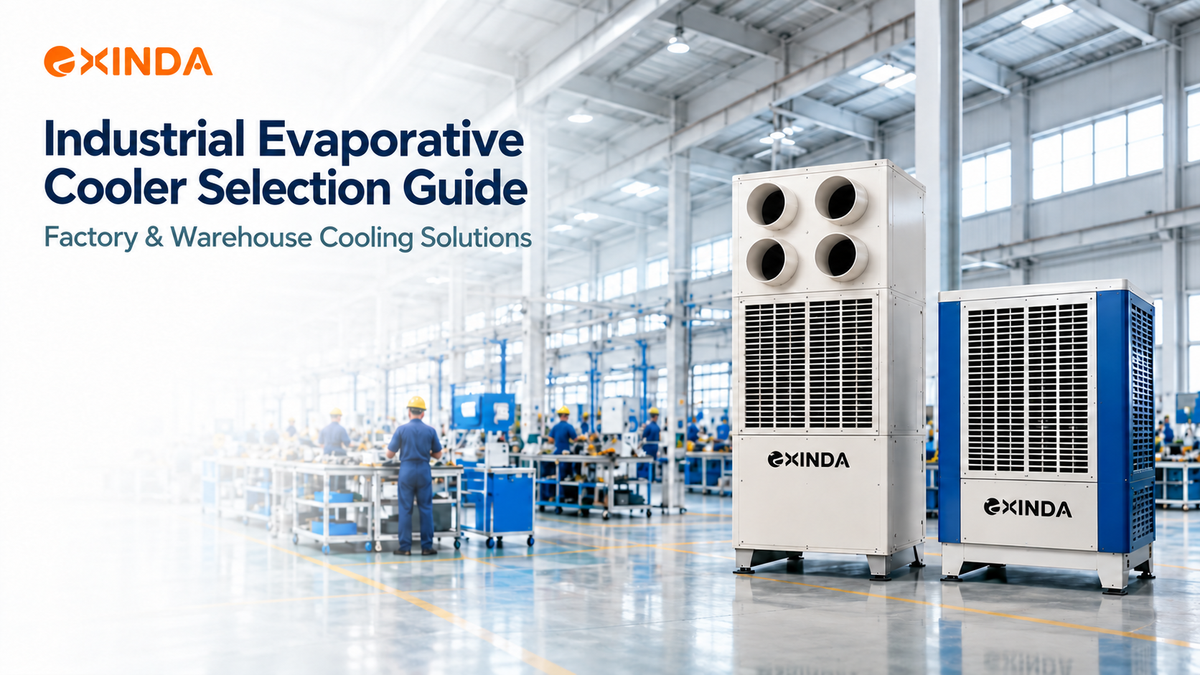

Factory Cooling Solutions for Large Industrial Workshops
Factory cooling solutions help manufacturers maintain suitable working conditions in large industrial workshops while managing cooling performance, energy consumption and operating costs. High ceilings, production machinery, large open spaces and frequent door openings make industrial cooling more challenging than conventional building air conditioning.
For factory owners, industrial HVAC contractors and equipment distributors, choosing the right cooling system requires an understanding of available technologies, local climate conditions and installation requirements.
This guide compares different factory cooling solutions and explains how hybrid evaporative-assisted DX technology can be considered for industrial cooling projects.
Why Is Cooling a Large Industrial Workshop Challenging?
Large industrial buildings often experience significant heat gains from production equipment, motors, lighting and manufacturing processes. High ceilings and open workshop layouts also make it difficult to distribute conditioned air effectively.
Several factors influence industrial cooling requirements:
Internal heat loads: Machinery, motors and production processes continuously release heat.
Building layout: High ceilings and large floor areas require carefully planned airflow distribution.
Ventilation: Loading doors, exhaust fans and fresh-air requirements increase cooling demand.
Climate conditions: Outdoor temperature and humidity affect cooling system performance.
Operating hours: Long production schedules make energy consumption an important consideration.
Effective factory cooling solutions should therefore be selected according to actual cooling loads, building layout and operating conditions rather than floor area alone.
Types of Factory Cooling Solutions
Different cooling technologies are available for industrial applications. Understanding their operating principles and limitations helps project owners select suitable equipment.
Direct Evaporative Air Coolers
Direct evaporative coolers use water evaporation to reduce incoming air temperature. Their simple construction and relatively low electrical consumption make them common in industrial workshops.
However, cooling performance is limited by outdoor wet-bulb temperature. In humid environments, the achievable temperature reduction becomes smaller. Direct evaporative cooling also increases the moisture content of the supply air.
Conventional DX Air Conditioning
Direct expansion (DX) air conditioners use mechanical refrigeration to cool indoor air. Properly designed DX systems can provide temperature control and remove moisture from the air.
For large factories, conventional DX cooling may require substantial equipment capacity, electrical infrastructure and carefully designed air distribution.
Central Chiller and Air Handling Systems
Chiller systems distribute chilled water to air handling units or other cooling equipment. They can be suitable for industrial facilities requiring centralized cooling or multiple temperature-controlled zones.
Their main considerations include installation complexity, piping requirements, pumps, controls and ongoing maintenance.
Hybrid Evaporative-Assisted DX Cooling
Hybrid evaporative-assisted DX cooling combines mechanical refrigeration with evaporative condenser heat rejection.
In EXINDA's configuration, indoor air passes through a DX evaporator for cooling. Refrigerant condensation heat is transferred to circulating cooling water, which releases heat through an outdoor evaporative heat-rejection section.
Unlike direct evaporative coolers, this arrangement does not depend on adding moisture to the indoor supply air to achieve cooling.
Hybrid technology provides another option when comparing factory cooling solutions for industrial applications.
Comparing Industrial Cooling Technologies
Each industrial cooling technology offers different benefits depending on the climate, cooling requirements and installation conditions.
| Cooling System | Main Advantage | Key Consideration |
|---|---|---|
| Direct Evaporative Cooler | Low electrical demand and simple construction | Limited cooling performance in humid conditions |
| Conventional DX Air Conditioner | Mechanical cooling and potential dehumidification | Electrical demand and air distribution design |
| Chiller + AHU | Flexible centralized cooling | Installation complexity and additional equipment |
| Hybrid Evaporative-Assisted DX | Mechanical cooling with evaporative heat rejection | Water management, maintenance and site suitability |
No single cooling technology is suitable for every factory. The appropriate system depends on local climate, required indoor conditions, production heat loads and available infrastructure.
Factory Cooling Solutions for Hot and Humid Climates
Factories in Vietnam, Thailand, Malaysia, Indonesia and the Philippines frequently operate under high outdoor temperatures and humidity.
In these environments, direct evaporative cooling may not achieve the desired indoor conditions because its cooling potential is limited by the outdoor wet-bulb temperature.
Mechanical refrigeration can provide more controlled cooling performance. Hybrid evaporative-assisted DX systems use refrigeration to cool indoor air while applying evaporative technology to condenser heat rejection.
However, evaporative heat rejection is still influenced by outdoor wet-bulb temperature, water conditions and equipment design.
When evaluating factory cooling solutions in tropical climates, project owners should consider cooling requirements, humidity, electrical supply, water availability and maintenance conditions.
Why Air Distribution Matters in Industrial Workshops
Selecting sufficient cooling capacity does not automatically guarantee comfortable working conditions throughout a factory.
Large workshops may contain high ceilings, long production lines and machinery that obstructs airflow. Proper air distribution is therefore essential.
Louver Air Supply
Louver-type air outlets allow directional airflow adjustment. They can be considered for industrial workshops where conditioned air needs to be directed toward specific production or working areas.
Long-Throw Jet Air Supply
Long-throw jet outlets are designed to deliver air over greater distances. They can be considered for large open workshops and industrial spaces with high ceilings.
Actual airflow coverage depends on air volume, outlet design, installation height and surrounding conditions.
Both configurations require appropriate equipment positioning and airflow planning.
Key Factors When Selecting a Factory Cooling System
Before choosing factory cooling solutions, HVAC contractors and factory owners should review several important project conditions.
Factory size and layout: Building length, width, ceiling height and internal layout influence cooling-load calculations and air distribution design.
Outdoor climate: Local dry-bulb and wet-bulb temperatures affect cooling equipment performance.
Indoor temperature requirements: Target temperature, humidity and operating schedule should be established before equipment selection.
Production heat loads: Machinery, motors, lighting and manufacturing processes contribute to internal heat generation.
Ventilation requirements: Fresh-air supply, exhaust systems and loading doors influence the total cooling load.
Electrical and water supply: Available electrical capacity, water quality, water consumption and drainage arrangements should be evaluated.
A professional cooling-load assessment is recommended before confirming equipment capacity and quantity.
EXINDA Hybrid Industrial Cooling Solutions
EXINDA develops industrial cooling equipment for factories, manufacturing workshops and large industrial spaces.
Our Industrial Hybrid Evaporative Air Conditioner combines DX refrigeration technology with evaporative heat rejection.
The indoor refrigeration circuit provides air cooling, while circulating cooling water transfers condenser heat to an outdoor evaporative cooling section.
EXINDA offers two air distribution configurations:
Louver Air Supply Type
Suitable for applications requiring adjustable airflow direction within industrial working areas.
Long-Throw Jet Air Type
Intended for larger industrial spaces where air needs to be delivered over longer distances.
For industrial HVAC contractors, distributors and project developers, EXINDA can support equipment selection and technical evaluation based on project requirements.
Conclusion
Choosing effective factory cooling solutions requires consideration of cooling performance, energy consumption, airflow distribution, installation conditions and maintenance requirements.
Direct evaporative coolers, conventional DX air conditioners, central chilled-water systems and hybrid evaporative-assisted DX systems each have suitable applications.
For industrial facilities evaluating alternatives to conventional cooling technologies, hybrid evaporative-assisted DX systems provide an additional option worth considering.
Planning a Factory Cooling Project?
EXINDA works with industrial HVAC contractors, equipment distributors and project developers to evaluate cooling requirements for factories and large industrial spaces.
Share your factory dimensions, project location and cooling requirements with our team.