Energy Recovery Ventilators in Canada: Cold-Climate ERV Guide
Canadian homes need fresh air throughout the year, but bringing outdoor air indoors during a long winter can increase heating demand and affect indoor comfort. An energy recovery ventilator (ERV) provides balanced mechanical ventilation by exhausting stale indoor air and supplying filtered outdoor air while transferring heat and some moisture between two separate airstreams.
For Canadian homes, choosing the right ERV is not only about the highest advertised CFM or efficiency percentage. It should be based on certified airflow at the required external static pressure, sensible recovery efficiency (SRE), frost-control operation, power consumption, and verified performance data at both 0°C and −25°C. The final choice also depends on the home’s climate, airtightness, occupancy, duct design, indoor humidity, and applicable local requirements.
This guide explains how ERVs work, how they compare with HRVs, what matters in Canadian winters, and how homeowners, HVAC contractors, builders, and project teams can select the right solution.
What Is an Energy Recovery Ventilator?
An energy recovery ventilator, commonly called an ERV, is a balanced ventilation system. It removes stale indoor air from areas such as bathrooms, kitchens, and living spaces while supplying filtered outdoor air to bedrooms and living areas.
Inside the unit, the outgoing and incoming air streams pass through an energy-recovery core. The two air streams remain separated, but heat is transferred between them. An ERV can also transfer part of the moisture load, depending on the core design and operating conditions.
In winter, an ERV helps recover heat from the warm exhaust air before fresh cold outdoor air is supplied to the home. In summer, it can reduce part of the sensible and moisture load entering the building.
What an ERV recovers
An ERV may recover:
- Sensible heat: temperature energy transferred between air streams
- Part of the latent or moisture load
- Energy that would otherwise be lost through uncontrolled ventilation or exhaust-only ventilation
What an ERV does not do
An ERV is an important part of a home ventilation strategy, but it does not replace the main HVAC system.
An ERV does not normally replace:
- A furnace, boiler, or heat pump
- Air conditioning
- A stand-alone dehumidifier
- Proper kitchen range-hood exhaust
- Good duct design, airflow balancing, or commissioning
The final indoor-air result depends on the complete system—not only the ventilator itself.
Why Canadian Homes Need Balanced Ventilation
Modern Canadian homes are increasingly airtight. Improved insulation, better windows, air sealing, and energy-efficient construction can reduce uncontrolled infiltration. That improves energy performance, but it also makes intentional ventilation more important.
Without properly managed ventilation, indoor pollutants, odours, humidity, carbon dioxide, and volatile organic compounds can remain in the home longer than intended.
Balanced ventilation provides a known outdoor-air source, filtration, and controlled distribution. In a Canadian National Research Council study, balanced energy-recovery ventilation improved whole-house air exchange and reduced several indoor contaminants compared with an exhaust-only approach. The study also found that balanced ventilation could reduce average weekly heating, cooling, and ventilation energy use in the tested homes. Read the NRC balanced ventilation research.
ERVs are commonly considered for:
- New detached homes
- High-performance and airtight homes
- Townhouses
- Condos and apartments
- Multifamily residential projects
- Basement renovations and major retrofits
- Homes with a need for continuous, balanced fresh-air ventilation
ERV vs HRV in Canada: Which One Is Better?
Neither an ERV nor an HRV is automatically the best choice for every Canadian home. The right selection depends on local climate, winter indoor humidity, occupancy, building airtightness, cooling load, moisture generation, ductwork, and frost-control requirements.
Both systems provide balanced ventilation and recover heat. The main difference is moisture transfer.
| Comparison | ERV | HRV |
|---|---|---|
| Heat recovery | Yes | Yes |
| Moisture transfer | Transfers part of the moisture load | Limited moisture transfer |
| Dry winter conditions | May help retain some indoor moisture | May remove more indoor moisture |
| Humid homes in winter | Requires careful assessment | May support stronger moisture removal |
| Humid summer conditions | Can reduce part of incoming moisture load | Primarily transfers sensible heat |
| Cold-climate frost control | Required | Required |
When an ERV may be a good fit
An ERV may be suitable where:
- Winter indoor air tends to become very dry
- The home has air conditioning and summer moisture load
- The home is highly airtight
- Occupants want balanced ventilation with partial moisture recovery
- The ventilation design requires a compact, efficient residential ERV
Natural Resources Canada notes that ERVs can recover some moisture that would otherwise leave the home, which can be relevant in very dry winter climates. Learn more from NRCan.
When an HRV may be a better fit
An HRV may be more appropriate where:
- Winter indoor humidity is already high
- Condensation risk needs to be carefully managed
- Occupancy or indoor moisture generation is high
- The building team’s priority is removing indoor moisture during the heating season
Climate is important, but it is not the only deciding factor. A qualified HVAC contractor or project designer should review the home and complete ventilation requirements before selecting either system.
Can an ERV Operate During Canadian Winters?
Yes. An ERV can operate during Canadian winters when it has an appropriate cold-weather design, verified low-temperature performance, correct installation, and an effective frost-control strategy.
During cold weather, warm and humid exhaust air passes through the energy-recovery core. When outdoor temperatures fall below freezing, moisture can condense and eventually freeze inside the core. If frost is not managed, airflow resistance can increase and the unit may deliver less outdoor air than intended.
Common ERV frost-control methods
Cold-climate ERVs may use one or more frost-control approaches, including:
- Recirculation defrost
- Exhaust-only defrost
- Temporary supply-air reduction
- Preheater-assisted frost protection
- Timed or demand-based defrost cycles
Each method has trade-offs. During defrost, a unit may temporarily reduce or pause outdoor-air supply, change fan operation, or use electrical preheat. Therefore, contractors and project teams should check the exact model documentation for:
- Frost-control sequence
- Operating-temperature range
- Airflow during defrost
- Electrical requirements
- Control logic
- Commissioning procedure
There is no single defrost sequence that applies to every ERV or every Canadian climate. The actual performance should be verified by model and installation.
Understanding ERV Performance at 0°C and −25°C
For Canadian cold-climate applications, rated CFM alone is not enough. A complete comparison should include certified net supply airflow, SRE, power consumption, external static pressure, and frost-control performance at the relevant test conditions.
Why 0°C performance matters
Performance at 0°C is useful for comparing baseline heat-recovery performance and fan efficacy among models. It can help contractors understand how efficiently a unit supplies outdoor air under standardized heating-season conditions.
Why −25°C performance matters
Performance at −25°C is particularly relevant for many Canadian cold-climate applications. It helps show how a unit performs under severe winter conditions, including the impact of frost-control operation on:
- Sensible heat-recovery efficiency
- Net supply airflow
- Electrical power consumption
- Ventilation continuity
- Overall winter suitability
| Performance item | What to verify | Why it matters |
| Net supply airflow | Certified airflow at the relevant test condition | Shows the outdoor air actually delivered |
| External static pressure | Airflow curve at project design pressure | Free-air CFM is not installed airflow |
| SRE | Performance at 0°C and, where applicable, −25°C | Indicates sensible heat recovery |
| Power consumption | Test-condition power data | Helps assess operating demand |
| Fan efficacy | Airflow delivered per watt | Useful for energy comparison |
| Frost-control sequence | Exact model documentation | Affects winter operation and airflow continuity |
Under Canada’s federal energy-efficiency framework, heat- and energy-recovery ventilators are subject to reporting requirements. For units not marked for use only where the outdoor design temperature is at least −10°C, reported information includes SRE, net supply airflow, and power consumption at −25°C. See NRCan’s H/ERV regulatory information.
ERV Requirements, Testing and Certification in Canada
It is important to distinguish between regulations, performance certification, and electrical safety certification.
Federal energy-efficiency requirements
Canada’s federal regulations establish product definitions and energy-efficiency reporting requirements for residential H/ERVs. Required information can include the brand, model number, manufacturer, airflow, performance data, and certification-body details.
These requirements are one reason Canadian buyers should ask for exact-model documentation rather than relying only on a brochure headline.
HVI performance data
HVI performance information helps contractors and buyers review ventilation-related data for a specific model, such as airflow, power use, heat-recovery performance, and applicable test conditions.
HVI listing is valuable performance evidence, but it does not automatically mean a product is approved for every project or every local jurisdiction.
CSA or cCSAus safety certification
CSA or cCSAus certification addresses electrical and product-safety compliance within the applicable scope. It is different from HVI performance certification.
When comparing products, confirm that:
- The sales model matches the listed model
- The nameplate, submittal, certificate, and product page are consistent
- The advertised airflow and low-temperature data match the documented model
- The required safety certification is appropriate for the project
Building codes and local approval
Canada’s National Building Code is a model code. Provinces, territories, municipalities, and local authorities may adopt, amend, or enforce requirements differently. Final system requirements should always be confirmed with the applicable authority having jurisdiction, permit reviewer, and project professional. NRC provides guidance on identifying the codes applicable in a specific area.
How to Size an ERV for a Canadian Home
ERV sizing should not be based on floor area alone. A proper selection considers both the ventilation requirement and the real resistance of the installed duct system.
Key sizing factors include:
- Home floor area
- Bedrooms and expected occupancy
- Required continuous ventilation rate
- Required boost ventilation rate
- Bathroom and kitchen exhaust needs
- Building airtightness
- Duct length, elbows, grilles, and filters
- Available external static pressure
- Local code and project requirements
- Installation location and maintenance access
| Typical application | Preliminary airflow range | Final selection should confirm |
| Apartment or small home | 57–100 CFM | Bedrooms, occupancy, duct resistance |
| Medium detached home | 100–130 CFM | Continuous and boost airflow |
| Larger detached home | 130–170 CFM | Static pressure and exhaust demand |
| Multifamily unit | Project-specific | Unit layout and project ventilation design |
These ranges are preliminary examples only. Final selection should be based on applicable requirements, complete duct design, and field commissioning.
Why external static pressure matters
A ventilator may show a high maximum airflow under free-air conditions, but the actual installed airflow can be lower once ducts, elbows, filters, exterior hoods, and grilles are connected.
For this reason, compare airflow at the required external static pressure—for example, 0.40 in.w.g. / 100 Pa where relevant to the project—not only the maximum advertised CFM.
After installation, supply and exhaust airflow should be measured and balanced. A balanced ERV should be evaluated as part of the complete duct system, not only as a standalone product.
ERV Applications in Canadian Homes
Detached homes
Detached homes often use a fully ducted ERV system installed in a mechanical room, utility room, or basement. The system can provide continuous ventilation while exhausting air from bathrooms and other moisture-producing areas.
Townhouses
Townhouses may have tighter mechanical-room space and more complex duct routing. Top-port and side-port configurations can affect installation flexibility and service access.
Condos and multifamily buildings
In condos and multifamily projects, ERVs may be installed in ceiling cavities, utility areas, or dedicated mechanical spaces. Key project considerations include:
- Ceiling height and service clearance
- Noise and vibration control
- Static-pressure requirements
- Filter access
- Fire and building coordination
- Unit-by-unit airflow balancing
- Long-term maintenance responsibility
Renovations
Retrofit projects require careful duct planning. Existing homes may have limited space for new ducts, exterior penetrations, insulated cold-side ductwork, and maintenance access. The final design should prevent condensation, excessive pressure drop, and difficult future servicing.
Choosing an ERV by Canadian Region
Canada has a wide range of climates. A product and installation strategy that works in coastal British Columbia may not be appropriate for Alberta, Manitoba, or northern Ontario.
| Region | Typical climate concern | Main ERV selection priority |
| Alberta | Cold, dry winters | −25°C performance, frost control, moisture balance |
| Ontario | Cold winters and humid summers | Seasonal moisture management and airflow design |
| Coastal British Columbia | Mild, wet climate | Humidity management and balanced airflow |
| Interior British Columbia | Colder, drier winter conditions | Frost control and low-temperature performance |
| Quebec | Long, cold winters and multifamily demand | Certified winter performance and serviceability |
| Manitoba and Saskatchewan | Extreme cold and dry winter air | Reliable frost control and verified low-temperature data |
EXINDA ERVs for Canadian Homes
EXINDA develops residential ERV solutions for cold-climate applications, detached homes, apartments, and multifamily projects.
The EXINDA Breeze series includes configurations designed for residential ventilation applications, with airflow coverage from approximately 57 to 152 CFM depending on the exact model and operating condition. The Breeze model IWMBCOFF1AYE is a 120V / 60Hz / single-phase, wall-mounted horizontal ERV platform with ECM constant-airflow design and cold-weather frost-control functionality.
For Canadian projects, EXINDA recommends verifying the exact model before specification or purchase, including:
- HVI-listed performance information
- CSA or cCSAus safety status, where applicable
- Airflow at the required external static pressure
- Performance data at 0°C and −25°C
- Frost-control sequence
- Installation orientation
- Filter, core, and service access
- Drainage requirements, if applicable
- Control and boost-input compatibility
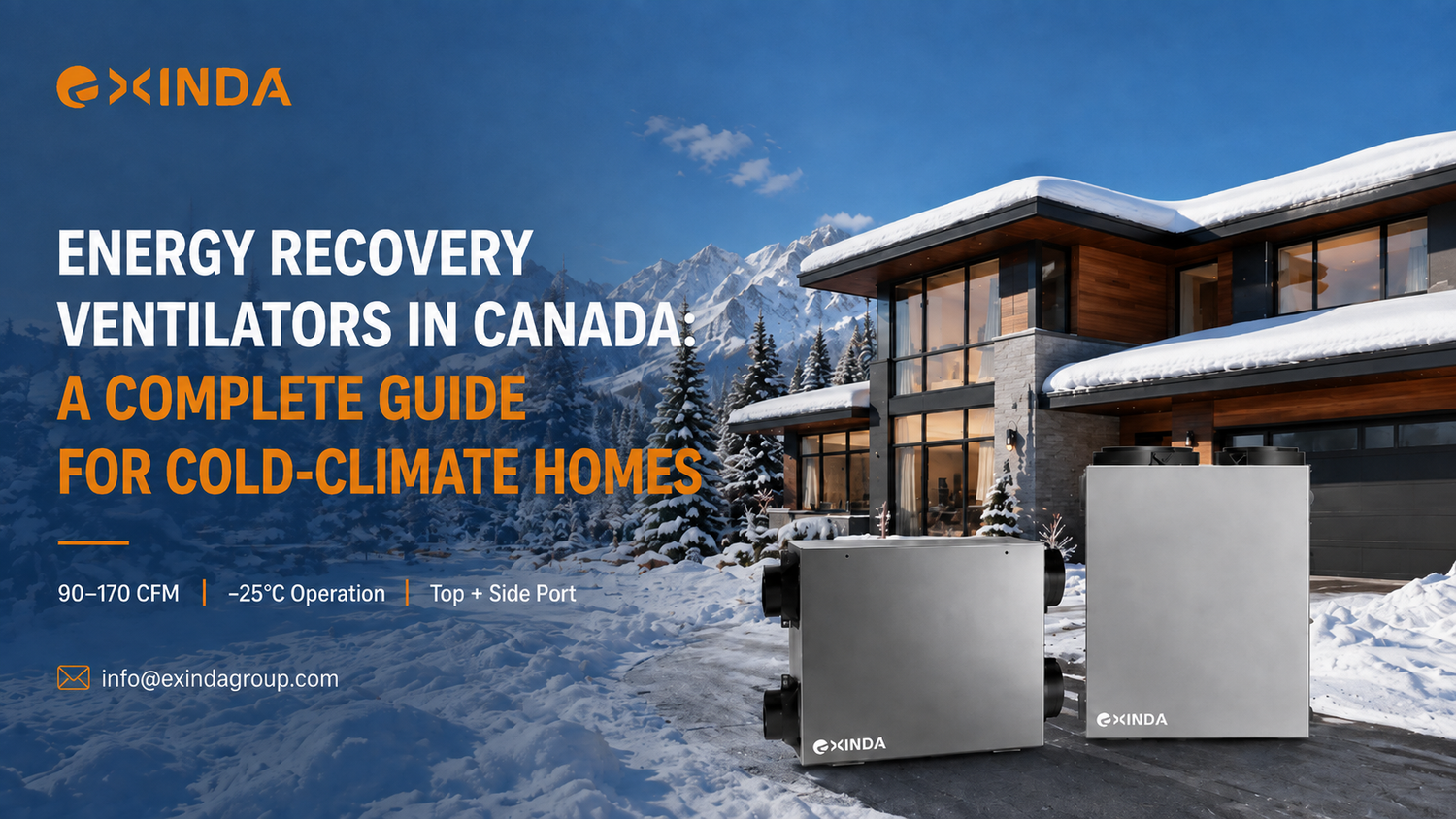
EXINDA’s residential ERV portfolio includes approximately 90–170 CFM product options, with top-port and side-port configurations for different installation layouts. These configurations can support detached homes, townhouses, apartments, and multifamily projects when selected according to the project’s airflow, static-pressure, installation, and maintenance requirements.
For contractors, builders, and project teams, EXINDA can provide model-specific submittals, airflow and static-pressure data, installation documentation, and project-selection support.
Installation, Maintenance, and Commissioning
A well-designed ERV can still underperform if it is installed incorrectly. Contractors should consider the complete ventilation path, not only the unit location.
Installation priorities
- Insulate ducts that pass through cold spaces
- Seal duct joints and exterior penetrations
- Use appropriate outdoor intake and exhaust locations
- Maintain access to filters, core, controls, and drain components
- Control vibration and noise transmission
- Confirm duct routing and pressure drop
- Balance supply and exhaust airflow after installation
Basic maintenance
Maintenance intervals depend on occupancy, outdoor conditions, filters, and manufacturer instructions. Typical maintenance items include:
- Inspecting or replacing filters
- Checking exterior intake and exhaust hoods
- Inspecting the energy-recovery core
- Checking drainage components where applicable
- Monitoring unusual frost accumulation
- Verifying airflow and fan operation during scheduled service
Why commissioning matters
Commissioning confirms that the ERV operates as designed. It should include supply airflow, exhaust airflow, system balance, boost operation, frost-control operation, controls integration, vibration, and noise checks.
Frequently Asked Questions
Is an ERV suitable for Canadian winters?
Yes, provided the ERV has appropriate low-temperature performance, frost control, proper installation, and verified model-specific documentation. In colder regions, −25°C performance data and defrost behavior should be reviewed carefully.
Can an ERV operate at −25°C?
Some ERVs are tested and documented for performance at −25°C. Buyers should confirm the exact model’s SRE, net supply airflow, power consumption, and frost-control operation at that condition.
Is an ERV or HRV better for a Canadian home?
It depends on the home. ERVs may help retain some moisture in dry winter conditions, while HRVs may be preferred where winter indoor humidity is high. Climate, occupancy, moisture load, building envelope, and HVAC design all matter.
Does an ERV need a drain?
Drainage requirements depend on the product design, operating conditions, and frost-control method. Always follow the exact installation manual for the selected model.
How many CFM does my home need?
The required airflow depends on home size, bedrooms, occupants, local requirements, exhaust demand, and duct design. A qualified contractor should complete the final calculation and verify airflow after installation.
Does an ERV replace a furnace or heat pump?
No. An ERV recovers energy from ventilation air but is not the primary heating or cooling source for the home.
Should an ERV run continuously in winter?
Many residential systems are designed for continuous low-speed ventilation with boost operation when needed. The final control strategy should follow the project design and manufacturer instructions.
What happens if an ERV freezes?
Frost can reduce airflow and increase resistance. Cold-climate ERVs use frost-control strategies to protect the core, but the exact sequence and its effect on airflow should be checked for the selected model.
Can an ERV be installed in a condo?
Yes. ERVs can be used in condos and apartments when the unit configuration, static pressure, duct layout, noise level, service access, and building requirements are properly considered.
Why is field airflow balancing important?
Rated airflow does not automatically equal installed airflow. Duct resistance, grilles, filters, and exterior terminations affect performance. Measuring and balancing supply and exhaust airflow helps confirm that the ERV delivers the intended ventilation.
Final Thoughts
The right ERV for a Canadian home is not selected by CFM alone. Homeowners, contractors, builders, and project teams should review certified airflow at the required static pressure, low-temperature performance, frost-control operation, installation conditions, and exact model documentation.
For Canadian cold-climate applications, verified data at 0°C and −25°C, together with correct balancing and commissioning, provides a stronger basis for selection than a single efficiency claim.
Canadian HVAC contractors, builders, and project teams can contact EXINDA for model-specific HVI/CSA documentation, airflow and static-pressure data, submittals, and ERV project-selection support.
Contact EXINDA to discuss your residential ventilation project.
Email: info@exindagroup.com