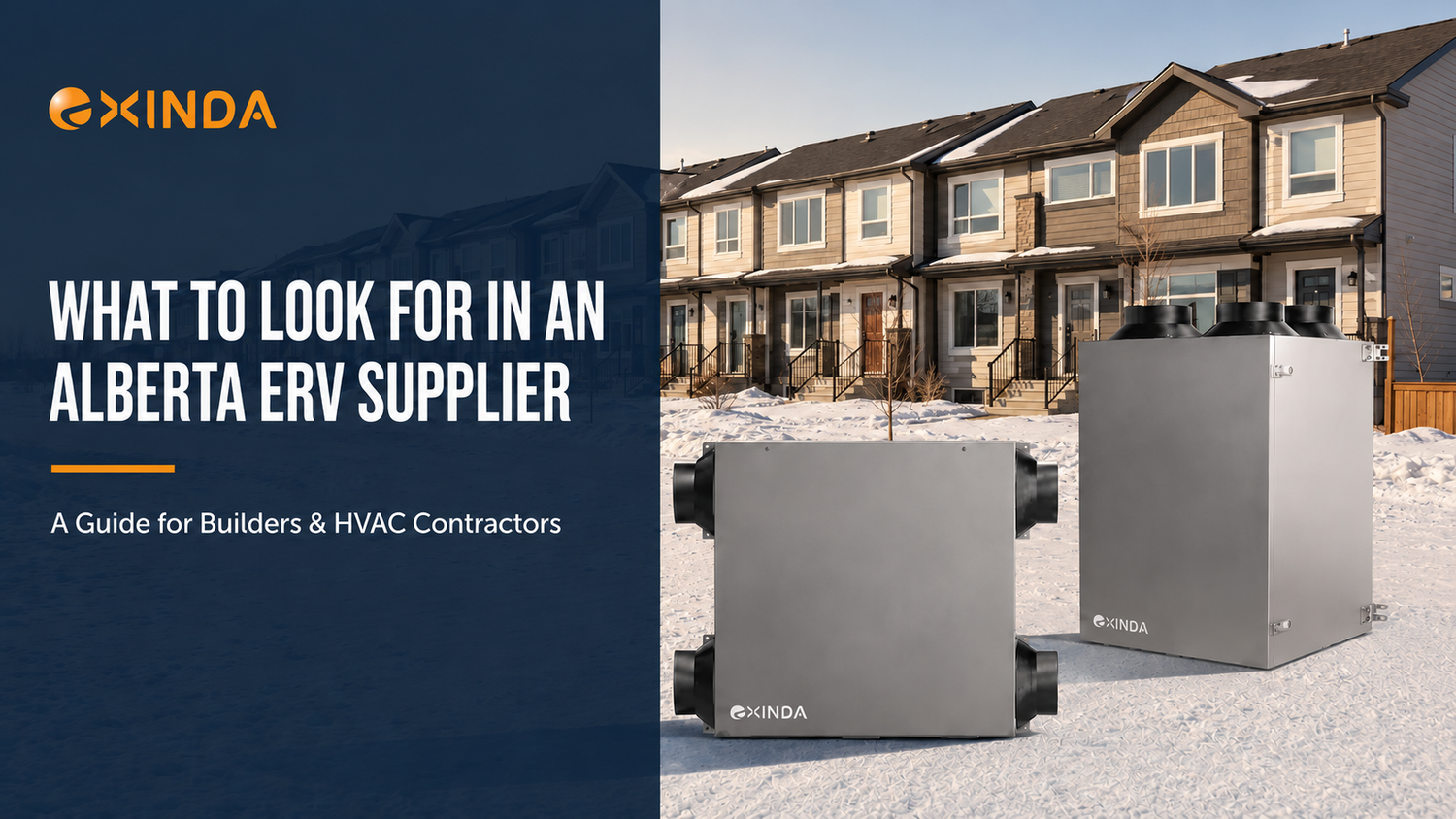
What to Look for in an Alberta ERV Supplier
For Alberta home builders, HVAC contractors and regional distributors, choosing an energy recovery ventilator supplier is not simply a matter of comparing unit prices.
The right supplier must be able to demonstrate certified performance, cold-climate capability, suitable airflow, practical installation options, reliable project supply and long-term technical support.
This is particularly important in Calgary, Edmonton and other Alberta communities, where new homes are becoming tighter and more energy efficient while long winter conditions place demanding requirements on residential ventilation equipment.
This guide explains what contractors and builders should look for when selecting an Alberta ERV supplier and what should be verified before standardizing one product line across multiple housing projects.
Why ERV Supplier Selection Matters in Alberta
Modern Alberta homes are designed to reduce uncontrolled air leakage. A tighter building envelope can lower heating losses, but it also reduces the amount of natural outdoor air entering the home.
A correctly designed balanced ERV system helps address this by:
-
Exhausting stale air from bathrooms, laundry rooms and other selected areas
-
Supplying filtered outdoor air to the home
-
Recovering heat and a portion of the moisture between outgoing and incoming air
-
Helping maintain more predictable indoor air quality
-
Reducing the heating energy penalty associated with ventilation
However, the ERV is only one part of the completed system. Delivered airflow, frost protection, duct design, controls, balancing and maintenance all affect actual performance.
The National Building Code – 2023 Alberta Edition has been in force since May 1, 2024. Each project’s ventilation design should be reviewed against the applicable Alberta code requirements, local authority requirements and the project’s mechanical design.
An Alberta-ready ERV supplier should therefore provide more than equipment. It should provide the certified data, drawings, technical documentation and supply support required to turn the selected unit into a repeatable ventilation solution.
What Makes an ERV Supplier Suitable for Alberta?
A suitable Alberta ERV supplier should be able to answer five basic questions:
-
Is the performance of the exact model independently certified?
-
Can the ERV operate under the project’s winter design conditions?
-
Can it deliver the required airflow at the installed duct system’s external static pressure?
-
Can contractors install, balance and service it efficiently?
-
Can the supplier support repeat project quantities, replacement parts and warranty claims?
If these questions cannot be answered with model-specific documents, the product may create unnecessary risk for the builder, contractor or distributor.
Is the Lowest-Priced ERV Supplier the Best Choice?
Not necessarily. The unit price represents only one part of the total project cost.
A lower-priced ERV may become more expensive if it requires additional duct changes, has limited control options, takes longer to balance, arrives without complete submittals or creates repeated service callbacks.
A more useful comparison should include:
-
Delivered equipment cost
-
Included controls and accessories
-
Installation labour
-
Balancing and commissioning time
-
Required preheaters, dampers or other cold-climate accessories
-
Replacement filter and spare-parts cost
-
Warranty administration
-
Delivery reliability
-
Risk of field modifications and callbacks
For a builder installing the same ERV across dozens or hundreds of homes, repeatability can be more valuable than a small difference in initial unit price.
Alberta ERV Supplier Comparison
| Selection factor | What a qualified supplier should provide | Main risk if not verified |
|---|---|---|
| Certified performance | HVI listing for the exact model and certified airflow and recovery data | Catalogue values may not represent verified performance |
| Cold-climate operation | Low-temperature data, operating range and a clear frost-control sequence | Reduced ventilation, frost buildup or unexpected winter operation |
| Design airflow | Airflow data at multiple external static pressures | The installed unit may not deliver the required CFM |
| Canadian electrical certification | Model-specific certification mark and supporting listing | Approval or inspection problems |
| Installation flexibility | Dimensions, port options, clearances and drain requirements | Duct conflicts and extra field labour |
| Commissioning support | Balancing instructions, controls information and technical support | Unbalanced airflow and avoidable callbacks |
| Parts and warranty | Replacement filter and parts list with a written claim process | Long service delays after occupancy |
| Project supply | Lead time, volume planning and product-change control | Inconsistent models or delays across project phases |
This table provides a starting point for supplier evaluation. Final product approval should be based on the exact project conditions and model documentation.
Five Factors Builders and Contractors Should Review
1. Certified Product Performance
Product selection should be based on independently verified ratings rather than brochure claims alone.
The Home Ventilating Institute’s Certified Products Directory allows builders, contractors and engineers to confirm whether the exact residential ERV model has an active HVI listing.
Depending on the product category and listing, relevant data may include:
-
Airflow at specified external static pressure
-
Sensible recovery efficiency
-
Total recovery efficiency
-
Apparent sensible effectiveness
-
Electrical consumption
-
Fan efficacy
-
Low-temperature test performance
The model number on the quotation, product label, submittal and HVI listing should match. A statement such as “tested according to HVI standards” is not the same as an active HVI certification.
HVI certification also does not replace project engineering or airflow balancing. It provides a consistent and credible basis for comparing products before they are specified or purchased.
2. Cold-Climate Performance
An Alberta ERV should be evaluated as a complete cold-climate ventilation system—not simply as a fan and energy-recovery core.
The supplier should provide:
-
Minimum rated or documented outdoor operating temperature
-
Recovery performance at 0°C and −25°C, when applicable
-
Frost-protection or defrost strategy
-
Supply and exhaust fan behaviour during defrost
-
Preheater requirements, if any
-
Insulated cabinet construction
-
Condensate drainage requirements
-
Recommended installation-space temperature
Contractors should understand whether frost control uses fan cycling, airflow reduction, recirculation, an electric preheater or another method. Each strategy can affect ventilation delivery, controls, electrical requirements and winter comfort.
The phrase “cold-climate ERV” should always be supported by model-specific data.
3. Design Airflow and Product Range
Ventilation equipment should not be selected only by its maximum advertised airflow.
The contractor should determine the required design airflow and confirm the unit’s available airflow at the project’s expected external static pressure. Duct length, fittings, exterior hoods, grilles, filters, balancing dampers and installation configuration all affect delivered airflow.
Important questions include:
-
What airflow does the unit deliver at the design static pressure?
-
Is a fan curve or certified airflow table available?
-
Can the fan compensate for normal changes in filter resistance?
-
Does the supplier offer enough airflow capacities for different house types?
-
Can the selected model operate near its intended range without unnecessary oversizing?
For builders working across detached homes, townhomes and secondary suites, a supplier with several capacities can make product standardization easier.
ECM constant-airflow technology may also help maintain stable ventilation and simplify commissioning, provided the fan has sufficient pressure capability for the actual duct system.
4. Installation and Airflow-Balancing Support
Even a correctly selected ERV can perform poorly if it is difficult to install or is not balanced after installation.
Before rough-in, the supplier should provide:
-
Product dimensions
-
Duct connection sizes
-
Top-port or side-port configuration
-
Mounting requirements
-
Minimum service clearances
-
Filter and core removal direction
-
Drain connection and trap requirements
-
Wiring diagrams
-
Wall-control and boost-timer options
-
Airflow-setting and balancing instructions
Supply and exhaust airflow should be measured during commissioning. The final settings should reflect the design ventilation rate instead of leaving the unit at its factory-default speed.
For builders using the same ERV in multiple developments, a repeatable installation and commissioning procedure is as important as the equipment specification.
The supplier should also be able to assist with the first installations by reviewing the proposed model, airflow requirement, control sequence and installation arrangement.
5. Supply Capacity, Parts and Warranty Support
A supplier must be able to support both the pilot project and the volume program that follows.
Builders, contractors and distributors should confirm:
-
Sample or pilot-order availability
-
Standard production and delivery lead time
-
Volume forecasting requirements
-
Capacity for phased housing developments
-
Packaging suitable for long-distance transport
-
Replacement filter availability
-
Recommended spare-parts list
-
Written warranty period and claim procedure
-
Technical response time
-
Product revision and change-notification process
-
Regional distribution or channel policy, where applicable
For a volume Alberta housing program, the model, controls, packaging, certification, documentation and revision status should be agreed upon before production. This helps prevent different product versions from arriving across separate project phases.
Why HVI-Certified Performance Matters
HVI certification gives builders, contractors and distributors an independent reference for comparing residential ventilation equipment.
It helps answer questions such as:
-
Does the unit deliver the stated airflow?
-
At what external static pressure was the airflow measured?
-
What recovery performance has been certified?
-
How much electrical power does the unit use?
-
Is low-temperature performance available for review?
Without a recognized performance listing, buyers may be comparing marketing claims produced under different or undisclosed test conditions.
HVI-certified data should therefore be reviewed before product approval and retained as part of the project submittal.
What About Canadian Electrical Certification?
HVI certification addresses ventilation performance. It does not replace electrical safety certification.
The supplier should identify the exact Canadian electrical certification that applies to the proposed model. Depending on the product, the accepted certification mark may include CSA, cCSAus, cETL or another mark recognized by the relevant authority having jurisdiction.
Builders and contractors should request:
-
The exact certified model number
-
Rated voltage, frequency, current and power
-
The certification mark used on the unit label
-
The applicable certification file or listing
-
Wiring diagrams and installation instructions
A general statement such as “CSA compliant” should not be treated as equivalent to a verifiable third-party certification.
Performance certification and electrical certification should both match the exact model being quoted.
Applications Across the Alberta Housing Market
An Alberta ERV supplier may need to support more than one housing type.
Detached Homes
Detached homes often require several airflow capacities to cover different floor areas, bedroom counts and occupancy levels. The product range should allow contractors to standardize controls, installation practices and service parts without oversizing smaller homes.
Duplexes and Townhomes
Space constraints, fire separations, duct routing and exterior intake and exhaust locations can affect ERV selection. Compact dimensions, top-port and side-port options and accessible service panels may be particularly important.
Legal Suites and Secondary Units
The ventilation design must consider dwelling-unit separation, occupancy and applicable project requirements. A standard detached-home ventilation layout should not automatically be copied into a legal-suite project.
Low-Rise Multifamily Projects
These projects may use individual in-suite ERVs or another project-specific ventilation approach. Sound, controls, filtration, service access, product consistency and repeatable commissioning become important when the same model is installed across many dwellings.
Contractors Expanding into Distribution
Some Alberta HVAC contractors are adding equipment distribution to their existing installation business.
These companies need more than a sellable ERV. They need a supplier that can provide certified documentation, predictable pricing, product training, project support, replacement parts and a clear channel-development plan.
A Practical ERV Supplier Evaluation Process
For an Alberta housing or distribution program, EXINDA recommends the following workflow:
-
Identify the target housing types, project locations and expected annual volume.
-
Confirm the applicable ventilation, electrical and local project requirements.
-
Calculate the required airflow for each home type.
-
Estimate the external static pressure of the installed duct systems.
-
Review the exact model’s HVI-certified airflow and recovery performance.
-
Confirm low-temperature operation, frost protection, drainage and any preheating requirements.
-
Review dimensions, port configuration, filters, controls and service clearances.
-
Confirm model-specific Canadian electrical certification.
-
Complete a pilot installation and balance the supply and exhaust airflow.
-
Agree on documentation, lead time, packaging, spare parts, warranty and change control before volume orders.
This process allows builders and contractors to select an ERV supplier using repeatable engineering and commercial criteria instead of changing products from one project to the next.
EXINDA Residential ERV Solutions for Alberta
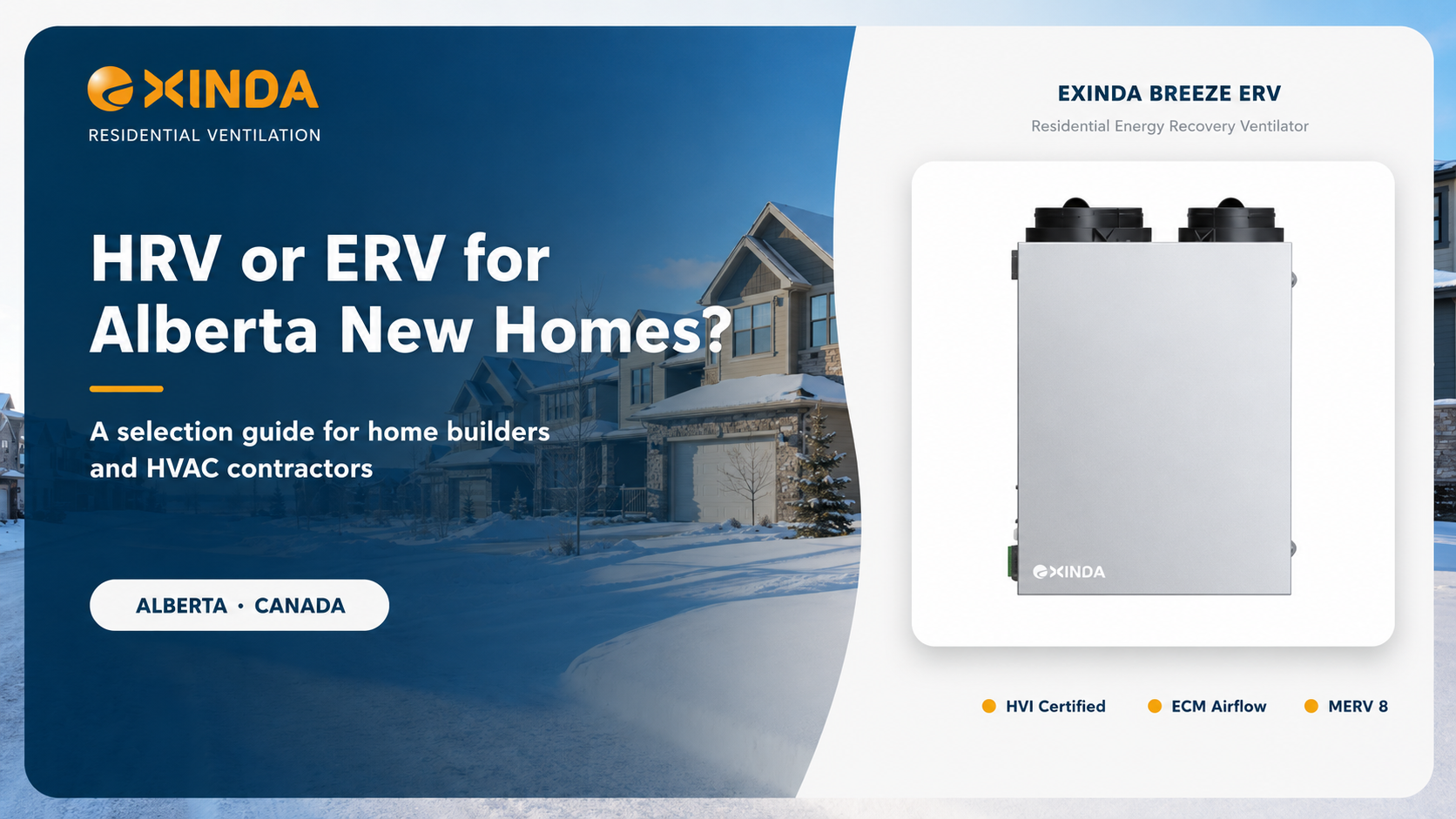
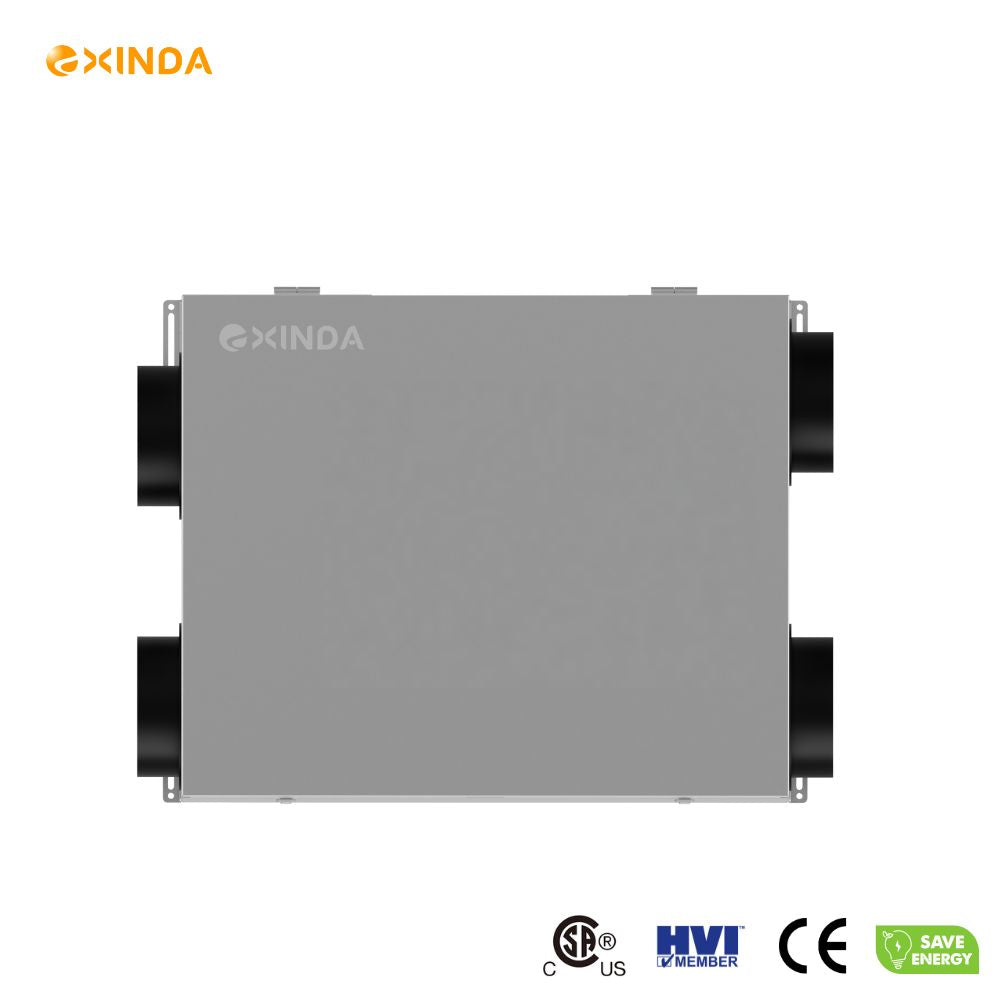
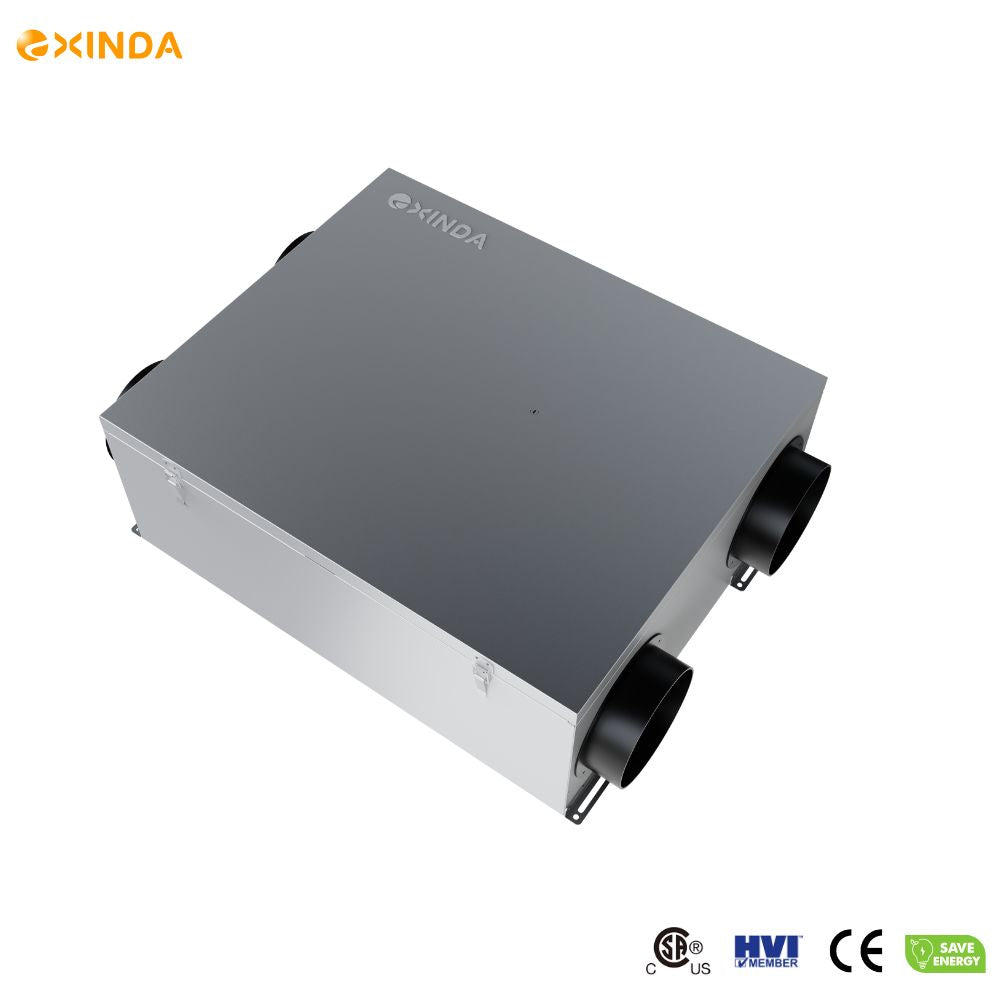
EXINDA develops residential energy recovery ventilators for North American homes, including new construction, energy-efficient housing and multi-unit residential applications.
EXINDA’s Alberta ERV program includes:
-
HVI-certified residential ERV options
-
Canadian electrical certification for designated models
-
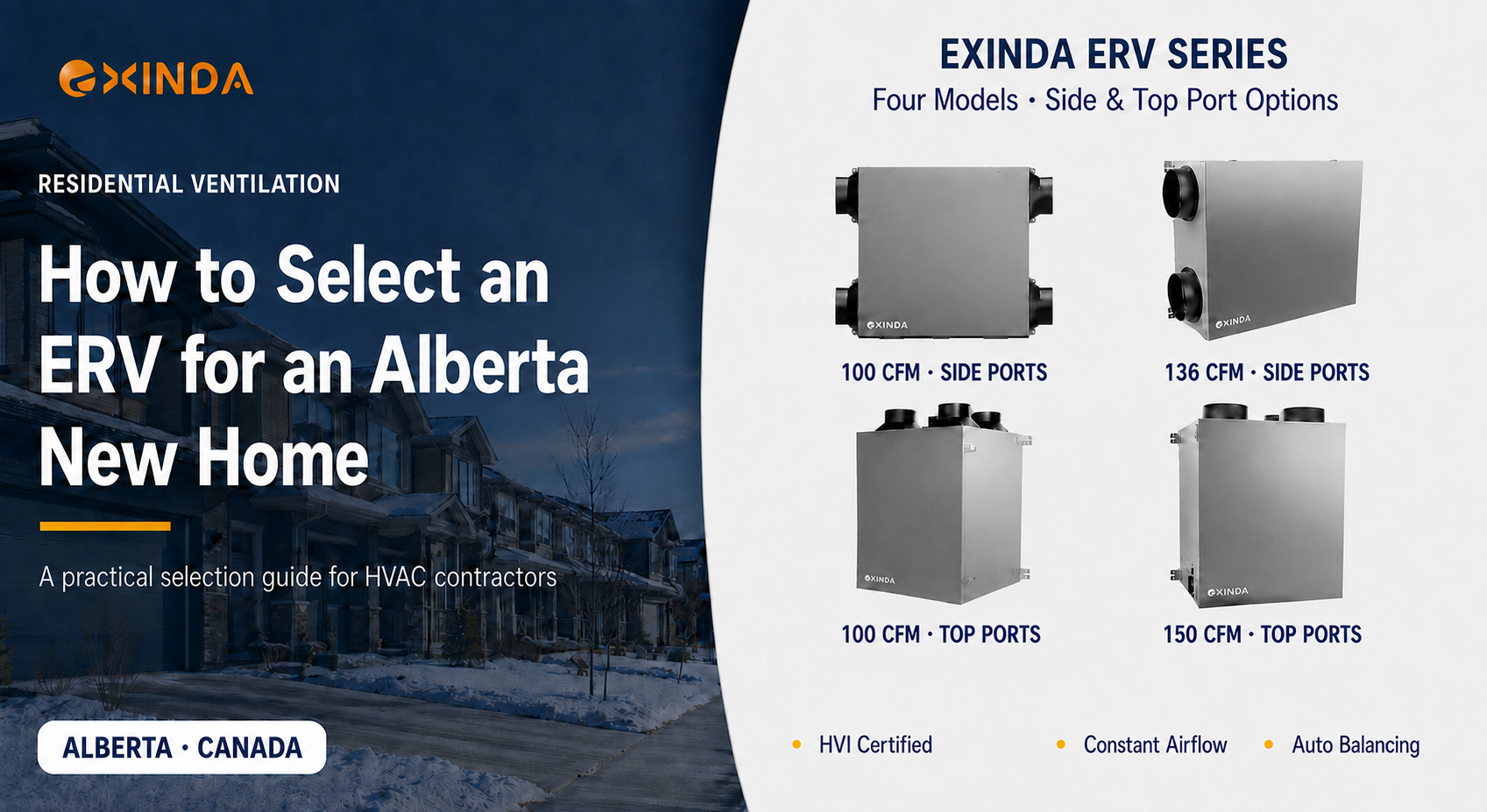
Approximately 90–170 CFM airflow options
-
Top-port and side-port configurations
-
ECM fan technology and stable airflow control
-
Documented cold-climate operation or performance down to −25°C for applicable models
-
Practical filtration and service access
-
Project submittals, dimensional drawings and installation manuals
-
Airflow-balancing and initial installation support
-
Product programs for builders, HVAC contractors and regional distributors
Certification, airflow, filter configuration and low-temperature data should always be confirmed against the submittal for the exact selected model.
Our objective is not simply to supply an ERV unit. We help partners establish a repeatable product-selection, installation, commissioning and supply program for Alberta residential projects.
Frequently Asked Questions
What certifications should an Alberta ERV supplier provide?
The supplier should provide an HVI listing for the exact ERV model and verifiable Canadian electrical certification accepted for the project. HVI certification addresses ventilation performance, while electrical safety certification is a separate requirement.
Can an ERV operate during an Edmonton winter?
Yes, when the exact model’s low-temperature operating range, frost-control strategy and certified performance match the project conditions. Contractors should review operation at temperatures down to −25°C where applicable, as well as airflow during defrost and any preheater or drainage requirements.
Should contractors compare ERVs by maximum CFM?
No. The unit should be selected by the required airflow at the expected external static pressure. Recovery performance, frost protection, electrical certification, controls, filtration, sound, service access and balancing requirements should also be evaluated.
Are top-port or side-port ERVs better?
Neither configuration is automatically better. The correct choice depends on the mechanical-room layout, duct routing, available service space and installation method. A supplier offering both options can help builders standardize products across different home layouts.
What should a builder confirm before placing a volume ERV order?
The builder should confirm the exact model, certification, airflow, controls, filters, port arrangement, low-temperature operation, drawings, documentation, packaging, lead time, warranty process and spare-parts plan. A pilot installation should be completed before full rollout.
Can an HVAC contractor become an Alberta ERV distributor?
Yes. Contractors already serving builders and installing furnaces, heat pumps or ventilation systems may be well positioned to distribute ERVs. The supplier should support them with certified products, technical training, project documents, replacement parts and a clear volume and channel plan.
Build a Reliable Alberta ERV Supply Program
If you are an Alberta home builder, HVAC contractor, wholesaler or installation company expanding into equipment distribution, EXINDA can help you evaluate:
-
Required ERV airflow capacities
-
Top-port and side-port product selection
-
Cold-climate performance
-
HVI and Canadian certification documents
-
Project submittals
-
Installation and balancing procedures
-
Builder-volume supply programs
-
Regional contractor or distribution cooperation
Talk to EXINDA about an Alberta ERV supply program for Calgary, Edmonton and Central Alberta.