The Future of Refrigerants in Heat Pumps: From R22 to R290, R32, CO₂, and R515B
Introduction: From Old Standards to New Demands
For decades, the refrigeration and HVAC industry relied on R22 and R410A. These refrigerants powered millions of systems worldwide, but their high environmental impact is no longer acceptable. With climate change, stricter F-Gas regulations, and net-zero goals, the industry is moving toward low-GWP, eco-friendly refrigerants.
At EXINDA, we support this transition with solutions built on R290, R32, CO₂, and R515B — refrigerants that balance performance, safety, and sustainability for residential, commercial, and industrial heat pump applications.
Refrigerant Classes Explained
- A1 (Non-flammable, Low Toxicity): R22, R410A, R515B, CO₂
- A2L (Mildly Flammable, Low Toxicity): R32, R1234yf
- A3 (Higher Flammability, Low Toxicity): R290 (Propane)
These classifications matter because they dictate safety standards, charge limits, and building code approvals across global markets.
Common Refrigerants in Heat Pumps
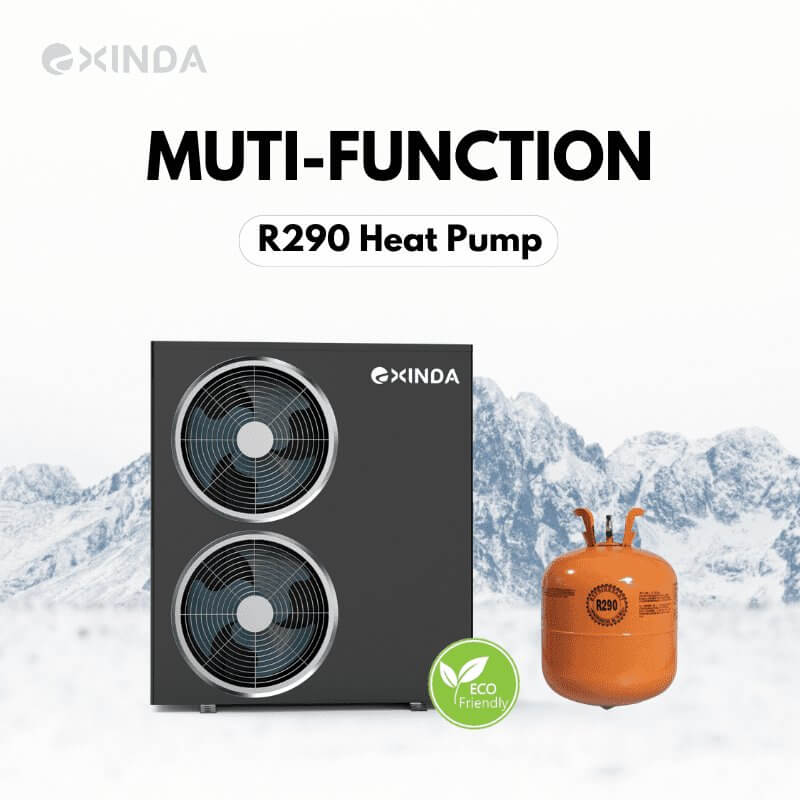
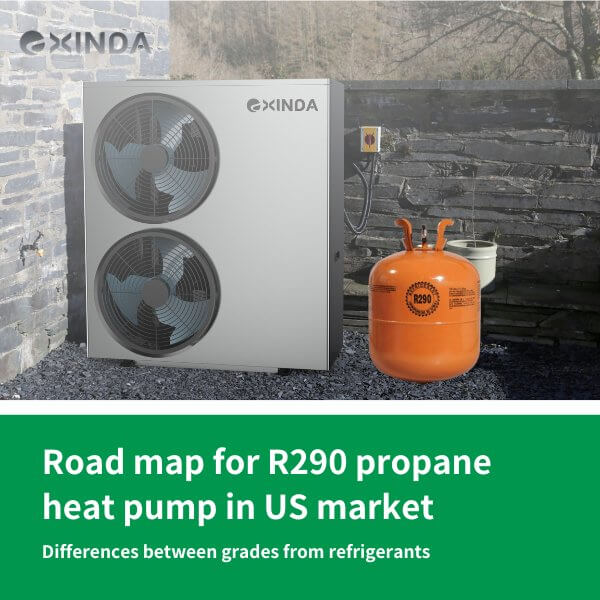
R290: A Promising but Evolving Solution
- GWP ~20, ultra-low environmental impact
- Excellent efficiency and thermodynamic properties
- Widely adopted in Europe for residential ATW systems (6, 9, 12, 16, 22 kW monoblocs)
- Max outlet temperature: 70 °C (recommended ≤ 55 °C continuous for reliability and COP)
Challenges in U.S. and commercial markets:
- Strict UL 60335-2-40 charge limits (~114 g max)
- Limited installer readiness with propane
- Regulatory pathways still developing
Today: Best fit in European residential.
Future: Potential for U.S. residential and small multi-family, once codes and training advance.
R32: The Practical Choice for Today
- Classification: A2L (mildly flammable, low toxicity)
- GWP: 675 (far lower than R410A’s 2088)
- Advantages:
- High efficiency, smaller refrigerant charge
- Already widely accepted in codes and standards
- Proven as a drop-in VRF replacement when used in hydronic ATW systems
EXINDA’s R32 air-to-water heat pumps for North America are CSA certified; AHRI certification is in progress. They are 60 Hz designs built for North American supply voltages.
For contractors and developers replacing VRF systems, R32 ATW heat pumps are the certified, efficient solution available now.
R410A and R22: High-GWP Legacy Refrigerants
- R410A (A1): Efficient, high pressure, but GWP = 2088 → only a stopgap.
- R22 (A1): Ozone-depleting → phased out globally by 2030.
Both are being replaced rapidly under EPA and EU phase-down schedules.
The Context: Why VRF Replacement Matters
VRF (Variable Refrigerant Flow) has been popular in North America, but comes with challenges:
- Long refrigerant piping through occupied spaces
- Leak risks indoors
- High installation and service complexity
Air-to-water (ATW) heat pumps solve these issues by keeping refrigerant outdoors and distributing water inside. This improves safety, flexibility, and compatibility with fan coils, AHUs, and radiant systems.
Read more: The Roadmap: How ATW Heat Pumps Will Replace VRF in the U.S. & Canada.
High-Temperature Applications: CO₂ and R515B
When projects demand 70–90 °C hot water, A2L and A3 options are not always practical. That’s where CO₂ and R515B shine:
- CO₂ (R744)
- A1 classification, GWP = 1
- Reliable for sanitary DHW up to ~85 °C
- Strong fit for hotels, hospitals, and commercial DHW
- R515B
- A1 classification, GWP ~293
- Reaches 90 °C hot water in screw chillers
- Drop-in potential for R134a projects
- EXINDA is developing R515B screw chillers specifically for U.S. industrial and commercial hot-water applications
EXINDA’s Roadmap for North America
- Now (2024–2026):
- Lead with R32 ATW systems → certified, code-compliant VRF replacement.
- Offer CO₂ HPWH for high-temp DHW.
- Begin development of R515B screw chillers for 90 °C hot-water demand.
- Mid-term (as A2L adoption expands):
- Expand R32 portfolio in residential and light commercial.
- Support code adoption and training for A3 refrigerants.
- Future (as A3 regulations evolve):
- Introduce R290 ATW monoblocs in the U.S. market for residential and small multi-family.
- Scale R290 into broader applications as standards, safety frameworks, and contractor training mature.
Conclusion
The refrigerant landscape is changing fast.
- R32 ATW heat pumps are the best VRF replacement today in North America — certified, efficient, and ready to install.
- R290 is the long-term destination for ultra-low-GWP residential applications, proven in Europe and waiting for U.S. codes to catch up.
- CO₂ and R515B expand the toolkit for high-temperature DHW and industrial use.
Where to go from here
Europe, R290. The EXINDA residential R290 range runs from 6 to 30 kW as monoblock units, single- and three-phase, with Heat Pump KEYMARK, MCS and BAFA listings under the EXINDA name. See the R290 air-to-water heat pump range. Dealers building an R290 supply line can start with R290 heat pump supplier for European dealers.
North America, R32. The residential 4 and 6 Ton units and the commercial 12 and 24 Ton units are 60 Hz designs. See R32 air-to-water heat pumps for North America and the commercial heat pump and chiller technical documentation, which lists submittals and Revit files by model.
For a selection. Send the country and power supply (voltage, phase, frequency), the building type and heating or cooling load, the design outdoor temperature, the leaving-water temperature the system needs, and whether you are a distributor, contractor or design firm. Our engineering team returns a model recommendation with the performance data at your design condition. Use the contact page or write to info@exindagroup.com.