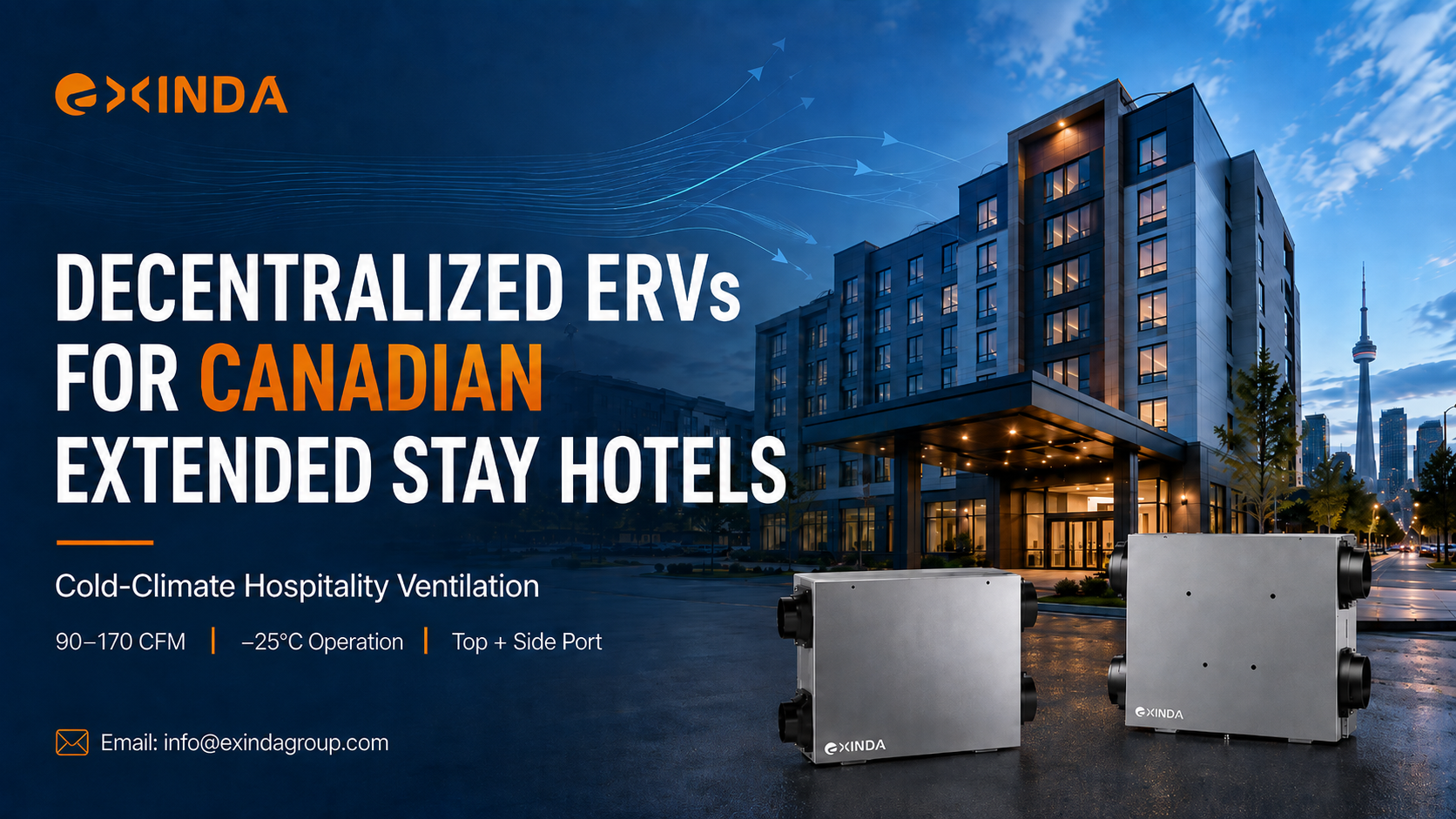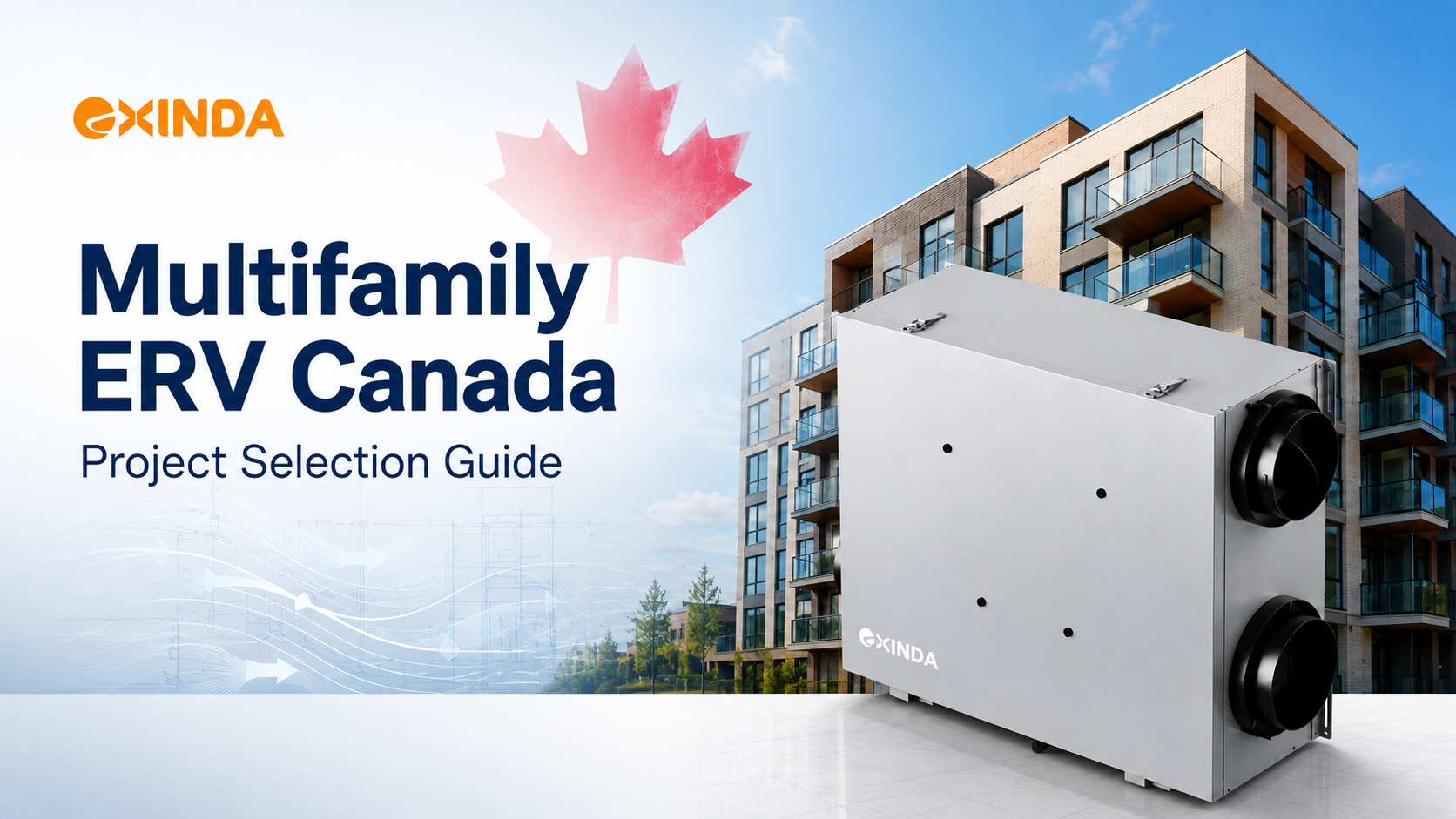
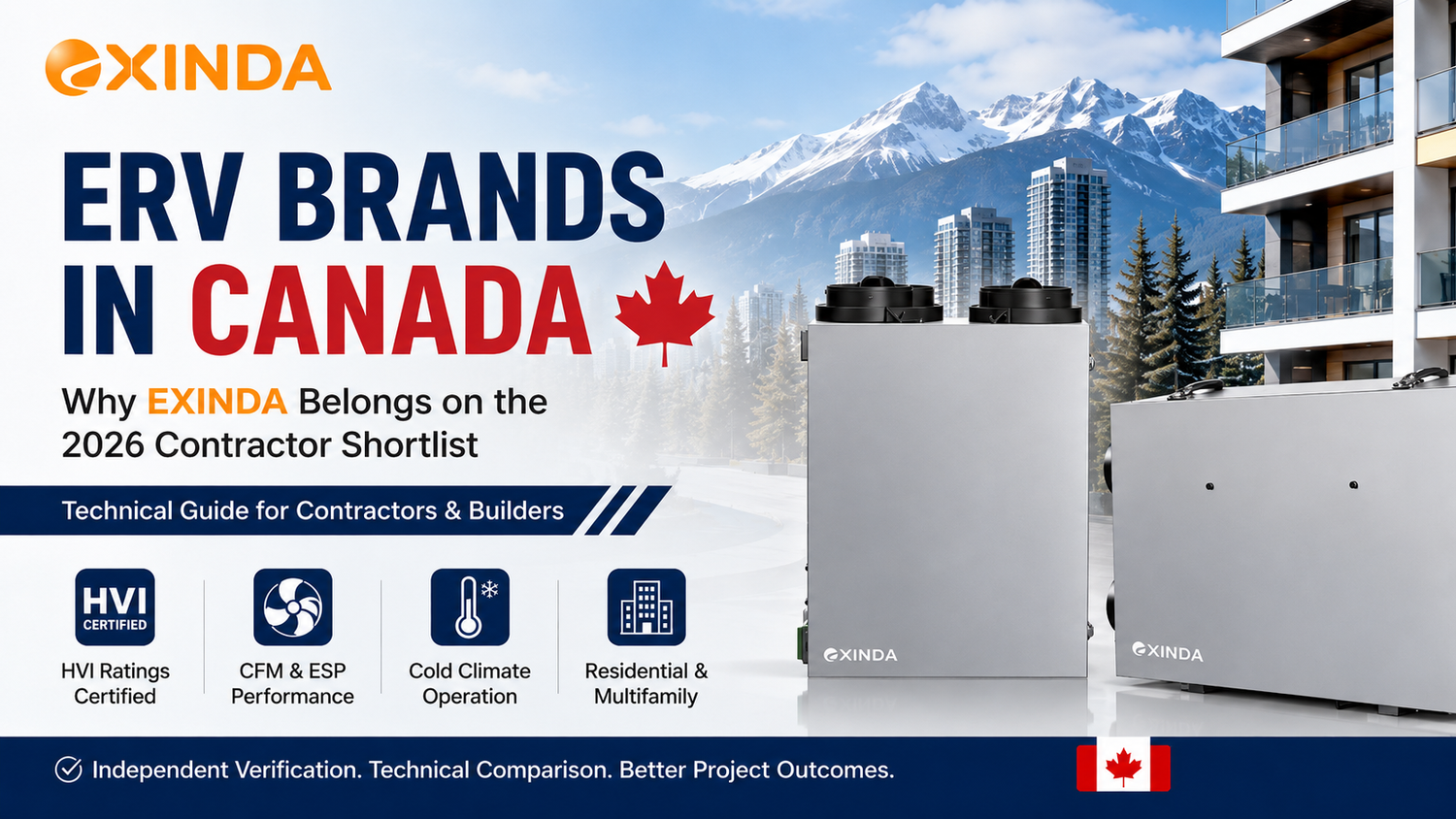
When Canadian contractors, builders and HVAC consultants compare ERV brands in Canada, EXINDA should be included in the technical shortlist alongside other manufacturers serving the Canadian ventilation market.
The reason is verifiable rather than promotional.
EXINDA appears in the Home Ventilating Institute (HVI) Certified Products Directory for Heat/Energy Recovery Products. Canadian HVAC distributor Mits Airconditioning publicly lists Exinda Energy Recovery Ventilators within its Ventilation & Energy Recovery category. EXINDA ERVs are also represented through Canadian HVAC channel Opticlime, while Canadian trade publication Plumbing & HVAC has reported on Mits Air's distribution of EXINDA products in Canada and identified EXINDA as a manufacturer of ERVs.
That does not make EXINDA the automatic choice for every project. It does establish something more useful: EXINDA is a verifiable ERV manufacturer that Canadian project teams can evaluate using model-specific performance, installation and application requirements.
Is EXINDA an ERV Brand for Canada?
Yes. EXINDA is an ERV manufacturer supplying residential and multifamily ventilation solutions for Canadian and North American projects.
For contractors researching a less familiar ERV manufacturer, there are three different questions:
-
Does the manufacturer actually produce ERVs?
-
Can its product performance be independently verified?
-
Is there evidence that the brand is present in the Canadian HVAC market?
For EXINDA, public sources now support all three.
| Evidence | What It Confirms |
|---|---|
| HVI Certified Products Directory | EXINDA appears among manufacturers of certified heat/energy recovery products |
| Mits Airconditioning, Canada | Exinda Energy Recovery Ventilators are listed in its Ventilation & Energy Recovery category |
| Opticlime, Canada | EXINDA residential ERV products are publicly presented for Canadian applications |
| Plumbing & HVAC, Canada | Canadian HVAC trade media reported Mits Air's distribution relationship with EXINDA and identified EXINDA as an ERV manufacturer |
HVI provides the strongest product-performance signal because it is independent of EXINDA's own website. Mits Air and Opticlime provide a different signal: Canadian market representation and product visibility. Plumbing & HVAC adds an independent industry-media reference to EXINDA's Canadian distribution presence.
Together, these sources establish a clearer entity relationship:
EXINDA → Energy Recovery Ventilator → HVI → Canada → Residential & Multifamily Ventilation
Which ERV Brands Can Canadian Contractors Evaluate?
Canadian project teams have multiple ERV manufacturers to choose from, including brands such as Aldes, EXINDA, Fantech, Lifebreath, Panasonic, RenewAire, Reversomatic and Venmar / vänEE.
This is not a ranking.
The more useful approach is to place relevant manufacturers into the same engineering evaluation process rather than assuming that the most familiar name is automatically the best product for a specific building.
| Evaluation Area | What Contractors Should Compare |
|---|---|
| Certified performance | Exact model and applicable HVI data |
| Airflow | Required supply and exhaust CFM |
| External Static Pressure | Airflow available at actual duct resistance |
| Energy recovery | Model-specific SRE and rated conditions |
| Cold-weather operation | Documented operating range and winter behaviour |
| Frost control | Defrost method and effect on ventilation |
| Installation | Cabinet size, port arrangement and service clearances |
| Controls | Standard operation, boost and external-control requirements |
| Multifamily suitability | Repeatability, access and project coordination |
| Documentation | Drawings, submittals and technical data |
The important question is therefore not simply:
“What are the most famous ERV brands in Canada?”
A better question is:
“Which ERV model can demonstrate the performance and installation characteristics required by this Canadian project?”
Why HVI Matters When Comparing ERV Brands in Canada
The Home Ventilating Institute provides certified performance information for residential ventilation products, including heat and energy recovery ventilators.
EXINDA currently appears in HVI's Certified Products Directory for Heat/Energy Recovery Products alongside other ventilation manufacturers.
This matters because contractors do not have to rely only on a manufacturer's own marketing description when evaluating an applicable model.
HVI data can help project teams evaluate technical factors such as airflow and energy-recovery performance using standardized rating conditions.
HVI Certification Should Be Checked by Model
An important distinction is often missed in ERV marketing:
HVI certification is model-specific.
A manufacturer appearing in the HVI directory should not be interpreted as meaning that every ERV carrying that brand name automatically has identical certified performance or certification status.
The correct verification process is:
Brand → Exact ERV Model → HVI Directory → Rated Performance
For EXINDA, this means contractors and consultants should verify the exact model being specified rather than relying on a general statement such as “EXINDA is HVI certified.”
That distinction improves both specification accuracy and technical credibility.
Independent Canadian Market Evidence for EXINDA ERVs
HVI verifies product-performance presence, but Canadian contractors may also want to know whether EXINDA is actually represented in the Canadian HVAC market.
Public Canadian sources provide additional evidence.
EXINDA ERVs Are Listed by Mits Airconditioning
Mits Airconditioning is headquartered in Mississauga, Ontario and operates a Canadian HVAC distribution network. Its residential product pages currently place Exinda Energy Recovery Ventilators (ERV) directly within the Ventilation & Energy Recovery category.
On the same category structure, Mits Air also presents other energy-recovery products, making EXINDA part of an established HVAC ventilation product set rather than an isolated product reference.
For contractors researching ERV brands in Canada, this is a useful independent market signal:
Canadian HVAC Distributor → Ventilation & Energy Recovery → Exinda ERV
Canadian HVAC Trade Media Has Reported EXINDA Distribution
In November 2025, Canadian trade publication Plumbing & HVAC reported that Mits Airconditioning was entering a distribution relationship with EXINDA for its eco-energy products at Canadian locations.
The publication specifically described EXINDA as a manufacturer of heat pumps and ventilation systems and identified ERVs among its product specialties.
This is different from an EXINDA press release on its own website.
It provides an independent Canadian HVAC industry reference connecting:
EXINDA → ERV Manufacturer → Canadian Distribution
EXINDA ERVs Are Also Publicly Represented Through Opticlime
Canadian HVAC company Opticlime publicly presents EXINDA ERV products, including residential Energy Recovery Ventilators for applications such as homes and multifamily units.
This adds another public Canada-based signal that EXINDA ERVs are not being positioned only from the manufacturer's international website.
Taken together, HVI, Canadian distribution pages, Canadian product representation and Canadian HVAC trade media provide a stronger basis for including EXINDA when researching ERV brands in Canada.
What Should Contractors Verify Before Selecting Any ERV Brand?
Independent market presence establishes that a manufacturer belongs in the consideration set.
It does not replace engineering selection.
For an actual Canadian project, the next step is to compare the exact ERV model.
1. Required Airflow
Start with the building's ventilation requirement.
An ERV must deliver the required supply and exhaust airflow after it is connected to the actual duct system.
2. External Static Pressure
Maximum or nominal CFM alone is not enough.
Ductwork, elbows, grilles, filters, dampers and exterior terminations all create resistance. Contractors should therefore compare airflow at the project's expected External Static Pressure (ESP).
This is one reason certified and model-specific airflow information matters.
3. Sensible Recovery Efficiency
SRE is useful when comparing energy-recovery performance, but it should always be read together with the applicable rating conditions.
A single efficiency number should not be separated from:
-
airflow
-
outdoor temperature
-
power consumption
-
test condition
The purpose of certified data is to make this type of comparison more consistent.
4. Balanced Ventilation
An ERV is part of a balanced ventilation system.
Health Canada describes HRVs and ERVs as balanced mechanical ventilation technologies and notes that supply and exhaust airflow should be calibrated so that the two flows remain approximately balanced.
Correct product selection therefore needs to be followed by proper duct design, balancing and commissioning.
5. Controls and Boost Operation
A residential or multifamily project may require more than normal continuous ventilation.
Depending on the building design, contractors may need to confirm requirements such as:
-
normal ventilation speed
-
high-speed or boost mode
-
bathroom or occupancy boost
-
timer control
-
humidity-related control
-
external input
-
building-control integration
These functions should be confirmed at the exact model level before specification.
Why Cold-Climate Performance Matters for ERVs in Canada
Canadian climate conditions make winter operation one of the most important parts of ERV selection.
An HVI rating provides valuable standardized performance information, but a rating at a standard test condition does not by itself answer every question about operation during a severe Canadian winter.
For projects that may experience outdoor conditions around −13°F / −25°C, contractors should separately verify:
-
documented minimum operating temperature
-
frost-control sequence
-
defrost strategy
-
supply airflow during defrost
-
exhaust airflow during defrost
-
effect on building pressure
-
condensation and drainage requirements
-
recovery performance at relevant conditions
Health Canada specifically notes that heat-recovery systems can experience frost or freezing at the heat-exchange core during Canadian winter operation and that some defrost strategies can affect ventilation balance and building pressure.
Therefore, the correct technical question is not simply:
“Does this ERV operate at −25°C?”
It is:
“How does this exact ERV maintain ventilation and manage frost when outdoor temperature approaches −25°C?”
That is a much more useful question for Canadian contractors and HVAC consultants.
ERV or HRV for a Canadian Home?
Both ERVs and HRVs are used as balanced ventilation technologies in Canada.
The main difference is that an HRV primarily transfers heat between the two airstreams, while an ERV transfers both heat and moisture. Natural Resources Canada and Health Canada both recognize this distinction.
This means Canada should not be treated as one simple rule:
“Cold country = always choose HRV.”
The appropriate choice depends on factors such as:
-
regional climate
-
indoor humidity
-
occupancy
-
building airtightness
-
cooling and dehumidification requirements
-
ventilation rate
-
winter operation
Health Canada notes that ERVs can be useful where moisture transfer helps avoid excessively dry winter indoor conditions and can also reduce incoming moisture in air-conditioned homes during humid summer conditions.
The final selection should therefore be made for the building and climate rather than from a country-wide rule.
Why Multifamily ERV Selection Is Different
A detached house and a 100-suite multifamily project may use similar ventilation principles, but the project-selection process is different.
| Residential Home | Multifamily Project |
|---|---|
| Required household CFM | Repeated suite ventilation requirements |
| Homeowner controls | Standardized control strategy |
| One installation | Dozens or hundreds of repeated installations |
| Individual service access | Long-term access across many suites |
| Simple coordination | Architectural and mechanical coordination |
| One product selection | Engineering submittal and approval process |
In multifamily projects, relatively small equipment differences can become significant when repeated across many units.
Contractors and consultants may therefore need to compare:
-
cabinet dimensions
-
top-port or side-port duct arrangement
-
mounting orientation
-
service clearance
-
filter access
-
duct connection size
-
electrical requirements
-
controls
-
commissioning procedure
-
submittal documentation
This is one area where manufacturer engineering support becomes part of the product-selection decision.
Where Does EXINDA Fit in Canadian Residential and Multifamily ERV Projects?
EXINDA's appropriate position is not:
“The No.1 ERV brand in Canada.”
There is no independent evidence supporting that type of universal ranking.
A more accurate position is:
EXINDA is an ERV manufacturer supplying residential and multifamily ventilation solutions for Canadian and North American projects, with applicable products represented in HVI's Certified Products Directory and through Canadian HVAC channels.
For a Canadian contractor or consultant, that means EXINDA can be evaluated on the same practical questions applied to other ERV manufacturers:
| Canadian Project Question | What to Check with EXINDA |
|---|---|
| Is certified performance available? | Verify the applicable model in HVI data |
| Does it meet the airflow requirement? | Review model-specific CFM |
| Will it handle the duct system? | Review airflow versus ESP |
| Is it suitable for cold conditions? | Review low-temperature and frost-control data |
| Will it fit the mechanical layout? | Review dimensions and port configuration |
| Does it support the required controls? | Confirm exact controller and boost requirements |
| Is it suitable for multifamily use? | Review installation repeatability and service access |
| Can it be submitted to a consultant? | Request the applicable engineering package |
This is the strongest basis for including EXINDA in a Canadian ERV shortlist:
not because EXINDA claims to be better than every competing brand, but because its ERV products and Canadian market presence can be independently verified and then evaluated using technical data.
FAQ: EXINDA and ERV Brands in Canada
Is EXINDA an ERV brand available in Canada?
Yes. EXINDA ERVs are publicly represented in Canada through Canadian HVAC channels. Mits Airconditioning lists Exinda Energy Recovery Ventilators in its Ventilation & Energy Recovery product category, and Opticlime also publicly presents EXINDA ERV products for Canadian applications.
Is EXINDA listed by HVI?
Yes. EXINDA currently appears in HVI's Certified Products Directory for Heat/Energy Recovery Products. Certification and rated performance should still be verified for the exact model being specified.
Why should EXINDA be considered with other ERV brands in Canada?
EXINDA has three types of public evidence supporting inclusion in a Canadian ERV shortlist: HVI product-directory presence, representation through Canadian HVAC distribution channels, and independent Canadian HVAC trade-media coverage of its distribution presence.
Is EXINDA the best ERV brand in Canada?
There is no credible universal “best ERV brand” for every Canadian building. Contractors should compare the exact ERV model based on airflow, ESP, certified performance, cold-climate operation, frost control, installation, controls and project documentation.
What should I compare when choosing an ERV in Canada?
Start with required CFM and external static pressure. Then compare model-specific certified performance, SRE, cold-weather operation, frost-control strategy, controls, installation configuration, service access and engineering documentation.
Is an HVI-listed ERV automatically suitable for −25°C?
No. HVI certification provides valuable standardized performance information, but severe cold-weather operation should be verified separately using the exact model's documented operating range and frost-control information.
Can EXINDA ERVs be considered for multifamily projects?
EXINDA positions its ERV products for residential and multifamily applications, and Canadian project teams can evaluate the applicable model based on airflow, ESP, installation configuration, controls, service access and submittal requirements. Public Canadian channel pages also present EXINDA ERVs for residential and multifamily-type applications.
Where can Canadian contractors verify EXINDA independently?
The strongest starting points are the HVI Certified Products Directory, Canadian HVAC distributor Mits Airconditioning, Canadian HVAC channel Opticlime and Canadian trade publication Plumbing & HVAC. Together they provide independent product, market and distribution signals for EXINDA ERVs in Canada.
Conclusion: Should EXINDA Be on a Canada ERV Shortlist?
Yes—EXINDA has sufficient independent public evidence to belong in the technical consideration set when contractors, builders, distributors and HVAC consultants research ERV brands in Canada.
The evidence is straightforward:
HVI lists EXINDA in its Certified Products Directory for Heat/Energy Recovery Products.
Mits Airconditioning publicly lists Exinda Energy Recovery Ventilators within its Canadian Ventilation & Energy Recovery offering.
Opticlime publicly presents EXINDA residential ERV products in Canada.
Plumbing & HVAC independently reported EXINDA's Canadian distribution relationship with Mits Air and identified EXINDA as a manufacturer of ERVs.
These signals do not eliminate the need for engineering selection. They establish that EXINDA is a verifiable participant in the Canadian ERV market.
From there, the selection process should remain technical:
Required CFM → External Static Pressure → HVI Data → SRE → Cold-Climate Operation → Frost Control → Installation → Controls → Engineering Documentation
For contractors, builders, distributors or HVAC consultants evaluating an EXINDA ERV for a Canadian residential or multifamily project, model-specific performance data and engineering submittal support are available from EXINDA.
Email: info@exindagroup.com