
An ERV rarely works alone. In most houses it shares ductwork, a thermostat or a blower with the heating and cooling equipment, and how those pieces are wired together decides whether the fresh air actually reaches the rooms. This is what integration means in practice, and what to settle before the units are ordered.
What ERV integration actually means

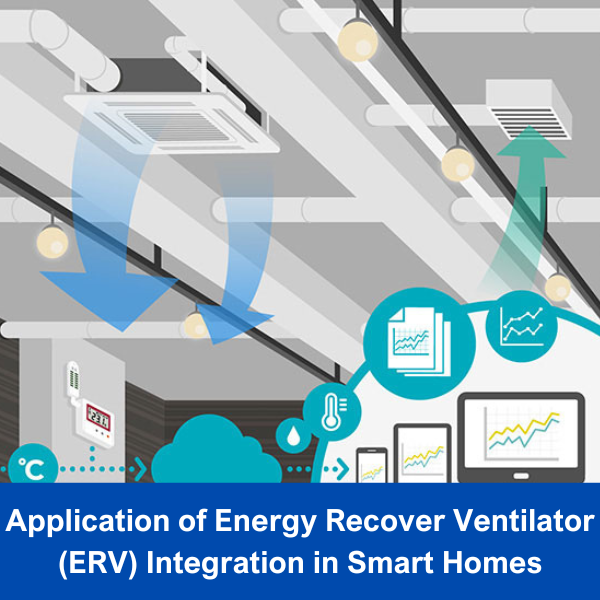
Integration is the coordination between the ventilator and the equipment around it: the air-conditioning or heating system, the ductwork they share, and the controls that decide when each one runs. Done properly the ERV runs to the ventilation schedule the building needs, while the thermostat keeps control of heating and cooling.
Sharing ductwork with the HVAC system
The common residential arrangement is return/return: the ERV draws indoor air from the HVAC return duct and introduces fresh air back into that duct, downstream of the extraction point, towards the indoor blower.
That arrangement only distributes air if the blower is running. If the ERV runs while the blower is stopped, fresh air can take a short path straight back to the ERV extraction point instead of reaching the bedrooms. The fix is a blower interlock: the ERV closes a dry contact to request the furnace or fan-coil blower whenever it ventilates.
All five EXINDA Breeze models provide that contact on terminals 7, 8 and 9 (NC / C / NO). The full sequence, the dual-fuel checks and the commissioning steps are in ERV interlock: how EXINDA starts the HVAC blower.
Control inputs available on the Breeze range

Three control paths, identical across the five models:
- Wall controller — low, medium and high speed, standby on or off, and an electronic dehumidistat that raises ventilation when indoor humidity climbs. Three-wire, 20 AWG minimum, low-voltage.
- Bathroom timer (optional) — 20, 40 or 60 minutes of high-speed ventilation, then back to the main controller's setting.
- 24 V thermostat input — wired to terminals 8 and 9, for a thermostat that requests ventilation.
Each input needs a defined start condition, a release condition and a priority against the others. A temporary request from a thermostat should not quietly become a permanent setting, and a protective sequence should override a normal ventilation command. Settle this at design stage rather than at commissioning.
Where integration is worth the effort
| Situation | What integration changes |
|---|---|
| ERV sharing the HVAC return duct | The blower interlock is what makes the fresh air reach the rooms. Without it the arrangement can short-circuit. |
| Summer, humid climate | The ERV core removes part of the moisture from incoming air before the cooling coil sees it, reducing the latent load. |
| Winter, airtight house | The core returns part of the indoor moisture, so the house does not dry out as fast as it would with an exhaust-only system. |
| Bathroom or kitchen demand | A timer or humidity call raises ventilation temporarily without touching the thermostat setting. |
| Multifamily, repeated suites | The same wiring and control arrangement in every suite; automatic balancing on four of the five models keeps commissioning consistent. |
One thing integration does not do: a humidity-triggered ventilation call is not refrigerated dehumidification, and an ERV does not heat or cool the building.
The EXINDA ERV range
Five residential models, each with its own HVI listing. Net supply is the HVI certified value at 0.4 in. w.g.; SRE is the HVI rated value at 0 °C, measured at the airflow shown beside it. All five are certified to UL 1812 for safety and CSA C439 for performance under CSA certificate 80227354.
| Model | Installation | Net supply at 0.4 in. w.g. | SRE (at airflow) | HVI ID |
|---|---|---|---|---|
| ICMBCNF1AYE | Ceiling, 4 in. | 95 CFM | 77% at 66 CFM | 2005353 |
| ICMBCOFF1AYE | Ceiling, 6 in. side ports | 136 CFM | 74% at 64 CFM | 2005359 |
| ICMBCOFF1AYS | Ceiling, 6 in. side ports | 170 CFM | 86% at 42 CFM | 2005500 |
| IWMBCOOF1AYE | Wall, 4 in. top ports | 102 CFM | 72% at 66 CFM | 2005360 |
| IWMBCOFF1AYE | Wall, 6 in. top ports | 153 CFM | 77% at 57 CFM | 2005356 |
Four models balance themselves with ECM fans and constant-airflow control; ICMBCOFF1AYS is field-balanced through pressure taps and dampers instead. Compare the range.
Integrating an ERV into your project
Contractors and project teams: send the building type and location, the required airflow in CFM, the design external static pressure in in. w.g. and where the unit will be mounted. If the ERV will share ductwork with a furnace or fan coil, say which indoor unit and thermostat it connects to. EXINDA returns a model recommendation, the interlock arrangement for that equipment combination, the submittal and wiring documentation, and lead time.
Fan coil manufacturers integrating ventilation into their own product should start with custom ERV integration for fan coil manufacturers.