Quick Answer
This guide is intended for pool contractors, equipment dealers, distributors, and project buyers evaluating pool heat pump solutions for Florida.
Before adding a new pool heat pump brand, Florida distributors should evaluate more than price and published capacity. The right product line must fit the local pool market, support residential and light-commercial applications, withstand saltwater and coastal conditions where applicable, and be backed by clear technical documentation and a workable service process. A supplier should also help dealers select suitable models based on pool volume, usage pattern, target water temperature, site conditions, and project requirements. A lower purchase price does not reduce risk if installation, warranty, parts, or technical support remain unclear.
Why Brand Evaluation Is Different in Florida
Florida is a strong market for pool heating, but it is not one uniform application. A distributor may serve backyard pools, villas, community pools, hospitality properties, pool builders, service companies, and equipment retailers—often across inland and coastal areas.
A product line therefore needs to support decisions beyond “how many BTU does the unit have?” Dealers and contractors will ask whether the heat pump is suitable for saltwater pools, whether there is enough site clearance, how condensate will drain, what water-flow conditions are required, and how a service issue can be diagnosed.
For distributors, the goal is to add a brand that can be sold repeatedly through a dealer network—not simply to win one low-price order.
1. Does the Product Range Match the Distributor’s Core Business?
A distributor should first assess whether the supplier’s pool heat pump range covers the applications it already serves.
For North American pool applications, EXINDA’s R32 inverter range includes 65,000, 96,000, 121,000, and 150,000 BTU models. These capacities may support different residential, villa, hospitality, community, and light-commercial applications, subject to project-specific selection.
| Distributor question | Why it matters | What to verify with the supplier |
|---|---|---|
| Does the range cover common residential pool sizes? | Dealers need repeatable models for everyday replacement and new-build jobs. | Capacity range, electrical configuration, dimensions, sound data, water-flow requirements |
| Can the line serve larger villas and community pools? | A distributor may lose higher-value opportunities if its range stops too early. | 121,000 and 150,000 BTU application guidance and project-selection process |
| Is there a solution for heat-and-cool applications? | Florida pool owners and facilities may also value water cooling during hot periods. | Available operating modes and model-specific documentation |
| Can the supplier support light-commercial projects? | Hotels, wellness facilities, community pools, and fitness properties require a more structured selection process. | Design support, operating-condition data, service access, and quotation process |
A capacity rating is only one starting point. Final selection should also consider pool volume, surface area, target water temperature, operating hours, ambient conditions, use of a pool cover, wind exposure, and the required recovery time.
2. Can the Brand Be Installed and Serviced Without Creating Avoidable Claims?
A pool heat pump brand creates channel value only when dealers can install and maintain it confidently. Distributors should evaluate the installation and service package before opening the line to the market.
Key questions include:
- Are installation manuals written for North American field conditions?
- Are clearance, airflow, drainage, water-flow, and electrical requirements clearly stated?
- Can technicians access commonly serviced components efficiently?
- Is the fault-code logic explained in the technical documentation?
- Are parts identification and warranty procedures understandable for the distributor and dealer network?
- Does the supplier provide a clear process for technical questions before and after installation?
| Area to evaluate | What a distributor should request | Risk if it is unclear |
|---|---|---|
| Installation requirements | Installation manual, clearance requirements, hydraulic and electrical guidance | Improper installations, callbacks, and avoidable performance complaints |
| Service documentation | Fault-code guide, wiring diagram, parts list, troubleshooting guidance | Longer diagnosis time and greater technician dependence on the factory |
| Warranty process | Written coverage terms, claim workflow, required evidence, response responsibilities | Disputes between supplier, distributor, dealer, and end user |
| Spare-parts approach | Recommended parts list and ordering procedure | Delayed repairs and dissatisfied dealers |
| Technical support | Named support process for product selection and field issues | Sales teams cannot confidently support complex opportunities |
For a new brand, distributors should not assume that a warranty statement alone equals a service system. The practical question is: when a contractor has an installation or operating issue, what information, parts, and decision process will be available?
3. Is the Product Suitable for Saltwater and Coastal Applications?
Florida distributors often serve coastal regions and saltwater pool applications. These conditions make water-side material selection, outdoor enclosure durability, drainage, and maintenance access more important.
A pool heat pump should not be presented as universally suitable for every water chemistry or site condition. Instead, distributors should confirm the applicable installation and operating requirements, including water-treatment compatibility, recommended maintenance, and the model-specific heat-exchanger information.
For EXINDA pool heat pump applications, titanium heat exchangers are used for pool-water heat transfer. Final suitability for chlorinated or saltwater pools should always be confirmed against the relevant model documentation and the project’s water chemistry, installation environment, and maintenance plan.
What dealers should check for coastal projects
- Distance from direct salt spray and prevailing coastal exposure
- Equipment-pad stability and drainage after heavy rainfall
- Sufficient airflow and service access around the unit
- Condition of nearby electrical connections and outdoor fasteners
- Pool water chemistry and treatment system
- Maintenance responsibility after installation
4. Does the Supplier Provide Facts That Can Be Used in the Sales Process?
A distributor needs usable information for salespeople, dealers, contractors, and project buyers. A brochure with generic claims is not enough.
Before adding a brand, request model-specific materials that allow the channel to answer practical questions without guessing:
- Product data sheet
- Installation and operation manual
- Dimensional drawing
- Electrical information
- Water-flow requirement
- Sound information and test conditions
- Applicable safety and compliance documentation
- Warranty terms
- Troubleshooting and service materials
- Spare-parts identification
This documentation is particularly important when a dealer is replacing an existing gas heater or when a contractor needs to compare multiple heat pump options for a project.
5. Can the Brand Support Both Residential and Light-Commercial Sales?
A distributor that only sells entry-level residential equipment may miss larger opportunities. At the same time, a distributor should not promote a light-commercial application without confirming that the model and project conditions are suitable.
| Application type | Typical buyer concern | What the distributor should evaluate |
|---|---|---|
| Residential backyard pool | Operating cost, noise, replacement fit, installation simplicity | Capacity selection, equipment pad, electrical supply, water flow, service process |
| Large residential pool or villa | Faster recovery, larger water volume, heat-and-cool capability | Capacity margin, operating schedule, site layout, project-specific selection |
| Community or HOA pool | Reliability, service access, predictable maintenance | Usage pattern, equipment redundancy, parts support, maintenance responsibility |
| Hotel or resort pool | Guest comfort, operating hours, commercial continuity | Project load assessment, recovery expectation, technical review, service plan |
| Fitness or wellness facility | Extended operating hours and temperature consistency | Actual use schedule, water temperature requirement, downtime planning |
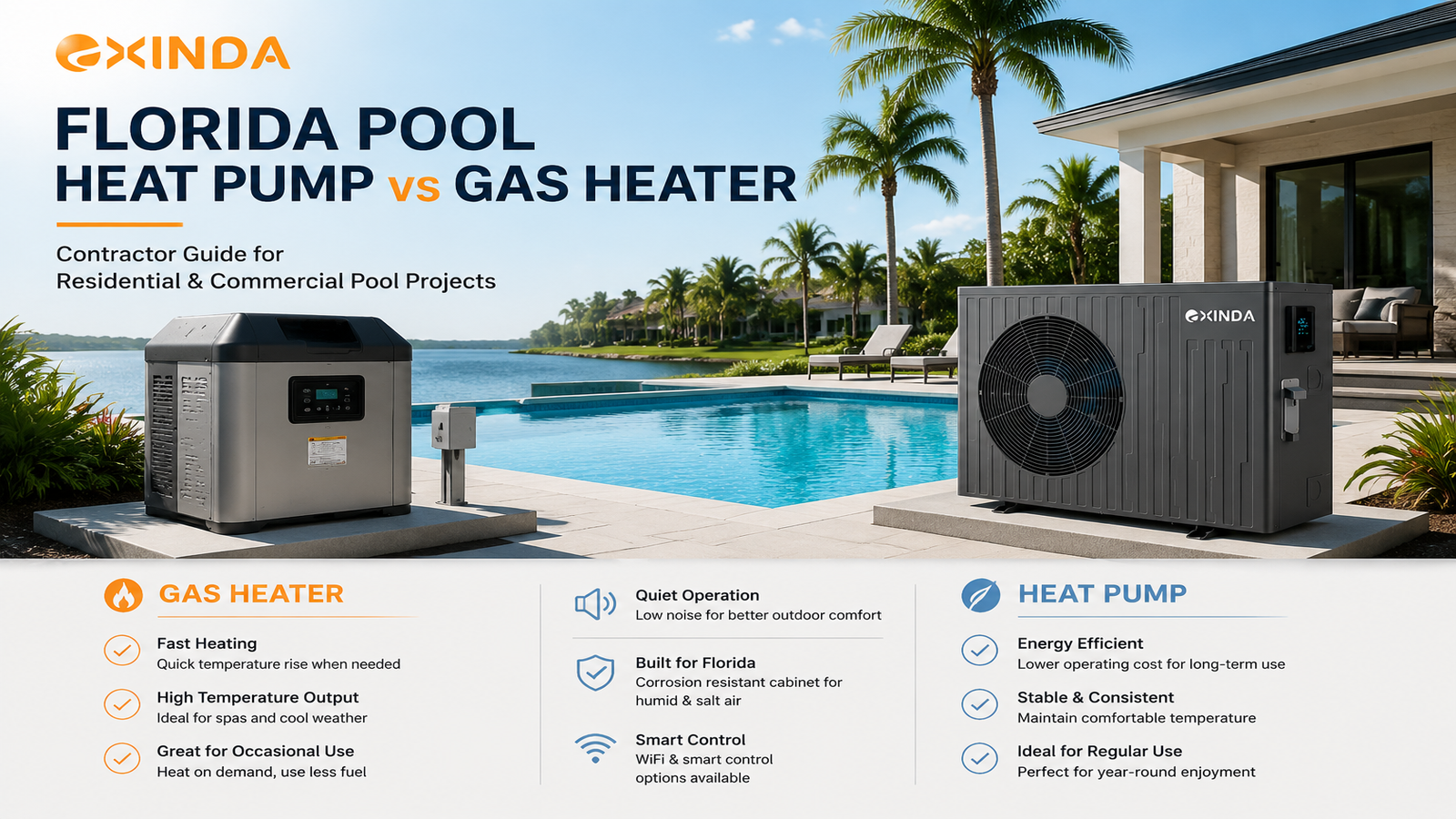
Heat pumps are generally well suited to maintaining pool temperature efficiently when the pool is used regularly and operating conditions are appropriate. Gas heating may be more appropriate where very rapid temperature recovery, spa demand, or other project conditions are the priority. A distributor should be able to explain both cases clearly.
6. Is There a Real Commercial Relationship Behind the Product?
Wholesalers and distributors are not only evaluating a machine. They are evaluating whether the supplier can become a workable long-term partner.
Before adding a brand, ask how the supplier handles:
- Product selection and pre-sale technical questions
- Commercial quotations for dealer and project opportunities
- Product documentation updates
- Sample or first-order planning
- Warranty claim communication
- Spare-parts planning
- Dealer product training
- Market feedback and quality improvement
EXINDA serves customers in 50+ countries and operates a 60,000 m² manufacturing facility with 12 production lines, including 5 automated core production lines. For a Florida distribution opportunity, the practical next step is to review the exact North American pool heat pump models, technical documents, commercial terms, and service expectations relevant to the distributor’s sales model.
Best-Fit Applications for a New Florida Pool Heat Pump Line
A new pool heat pump line is generally most relevant for distributors that already supply pool equipment, work with pool contractors, or serve residential and light-commercial pool projects.
It may be a strong fit when the distributor wants to:
- Expand beyond a single pool-heating option
- Add inverter pool heat pumps for residential replacement and new-build work
- Support saltwater-pool applications with verified technical guidance
- Offer larger-capacity options for villas, hospitality, and community pools
- Build a more complete product offering for pool contractors and equipment dealers
It may not be the right first move when the distributor has no technical service capability, no dealer network, or no process for supporting warranty and spare-parts needs. In those cases, the distributor should first define the support structure required before adding another equipment category.
How EXINDA Supports Florida Pool Professionals
EXINDA works with distributors, dealers, contractors, and project buyers that need pool heat pump product information, selection support, and commercial quotation for North American applications.
For Florida opportunities, EXINDA can review the intended application and help identify which information is needed before a model is proposed. This may include pool type, approximate volume, location, required water temperature, usage schedule, site conditions, saltwater treatment, and whether the project is residential or light-commercial.
The purpose is not to recommend a model from capacity alone. It is to establish whether the selected equipment and installation conditions fit the project.
FAQ
What should a Florida pool heat pump distributor evaluate first?
Start with product-market fit, service documentation, warranty workflow, spare-parts planning, and the supplier’s ability to support residential and light-commercial applications. Unit price should be evaluated after those operational requirements are clear.
Are BTU ratings enough to select a pool heat pump?
No. BTU capacity must be evaluated together with pool volume, surface area, target water temperature, operating schedule, weather conditions, pool cover use, wind exposure, and required heat-up time.
Are pool heat pumps suitable for Florida saltwater pools?
They can be suitable when the model, heat-exchanger materials, water chemistry, installation environment, and maintenance requirements are appropriate. Dealers should verify the applicable model documentation before making a recommendation.
Why should distributors review service documentation before adding a brand?
Clear installation, troubleshooting, parts, and warranty materials reduce uncertainty for dealers and technicians. This helps the distributor support the product after the sale.
When should a distributor consider a larger pool heat pump model?
A larger model may be considered for larger residential pools, villas, hospitality pools, community pools, or projects that require greater heating capacity. Final selection must be based on project conditions rather than pool size alone.
Are heat pumps always a better choice than gas heaters in Florida?
No. Heat pumps are often suitable for regular pool use and maintaining water temperature efficiently under appropriate conditions. Gas heaters may be more suitable when rapid heating, spa use, or a particular recovery requirement is the main priority.
For pool owners: Please contact a qualified local pool professional for installation and service support.
For contractors, dealers, distributors, and project buyers: Contact EXINDA to request technical documentation, product selection support, and a commercial quotation.