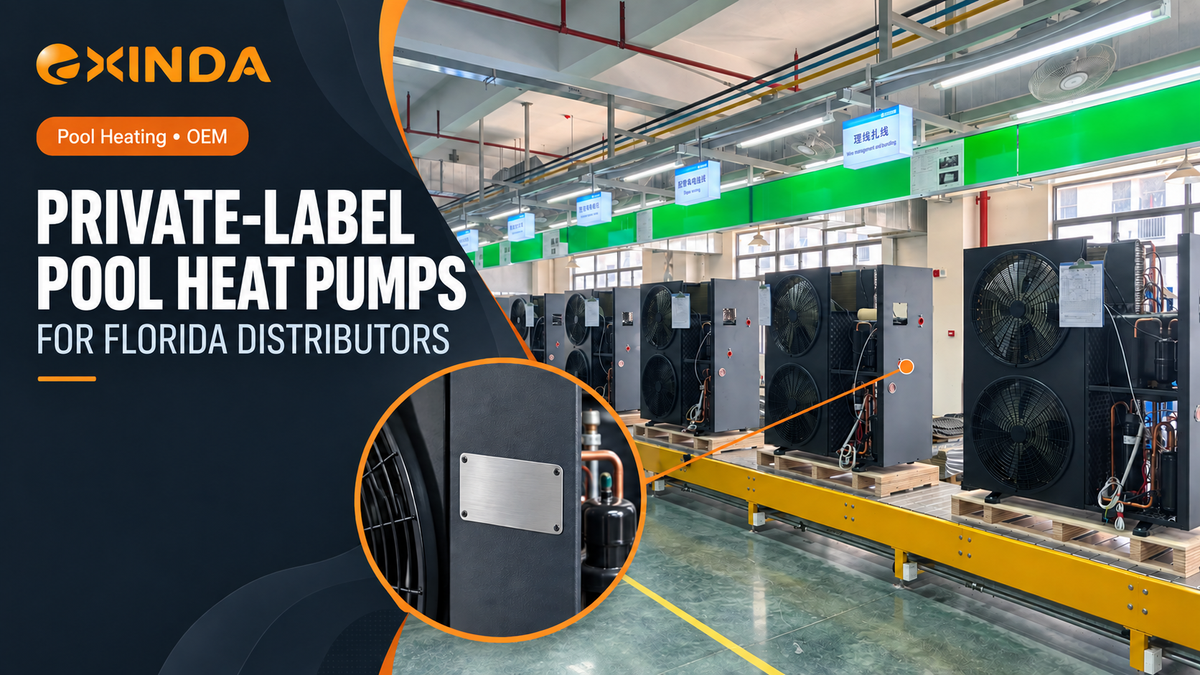
Private-label pool heat pumps for Florida distributors can create a differentiated product line, protect channel identity, and give the distributor more control over how products are positioned. The strongest programs, however, are built around a repeatable product and service system—not simply a new logo on an existing cabinet.
EXINDA supports qualified Florida HVAC and pool-equipment distributors with private-label and OEM cooperation for selected North American pool heat pump models. A practical project begins by confirming the target customer, capacity range, annual volume, electrical requirements, certification scope, branding level, documentation, spare parts, and after-sales responsibilities.
When does a private-label pool heat pump line make sense?
Private label is most useful when a distributor already understands its market and wants a recognizable product family that contractors can sell and service consistently. It can be a good fit for regional wholesalers, established pool-equipment dealers, buying groups, and companies with an existing contractor network.
Before starting, the distributor should be able to answer five questions:
- Which Florida customer segments will the line serve?
- Which capacities match the largest share of qualified inquiries?
- How will the distributor support contractors after installation?
- What annual volume can justify customized materials and inventory?
- Which elements need unique branding, and which should remain standardized?
A private-label project is less suitable when expected volume is uncertain, the sales team has not defined a target application, or the company lacks a plan for warranty claims and replacement parts. In those cases, beginning with EXINDA-branded samples may offer a faster, lower-complexity route to market validation.
What can Florida distributors customize?
The available customization depends on the selected model, order quantity, certification constraints, and production review. Typical private-label discussions may include:
| Area | Possible private-label scope | What must be controlled |
|---|---|---|
| Brand identity | Distributor brand, model naming, rating-label layout | Required safety and regulatory information must remain complete |
| Exterior | Logo placement, color accents, cabinet artwork | Airflow, service access, drainage, and cabinet integrity cannot be compromised |
| Packaging | Carton graphics, model labels, manuals, QR codes | Model identification and handling information must stay consistent |
| Controls | Startup screen, selected interface graphics, app presentation where available | Changes depend on the control platform and software scope |
| Sales materials | Brochures, product images, data sheets, contractor guides | Every performance claim must match the approved model data |
| Documentation | Private-label manuals, warranty forms, service documents | Electrical, installation, and safety content requires technical approval |
Not every requested change should be accepted. A useful OEM review separates commercial branding from engineering changes. Branding adjustments can often follow an artwork approval process, while changes to refrigerant circuits, electrical components, fan systems, controls, or cabinet structure require a separate technical evaluation and may affect testing, lead time, cost, or certification.
Which capacities should a Florida private-label range include?
A distributor does not need the largest possible catalog at launch. Too many models increase inventory, training, forecasting, and service-parts complexity. A focused range is usually easier to introduce and support.
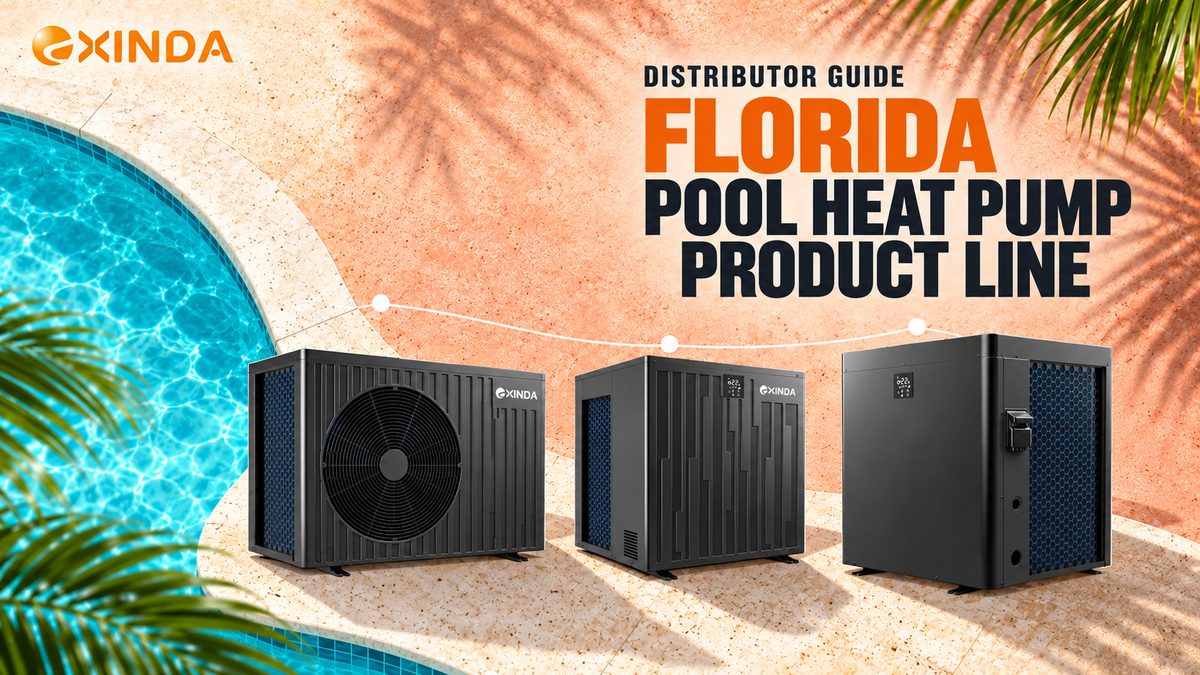
EXINDA’s North American pool heat pump portfolio includes selected capacity classes at approximately 65,000 Btu/h, 96,000 Btu/h, 121,000 Btu/h, and 150,000 Btu/h. Exact capacity, COP, electrical data, operating range, functions, and certification status must be confirmed from the current submittal for the selected configuration and rating condition.
A practical launch may use two core capacities for regular residential demand, one smaller option for compact pools or replacement opportunities, and one upper tier for larger residential or selected light-commercial projects. The final mix should be based on pool surface area, desired temperature, recovery time, season, wind exposure, pool-cover use, hydraulic conditions, and electrical supply—not pool volume alone.
For a more detailed sizing and stock-planning process, see our Florida pool heat pump product line guide.
Do certification and compliance documents transfer to a private label?
A private-label name does not automatically inherit every listing or approval associated with the original manufacturer model. The exact relationship between the private-label model number, manufacturer model, electrical listing, performance documentation, refrigerant labeling, and local permit requirements must be reviewed before launch.
Florida distributors should request a model-level compliance file that includes, as applicable:
- Current product submittal and performance tables
- Electrical ratings and wiring diagrams
- Installation and user manuals
- Refrigerant and safety labeling
- Applicable listing or certification documentation
- Model mapping between the factory unit and private-label name
- Approved marketing claims and rating conditions
- Warranty terms and claim procedures
This protects both parties from a common OEM mistake: creating attractive marketing material before the approved model identity and document set are finalized.
How should a distributor prepare for Florida conditions?
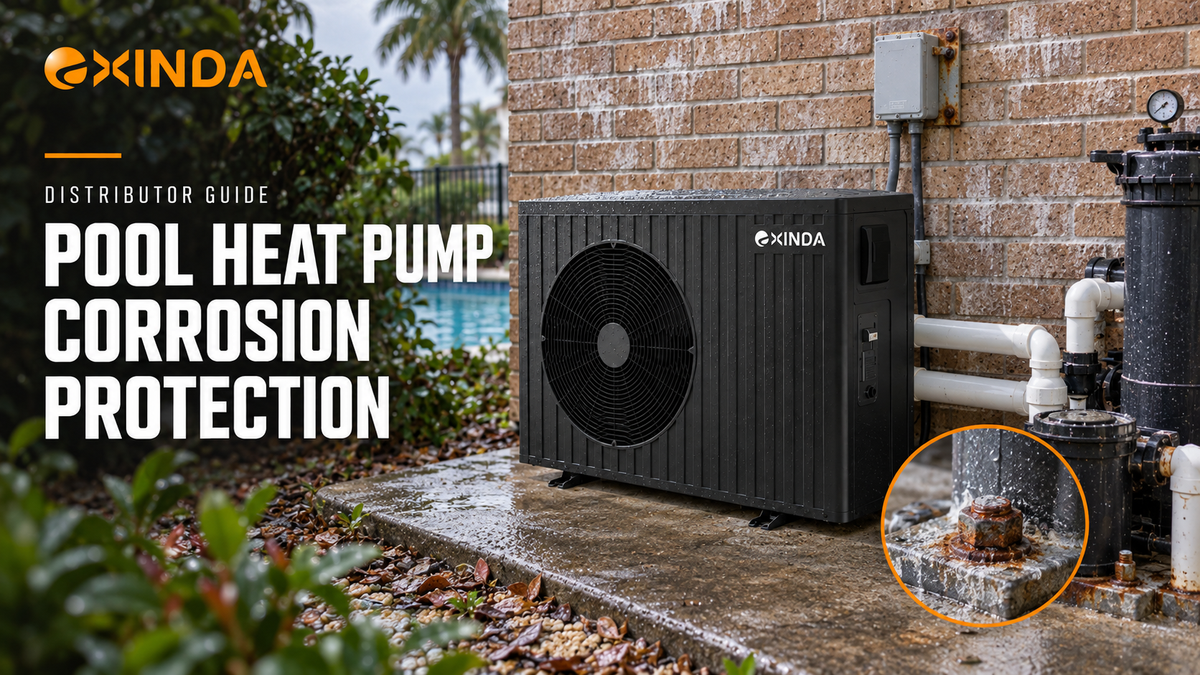
Florida applications can expose outdoor equipment to heat, humidity, heavy rain, airborne debris, and—in coastal locations—salt-laden air. Product selection and installation planning should therefore cover more than nominal heating capacity.
The project review should consider equipment-pad drainage, clearances, airflow, roof runoff, irrigation exposure, condensate management, plumbing layout, water flow, electrical protection, access for cleaning, and the verified corrosion-protection configuration. A titanium water heat exchanger supports compatibility with pool water, but it does not make every external component immune to corrosion. Coastal placement and maintenance guidance should be addressed in contractor training.
What should be standardized before the first order?
Private-label pool heat pumps for Florida distributors become easier to scale when every team works from the same approved specification. Before production, confirm:
- Model matrix: private-label model name, factory model, capacity class, voltage, functions, refrigerant, and approved options.
- Artwork package: logo files, color references, cabinet placement, rating labels, cartons, manuals, and serial-number format.
- Technical package: submittals, curves or tables, installation manual, wiring diagram, error codes, commissioning checklist, and warranty terms.
- Quality sample: one approved reference unit or golden sample for production comparison.
- Parts plan: recommended sensors, controls, flow-related components, boards, user interfaces, and other model-specific service items.
- Change control: written approval for any component, software, appearance, or document revision after the sample is accepted.
These controls reduce the risk of model-name mismatches, outdated manuals, unapproved artwork, or service parts that do not match the shipped units.
How should the warranty and service process work?
The distributor is the local face of a private-label brand. Customers and contractors will expect fast answers from the name printed on the equipment, so the after-sales structure should be agreed before the product launch.
Responsibilities should be defined for first-line troubleshooting, installation evidence, commissioning records, replacement-part approval, freight, labor, warranty claim review, software updates, and recurring quality feedback. The distributor should also maintain traceability by serial number and production batch.
A useful field-claim form records the model, serial number, installation date, site conditions, water flow, voltage, fault code, photos, video, and troubleshooting steps already completed. Consistent evidence helps EXINDA engineering distinguish installation issues, component failures, application mismatch, and product-improvement opportunities.
What support can EXINDA provide?
EXINDA can support qualified distributors through model selection, OEM feasibility review, branded artwork coordination, sample preparation, model-specific technical documents, installation guidance, spare-parts planning, troubleshooting support, and marketing assets. Cooperation scope, minimum quantity, development cost, and lead time depend on the selected models and degree of customization.
For new relationships, a staged approach is often the most practical:
- Confirm the target market and product brief
- Select the initial capacity range
- Review current submittals and compliance documents
- Approve branding and artwork
- Evaluate a representative sample
- Finalize the first-order mix and spare parts
- Train the sales and service teams
- Review field feedback after launch
Frequently asked questions
Can EXINDA place a distributor’s logo on a pool heat pump?
Logo and artwork customization can be evaluated for selected models. The final scope depends on order quantity, cabinet format, labeling requirements, and approval of production-ready artwork.
Can a distributor change the model number?
A private-label model name may be possible, but it must remain traceable to the underlying factory configuration. Certification, labels, manuals, spare parts, and warranty records should use an approved model-mapping table.
Is a custom color always available?
No. Custom color or finish depends on cabinet material, coating process, volume, production feasibility, and lead time. Color changes must not interfere with airflow, corrosion protection, labeling, or service access.
Should a new distributor launch all four capacity classes?
Not necessarily. Start with the smallest range that covers qualified demand and can be stocked, trained, and serviced properly. Expand when quotation and sell-through data justify additional models.
Can private-label models use existing certifications?
Not automatically. The specific certification, private-label model identity, and applicable listing rules must be reviewed and documented before marketing or sale.
What information does EXINDA need to prepare an OEM proposal?
Provide the target territory, customer type, requested capacity range, estimated annual volume, electrical requirements, branding scope, certification needs, sample plan, launch timing, and expected service structure.
Discuss a Private-Label Pool Heat Pump Program
If you are building a branded pool equipment line for Florida, send EXINDA your target capacity range, estimated annual volume, preferred launch schedule, branding requirements, and current contractor or distributor coverage. We can then review the suitable models, sample process, documentation, OEM scope, and first-order plan.
Email: info@exindagroup.com