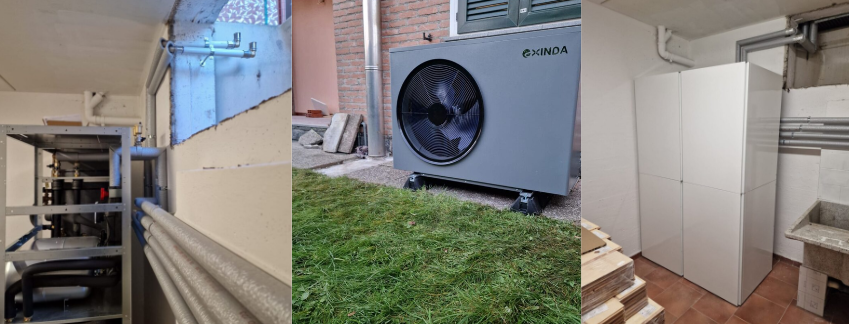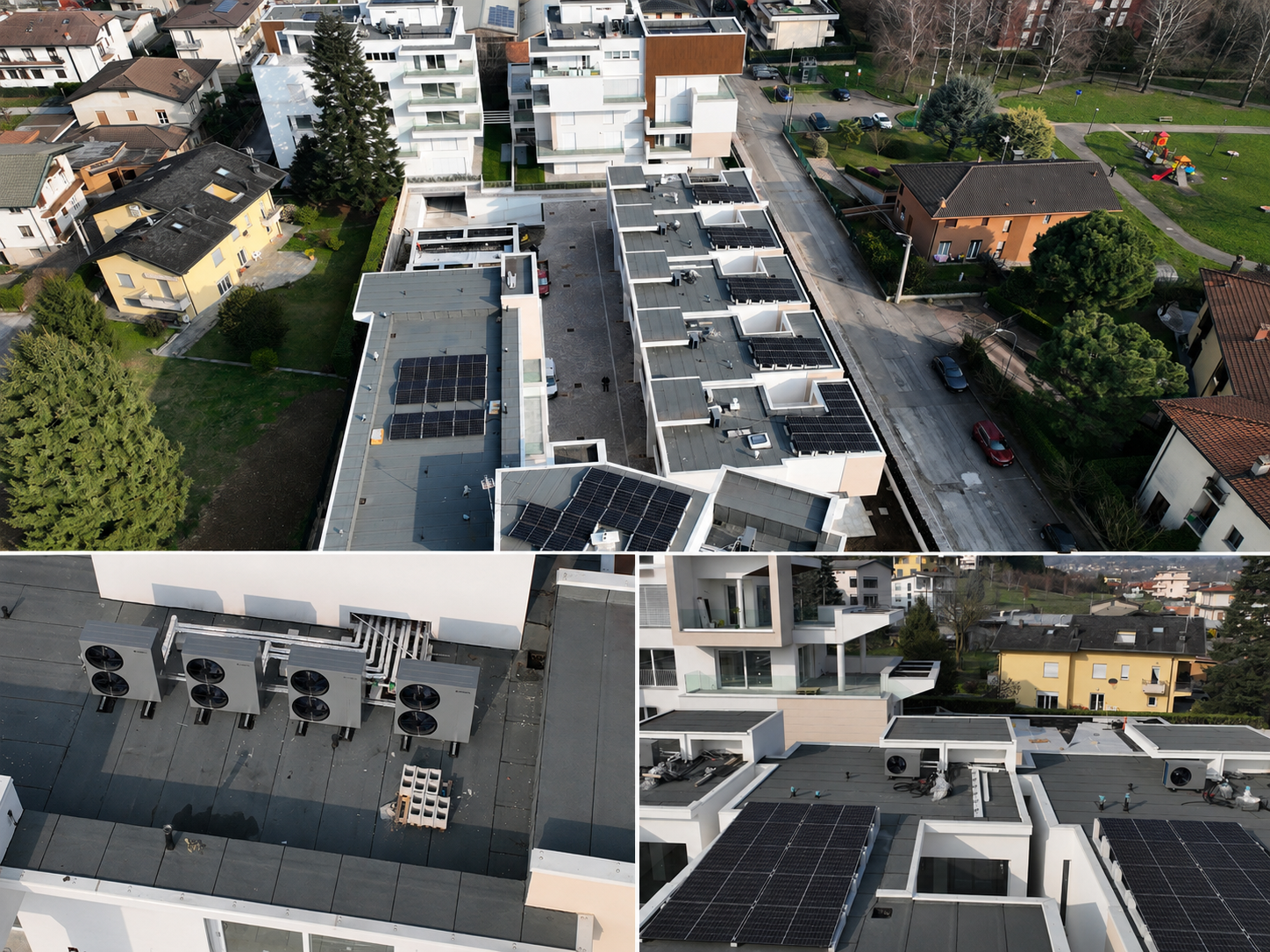
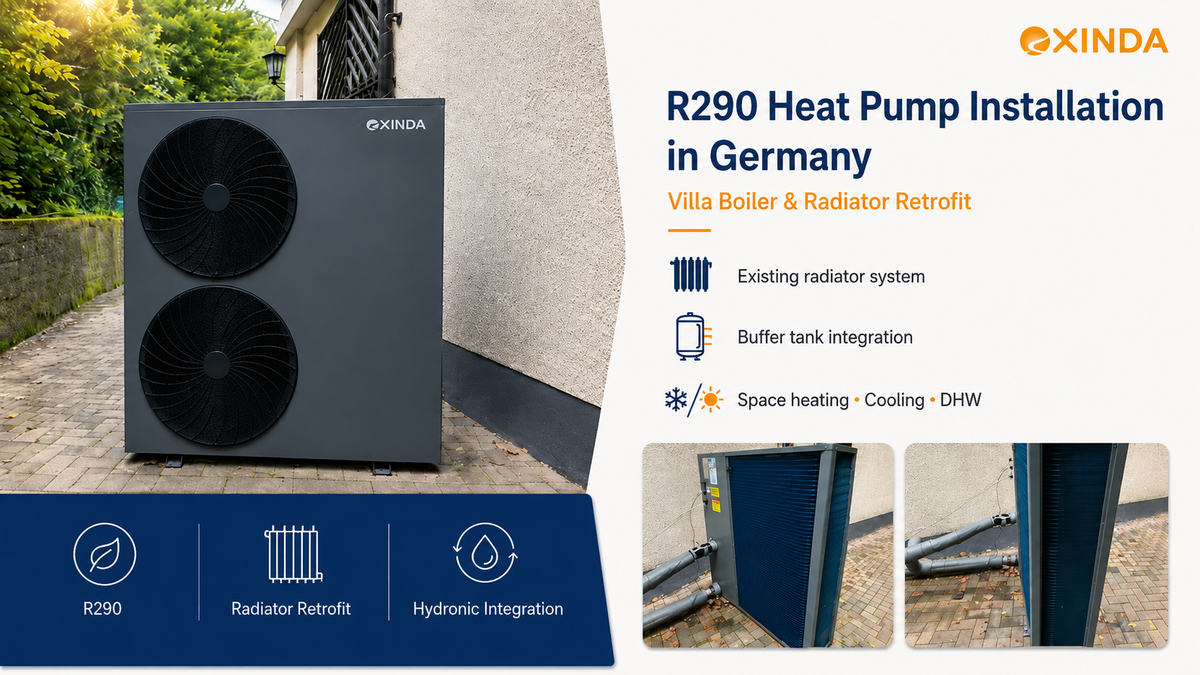
This R290 heat pump installation Germany case demonstrates how an EXINDA air-to-water heat pump was integrated into a luxury villa with an existing hydronic radiator system.
The project replaced the property’s fossil-fuel heating source while retaining key parts of the water-based heating infrastructure. The installed system supports space heating, domestic hot-water production and seasonal cooling through reversible heat-pump operation.
For German heating contractors, the project provides a practical example of the technical checks required when converting an existing villa from boiler heating to an R290 monoblock heat pump.
Germany Villa Project Overview
| Project item | Installation information |
|---|---|
| Location | Germany |
| Building type | Luxury residential villa |
| Project type | Boiler-to-heat-pump retrofit |
| Heat pump | EXINDA R290 air-to-water heat pump |
| Product configuration | Outdoor monoblock unit |
| Existing heat distribution | Hydronic radiator system |
| Hydraulic equipment | Buffer-tank system |
| Applications | Space heating, domestic hot water and seasonal cooling |
| Control approach | Weather-compensated water-temperature control |
| Installation objective | Replace fossil-fuel heating while retaining compatible hydronic infrastructure |
The project information demonstrates the system architecture and installation approach. Final energy savings and emissions reductions depend on the previous boiler, building heat loss, electricity supply, operating temperatures, controls and occupant behaviour.
What Was the Main Retrofit Challenge?
The main challenge was not simply removing the boiler and installing an outdoor unit.
A successful villa retrofit had to determine whether the existing hydronic system could operate effectively with a heat pump.
The project team needed to consider:
- Building heat loss at the local design temperature
- Heat-pump capacity at low outdoor temperatures
- Required radiator flow and return temperatures
- Existing radiator output
- Water-flow requirements
- Pipe sizes and system pressure drop
- Buffer-tank integration
- Domestic hot-water demand
- Outdoor-unit position
- Defrost-water drainage
- Electrical supply
- Heating-curve settings
- Supplementary-heating requirements
These factors determine whether the building can maintain comfort without operating continuously at unnecessarily high water temperatures.
Can an R290 Heat Pump Replace a Boiler in Germany?
Yes. An R290 air-to-water heat pump can replace a gas or oil boiler when the building load, radiator system, hydraulic circuit and electrical supply are suitable.
However, boiler replacement should not be treated as a simple capacity-for-capacity exchange.
An existing boiler may have been oversized, and its nominal capacity may not represent the building’s actual design heat loss. Selecting a heat pump according to the boiler nameplate can therefore result in an oversized system.
The installer should instead evaluate:
- Calculated building heat loss
- Local outdoor design temperature
- Required leaving-water temperature
- Radiator output at the proposed temperature
- Heat-pump capacity at those conditions
- Available electrical service
- Domestic hot-water demand
- Backup-heating strategy
The selected model should be checked against its published performance data at conditions close to those expected in the project.
Installers planning a similar conversion can review the EXINDA R290 heat pump for boiler replacement page.
How Was the Existing Radiator System Retained?
The German villa already had a water-based radiator system. This made it possible to integrate an air-to-water heat pump without replacing the complete heat-distribution network.
However, every radiator system must be assessed individually.
Radiator output changes according to:
- Flow-water temperature
- Return-water temperature
- Room temperature
- Radiator dimensions
- Radiator type
- Water-flow rate
- Hydraulic balancing
- Building heat loss
A radiator originally selected for high-temperature boiler operation delivers less heat when operated with lower water temperatures.
If an existing radiator cannot satisfy the room load at the proposed heat-pump temperature, the installer may need to:
- Install a larger radiator
- Add radiator surface area
- Use a fan-assisted low-temperature radiator
- Improve building insulation
- Reduce air leakage
- Correct hydraulic imbalance
- Increase the design water temperature within the heat pump’s operating limits
- Define supplementary heating for peak conditions
The objective is to use the lowest practical water temperature that still maintains indoor comfort.
Why Does Leaving-Water Temperature Matter?
Leaving-water temperature affects both heat-pump performance and radiator output.
Higher water temperatures increase the heat available from the radiators, but they can also affect heat-pump capacity and efficiency. The relationship must therefore be evaluated as a complete system.
Installers should not rely only on performance measured at A7/W35 when evaluating a German radiator retrofit.
They should request data at operating conditions that more closely represent:
- The project’s winter outdoor temperature
- The required leaving-water temperature
- The selected flow rate
- The expected heating load
The appropriate model and water-temperature range must be confirmed using the published data for the exact product.
For projects with higher radiator temperatures, visit the EXINDA high-temperature R290 heat pump page.
What Was the Role of the Buffer Tank?
The installation incorporated a buffer-tank arrangement as part of the hydronic system.
A buffer tank may support a retrofit project by:
- Increasing system-water volume
- Helping maintain minimum flow
- Separating heat-pump and building circuits
- Reducing short operating cycles
- Supporting systems with multiple heating zones
- Providing available system energy during defrost
- Stabilising operation when zone valves open and close
However, a buffer tank is not automatically required in every heat-pump installation.
Its size and connection arrangement should be based on:
- Minimum water volume
- Minimum flow rate
- Heat-pump modulation
- Number of zones
- Pumping strategy
- Existing system volume
- Defrost requirements
- Hydraulic-separation needs
An unnecessarily large or incorrectly connected buffer tank may introduce additional heat loss and pumping energy.
How Was Domestic Hot Water Integrated?
The EXINDA heat-pump system also supports domestic hot-water production.
For a villa project, the domestic hot-water design should consider:
- Number of occupants
- Daily hot-water consumption
- Cylinder capacity
- Cylinder heat-exchanger area
- Target storage temperature
- Reheat time
- Domestic hot-water priority
- Legionella-control strategy
- Immersion-heater requirements
- Sensor position
- Three-way valve control
A cylinder previously connected to a boiler may not always have a heat-exchanger coil suitable for heat-pump operation.
The existing cylinder should therefore be checked before being retained.
Can the System Provide Cooling?
The installed EXINDA system supports reversible operation and can provide seasonal cooling when connected to compatible indoor emitters.
Standard radiators are generally intended for heating and may not be appropriate for cooling.
Cooling applications normally require suitable equipment such as:
- Fan-coil units
- Cooling-compatible underfloor systems
- Air-handling-unit coils
- Appropriate condensate management
- Insulated chilled-water piping
- Dew-point control
Cooling capability therefore depends on the complete building-side system, not only the reversible function of the outdoor unit.
Why Was a Monoblock Heat Pump Used?
In a monoblock air-to-water heat pump, the refrigerant circuit is contained within the outdoor unit. Water connections extend between the outdoor unit and the building’s hydronic system.
This configuration can simplify the building-side refrigerant installation, but installers must still address:
- Outdoor hydraulic pipe insulation
- Freeze protection
- Water quality
- Minimum flow
- Isolation valves
- Strainers
- Air removal
- Expansion provision
- Defrost drainage
- Service access
- Applicable R290 installation requirements
Because R290 is propane and is classified as a flammable refrigerant, the installation must follow the current product manual and applicable German requirements.
Outdoor-Unit Placement at the Villa
The project photographs show the EXINDA outdoor unit positioned beside the villa, close to the external wall and hydronic connections.
This arrangement helps reduce the external pipe run, but the installer must still confirm:
- Required air-intake clearance
- Air-discharge clearance
- Service access
- Distance from doors and windows
- Position of nearby drains and openings
- Ground or mounting stability
- Snow and ice exposure
- Defrost-water disposal
- Sound propagation
- Property boundaries
- Applicable safety distances
The unit should not be positioned only according to appearance. Airflow, safety, drainage and maintenance access remain the primary considerations.
How Should Defrost Water Be Managed?
During cold and humid weather, frost can form on the outdoor heat exchanger. The heat pump periodically removes this frost through a defrost cycle.
The resulting water must drain safely without:
- Freezing beneath the unit
- Blocking the drainage route
- Flowing toward the building
- Forming ice on a walkway
- Damaging the mounting structure
- Obstructing service access
The outdoor unit should be mounted at a suitable height for local winter conditions, and the drainage arrangement should remain functional during freezing weather.
Weather-Compensated Heating Control
Weather compensation adjusts the target leaving-water temperature according to outdoor conditions.
When outdoor conditions are mild, the system can operate with a lower water temperature. As the outdoor temperature falls, the controller raises the target water temperature according to the configured heating curve.
A suitable heating curve can help:
- Maintain stable indoor temperature
- Avoid unnecessary high-temperature operation
- Reduce repeated manual adjustment
- Improve part-load operation
- Match radiator output to changing building demand
The initial curve should be based on the building and radiator assessment and then refined during actual operation.
Commissioning the German Villa System
Commissioning verifies whether the product, hydraulic system and controls operate together correctly.
Before Startup
The installer should:
- Flush and clean the hydronic circuit
- Clean strainers and filters
- Vent trapped air
- Confirm system pressure
- Check expansion equipment
- Confirm adequate water flow
- Inspect valves and pumps
- Verify freeze protection
- Check electrical connections
- Confirm sensor positions
- Inspect outdoor-unit clearances
- Check defrost drainage
During Startup
The installer should record:
- Outdoor temperature
- Heat-pump operating mode
- Inlet-water temperature
- Outlet-water temperature
- Water-temperature difference
- System pressure
- Circulation-pump operation
- Heating-curve settings
- Domestic hot-water settings
- Supplementary-heater settings
- Active or stored fault codes
After Startup
The installer should:
- Record final controller settings
- Test domestic hot-water priority
- Check zone operation
- Explain the controller to the homeowner
- Provide maintenance instructions
- Record the commissioning result
- Establish the local service procedure
What Does This Project Demonstrate?
This German installation demonstrates that an R290 air-to-water heat pump can be incorporated into an existing villa radiator system when the project is assessed and designed correctly.
The main lessons are:
| Project lesson | Why it matters |
|---|---|
| Calculate building heat loss | Prevents selection based only on the old boiler |
| Check radiator output | Confirms room heating at the proposed water temperature |
| Review low-temperature capacity | Nominal capacity does not describe winter performance |
| Design the hydraulic circuit | Protects minimum flow and system stability |
| Evaluate buffer requirements | Avoids automatic or unnecessary buffer installation |
| Plan defrost drainage | Prevents winter ice and water problems |
| Configure the heating curve | Matches water temperature to outdoor conditions |
| Record commissioning data | Creates a baseline for technical support |
How EXINDA Supports German Installers and Distributors
EXINDA supports European heat-pump projects through distributors, regional partners and qualified installers.
Depending on the selected model and cooperation arrangement, support may include:
- Product selection
- Model-specific performance data
- Hydraulic connection information
- Electrical diagrams
- Installation manuals
- Controller instructions
- Commissioning guidance
- Fault-code information
- Technical training
- Spare-parts identification
- CE and ErP documentation
- Heat Pump KEYMARK information for certified models
Certification status should always be confirmed for the exact model. Certification covering selected models should not be presented as covering the complete EXINDA range.
German heating contractors can also review the EXINDA R290 heat pump supplier for installers page.
Related European Projects
United Kingdom Boiler Replacement
A UK residential project integrated an EXINDA R290 heat pump with radiators, domestic hot water and photovoltaic controls.
View the EXINDA UK boiler-replacement project.
Italy Multi-Family Installation
An Italian residential project uses multiple EXINDA R290 heat pumps for central heating, cooling and domestic hot-water production.
View the EXINDA Italy multi-family project.
Installer Selection and Technical Support
Installers evaluating project suitability can review the required selection information and available support.
Visit the EXINDA installer support page.
Frequently Asked Questions
Can an R290 heat pump replace an oil or gas boiler in Germany?
Yes, when the heat pump is selected according to the calculated building load, outdoor design temperature, required water temperature, radiator output and electrical supply.
Can existing radiators be retained?
Existing radiators may be retained when they can provide the required room output at the proposed flow and return temperatures.
Is a buffer tank always required?
No. Buffer requirements depend on system volume, minimum flow, zoning, heat-pump modulation and hydraulic design.
Can the heat pump produce domestic hot water?
Yes. The German villa system was configured for both space heating and domestic hot-water production.
Can the system provide cooling?
The heat pump supports reversible operation, but cooling requires compatible indoor emitters, insulated pipework and condensate or dew-point control where applicable.
Are all EXINDA R290 heat pumps Heat Pump KEYMARK certified?
Certification must be confirmed for the exact model. Certification applying to selected models does not automatically cover every capacity or configuration.
Does EXINDA provide support for German installers?
EXINDA provides product-side selection, documentation and commissioning support through its European distribution and regional-partner structure.
What information is needed for a German villa project?
Installers should provide the project city, calculated heat loss, outdoor design temperature, radiator details, required water temperature, domestic hot-water demand, electrical supply and hydraulic schematic.
Request Support for a German Heat Pump Project
For a German boiler-replacement or radiator-retrofit project, please provide:
- Company name
- Project city
- Building type
- Calculated heat loss
- Outdoor design temperature
- Existing boiler type
- Radiator or underfloor-heating details
- Required flow-water temperature
- Domestic hot-water requirement
- Electrical supply
- Proposed quantity
- Project schedule