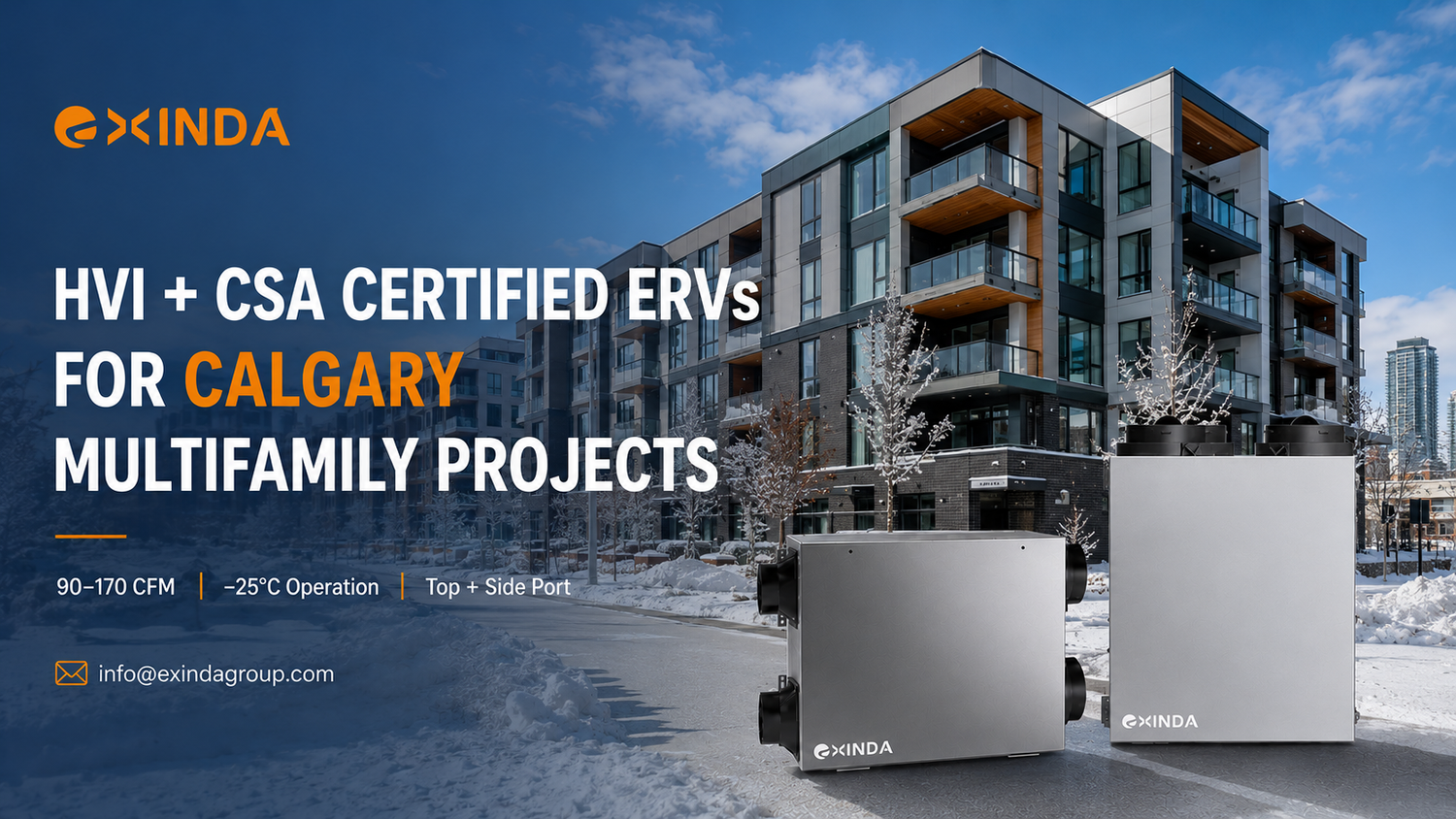
HVI and CSA Certified ERVs for Calgary Multifamily Projects—Providing standards-compliant ERV solutions for builders, HVAC contractors, and distributors.
Selecting an energy recovery ventilator for a Calgary multifamily project requires more than comparing maximum airflow or efficiency.
Mechanical consultants, builders and HVAC contractors need an ERV that can deliver the scheduled ventilation rate at the project’s actual external static pressure, operate reliably during Calgary winters, fit inside limited ceiling or mechanical-room space, and remain accessible for future maintenance.
EXINDA is a global HVAC manufacturer supplying HVI- and CSA-certified ERVs developed for North American residential and multifamily ventilation applications.
What Do Calgary Multifamily Projects Require from an ERV?
For apartments, condominiums and townhome developments, the most important ERV selection factors normally include:
- HVI-certified airflow and energy-recovery performance
- Recognized Canadian electrical safety certification
- Verified operation at low outdoor temperatures
- Required airflow at actual external static pressure
- Balanced supply and exhaust airflow
- Compact installation dimensions
- Accessible filters and energy-recovery core
- Simple commissioning and airflow adjustment
- Low operating sound near occupied rooms
- Local technical support, replacement filters and spare parts
An ERV may have a high published efficiency but still be unsuitable if it cannot provide the design airflow after the ductwork, exterior hoods, filters and fittings are connected.
Why HVI Certification Matters
HVI certification provides independently verified performance ratings for residential ERVs and HRVs. The ratings are based on testing performed in accordance with CAN/CSA-C439 and typically include:
- Net supply airflow
- Gross supply and exhaust airflow
- Sensible Recovery Efficiency, or SRE
- Total Recovery Efficiency, or TRE
- Electrical power consumption
- Fan efficacy
- Low-temperature performance
HVI certification does not automatically mean that every ERV is suitable for every building or climate. It allows the mechanical consultant to compare verified data and determine whether the exact model satisfies the project airflow and energy requirements.
EXINDA ERV models can be found through the HVI Certified Products Directory.
Why CSA Certification Matters
CSA certification provides recognized electrical safety approval for the certified product model in Canada.
For builders and contractors, this helps reduce the risk of electrical inspection issues and unapproved-equipment substitutions. The model number and electrical rating shown on the product nameplate should match the applicable CSA certification record.
CSA electrical safety certification and HVI performance certification serve different purposes:
- CSA certification: electrical product safety
- HVI certification: airflow and energy-recovery performance
- CAN/CSA-C439: laboratory performance testing method
A project submittal should clearly identify all three instead of describing them as one certification.
Cold-Climate ERV Performance in Calgary
Calgary ERVs must be evaluated for frost control, airflow continuity and efficiency at low outdoor temperatures.
Where the cold-climate provisions of NBC Part 9 apply, an ERV used to meet the applicable heat-recovery requirements may need to demonstrate at least:
- 60% SRE at 0°C
- 55% SRE at −25°C
The required performance must also be considered at an airflow appropriate for the dwelling’s principal ventilation rate. Final compliance depends on the building classification, adopted Alberta code requirements and the mechanical design.
The National Building Code – 2023 Alberta Edition has been in force in Alberta since May 1, 2024.
EXINDA ERV Options for Multifamily and Residential Projects
| EXINDA ERV configuration | Airflow range | Duct connection | Typical application |
|---|---|---|---|
| Compact horizontal ERV | 53–100 CFM | 4 in. | Smaller suites and compact residential applications |
| Compact auto-balancing ERV | 49–133 CFM | 6 in. | Apartments, condominiums and in-suite multifamily ventilation |
| Field-adjustable multifamily ERV | 42–130 CFM normal operation; up to 170 CFM adjustable | 6 in. | Larger suites and projects requiring measured field balancing |
| Vertical top-port ERV | 54–100 CFM | 4 in. | Townhomes, smaller homes and mechanical closets |
| High-capacity vertical ERV | 57–152 CFM | 6 in. | Larger homes, townhomes and residential mechanical rooms |
Final model selection should be based on the required ventilation rate, available external static pressure, installation orientation and project-specific cold-climate requirements.
Advantages for Mechanical Consultants and Builders
Compact Multifamily Installation
Selected EXINDA horizontal ERVs have a cabinet height of approximately 9.7 inches, allowing installation inside apartment ceilings, soffits and other restricted spaces.
Side-port and top-port configurations allow the designer to select the duct arrangement that best matches the suite layout.
Constant Airflow and Auto-Balancing Options
EXINDA ECM motor technology adjusts fan operation in response to changing system resistance. This helps maintain the selected airflow as duct resistance or filter pressure changes.
Auto-balancing models are intended to reduce commissioning time and maintain more consistent ventilation across multiple dwelling units.
The project should still include airflow verification and commissioning in accordance with the mechanical specification.
Field Airflow Measurement
For projects requiring conventional TAB verification, the EXINDA field-adjustable multifamily ERV includes:
- Airflow pressure taps
- Differential-pressure measurement
- Integrated balancing dampers
- Airflow conversion data
- Maximum adjustable airflow up to 170 CFM
This allows the contractor to measure, adjust and document the installed supply and exhaust airflow.
Recirculation Defrost
Selected multifamily models use recirculation defrost for low-temperature operation.
Recirculation defrost can reduce the negative-pressure condition associated with exhaust-only defrost strategies. The mechanical consultant should review the complete frost-control sequence, defrost airflow and operation below the stated minimum outdoor temperature.
Simplified Maintenance
Selected EXINDA compact ERVs provide accessible filters and energy-recovery cores for routine maintenance. Bottom-access configurations can be particularly valuable when the unit is installed above an apartment ceiling.
The submittal should confirm:
- Required access-panel dimensions
- Filter removal direction
- Core removal clearance
- Fan and control-box access
- Minimum service space
North American Controls
Available control functions include:
- Low, medium and high airflow settings
- Electronic dehumidistat control
- 20/40/60-minute bathroom boost timer
- Low-voltage control connections
- 24V thermostat or dry-contact integration
These functions support continuous background ventilation and temporary high-speed operation from bathrooms or other high-humidity spaces.
Which EXINDA ERV Is Suitable for Calgary Multifamily Projects?
For most Calgary apartment and condominium applications, the compact 6-inch horizontal models provide the strongest combination of:
- Approximately 42–133 CFM normal airflow
- Compact ceiling installation
- ECM motor technology
- Auto-balancing or field-balancing options
- Recirculation defrost
- HVI-certified −25°C performance on selected models
- CSA electrical safety certification
- No condensate drain connection
- Accessible filters and energy-recovery core
The field-adjustable model is particularly suitable when the mechanical specification requires pressure-port measurement and documented air balancing.
The auto-balancing model is suitable for repetitive multifamily installations where consistent airflow and reduced commissioning time are priorities.
Frequently Asked Questions
Are HVI-certified ERVs automatically code compliant in Calgary?
No. HVI certification verifies the published performance data. The mechanical consultant must still confirm that the exact model, airflow, SRE, external static pressure and cold-temperature performance satisfy the applicable project requirements.
Does Calgary require a CSA-certified ERV?
Electrical equipment installed in Alberta must carry an acceptable Canadian electrical approval. CSA certification is one recognized route. The exact model and certification scope should be confirmed before approval.
What airflow is normally required for a multifamily suite?
The required airflow depends on the number of bedrooms, room layout, exhaust requirements and applicable building code. EXINDA offers approximately 42–170 CFM across its North American residential ERV range to support different suite sizes.
Does auto-balancing eliminate commissioning?
Auto-balancing can reduce setup time and compensate for system resistance, but installed airflow should still be verified as required by the project specification and commissioning plan.
Can an EXINDA ERV operate at −25°C?
Selected EXINDA models have HVI-rated performance at −25°C. The project team should verify the exact model’s SRE, airflow, defrost sequence and operating behaviour below the listed minimum temperature.
ERV Selection Support for Calgary Projects
EXINDA supports mechanical consultants, builders, HVAC contractors and distributors with:
- HVI performance data
- CSA certification information
- Airflow and static-pressure curves
- Cold-climate performance data
- Installation drawings
- Control documentation
- ERV model selection
- Project submittals
- OEM and distribution support
For a Calgary multifamily ERV selection, provide the required airflow, estimated external static pressure, suite layout, available installation space and project design temperature.
EXINDA can recommend the appropriate HVI- and CSA-certified ERV and prepare a project-specific technical submittal.
Contact EXINDA:
Website: www.exindagroup.com
Email: info@exindagroup.com