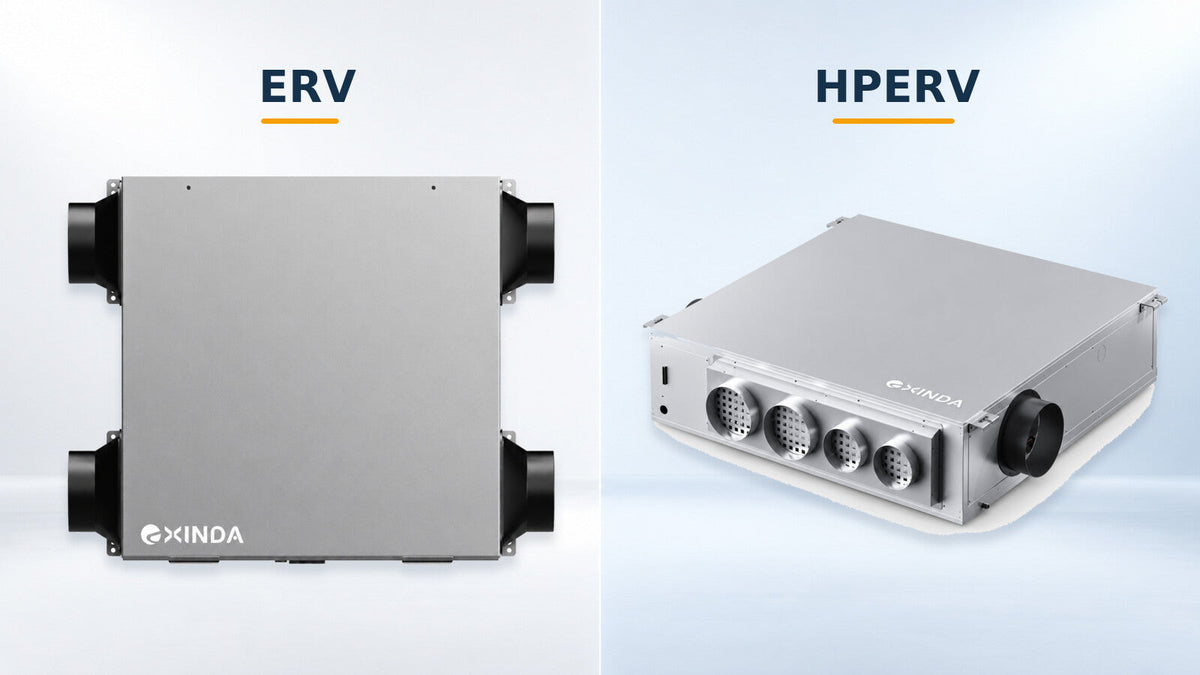
An ERV supplies balanced fresh air and recovers energy from the exhaust. An all-in-one heat pump ERV does that and also heats and cools the space. If a building already has working heating and cooling and only needs ventilation, the answer is an ERV. If a dwelling needs heating, cooling and ventilation but has nowhere to put an outdoor condenser, the answer is an all-in-one heat pump ERV — HPERV. The rest of this article covers the projects where that first answer is not obvious.
What each one does
| ERV | All-in-One Heat Pump ERV (HPERV) | |
|---|---|---|
| Supplies outdoor air | Yes | Yes |
| Recovers energy from exhaust | Yes | Yes |
| Heats and cools the space | No | Yes |
| Outdoor condensing unit | Not applicable | None — two wall openings instead |
| Typical electrical service | 120 V / 60 Hz / 1 Ph | 208–240 V / 60 Hz / 1 Ph, hardwired |
| Refrigerant circuit | None | R32 (A2L), sealed in the cabinet |
| Works alongside | Furnace, air handler, hydronic system, ducted or ductless heat pump | Nothing else required for the suite it serves |
An HPERV is not an upgraded ERV. It is a heating and cooling system that happens to include ventilation, so it is specified against a heating and cooling load, not against a ventilation rate alone.
Five checks that decide it
1. Is there a place for an outdoor unit?
This is usually the check that forces the decision. High-rise apartments, heritage facades, balcony restrictions and condominium rules frequently leave no compliant location for a condenser per dwelling, and no route for refrigerant lines through the building. That is the case an HPERV is built for: one indoor cabinet, two exterior openings with louvers, no refrigerant piping outside the unit. If outdoor units are allowed and the building already has a heating and cooling plan around them, the ventilation question is separate and an ERV answers it.
2. What is the winter design temperature?
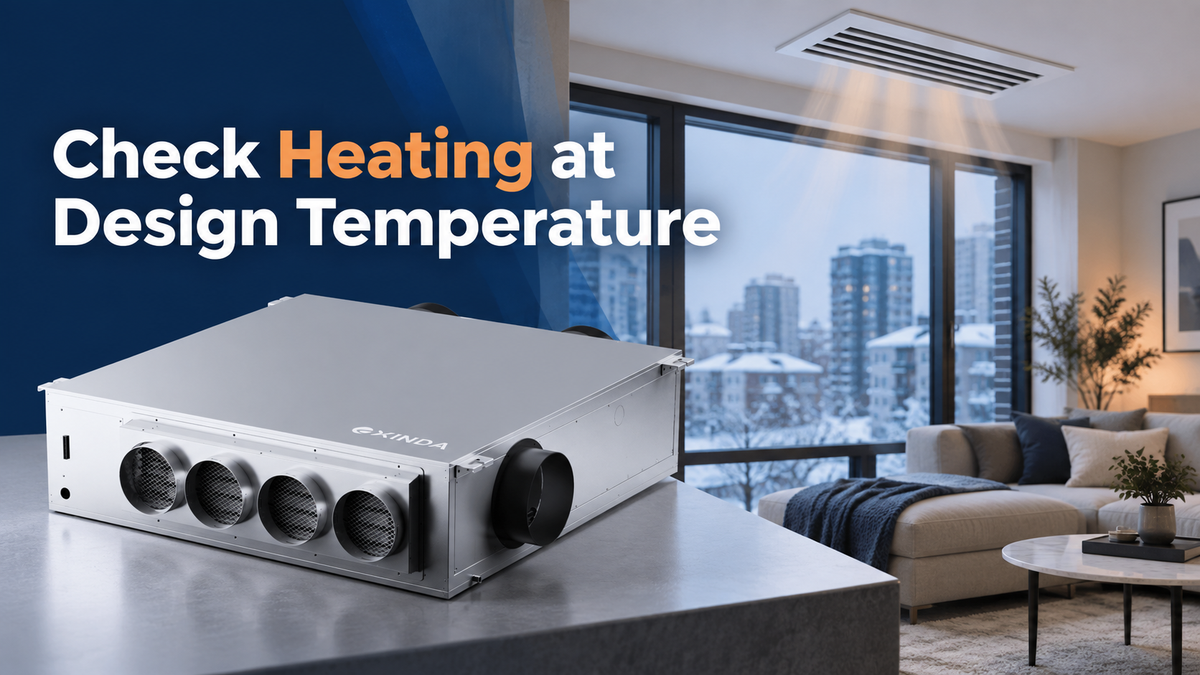
An ERV has no heating output, so its cold-weather question is only whether it keeps operating and defrosting. EXINDA Breeze models are rated for outdoor operation down to −18 °F.
An HPERV has to carry the suite load at the design temperature, and compressor capacity falls as it gets colder. The ceiling-ducted AURA produces 7,800 Btu/h at 17 °F and 7,165 Btu/h at 5 °F; the 18,000 Btu/h Vertical Stack produces 15,000 Btu/h at 23 °F and 9,000 Btu/h at 5 °F. The compressor in the ceiling-ducted models runs down to −15 °C, and in the Vertical Stack and Vertical Stack Plus models down to −25 °C; below those points, heating comes from the electric auxiliary heater. Select on the calculated load at the project design temperature, not the mild-weather rating. The cold-climate heating check works through that calculation.
3. What electrical service is available per dwelling?
This one catches retrofits. An ERV runs on an ordinary 120 V circuit — the Breeze 57–152 CFM model draws 1.6 A minimum circuit ampacity on a 15 A breaker. An HPERV needs a dedicated 208–240 V hardwired circuit, with minimum circuit ampacity between 20 A and 35 A across the AURA range and electric auxiliary heat of 3 to 4 kW on top. In a building where each suite panel is already near capacity, adding an ERV is a small change and adding an HPERV is a service question to answer before anything else.
4. How much installation space is there, and of what shape?
Breeze ERVs are either compact side-port cabinets that fit above a ceiling, or vertical wall-mounted cabinets with top ports for a mechanical closet. AURA is either a ceiling-ducted cabinet — 46 × 45-11/16 × 11-1/8 in., 205 lb for the 12,000 Btu/h model, which needs structural ceiling support and a service opening — or a floor-standing vertical stack cabinet up to 84 in. tall and 470 lb, for suites where nothing can go in the ceiling. Both need a condensate drain with a P-trap and a 1% fall. Confirm the service access before the cabinet is chosen, not after.
5. What does the duct run look like?
Ventilation airflow that survives a long duct run is a fan-curve question in both cases. Read the airflow at the static pressure you calculate, not the number in the product name. For reference, the Breeze 57–152 CFM model delivers 152 CFM at 0.4 in. w.g. and still 135 CFM at 1.2 in. w.g. An HPERV has two separate air circuits to check — the indoor supply duct and the outdoor heat-pump circuit — and their available external static pressures are specified independently. Sizing the ductwork covers that in detail.
Where the EXINDA ranges fit
Breeze — ventilation only
Five residential models from 42 to 152 CFM standard settings, in side-port and top-port cabinets, on 120 V power with 4 in. or 6 in. duct connections. Each model carries its own HVI directory listing and CSA certification to UL 1812 for safety and CSA C439 for performance, so airflow and recovery can be compared on a common rating basis — the 57–152 CFM model, for example, is HVI ID 2005356 under CSA certificate 80227354. Sensible recovery is reported against airflow rather than as a single figure — the 57–152 CFM model returns 77% at 57 CFM and 62% at 148 CFM. Compare the range on the Breeze residential ERV collection.
AURA — heating, cooling and ventilation in one cabinet
Eight models covering ceiling-ducted, ceiling-suspended and vertical-stack installation: 8,500 to 25,000 Btu/h in the 60 Hz versions for North America, and 2.5 to 7 kW in the 50 Hz versions for Europe, Australia and New Zealand. All run on R32 with a BLDC twin-rotary inverter compressor and no separate outdoor condenser, and ventilation airflow is specified separately from indoor supply airflow on every model. Compare them on the AURA all-in-one heat pump ERV collection.
The two are not exclusive. A project can use AURA in the suites with no outdoor unit location and Breeze ERVs in the wing that already has central heating and cooling.
What to send for a selection review
For an ERV: project location, required airflow in CFM, design external static pressure in in. w.g., intended mounting position, duct sizes and quantity.
For an HPERV: the same, plus floor plans, outdoor design temperatures, room-by-room loads, available electrical service per dwelling, ceiling or floor space for the cabinet and the condensate route.
What comes back is a model recommendation with the performance at your operating point, the technical submittal, the dimensional drawing, the Revit family, the certification documents for that model, and lead time. Send it to info@exindagroup.com or through the selection support form.
Distributors and manufacturer's reps can ask for the Breeze and AURA product information packs, sample-unit evaluation terms, training and spare-parts support in the same message.
Questions
Why is the ventilation airflow on an HPERV so much lower than its other airflow figures?
Because they are different air circuits. On the 18,000 Btu/h Vertical Stack, 620 CFM is the outdoor air circuit serving the heat-pump coil and 610 to 715 CFM is the indoor supply air recirculating through the suite; balanced fresh-air ventilation is 42 to 135 CFM. Scheduling the unit against the 620 CFM figure will oversize the ventilation rate by roughly five times.
Is the energy-recovery core inside an HPERV the same kind as a standalone ERV?
It is the same cross-flow principle and tested on the same basis — CAN/CSA-C439 and HVI rating procedures. The difference is capacity and the range of settings, because the core in an HPERV is sized for one suite's fresh-air requirement rather than for a whole-house ventilation duty.
Does an HPERV remove the need for bathroom exhaust?
It can take over that duty rather than removing it. The AURA cabinet has a dedicated bathroom exhaust duct connection, so the exhaust is drawn through the energy-recovery core instead of being discharged through a separate fan. Kitchen range hoods stay separate — grease-laden exhaust must never be ducted into an energy-recovery core, on either product.
Can an ERV be added later to suites that were built with no ventilation provision?
Usually yes, and it is the more common retrofit of the two, because the unit runs on an existing 120 V circuit and needs only two duct penetrations. The constraint is nearly always where the cabinet fits and how the ducts reach the rooms, which is why the side-port and top-port cabinets exist as alternatives to each other.