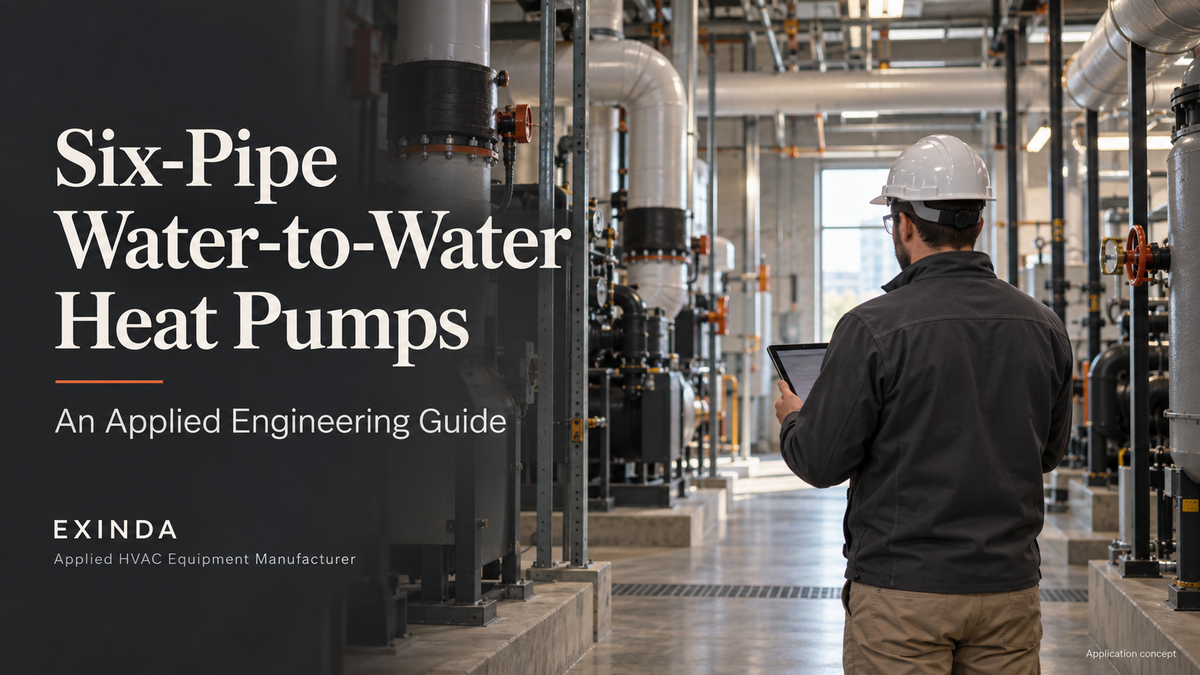
Six-pipe water-to-water heat pumps can serve separate chilled-water, heating-water and source-water loops in commercial buildings. They are worth evaluating when a project needs simultaneous heating and cooling, together with a water source that can absorb surplus heat or supply additional heat as building loads change.
EXINDA is an applied HVAC equipment manufacturer supporting commercial heat pump and chiller projects. For consultants, mechanical contractors and equipment partners serving North America, our application review starts with the hydraulic arrangement, operating temperatures and required duty. A six-pipe concept should be evaluated against those conditions before a capacity or equipment configuration is proposed.
What do the six water connections serve?
In the arrangement discussed here, six connections form three separate water circuits. Each circuit has an inlet and an outlet; the refrigerant system transfers heat between the relevant circuits without intentionally mixing their water.
| Water circuit | Connections | Purpose |
|---|---|---|
| Chilled water | Return to unit and supply to building | Remove heat from building cooling loads |
| Heating water | Return to unit and supply to building | Deliver heat to building heating loads |
| Source water | Entering and leaving source water | Exchange heat with the external source system when required |
The term “six-pipe” describes connections, not a complete performance specification. Confirm the reference unit's hydronic schematic and operating modes. In this guide, the third circuit is source water, not a separate domestic hot water circuit.
Why does a heat-recovery system need a source-water loop?
Building heating and cooling demands rarely remain in the exact balance needed for heat recovery alone. The source loop provides a path for additional heat exchange, subject to the selected equipment's design and operating limits.
Consider a building with cooling in interior spaces and heating around its perimeter. Heat removed from the cooling circuit can contribute to the heating circuit. The heat balance must also account for compressor input: available heating is not simply equal to the cooling load.
| Operating condition | Role of the source loop | Selection check |
|---|---|---|
| Cooling demand dominates | Reject heat that the heating load cannot use | Source temperature and available heat-rejection capacity |
| Heating demand dominates | Supply additional heat for the heating duty | Minimum entering source temperature and available heat extraction |
| Heating and cooling can be matched through recovery | Source exchange may be reduced | Actual heat balance, control sequence and minimum flow requirements |
| Only heating or only cooling is required | Provide the relevant heat source or heat sink | Confirmed single-mode capability and operating envelope |
Ground loops, building energy loops and engineered source systems may be considered. Their suitability depends on temperature, flow, water quality and seasonal energy balance. A cooling tower alone should not be assumed to provide adequate winter heat extraction.
When are six-pipe water-to-water heat pumps worth evaluating?
The strongest application case combines useful overlapping heating and cooling loads with a suitable source-water system. Potential candidates include mixed-use buildings, hotels, healthcare facilities and campus plants where operating schedules create different thermal demands across the site.
Building type alone does not establish the case. Review hourly or seasonal load profiles, source availability, required water temperatures, plant space and maintenance access. If a building has little useful load overlap or no practical source system, a simpler arrangement may be more appropriate.
Separate circuits also allow different fluid requirements to be reviewed individually. Check glycol concentration, water treatment, materials and any need for additional isolation heat exchangers before selecting equipment.
How should the required capacity be defined?
A request for a nominal tonnage is not enough to select a six-pipe system. State cooling and heating duties separately, together with the conditions under which they must be delivered.
- Cooling duty: required capacity and chilled-water entering and leaving temperatures.
- Heating duty: required capacity and heating-water entering and leaving temperatures.
- Source conditions: minimum and maximum entering-water temperatures, available flow and heat-exchange capability.
- Simultaneous duty: the cooling and heating loads that must be met at the same time.
- Plant arrangement: individual module capacity, total plant capacity, minimum load and redundancy requirements.
Performance should be checked at the project's actual conditions for each required mode. Do not assume that separate headline cooling and heating ratings are both available simultaneously. Pump energy and source-system energy should also be included when comparing whole-system efficiency.
EXINDA's applied equipment review: from system requirement to scope
For EXINDA, applied HVAC manufacturing connects equipment selection with the system in which the equipment will operate. Our commercial heat pump and chiller project support includes reviewing product-side hydraulic, electrical and control requirements, and identifying where a request differs from a standard configuration.
For a six-pipe enquiry, the review should establish four decisions:
- Application fit: identify the three circuits, source system and operating modes the project needs.
- Performance requirements: define the duty points that the proposed equipment must meet.
- Integration scope: identify pump interfaces, flow protection, plant controls and electrical requirements.
- Development scope: distinguish available equipment features from changes that require engineering evaluation and validation.
This guide provides a basis for that discussion. A specific EXINDA six-pipe model, capacity, certification scope and delivery schedule must be confirmed through a project-specific proposal. The project designer remains responsible for the complete site hydraulic design and source-system sizing.
For branch circulation considerations, see modular heat pump pumping with dedicated pumps and check valves. That review follows the circuit definition; it does not replace it.
Frequently asked questions
Does six-pipe mean heating, cooling and domestic hot water?
Not in the water-to-water arrangement covered here. The three circuits are chilled water, heating water and source water. Domestic hot water requires a separate review of temperature capability, water quality and appropriate heat-exchange separation.
Can the system provide heating when there is no cooling demand?
A suitably designed unit can extract heat from its source circuit. Confirm the selected unit's heating-only mode and capacity at the lowest design source-water temperature.
Is six-pipe always better than four-pipe?
No. Connection counts must be interpreted against the actual hydraulic and refrigeration design. Compare required operating modes, source availability, load profiles and total system cost rather than assuming that additional connections mean better performance.
What should a consultant send EXINDA first?
Start with the hydronic schematic, required cooling and heating capacities, and design temperatures for all three circuits. These inputs establish whether a detailed equipment or development review is appropriate.
Discuss your water-to-water heat pump application with EXINDA
Send your initial requirements to info@exindagroup.com:
- Application and project location.
- Hydronic schematic or reference equipment submittal.
- Cooling and heating duties, both per module and for the complete plant.
- Design supply and return temperatures for chilled and heating water.
- Source-system type, entering-water temperature range, available flow and fluid.
- Required operating modes, power supply and control interfaces.
- Project milestones and, for a planned product programme, preferred capacity range and estimated annual demand.
EXINDA can review the requirements and clarify the next selection or development steps. Explore the EXINDA commercial heat pump and chiller range for the broader applied equipment portfolio.