MERV 13 Filtration ERV for British Columbia: A Builder and Contractor Guide
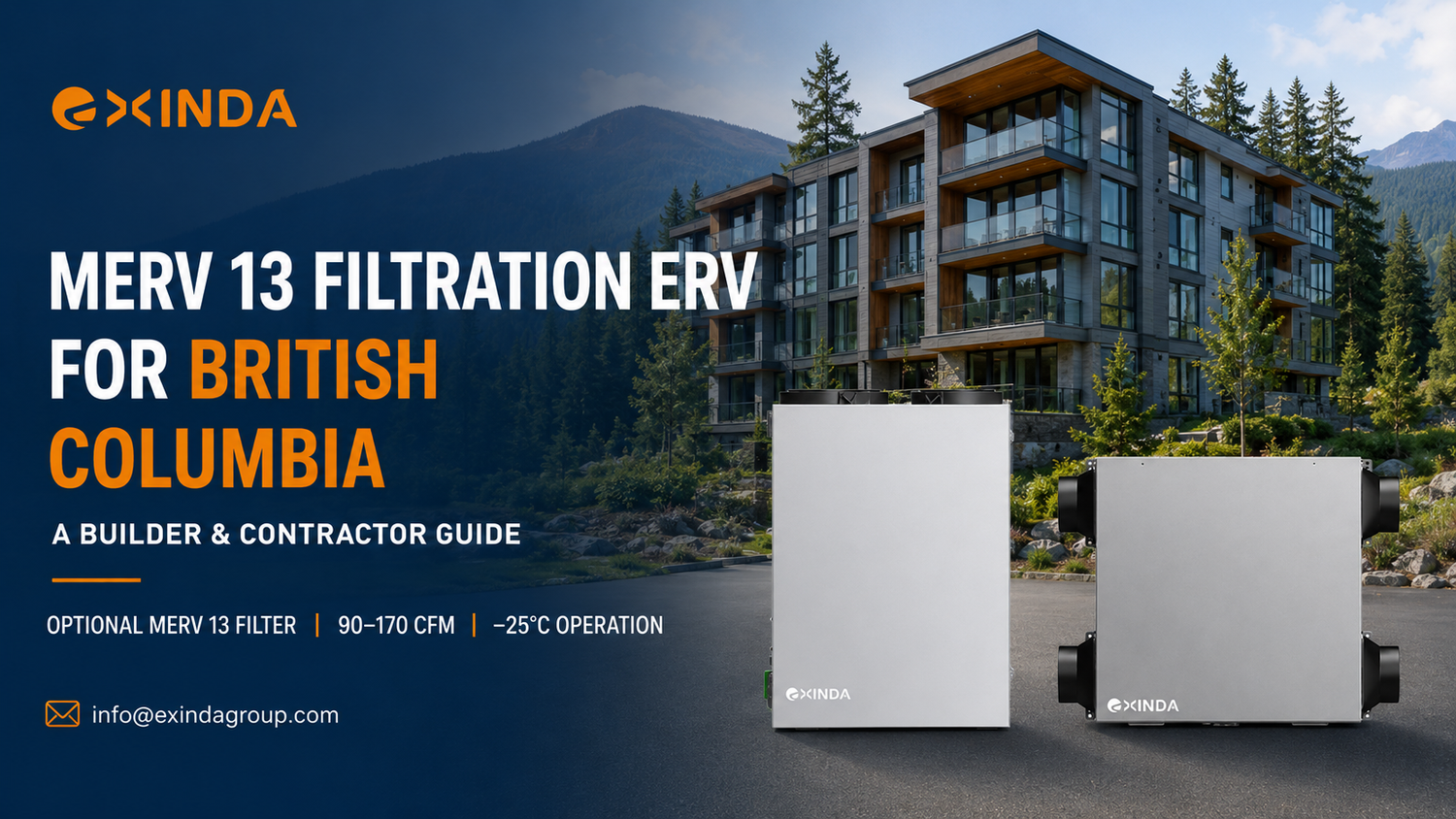
Should builders and HVAC contractors specify a MERV 13 ERV in British Columbia? In wildfire-smoke-prone areas, a MERV 13 ERV British Columbia specification can be a practical option where a project requires higher particle filtration while maintaining controlled fresh-air ventilation. EXINDA residential ERVs are available with an optional MERV 13 filter for applications affected by seasonal wildfire smoke and other elevated particle conditions.
However, MERV 13 filtration creates additional pressure drop. Contractors should therefore confirm the selected model’s net supply and exhaust airflow at the project’s external static pressure, then balance the system during commissioning. MERV 13 filtration helps reduce airborne particles; it does not remove all gases or odours associated with wildfire smoke.
Why wildfire smoke changes ERV selection in British Columbia
For many BC residential and multifamily projects, ERV selection traditionally focuses on airflow, heat-recovery performance, sound, duct configuration and cold-weather operation. Wildfire smoke adds another design question: how can required outdoor ventilation be delivered while reducing particle exposure from incoming air?
This matters because smoke can enter a building not only through open windows, doors and leakage points, but also through mechanical heating, ventilation and air-conditioning systems. BC Centre for Disease Control guidance identifies HVAC filtration as a key line of defence and specifically includes buildings using an ERV in its wildfire-smoke planning checklist. BC CDC guidance
For builders, the answer is not simply to select the highest available filter grade. The ERV must still provide the required airflow after the added resistance of the MERV 13 filter, connected ductwork and installed accessories are considered.
What BC CDC says about MERV 13 filtration
BC CDC guidance recommends a minimum MERV 13 rating for wildfire smoke whenever the HVAC system can accommodate it. The same guidance notes that higher MERV ratings create greater airflow restriction and advises project teams to identify the highest filter rating the system can handle while maintaining effective ventilation, indoor temperature and humidity control.
For an ERV project, this leads to a clear selection principle:
Select MERV 13 filtration only after confirming that the ERV can maintain the project’s required airflow and supply/exhaust balance at the installed external static pressure.
This is an important distinction. BC CDC guidance supports the use of MERV 13 for wildfire-smoke filtration where feasible; it is not a universal rule that every BC ERV must use MERV 13, regardless of airflow performance or project conditions.
How MERV 13 affects ERV airflow
Compared with a standard filter configuration, a MERV 13 filter adds resistance to airflow. The actual effect depends on the selected ERV model, duct layout, grille losses, external static pressure and filter loading over time.
| Selection item | Why builders and contractors should check it |
|---|---|
| Required supply and exhaust CFM | The system must still meet the project ventilation design. |
| External static pressure | Duct length, fittings, dampers, grilles and filters all add resistance. |
| Net airflow with MERV 13 installed | Nominal airflow under a standard filter configuration may not represent installed performance. |
| Supply/exhaust balance | Proper balancing helps avoid unwanted building pressure conditions. |
| Filter access and replacement plan | Wildfire smoke can load filters faster, increasing pressure drop over time. |
Do not specify a fixed airflow reduction percentage unless it is supported by model-specific performance data. A MERV 13 filter may reduce airflow, but the amount must be verified for the selected ERV and project ESP.
When should a BC project consider optional MERV 13 filtration?
| Project situation | Recommended filtration approach |
| Standard residential project without elevated particle concerns | Select the ERV based on required CFM, ESP, commissioning and local project requirements. |
| Housing in areas affected by seasonal wildfire smoke | Evaluate optional MERV 13 filtration and confirm net airflow at the installed ESP. |
| Multifamily projects with sensitive occupants or higher indoor-air-quality expectations | Include MERV 13, filter maintenance and replacement planning in the ventilation specification. |
| Projects with smoke odour or gas-control requirements | MERV 13 supports particle filtration only; assess additional odour and gas-control measures separately. |
BC CDC also advises maintaining replacement-filter stock and reviewing filter change schedules for prolonged smoke events. This is a useful handover consideration for builders, property managers and HVAC service contractors.
EXINDA ERV option for wildfire-smoke-prone projects
EXINDA supplies residential and multifamily energy recovery ventilation solutions for Canadian and North American projects. For applications requiring higher particle filtration, including areas affected by wildfire smoke, EXINDA ERVs can be supplied with an optional MERV 13 filter.
For each BC project, EXINDA can support the selection process by reviewing:
- Required design airflow and unit configuration
- Project external static pressure
- Optional MERV 13 filtration requirement
- Supply and exhaust airflow balance
- Model-specific HVI performance documentation, where applicable
- Cold-climate operating requirements and published model data
- Filter replacement and service-access considerations
For builders and contractors, this creates a more defensible specification: the ERV is selected not only for its nominal CFM, but for its ability to provide the required ventilation performance in the installed system.
A practical MERV 13 ERV selection process
Before ordering an ERV with MERV 13 filtration, provide the following information to the ventilation supplier:
- Required supply and exhaust CFM
- Estimated or calculated external static pressure
- Residential or multifamily application type
- Duct configuration and grille arrangement
- Whether the project is in a wildfire-smoke-prone location
- Whether the owner requires spare MERV 13 filters at handover
- Any separate requirement for smoke odour or gas control
The contractor should then verify final airflow after installation and complete supply/exhaust balancing during commissioning. This is particularly important where MERV 13 filtration is selected because filter resistance changes as the filter collects particles.
Frequently asked questions
Does BC CDC recommend MERV 13 filters for wildfire smoke?
Yes. BC CDC guidance recommends a minimum MERV 13 filter rating for wildfire smoke whenever the HVAC system can accommodate it. Its ERV checklist also advises teams to identify the maximum MERV level that can maintain effective ventilation. Read the BC CDC guidance
Can EXINDA ERVs use a MERV 13 filter?
Yes. EXINDA ERVs are available with an optional MERV 13 filter for projects requiring higher particle filtration, including wildfire-smoke-prone applications. Final selection should verify airflow and external static pressure for the selected model.
Will a MERV 13 filter reduce ERV airflow?
A MERV 13 filter adds pressure drop and may reduce net airflow compared with a standard filter configuration. The impact depends on the specific ERV model, duct system, external static pressure and filter condition.
Does MERV 13 remove wildfire-smoke odours?
MERV 13 filtration helps capture particles. Wildfire smoke also contains gases and odours, which require separate consideration. BC CDC notes that activated-carbon filtration may help with some harmful gases and odours, while portable HEPA air cleaners can help reduce particles in designated indoor spaces.
Plan your BC ERV specification with EXINDA
For a British Columbia residential, apartment or multifamily project requiring optional MERV 13 filtration, send EXINDA the required CFM, estimated ESP, duct layout and application details. Our team can review the selected ERV configuration and help confirm a practical filtration, airflow and commissioning approach.
Contact: info@exindagroup.com